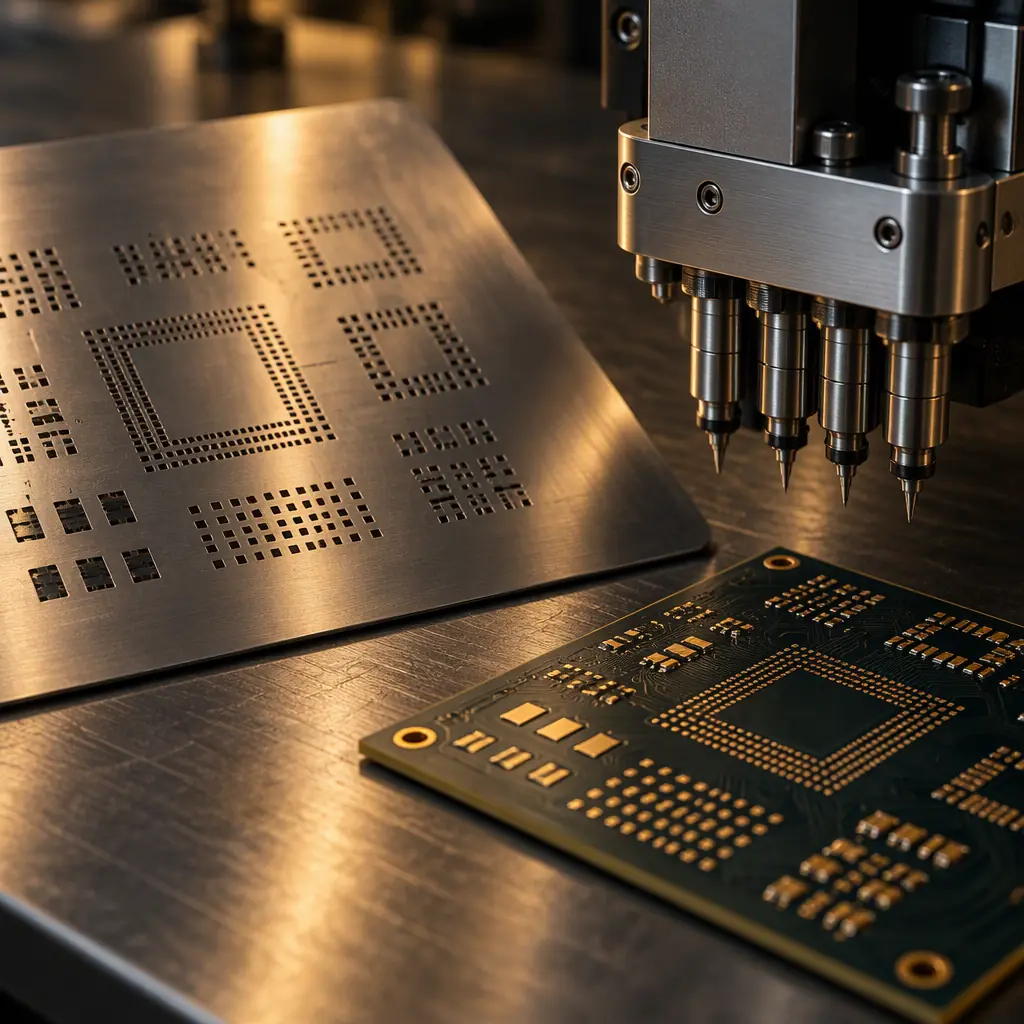
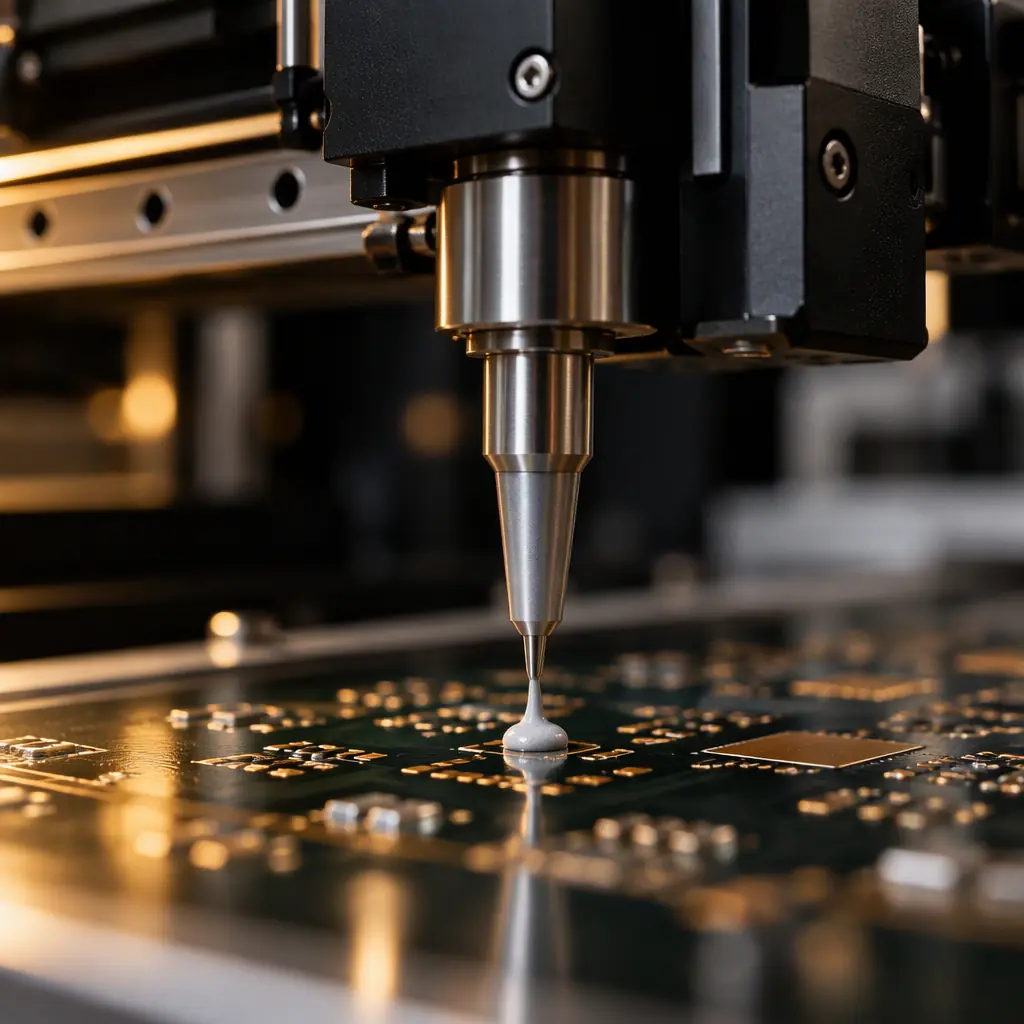
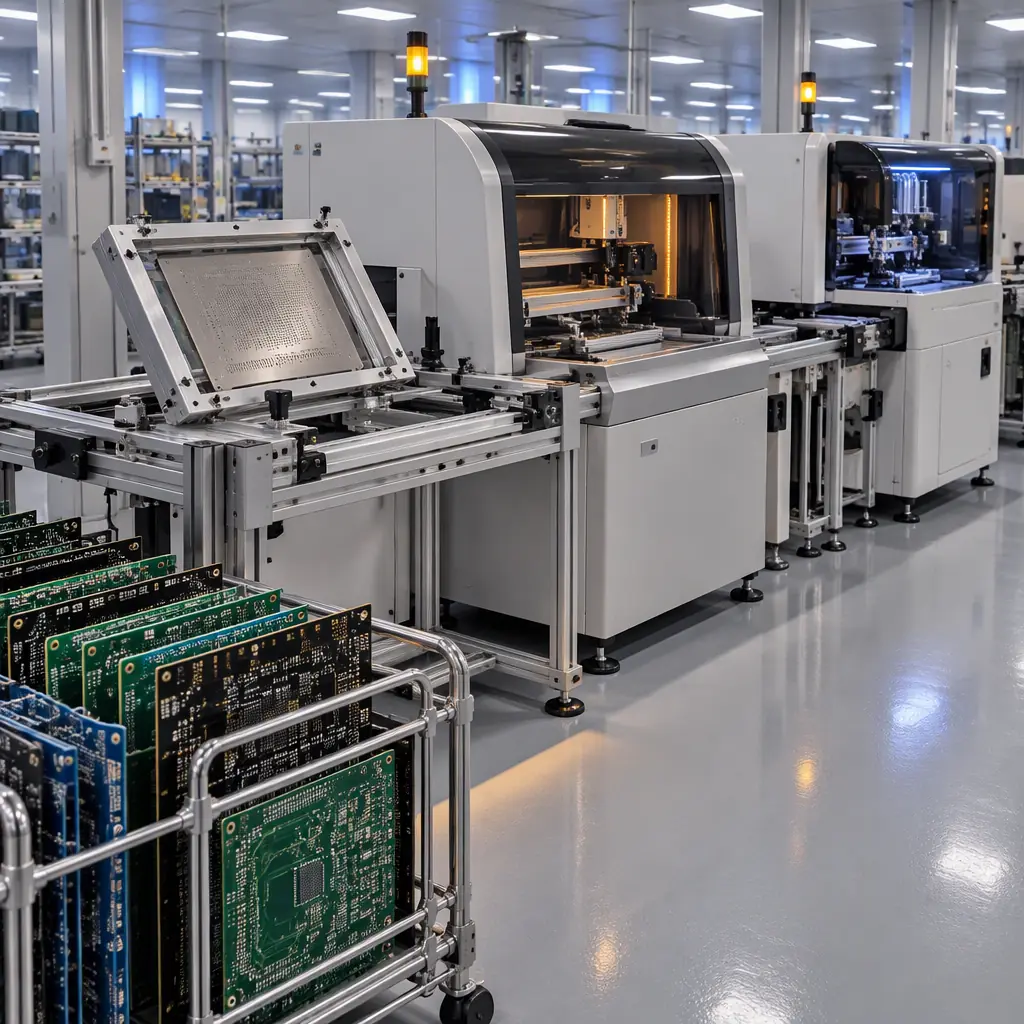
The two technologies do the same job through completely different economics. A stencil printer squeegees solder paste through laser-cut or electroformed apertures in a stainless steel foil. The foil is bonded to a tensioned frame, and that frame is tooling: a fixed charge of roughly $150–$400 per revision, payable before the first board is printed. A solder paste jetting head carries no foil at all. It fires discrete paste deposits from a piezoelectric-driven nozzle, driven entirely by the CAD pad coordinates in software.
That single difference inverts the cost curve. Stencils are cheap per board and expensive to start. Jetting is free to start and more expensive per board. Everything a buyer needs to decide between them falls out of where your run size and change frequency sit relative to that crossing point. If you are already comparing jetting platforms, our jetting machine selection guide covers nozzle and pump architectures; this page covers the buying decision itself.
The Cost Model: Where The Two Lines Cross
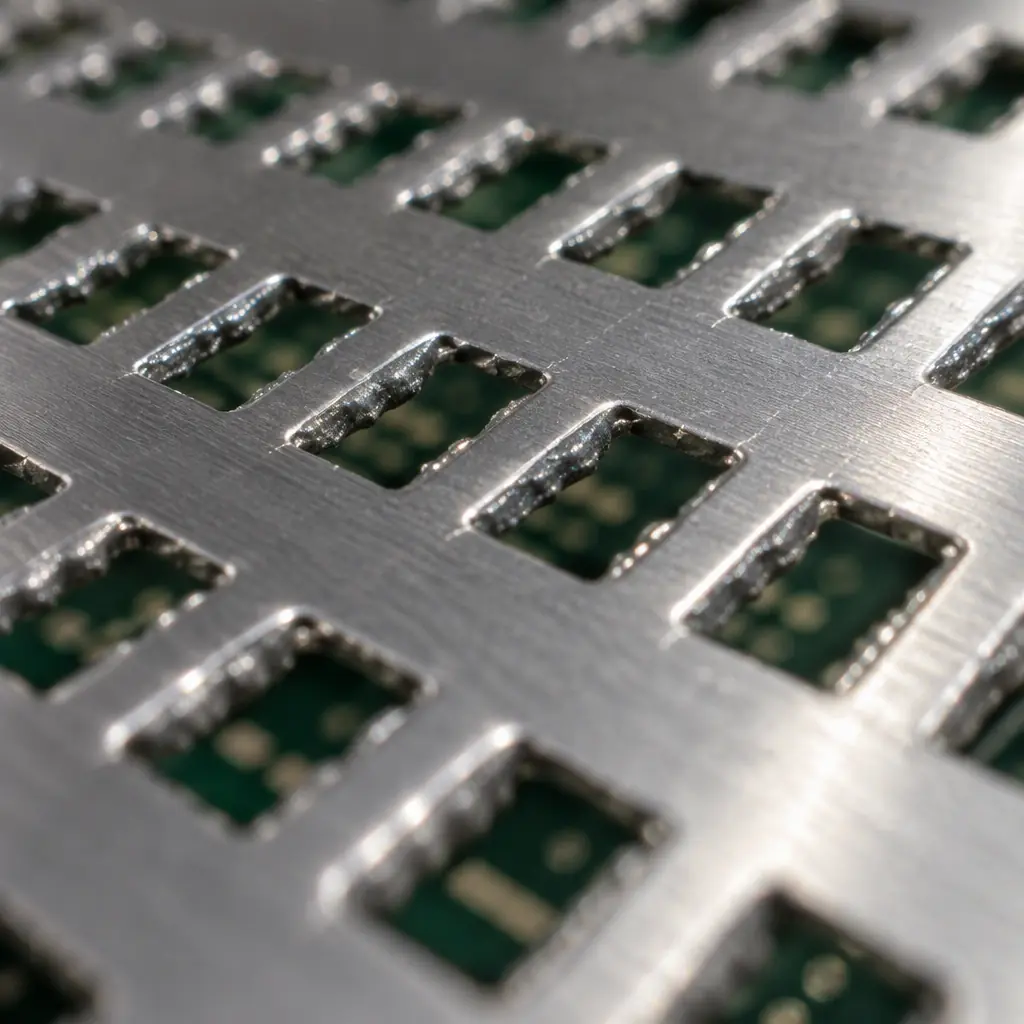
Compare the two on total printed cost, not on print speed. The jetting line has a near-zero intercept and a steeper slope; the stencil line has a high intercept and a shallow slope. They cross once, and that crossing point is the number worth calculating for your own program.
The typical inputs we see on quotes are a stencil tooling charge of $150–$400 per revision, a jetting machine rate of roughly $35–$70/hour fully loaded, a jetting deposit rate around 1,200–2,000 deposits/second per head, and a squeegee print cycle of 20–35 seconds per panel including load, print, inspect and unload. On a 500-placement board that works out to roughly 25–45 seconds of jetting time versus about 30 seconds of stencil time. The gap is small per board. It is the fixed tooling charge that dominates small quantities.
| Cost element | Stencil printing | Solder paste jetting |
|---|---|---|
| Fixed tooling per revision | $150–$400 | $0 |
| Fixed tooling per board @ 100 units | $1.50–$4.00 | $0.00 |
| Fixed tooling per board @ 5,000 units | $0.03–$0.08 | $0.00 |
| Print time, 500-placement board | ~30 s per panel | ~25–45 s per panel |
| Changeover between two BOMs | Stencil swap, ~2–5 min | Software only, <1 min |
| Fine-pitch limit | ~0.35–0.40 mm, area-ratio bound | ~0.20–0.30 mm |
| Paste waste per change | 1–2 stencil clean cycles | Purge volume, grams |
Read down the table and the decision rule is visible. Below roughly 1,000 boards on an otherwise stable design, the stencil tooling charge is a material share of unit cost and jetting usually wins. Above 5,000 boards on an unchanged layout, the tooling charge has amortised to three or four cents per board and the stencil's faster per-panel cycle time dominates. Between those two numbers the answer genuinely depends on your change frequency.
The Break-Even Volume, Worked Through
Take a concrete program: a 120 mm x 80 mm industrial control board with 480 placements, Type 4 SAC305 paste, quoted at $11.40 per assembled board at 1,000 units. Stencil tooling is $280. Jetting adds roughly 6 seconds of machine time per board over the stencil at a loaded rate of $52/hour.
Stencil line cost per board
Tooling $280 spread across the run, plus base assembly cost. At 500 boards the tooling alone is $0.56 per board. At 1,000 boards it is $0.28. At 5,000 boards it falls to $0.06. The squeeze print cycle is the cheaper process at every volume.
Jetting line cost per board
Zero tooling, plus roughly $0.09 per board of added machine time at the rates above. That $0.09 does not change with volume.
The crossing point
Stencil tooling equals jetting's added machine time at roughly 3,100 boards. Below that, jetting is cheaper on a single-revision program. Above it, the stencil wins. Now repeat the calculation with a second revision: two stencil charges, crossing point doubles to about 6,200 boards. This is the calculation that matters, and it is why a program that revises three times before production is almost always a jetting program.
Where Jetting Genuinely Beats The Stencil
Three situations push the decision away from cost alone and toward capability.
High BOM mix on one line
If a line changes between more than about 50 different board types per shift, stencil logistics become the bottleneck, not print speed. Every change is a physical foil retrieval, verification and load. Jetting changes are software-only, which is the same economics our SMED changeover guide describes for the rest of the line. Where changeover dominates, jetting wins on throughput even when it prints slower.
Paste volume variation on one board
A stencil deposits the same volume thickness across the whole foil. Jetting sets deposit volume per pad in software, so a board that mixes a large thermal pad with 01005 passives can get 2–3x different volumes on the same print. That matters on assemblies with mixed power and fine-pitch content, and it is one of the reasons jetting appears in fine-pitch assembly work.
Non-flat or stepped surfaces
Boards with tall components already fitted, cavities, or significant warpage cannot be squeegeed reliably because the foil cannot seal against an uneven surface. Jetting is contactless and tolerates height variation, which opens up rework, second-pass and odd-form assembly. The trade-offs against stencil-based rework are covered in our PCB rework guide.
Where The Stencil Still Wins
Do not read the cost model as a case for replacing stencils. On stable, high-volume production the stencil is faster, better characterised and cheaper, and no jetting head changes that.
At volumes above roughly 10,000 boards per revision, the tooling charge is economically irrelevant and the squeegee's parallel print cycle is the fastest way to deposit paste on a panel. Stencils also hold paste volume more repeatably across a long run because the aperture geometry is fixed and measurable, which simplifies SPI control limits and the process capability evidence your customer may ask for. And a stencil is a physical artefact you can inspect, photograph and store against a revision number, which some aerospace and medical quality systems prefer as objective evidence.
| Program profile | Recommended process | Why |
|---|---|---|
| Prototype, 10–50 boards | Jetting | Tooling charge exceeds the entire paste cost |
| Pilot, 50–1,000 boards, layout still moving | Jetting | Each revision would re-bill a full stencil |
| 1,000–5,000 boards, frozen layout | Either, calculate | Crossover sits in this band |
| 5,000–10,000 boards, frozen layout | Stencil | Tooling amortised, print cycle faster |
| >10,000 boards per revision | Stencil | Fixed aperture volume, best SPI repeatability |
| >50 BOMs per shift, any volume | Jetting or hybrid | Changeover, not print speed, is the constraint |
The Hybrid Answer Most Programs Should Choose
The framing of "jetting or stencil" is usually wrong. On a modern line both processes are available, and the useful question is which boards on the schedule go to which station.
The practical split we run at Huaxing PCBA is straightforward. New and unproven layouts, engineering builds, and any run under about 1,000 boards go to jetting so the design can move without tooling drag. Once a layout freezes and volume is confirmed, the program moves to a stencil for the production ramp, where the print cycle is faster and paste volume is easier to hold inside tight SPI limits. High-mix low-volume work stays on jetting permanently, and a small number of fine-pitch or thermally-loaded boards stay on jetting even in production because their deposit volumes vary too much for a single foil thickness.
That split is a scheduling decision, and it needs two things from the buyer: an honest statement of how likely the layout is to change, and a quoted volume you actually intend to order. Ask your supplier for both numbers side by side before committing. Our jetting process qualification guide sets out the evidence a supplier should be able to produce if they claim jetting capability, and the stencil aperture design guide covers the equivalent for the foil side.
How To Read A Quote That Offers Both
When a quote shows two paste-deposition options, three fields decide the comparison. Check that the tooling line is separated out rather than bundled into a unit price, because bundled tooling hides the amortisation and makes a small run look cheaper than it is. Check the run quantity the per-unit price assumes, since the tooling component only behaves as expected at that volume. And check whether the jetting option carries a separate engineering or process-qualification charge, which is legitimate but needs to enter the model.
Summary: stencil printing is a fixed-cost technology that gets cheaper as you scale; jetting is a variable-cost technology that stays flat regardless of volume and removes the penalty for changing your mind. Calculate the crossover for your own revision count, send mixed and fine-pitch boards to jetting, send the frozen high-volume ramp to a stencil, and get both numbers quoted before you commit to either.
At Huaxing PCBA we run 8 SMT lines with both stencil printing and solder paste jetting available, placing down to 0201 and 0.3 mm pitch at a 98.7% first-pass yield. We offer 24-hour quick-turn assembly for engineering builds and a free DFM review that includes a paste-deposition recommendation for your volume and revision risk. Send your Gerber and BOM for a quote or talk to an engineer about which process fits your program.