
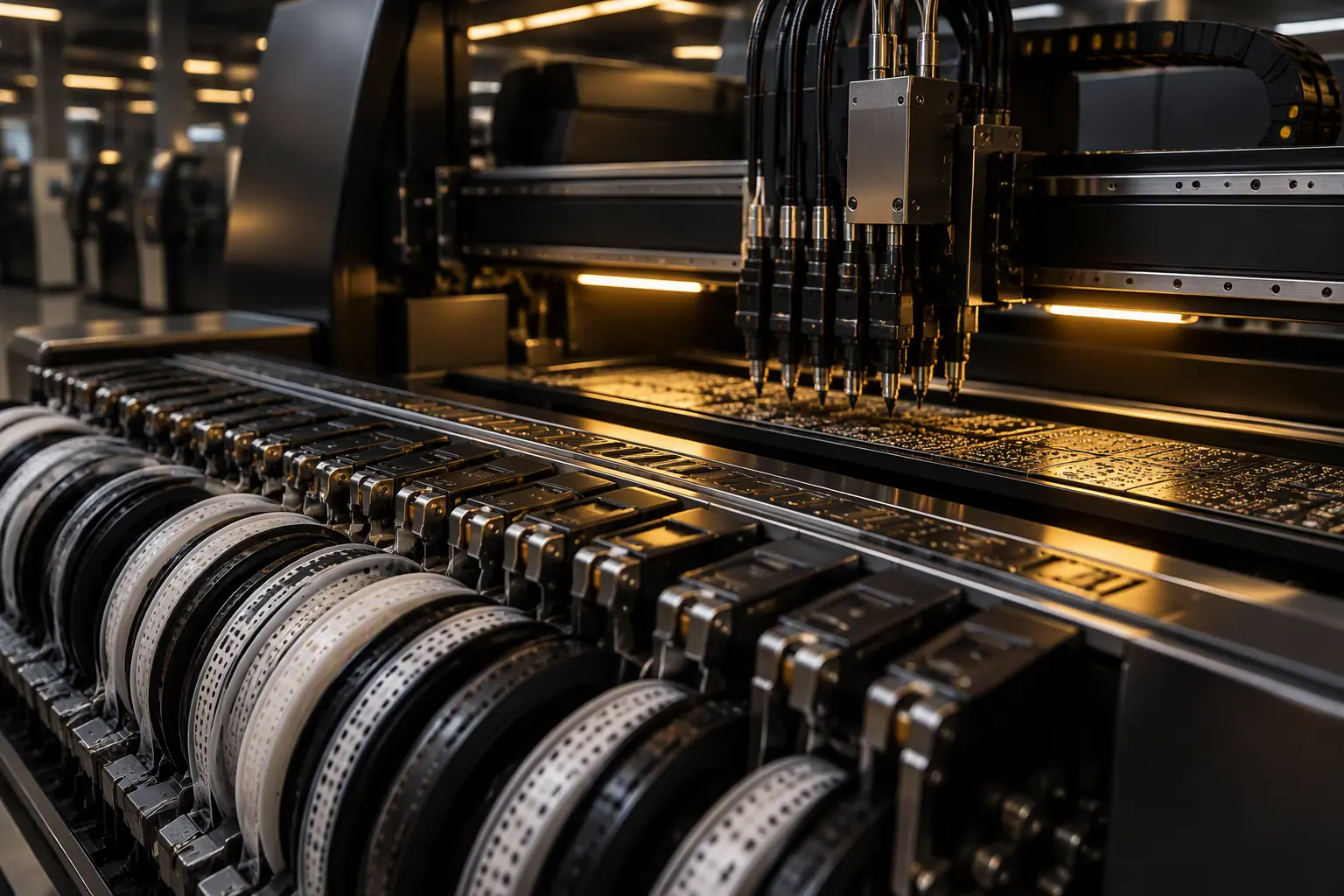
Ask a contract manufacturer how long a changeover takes and you will usually get a number, four hours, half a shift, a day. Rarely will you get the more useful answer, which is how much of that time is internal setup (the machine is stopped) versus external setup (work that could have been done while the line was still running). That split is the entire economics of small-batch SMT programs, and it is the difference between a supplier who can serve high-mix work profitably and one who quietly pads your quote to cover the chaos.
For a buyer running multiple product variants, frequent ECOs, or a mix of pilot and production builds, changeover time is not an abstract efficiency metric. It sets your minimum economic batch size, it drives whether your supplier will accept a 200-piece run at a sensible price, and it determines how quickly they can react when you need to pull a build forward. This guide covers what actually consumes changeover time on an SMT line, how the SMED discipline reduces it, and what to ask a supplier so their answer is comparable. At Huaxing PCBA we run 8 high-speed SMT lines and 4 DIP lines, and changeover performance is a weekly production metric rather than a one-off improvement project.
What Actually Consumes Changeover Time
Changeover is not one activity; it is a sequence of them, and they have very different cost profiles. Breaking it down is the first step, because the reductions available in each part are not equal.
| Changeover element | Typical share of time | Reducible by |
|---|---|---|
| Stencil change and alignment | 10–20 % | Pre-staged stencils, quick-release frames, offline verification |
| Feeder changeover and loading | 25–40 % | Pre-kitted carts, offline feeder setup, feeder calibration records |
| Program and recipe change | 5–15 % | Pre-loaded programs, offline recipe validation |
| Paste, nozzle and support tooling change | 10–20 % | Standardised tooling, pre-warmed paste, dedicated nozzle sets |
| First-article verification and fine-tuning | 15–35 % | Offline first-article strategy, SPI feedback, parametric recipes |
| Searching, waiting and walking | 10–25 % | The single largest easy win, kit completeness and 5S |
The last row is the one that surprises buyers. A large fraction of changeover time in an unimproved line is not technical work at all. It is the operator leaving the machine to find a feeder, a stencil, a nozzle or a document. That time is pure waste and it disappears the moment the kitting discipline is fixed.
Quick Answer: SMED (Single-Minute Exchange of Die) cuts changeover by separating internal setup, which can only be done while the machine is stopped, from external setup, which can be done while the line is still running. Converting internal tasks to external, standardising tooling, and eliminating search time typically removes 40–60 % of changeover duration without new capital equipment.
The SMED Discipline, Translated to SMT
SMED was developed for press tooling, but the logic maps cleanly onto an SMT line. There are four moves, and they are applied in order because the first two are free.
Separate internal from external work
Observe a changeover and record every task with a stopwatch. Mark each one as internal (line stopped) or external (could be done before or after). Most lines have never had this done, and the first pass typically reveals that 30–50 % of internal tasks did not need to be.
Convert internal to external
Pre-kit feeders on carts offline and verify them before the changeover starts. Pre-stage the stencil. Pre-load and validate the program. Preheat paste. Every task moved off the critical path is time the machine keeps producing.
Streamline what remains
Quick-release stencil frames instead of bolt-down clamps. Standardised nozzle sets. Colour-coded and position-labelled tooling. One-touch connectors. The target is to remove fasteners, adjustments and decisions from the stopped-line period.
Eliminate adjustment by parameterising
The most powerful move is making the setup self-correcting. Where a machine needs tuning to a new product, store the tuned values as a recipe keyed to the product so the next run starts from a known-good state rather than from scratch.
Pre-Kitted Feeder Carts and Offline Setup
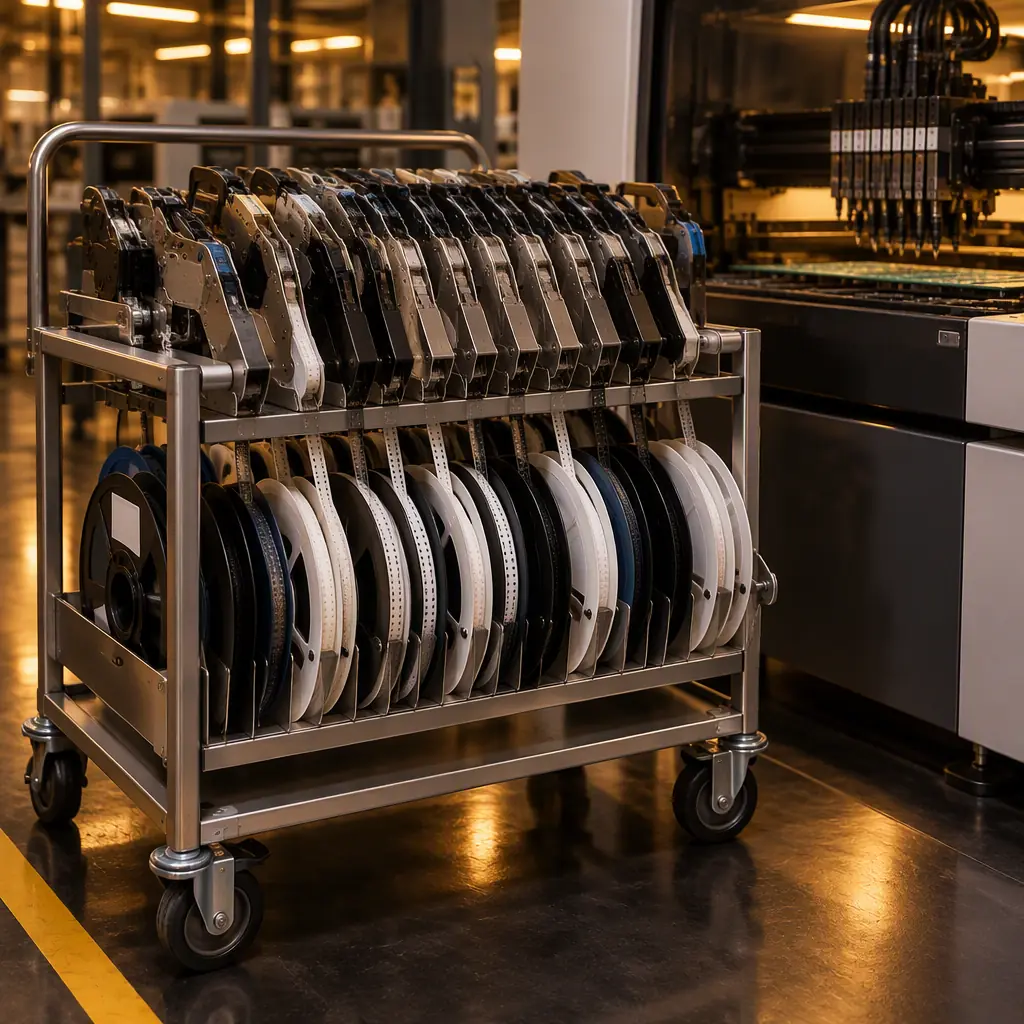
Feeder changeover is the largest single component of SMT changeover time, and it is also the most amenable to being moved off the line. The mechanism is a feeder cart: a wheeled trolley pre-loaded with the feeders, reels and splice positions for the next product, assembled at a kitting station while the current build is still running. At changeover the cart rolls up, the feeders are transferred or the cart is docked directly, and the line restarts with the setup already verified.
The pre-requisites are unglamorous but decisive: component kits that arrive complete from stores, a kitting area with the right lighting and a documented loading list, and feeder calibration records so a pre-loaded feeder is trusted rather than re-verified at the machine. Where a supplier runs this properly, the machine is stopped for a fraction of the time an unimproved line needs.
What SMED Buys You as a Buyer
Changeover time is invisible on a quotation, but it drives the numbers that appear on one. Three commercial effects follow directly.
| Effect | Mechanism | What you should see |
|---|---|---|
| Lower economic batch size | Less setup cost to amortise per run | Smaller runs quoted at sensible piece prices rather than punitive minimums |
| Better schedule flexibility | Shorter changeover means more changeovers per week are affordable | Faster response to pull-in requests and ECO-driven re-runs |
| Higher effective capacity | Machine time moves from setup to production | More headroom at the same equipment count, which matters most when everyone is busy |
The batch-size effect is the one buyers feel most. A supplier whose changeover costs two hours of line time must spread that cost across the run, which is why short runs attract minimum charges and why the price curve is steep at low volume. Buyers comparing a 200-piece pilot quote should understand that part of the difference between suppliers is changeover efficiency, not component pricing. Our PCB assembly cost breakdown shows where setup sits in the total, and our guide to PCB minimum order quantity explains how MOQ, panelisation and setup amortisation interact.
Changeover and Capacity Planning Together
Changeover performance and capacity planning are the same conversation, because changeover consumes the capacity you are trying to plan. The practical metric is boards per hour net of setup: a line that places 40,000 components per hour but spends 25 % of its week in changeover is delivering materially less than its nameplate rate on high-mix work.
This is why high-mix buyers should ask for capacity numbers in a form that accounts for setup. A supplier who quotes nameplate speed without stating the changeover assumption behind it is giving you a number that will not survive contact with your order pattern. Our SMT line capacity and throughput planning guide covers the boards-per-hour and bottleneck arithmetic in detail.
How to Judge a Supplier's Changeover Capability
Changeover performance is directly observable, and the questions below separate a supplier who has genuinely engineered it from one who has not. None of them require you to visit the factory, though a visit will confirm the answers immediately.
Ask for the internal versus external split, not the headline number
A supplier who can tell you what fraction of their changeover is internal has measured it. One who only has a total has not.
Ask how feeders are prepared
Offline pre-kitting on carts with documented loading lists is the signature of a real SMED programme. Loading feeders onto the machine at changeover time is the signature of one that has not started.
Ask whether the machine is tuned again on every run
If each build starts with the engineer tuning the process from scratch, parameters are not being stored as recipes, and setup time is being paid every time.
Ask how first-article verification is handled
First-article inspection on the line extends the stoppage. An offline or pre-validated strategy with SPI feedback applied parametrically shortens it.
Ask what a 200-piece run actually costs
The quote is the evidence. A supplier with real changeover discipline can quote small runs without a punitive minimum, because the setup is no longer a large fixed cost to recover.
Where Changeover Discipline Meets NPI
New product introduction and changeover efficiency compound. An NPI build requires a changeover into an unproven process, which is inherently slower, the first run also carries process development. A supplier with strong SMED discipline shortens NPI by starting from parameterised recipes rather than a blank machine state, and by pre-kitting the pilot build the same way a production build is kitted. Our PCBA NPI process guide covers the full new-product sequence, and our guide to stencil-free SMT for NPI and prototypes explains the break-even between stencil tooling and jetting for early builds.
Why We Invest in Changeover Performance
Changeover efficiency is the main reason a factory can serve both high-volume and high-mix work out of the same equipment without penalising either. That capability is what makes a supplier useful to a customer whose volumes change over time, a pilot today, a production ramp next quarter, a variant engineer change in between, without a re-quote and a re-tooling every time.
At Huaxing PCBA we run 8 high-speed SMT lines and 4 DIP lines with offline feeder pre-kitting, pre-staged stencils and stored parametric recipes, placing over 8 million components per day with a minimum placement capability of 0201 and 0.3 mm pitch BGA. Changeover readiness is why we can support 24-hour prototyping and 5-day PCBA prototyping alongside volume production, with 99.2 % on-time delivery across 150+ active customers in 30+ countries. Quality runs under ISO 9001, IATF 16949 and UL certification with IPC-A-610 Class 2 and 3 acceptance and AOI, X-Ray and SPI inspection in line, in a 15,000 m² facility with 500+ staff at a 98.7 % first-pass yield. Send us your build schedule and variant mix for a quote, or talk to our production engineering team about a high-mix program.