A prototype build that never leaves design iteration is a build that should not buy tooling. Yet the default reflex in most sourcing conversations is "send us the stencil price", and that single line item sets a floor under the cost of every revision you make before you commit to the design.
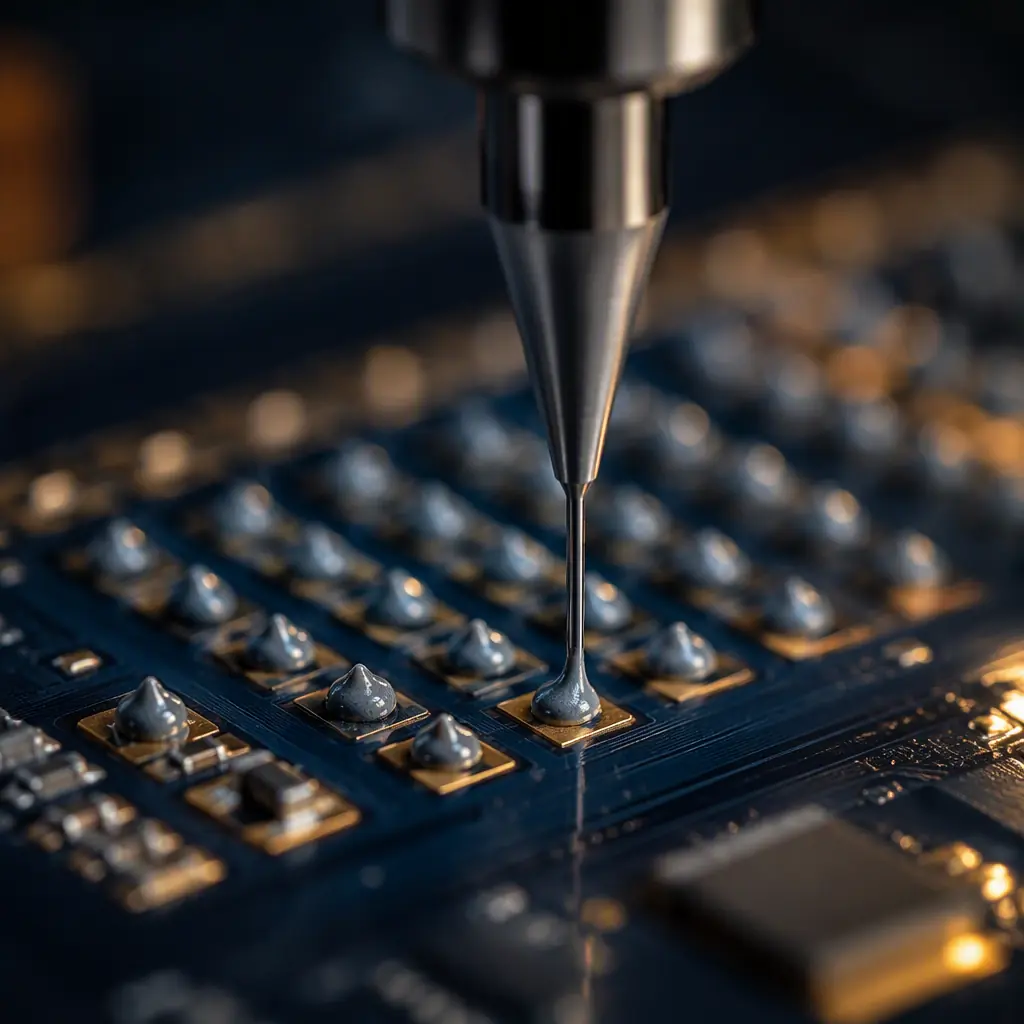
Stencil-free SMT means depositing solder paste without a foil: jetting the paste pad by pad, or dispensing it in dots and lines. At Huaxing PCBA we run stencil-free deposition for NPI and prototype builds on the same 8 SMT lines used for production assembly, under IATF 16949 and ISO 9001. The value is not that it is cheaper than a stencil on every build. It is that it is cheaper on the builds where you are still changing the design. This guide explains where that line falls.
What You Are Actually Paying For With a Stencil
A stencil is a fixed tool. Its cost is not the foil itself but the entire fixed setup around it: fabrication, framing if needed, shipping, incoming check, mounting and alignment, print trial, cleaning, and storage. The visible line item is the foil; the real cost is the setup event it forces on every product.
| Cost / step | Stencil route | Stencil-free route |
|---|---|---|
| Tooling per revision | $150–$600 | $0 |
| Lead time for tooling | 1–5 days | None, direct to program |
| Setup / changeover | 15–60 min | 0–10 min (program recall) |
| Per-revision rework | New foil required if pads move | Program edit only |
| Storage / tracking | Stencil rack, revision discipline | None |
The lead time number is the one buyers underestimate. A 1–5 day tooling wait does not just add cost. It adds a serial delay at the start of every build, exactly when your engineering team is waiting to see whether the design works.
The Three Stencil-Free Methods and What Each Is For
- Paste jetting . Non-contact droplet deposition, software-defined volume per pad. Best for fine pitch, mixed geometry boards and the highest mix environments. Covered in detail in our jetting machine selection guide.
- Paste dispensing . Needle or auger dispense in dots and lines. Lower capital than jetting, slower per pad, strong for coarse-pitch boards and small prototype quantities. A practical entry route for low-volume shops.
- Frameless / tooling-free stencils . Still a foil, but no permanent frame. Cheaper and faster than framed tooling but still a per-revision item. Covered in our zero-tooling stencil guide.
The distinction matters commercially: frameless stencils reduce the tooling cost, while true stencil-free deposition eliminates it together with the changeover. Only the latter removes the per-revision tax entirely.
Break-Even Volume: The Number That Decides Your Route
The break-even calculation is straightforward once you separate the fixed and variable parts.
Fixed cost of the stencil route: tooling plus setup hours plus tooling lead time converted to schedule cost. For a single revision that is roughly $350 tooling plus 0.5–1 hour of line setup. Call it $400–$450 per revision event.
Variable cost of the stencil-free route: extra deposition time per board. Jetting and dispensing are slower per board than a well-tuned foil print. The penalty is a function of pad count: roughly 10 to 40 seconds of additional cycle time per board on typical NPI boards.
So the break-even board count is the tooling event divided by the per-board time penalty converted to cost:
| Quantity per revision | Stencil route (tooling + setup) | Stencil-free (extra cycle time) | Cheaper route |
|---|---|---|---|
| 5 boards | ~$425 fixed | ~$5 (5 × 30s @ $120/h) | Stencil-free, decisively |
| 25 boards | ~$425 fixed | ~$25 | Stencil-free |
| 100 boards | ~$425 fixed | ~$100 | Stencil-free |
| 500 boards | ~$425 fixed | ~$500 | Stencil, marginally |
| 2,000 boards | ~$425 fixed | ~$2,000 | Stencil, clearly |
Read at a loaded line rate of $120/hour and a 30 second per-board penalty, break-even sits around 400–500 boards per revision. Below that, stencil-free wins. Above it, the foil print speed takes over.
Break-even rule of thumb: under ~400 boards per design revision, go stencil-free. Over ~500 boards on a stable design, a stencil pays for its own setup within the run.
Two multipliers move that threshold. First, revision count: if a design goes through five revisions before release, the tooling event repeats five times, pushing break-even five times higher in the stencil column. Second, component mix: boards mixing fine pitch with coarse pads favour jetting regardless of volume, because a single stencil aperture design cannot serve both well.
NPI-Specific Advantages Beyond Cost
For new product introduction, the cost comparison understates the case. Three effects matter more than dollars:
- Design iteration velocity. A pad change on a stencil route means waiting for a new foil. On a stencil-free route it is a program edit measured in minutes. Over a five-revision NPI cycle that difference is days, not hours, and it lands directly on your schedule critical path.
- First-article data quality. Stencil-free deposition with SPI gives per-pad volume data on the very first board rather than a pass/fail print verdict. That catches volume problems at revision one instead of at production ramp.
- Process consistency from prototype to production. If you run the same deposition method for the prototype and the low-volume production, the paste volumes you validated are the paste volumes you ship. A stencil route introduces a process change at the handoff, which is a common source of ramp yield loss.
That third point is the one most NPI plans miss. The prototype build is not just proof of concept, it is the process baseline. Changing deposition methods between prototype and production invalidates the baseline at exactly the moment you have the least margin. Our NPI process guide covers the full handoff checklist, and first-article inspection covers the verification side.
Design Rules That Make Stencil-Free Runs Succeed
Stencil-free deposition is not a drop-in swap for print. A few board design factors decide whether the run goes smoothly:
| Design factor | Why it matters stencil-free | Target |
|---|---|---|
| Pad size consistency | Volume is set per pad; wild variance needs per-pad tuning | Keep pad geometry within the same footprint family per net class |
| Solder mask defined vs non-solder-mask defined | Affects effective paste area and dot placement | Follow our SMD vs NSMD guide |
| Fiducial availability | Alignment accuracy drives deposit placement | Global + local fiducials, see fiducial design |
| Ground plane thermal mass | Large planes change reflow profile, not deposition, but interact | Balance copper per the reflow profile you validate |
| Paste selection | Must be jettable and compatible with the head | Confirm qualified paste before design freeze |
Most of these are existing DFM rules; the difference is that stencil-free deposition punishes geometry variance earlier and more visibly than a stencil does, because the volume is set per pad rather than by a common aperture.
Where Stencil-Free Does Not Fit
Be honest about the boundaries. Stencil-free is the wrong route when:
- You are running thousands of identical boards on a stable design, foil print speed wins on throughput.
- Your board is a dense, uniform fine-pitch array with hundreds of identical pads, the per-pad jetting time accumulates without the compensating benefit of geometry flexibility.
- Your product demands a paste formulation that has no qualified jettable equivalent.
- Your team cannot support program management discipline, stencil-free shifts the control from hardware to software, and unmanaged programs drift.
For those profiles the right answer is a stencil, and the right optimisation is a frameless one. See zero-tooling stencils and our low-volume assembly guide.
Planning Your First Stencil-Free Build
A useful checklist before you commit:
- Confirm quantity per revision is under roughly 400 boards, or the design has multiple anticipated revisions.
- Confirm your assembly partner has qualified jettable paste matching your reliability requirements (lead-free, high-temp, automotive).
- Request per-pad SPI volume data from the first article, not a pass/fail verdict.
- Confirm the same deposition method is available for the production follow-on, so your validated volumes carry over.
- Review pad geometry variance across the board and fix outliers before the run, not after.
Do those five things and the stencil-free path is uneventful. Skip them and the run becomes a process development project, which costs far more than the stencil you were trying to avoid. For the supplier-side view of the same decision, our supplier quality scorecard lists the process-control evidence worth asking for.
The Bottom Line
Stencil-free SMT is not a cheaper stencil. It is the removal of a fixed cost that repeats with every design revision. Under roughly 400 boards per revision, or on any design still moving, that removal is worth more than the print speed you give up. Above that volume on a frozen design, buy the stencil. The decision is arithmetic on your revision count and your run size, and it is worth doing before the next build starts.