The question buyers actually ask is not "what is paste jetting". It is "which machine, and will it pay for itself." Those are different questions. The first is answered by any process overview. The second requires you to compare three engineering specs against your own product mix, and then run a break-even against the stencil cost you are carrying today.
At Huaxing PCBA we run both processes side by side on 8 SMT lines with a combined capacity of 8M placements/day, under IATF 16949 and ISO 9001. That means the jetting-vs-stencil call is one we make per project, not per company. This guide is the framework we use. For the process-level comparison, start with our paste jetting vs stencil printing overview.
What a Jetting System Actually Does Differently
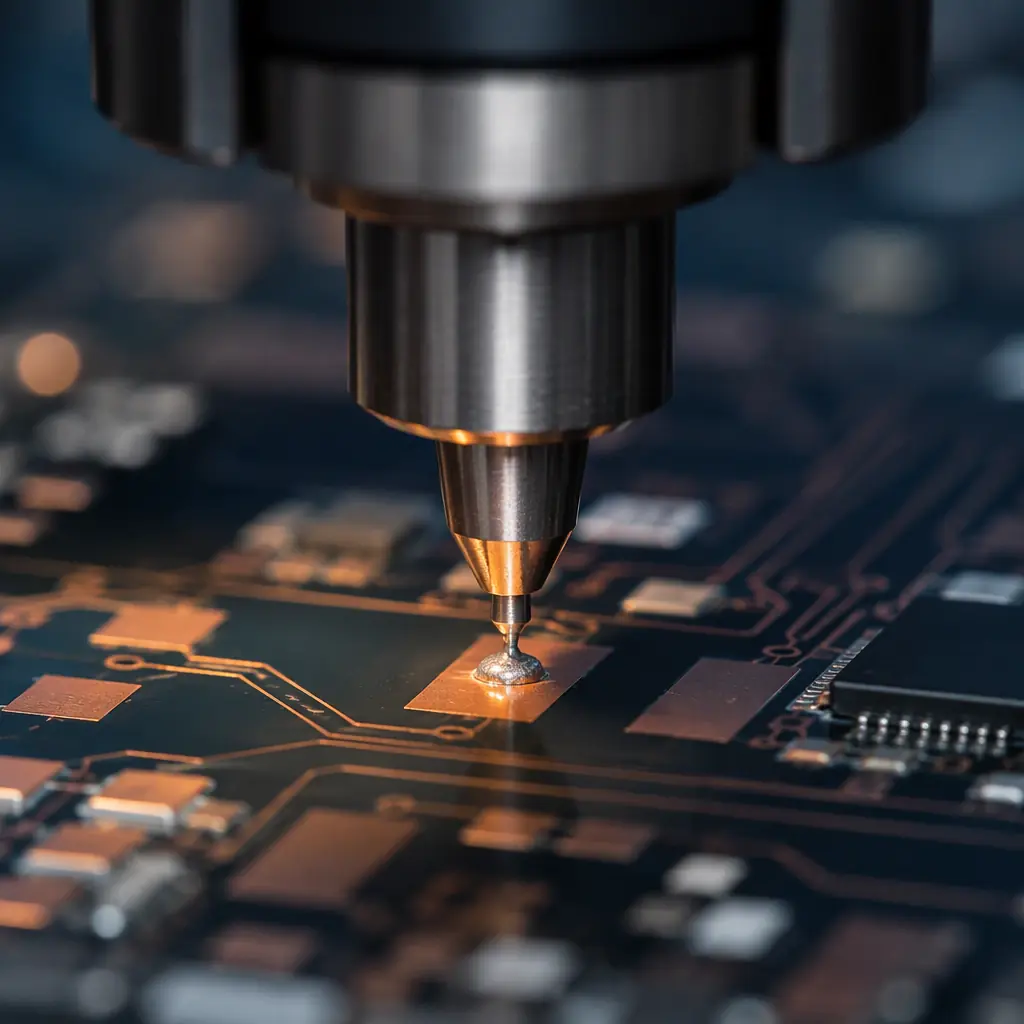
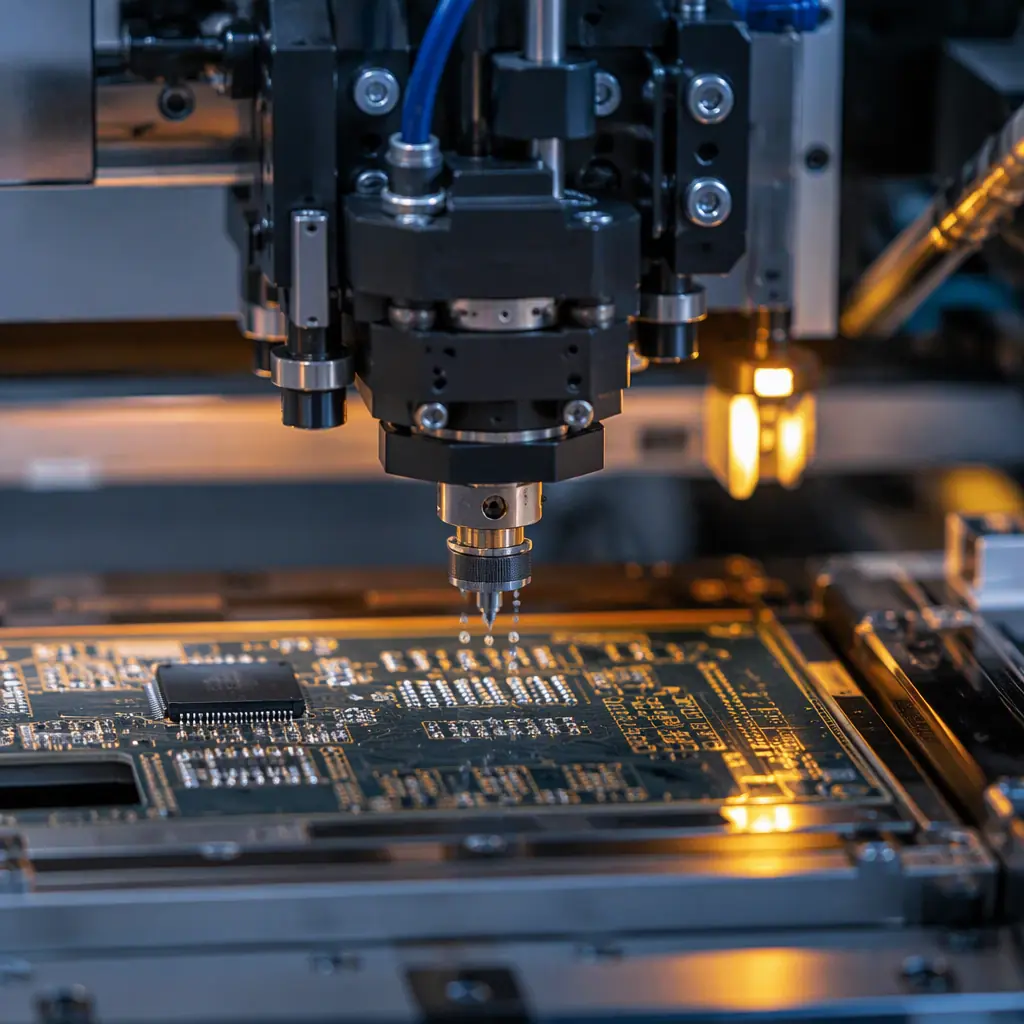
A stencil printer transfers paste through apertures punched in a metal foil. The aperture geometry is fixed at fabrication: change the pad layout, change the paste volume, and you need a new foil. A jetting head has no foil. It fires discrete droplets of paste from a nozzle, pneumatically or piezo-electrically, directly onto the pad. Volume is set in software by droplet count and size, so it changes per pad without any hardware swap.
That is the whole architectural difference, and everything else, the cost model, the changeover story, the quality control, follows from it. Deposits are built additively: a pad that needs 120 nL receives a defined number of droplets of known volume, and a fine-pitch pad next to it receives a smaller count. No aperture, no foil tension, no squeegee pressure across the whole board.
The Three Specs That Decide Which Machine You Buy
Machine datasheets are long. Three numbers carry most of the decision weight, because they map directly to the defects and costs you are trying to eliminate.
| Spec | Typical range to compare | What it controls |
|---|---|---|
| Deposit volume accuracy | ±5% to ±10% of target, in nL per droplet | Solder volume per joint → bridging, insufficient solder, joint strength |
| Jetting frequency | ~100 to 1,000 droplets/second per nozzle | Throughput on boards with many small pads; cycle time |
| Minimum deposit / dot size | ~0.2 mm to 0.4 mm dot, paste dependent | Whether 01005, 0201 and 0.3 mm-pitch parts are feasible at all |
Read those three together, not in isolation. A machine with excellent ±5% volume accuracy but a 100 Hz jet frequency will not keep up with a high-pad-count board. A machine with 1,000 Hz and coarse minimum dot size cannot place paste on a 0.3 mm-pitch footprint without bridging risk.
Deposit Volume Accuracy: The Number That Shows Up as Defects
Solder joint defects are usually a volume problem wearing a different costume. Insufficient solder, bridging, tombstoning and cold joints all trace back to the ratio of paste volume to pad and lead geometry. Stencil printing holds that ratio through fixed apertures designed with an area ratio target, the industry rule being an area ratio above roughly 0.66 for reliable release. A jetting system holds it by closed-loop control of droplet count; modern heads verify fired droplets and adjust, which is why a well-set jetting process can hold ±5% volume even as pad geometry varies across the board.
The practical consequence for a buyer: paste jetting removes the aperture-print-fidelity variable, but it introduces a paste-rheology variable. Jetting needs paste formulated for droplet formation, a different viscosity window than squeegee printing. Using a stencil-grade paste in a jetting head causes satellite droplets, clogging and inconsistent deposit mass. When you evaluate a machine, evaluate the qualified paste list alongside it; a system with no validated paste options is a system you will fight. See our solder paste selection guide for the formulation differences.
Key Takeaway: Ask for deposit mass data across the full pad geometry range on your own board, not a demo board. A machine that holds ±5% on uniform 0402 pads may drift badly on a mixed board with 01005 and 0.5 mm-pitch QFNs together.
Jetting Frequency: Where Throughput Is Won or Lost
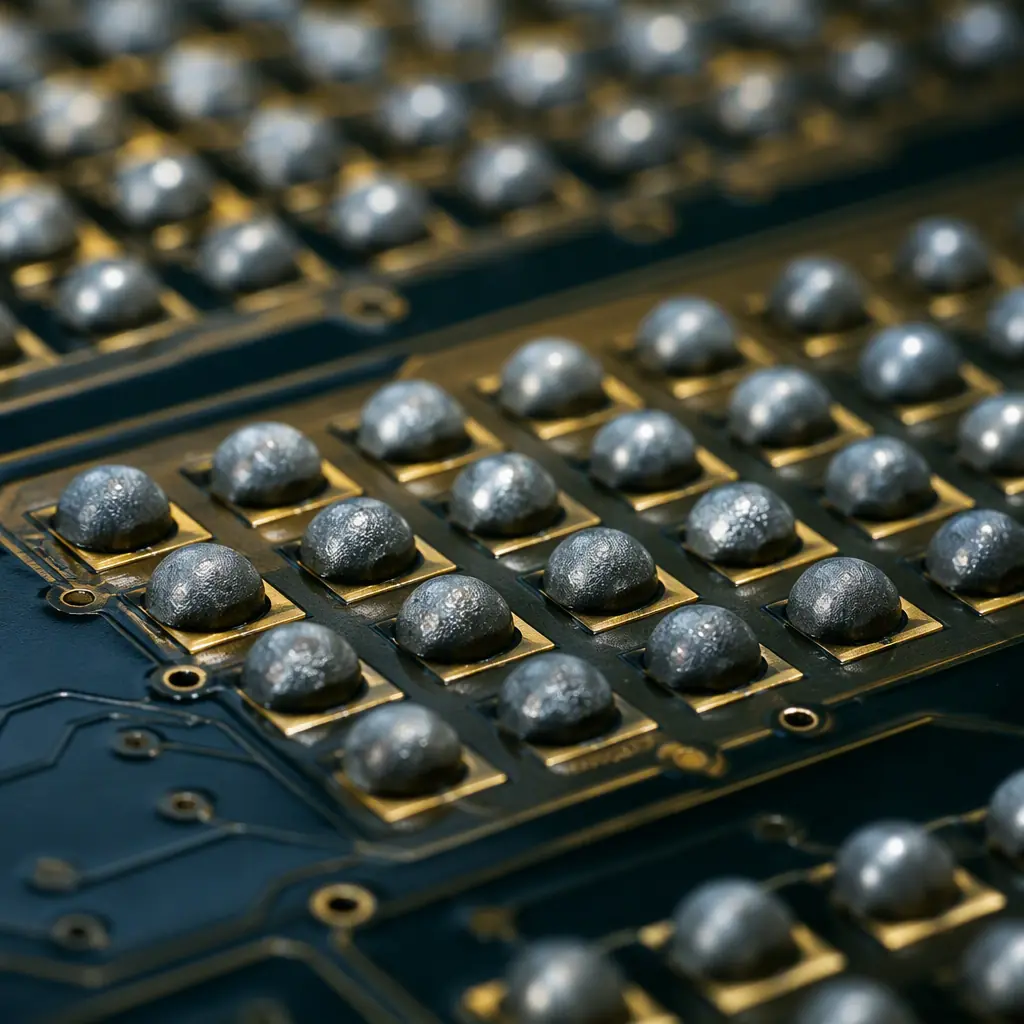
Cycle time on a jetting line is dominated by total droplets placed, not board count. A 500-pad board where each pad needs 20 droplets is 10,000 droplets. At 500 Hz that is 20 seconds of jetting time before you add load, alignment and inspection. At 200 Hz it is 50 seconds.
So the throughput question is board-specific. High-mix, low-pad-count boards rarely bottleneck on jet frequency. Dense boards with thousands of fine-pitch pads can. When you model machine choice, calculate total droplets per board for your densest product and divide by the rated frequency, then add realistic overheads: typically a 30–50% adder for alignment, fiducial reading and transfer. The rated figure is never the planning figure.
| Board profile | Droplets/board (typical) | What limits throughput |
|---|---|---|
| Sparse control board, ~300 joints, 0402+ | ~6,000 | Transfer and alignment overhead |
| Mixed industrial board, ~800 joints | ~16,000 | Jet frequency at 200–300 Hz |
| Dense module, 2,000+ joints with 01005 | ~40,000+ | Jet frequency, needs 500 Hz+ head |
This is the point where a buyer who assumed "jetting is slow" makes the wrong call. On a low-pad-count, high-mix board, jetting is often faster in real terms because it eliminates the stencil changeover between products. And changeover, not jetting speed, is where the hours go.
Minimum Dot Size: The Fine-Pitch Gate
Minimum dot size determines the finest pitch your process can serve. Approximate mapping, paste dependent:
- 0.4 mm dot . Comfortable down to 0.5 mm pitch and 0402/0603 passives
- 0.3 mm dot, 0.4 mm pitch QFN, 0201 passives
- 0.2 mm dot, 0.3 mm pitch and 01005, tight process window
Below about 0.2 mm dot size the process window narrows quickly: paste volume per joint becomes so small that surface-energy effects and paste aging dominate, and defect rates climb. For a 01005-heavy product, confirm the machine vendor has production references at that dot size with the specific paste you intend to use, not just a capability claim. Our fine-pitch SMT assembly guide covers the component-side constraints that run in parallel with the paste-side ones.
The Cost Model: Break-Even Against Stencil Printing
This is the part most evaluations skip. The relevant comparison is not machine price versus stencil price. It is total annual cost of ownership across your actual product mix.
A stencil costs roughly $150 to $600 depending on size, frameless versus framed, and technology (laser-cut foil versus electroformed). Each product revision typically needs a new stencil. Jetting has no per-product tooling, but carries a machine cost, a nozzle consumable, and a programming step per product that is usually 1–3 hours the first time.
| Cost element | Stencil printing | Paste jetting |
|---|---|---|
| Per-product tooling | $150–$600 per stencil, per revision | None |
| Changeover time | 15–60 min (swap, align, print test, clean) | 0–10 min (program recall) |
| Nozzle / consumable | Squeegee blades, periodic | Nozzle replacement, periodic + clog risk |
| First-article cost | Print test + inspection per setup | Program validation per new product |
| Paste constraint | Wide formulation freedom | Must be jettable paste |
Now the arithmetic. Suppose you run 40 distinct products a year with an average of 2.5 revisions each, 100 stencil events. At an average $350 per stencil that is $35,000 a year in tooling alone, before counting the changeover hours. At a loaded line rate of $80/hour and an average 30 minutes of changeover saved per event, the changeover recovery is another $4,000. That is roughly $39,000 a year of addressable cost against a machine that typically runs $80,000 to $250,000 depending on head count and automation.
Payback is therefore somewhere between 2 and 6 years for that profile. And it flips to under a year if your product mix is higher, your changeovers are longer, or your stencils are the expensive framed/electroformed type. Conversely, a company running three products in high volume with one or two revisions a year will not recover the machine cost in any reasonable window, and should stay on stencils. Our zero-tooling stencil guide covers the intermediate option for that profile.
Break-even rule of thumb: count your annual stencil events (products × revisions) and multiply by $350. If the result is under about $15,000, stencils win. Above about $40,000, a jetting head starts paying for itself inside a normal payback window.
Where the Two Processes Land in Practice
In our lines, the split is consistent and predictable:
- Jetting wins: prototypes and NPI, high-mix low-volume production, boards with mixed fine pitch and coarse pads, and any product with frequent ECO-driven revisions. See the NPI process guide.
- Stencil wins: single-product high-volume runs, very dense uniform fine-pitch arrays where print speed dominates, and products with thousands of identical pads where a well-tuned foil is faster per board.
- Both, on the same line: jetting handles the low-volume tail while stencils serve the high-volume head. This is the most common real-world answer and the one that resists simplistic "which is better" framing.
For the process-level mechanics behind that split, including deposit inspection and SPI setting, see our jetting vs stencil comparison and the AOI, X-ray and SPI inspection guide.
What to Put in an RFQ for a Jetting Build
If you are sourcing a jetting-capable assembly partner rather than buying a machine, the evaluation shifts to their process control. Ask for:
- Deposit volume data (deposit mass, not visual) across your actual pad geometry range
- The qualified jettable paste list they run, and whether it covers your temperature and reliability requirements
- Changeover time per product and how programming is retained between runs
- Nozzle maintenance interval under their production load, and clog-related downtime history
- First-article inspection data: SPI volume per pad against target, not just pass/fail
A partner who can produce those five items has a controlled jetting process. One who talks only about machine brand does not. Pair this with our supplier quality scorecard framework when comparing vendors.
The Bottom Line
Machine selection comes down to three specs, volume accuracy, jet frequency and minimum dot size, checked against your densest and your smallest product. Whether you should be buying at all comes down to one calculation: annual stencil events times stencil cost, plus the changeover hours you would recover. Do the second calculation before you read another datasheet. It eliminates most of the options faster than any spec comparison will.