

Every SMT line stops. A feeder runs dry, a printer throws a vision fault, a component arrives short, a customer adds a change order, or the line simply reaches the end of a batch. What differs between factories is not whether the line stops but what the process says must happen afterwards, and whether that instruction exists in writing before the stop occurs.
The failure mode is consistent and easy to recognise in a defect report after the fact: a burst of print-related defects, or a cluster of opens on one component type, confined to a small window of production. Investigators look for a machine fault and find none, because the machine recovered on its own. What did not recover was the paste on the stencil, the paste in the cartridge, or the boards that were mid-process.
This page covers the physical effects of a stop, a decision tree by stop duration, the paste abandon rules that matter, the reflow requalification question, and the records that allow a buyer to verify the rules were followed. Our changeover and SMED guide covers planned stops; this page is about unplanned ones and about the restart gate that follows.

A line at rest looks unchanged. The paste on the stencil and in the cartridge is not.
What Actually Degrades During a Stop
Four things change while the line is stopped, and they change at different rates. The printer's paste and stencil degrade fastest. The cartridge in the holder degrades next, its clock started at thaw, not at the stop. Boards in the conveyor, or in a magazine between print and placement, are degrading only in the sense that their printed paste is ageing. Components and the machine itself are unchanged.
Paste on the stencil loses solvent and gains viscosity
Paste on a stencil is exposed to air across a thin film, so the surface dries much faster than paste in a syringe. In a dry, air-conditioned shop at 23 degrees Celsius and 40 percent relative humidity, paste that has been spread on a stencil for 45 minutes will show a visibly different roll than paste that has been rolling for 5 minutes. That change is real; solvent loss raises viscosity, which reduces release at small apertures first.
Paste in the cartridge ages on the thaw clock, not the stop clock
A cartridge thawed at 06:00 and returned to the printer at 14:00 after a two-hour stop is an eight-hour-old paste, not a two-hour-old paste. The stop is irrelevant to its state. This is the most common bookkeeping error in a restart record.
The stencil accumulates dried paste in aperture walls
Apertures that were printing cleanly with wet walls now have partially dried paste adhering to the wall. On restart the first few prints release poorly at small apertures, which is exactly where the process has least margin. Cleaning the stencil before restart is cheap; discovering torn deposits at AOI is not.
Boards between print and placement carry exposed printed paste
A board sitting on an infeed conveyor with printed paste is a board with an open working window. If the stop extends past the coating's surface dry time, that paste will not reflow the way the recipe assumes. The board must be treated as suspect, not as routine.
Temperature and humidity drift in the enclosure
An enclosed printer holds a local environment. After a stop, that environment drifts toward ambient. On restart, paste and squeegee start at a different temperature, which changes viscosity for the first 10 or 15 minutes of printing. This is one reason the first boards after restart should not be treated as routine production.
Of those five, only the second is a documentation problem. The other four are physical and predictable, which means they can be handled by a rule based on duration rather than by operator judgement.
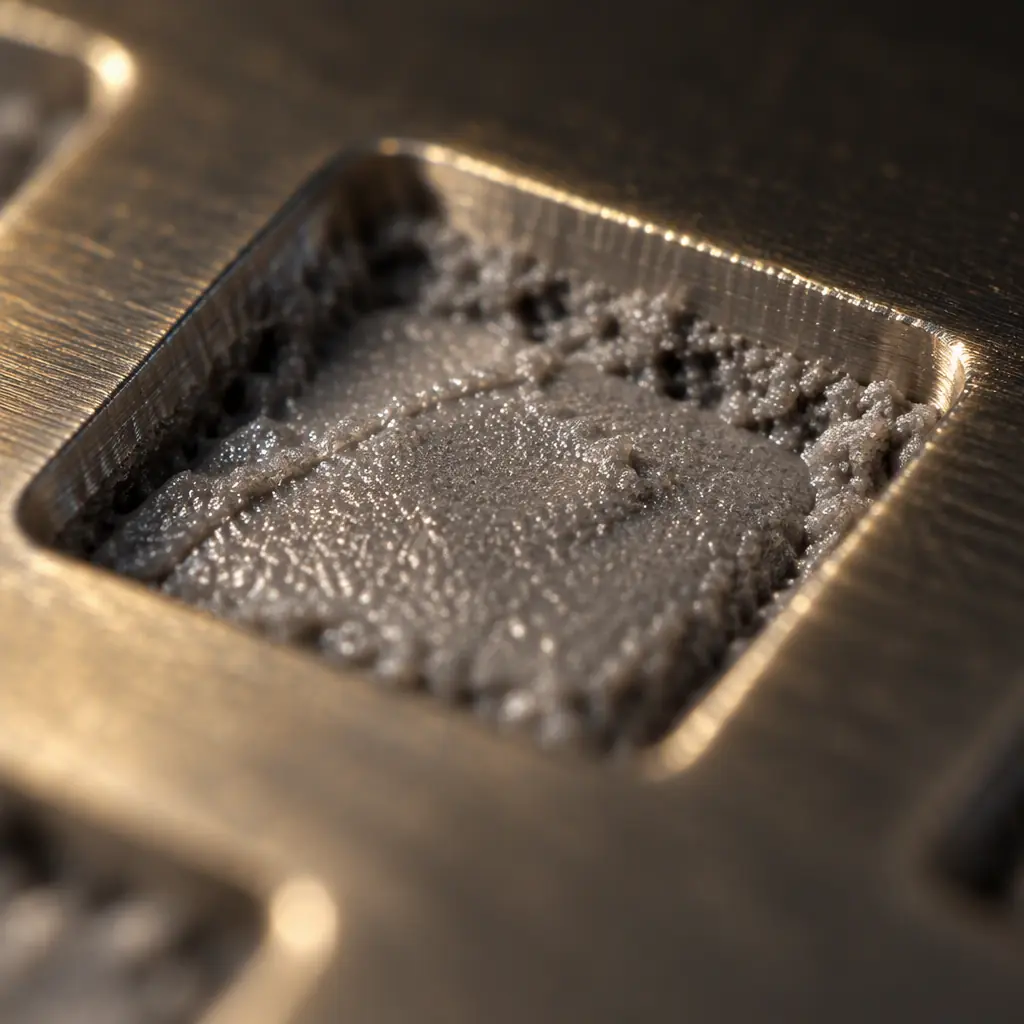
Aperture walls hold a thin paste film. On a stopped stencil that film dries first, and it is where release failure begins.
The Decision Tree by Stop Duration
The thresholds below are process control bands, not standard requirements. They are the numbers we run to, calibrated for a no-clean SAC305 Type 4 paste at controlled ambient, and they are conservative on purpose because the cost of the conservative branch is a stencil wipe and a few rejected boards.
| Stop duration | Paste on stencil | Paste in cartridge | Boards in process | Restart action |
|---|---|---|---|---|
| Under 10 minutes | Leave in place, keep rolling | No action | Continue | Print 2 test boards, inspect, proceed |
| 10 to 30 minutes | Re-mix the bead in place | No action | Continue | Clean stencil, re-mix, print 3 test boards with SPI check |
| 30 to 60 minutes | Re-mix, then judge by roll appearance | Clock continues | Hold any board with printed paste over 30 min | Clean stencil, fresh bead, first 5 boards inspected at SPI and AOI |
| 1 to 4 hours | Remove paste, clean stencil | Clock continues; check against working life | Quarantine printed boards, hold for engineering disposition | Fresh paste, requalify first 10 boards, hold until SPI trend restored |
| 4 to 8 hours | Remove and discard stencil paste, deep clean | Judge against working life; discard if exceeded | Quarantine all printed boards | Fresh cartridge, full first-article-lite: SPI 10 boards, AOI 5, X-ray if BGA |
| Over 8 hours or overnight | Remove, clean, dry | Discard all open paste | Quarantine all in-process boards | Treat as line start: new paste, stencil verified, first boards to FAI review |
The important column is the fourth, because printed boards in process are the ones that most often escape notice. A board holding printed paste for 50 minutes is not automatically scrap, but it cannot be processed as if it were printed a minute ago. The paste has partially dried, which changes slump and can produce a fillet that is short and steep rather than concave and continuous.
A stop of any length on a line running a water-soluble paste deserves an additional step: printed boards held beyond the dry time may need reflow before cleaning even if the print looks correct. Water-soluble chemistries are less forgiving of extended dwell, and the no-clean versus water-wash comparison explains why the process window differs.
Paste Abandon Rules That Actually Get Followed
Every factory has a rule about discarding paste. The rules that get followed share three properties: they are based on a clock the operator can read, they name who decides when the clock is exceeded, and they produce a record. Rules phrased as "discard paste that has degraded" are followed approximately never.
Two clocks, printed on the label
The thaw clock starts when the cartridge leaves the refrigerator and ends at the stated working life. The on-line clock starts at first scoop or first print. Both should be written on the cartridge label by hand at the moment they start. An operator who has to recall when thaw occurred will guess optimistically.
A named decision owner for over-age paste
When the thaw clock expires with half a cartridge unused, the choice is discard or continue. That choice should belong to one named role, usually the process engineer on shift, and it should be recorded. If the operator decides alone, the answer is always continue.
No re-refrigeration of paste returned from the line
Paste that has been on a stencil should not go back into the refrigerator. Condensation on re-thawing introduces moisture and the temperature cycling changes the flux vehicle. The rule is simple enough to hold, which is why it holds.
A physical discard container at the printer
Paste removed at the end of a run goes into a labelled container at the station, not back into a cartridge and not into a general bin. The container weight feeds the consumption audit described in the paste consumption cost model.
Restart approval recorded against the batch
The restart event itself, with the stop duration and the action taken, belongs on the batch record. Without it, a defect cluster cannot be linked to a stop, and the correlation that would justify a tighter rule is never made.
The re-refrigeration rule is worth defending because it is the one that gets broken quietly. A partially used cartridge looks like value; putting it back seems thrifty. The consequence is condensation, which shows up later as solder beading or voiding, and the cause is two shifts upstream by the time anyone looks.
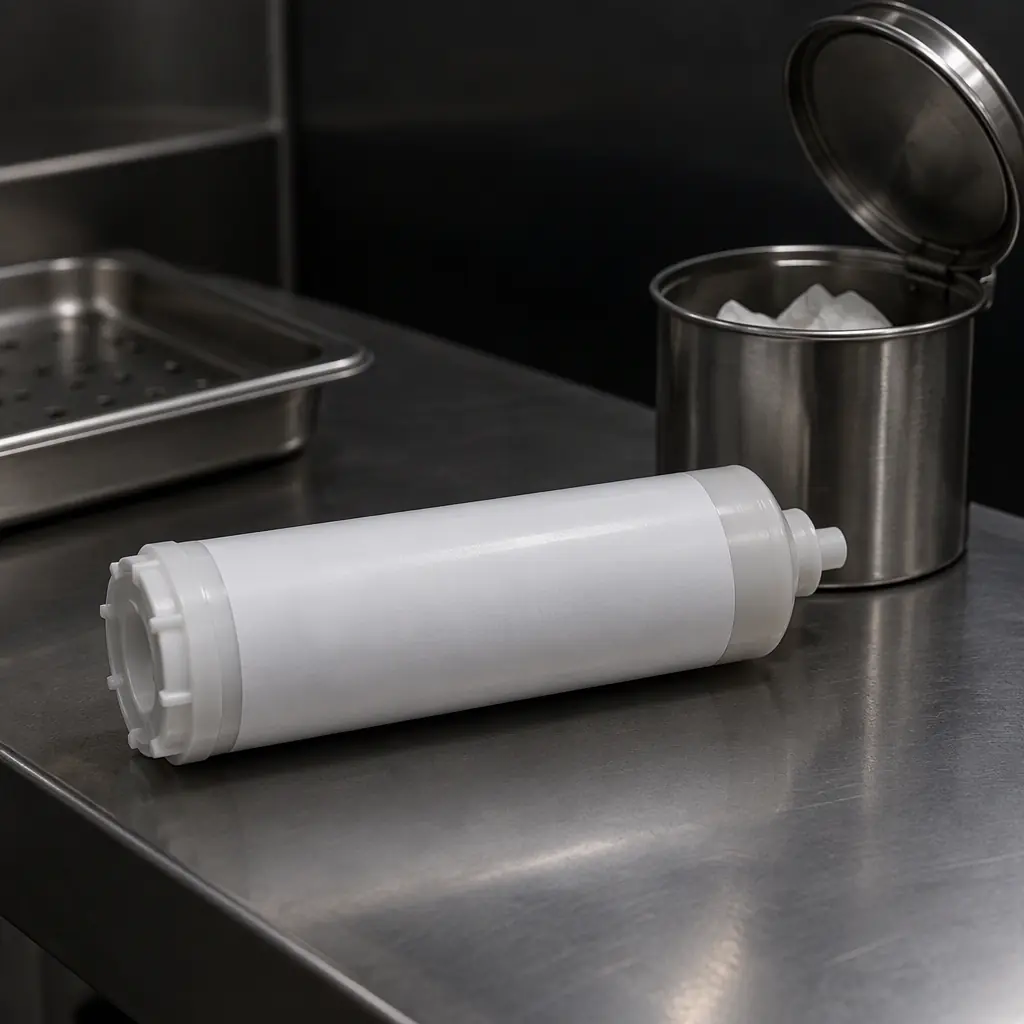
Two clocks on the label and a discard container at the station: the two controls that make a paste rule enforceable.
Reflow Requalification After a Stop
A stop on the printer side does not change the reflow recipe. A stop that allows the oven to cool, or that empties the oven and then restarts it, does change the thermal state of the equipment and requires more than simply resuming the profile.
Three questions resolve the requalification decision. Was the oven still under control and loaded with boards throughout? If yes, the profile is unchanged and the only question is whether the entering boards have a different paste state, which the decision tree above covers. If the oven was idle and cold for more than an hour, the first boards through after restart enter a zone stack that has not yet reached equilibrium, which is precisely what the profile was measured under. Those boards should be profiled, not assumed.
The third question is nitrogen. A nitrogen reflow with a specified oxygen concentration resumes at a different measured level than a steady-state line, and the setpoint takes time to re-establish. Boards processed during that recovery see a different oxygen exposure. The nitrogen reflow and oxygen control guide covers the measurement method; for restart purposes the rule is that the first boards after a cold start are only trusted once the oxygen reading is back inside the specified band.
| Oven state at stop | Duration | Requalification needed | Evidence to retain |
|---|---|---|---|
| Hot, loaded, boards in zones | Any | No profile change | Zone temperature log continues without excursion |
| Hot, empty, zones at setpoint | Under 30 minutes | No profile change, verify idle zone temperatures | Zone log showing all zones within tolerance |
| Hot, empty, zones at setpoint | 30 to 120 minutes | Profile one board with thermocouples before release | Attached profile with all peak and TAL values in band |
| Cooled or shut down | Any | Profile one board plus oxygen verification in nitrogen | Profile plus O2 reading at restart |
| Cooled, plus recipe change | Any | Full profile and first article before release | Profile, FAI report, X-ray if BGA or QFN |
Many suppliers will state that their profile is qualified and therefore no requalification is needed after a stop. That statement is correct only for the first two rows. The profile was measured on a hot oven; a cold restart is a different machine state, and the honest answer is a single profiled board, which costs ten minutes.
The Restart Gate: What Must Pass Before Production Resumes
The restart gate is the part a buyer should ask about in a supplier audit, because it is the difference between a documented process and an intention. It should be a short, specific list, and the outputs should be retained with the batch.
Paste state verified against both clocks
Not just the thaw clock. The on-line clock and the batch record must show the paste in use is within working life after the restart, or that a fresh cartridge has been opened and recorded.
Stencil cleaned and aperture condition inspected
Visual inspection at the finest aperture region, and a check that the foil has not been damaged during cleaning. Aperture damage during an urgent pre-restart clean is a real failure mode; the stencil lifecycle criteria give the retirement limits.
Test boards through SPI before production boards
Two to ten boards depending on stop duration, measured at SPI, before any board is allowed through placement. This is the single most effective restart control, because it measures the paste volume directly instead of inferring it from appearance.
First production boards through AOI with a temporary tightened limit
Alternatively pass with review rather than pass with no review. Call it out on the traveller so the AOI operator knows the boards are post-restart.
Quarantined in-process boards dispositioned in writing
Boards held from before the stop are sorted into release, rework or scrap by engineering, with a documented reason. Released boards from this group must not be mixed into the post-restart first-pass count, or the restart control loses its signal.
Restart event recorded on the batch record
Stop time, restart time, duration, action level applied, and who approved. This is the record that lets a defect cluster be traced to its cause a week later.
Restart is a first article, not a resumption
The cleanest way to describe it to a buyer: the process is treated as having produced a new first article. Not the full AS9102-style package, but the same principle, that the first units after the change are inspected before the run is released, and the evidence is kept. Suppliers who run restarts this way have a defensible answer when a customer asks why a lot had a defect cluster.
For high-reliability work, the restart gate should also include a recheck of any parameter that is measurable and cheap. Paste height at three aperture widths, first-board X-ray of any BGA or QFN, and a visual on the finest pitch part. The first article inspection structure provides a template that can be scaled down for this purpose.

Measuring paste height on the first boards after restart converts an inference into a number.
What to Write Into the Supply Agreement
Line stops are operations, and buyers rarely specify operations. Three clauses make the difference without micromanaging the factory.
Notification threshold
State the stop duration that must be reported to the customer during the run, typically four hours on a running order, and what information must accompany the notice. This is not about permission; it is about the buyer knowing that the lot has a restart event in it.
In-process board disposition
Require that boards held mid-process beyond the paste dry time are dispositioned by engineering, not reworked by habit, and that the disposition is recorded per lot.
Restart evidence on request
Require that the restart record, SPI results for the first boards after restart, and any reflow profile be available on request for any lot. This is a records clause, not a process clause, which makes it easy for a supplier to accept.
Where a lot has failed in the field, the restart record is usually the first thing that tells the story. The failure analysis method depends on batch records that link production events to serial numbers, and a stopped line is exactly the production event those records are least likely to contain.
For buyers managing many suppliers, the practical test in an audit is a single question: show me the last three line stops on this product and what you did about them. A supplier with a real process produces three records in a minute. A supplier without one explains that stops are rare.
The economics are not close. A stencil wipe and ten SPI measurements cost a few minutes. A defect cluster that reaches a customer costs a containment, a sort, a report and sometimes a requalification. The restart gate is the cheapest insurance on the line, and it only works if the rule exists before the line stops.