Ask three assemblers what flux they use and you will often get three answers chosen by habit rather than by product requirement. The flux chemistry is decided early, buried on the BOM and the process sheet, and then never revisited — yet it drives the cleaning operation, the equipment, the effluent treatment, the humidity reliability of the finished board, and whether a low-standoff component is safe to use at all. Getting it wrong is expensive in a way that only shows up months later in the field.
This guide sets out the three flux systems in plain terms, explains why surface insulation resistance under humidity is the real technical test, puts actual numbers on the cleaning cost that engineers often omit, and gives a decision table by application. At Huaxing PCBA we run no-clean, water-wash and solvent processes in the same facility under IATF 16949 and ISO 9001, with ionic cleanliness verification on every applicable build, so the trade-offs below are drawn from production rather than theory.
The Three Flux Systems in Plain Terms
All three systems do the same chemical job — remove oxide, prevent re-oxidation during soldering, and promote wetting. They differ in what they leave behind and how that residue is removed, or whether it is removed at all.
No-clean
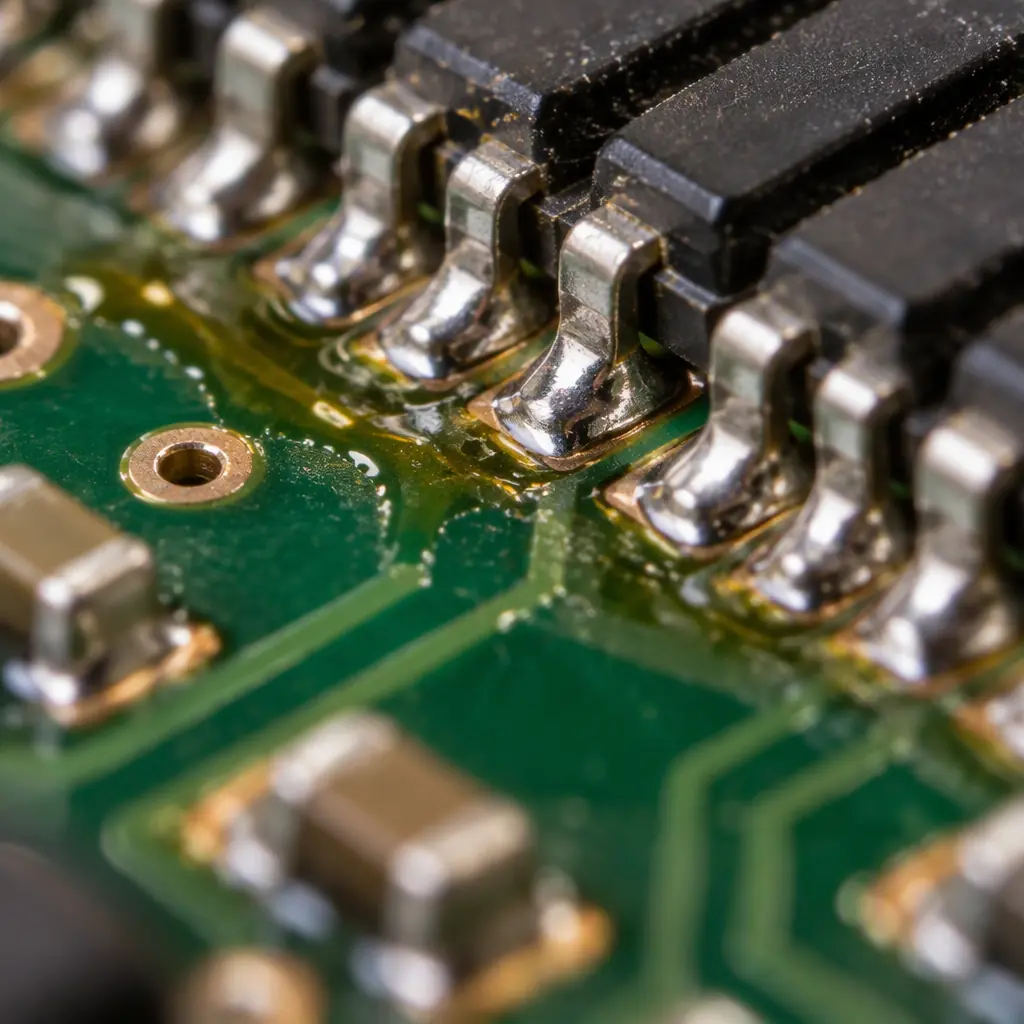
A mild flux whose residue is designed to remain on the board. The solids content is low, the residue is thin and non-tacky, and after reflow it is considered benign enough that cleaning is omitted. This is the default for most consumer and industrial surface-mount assemblies, and it is the cheapest route because it removes an entire process step. The catch is that "benign" is conditional on the residue remaining intact and dry — a point that matters greatly under humidity.
Water-wash (aqueous-cleanable)
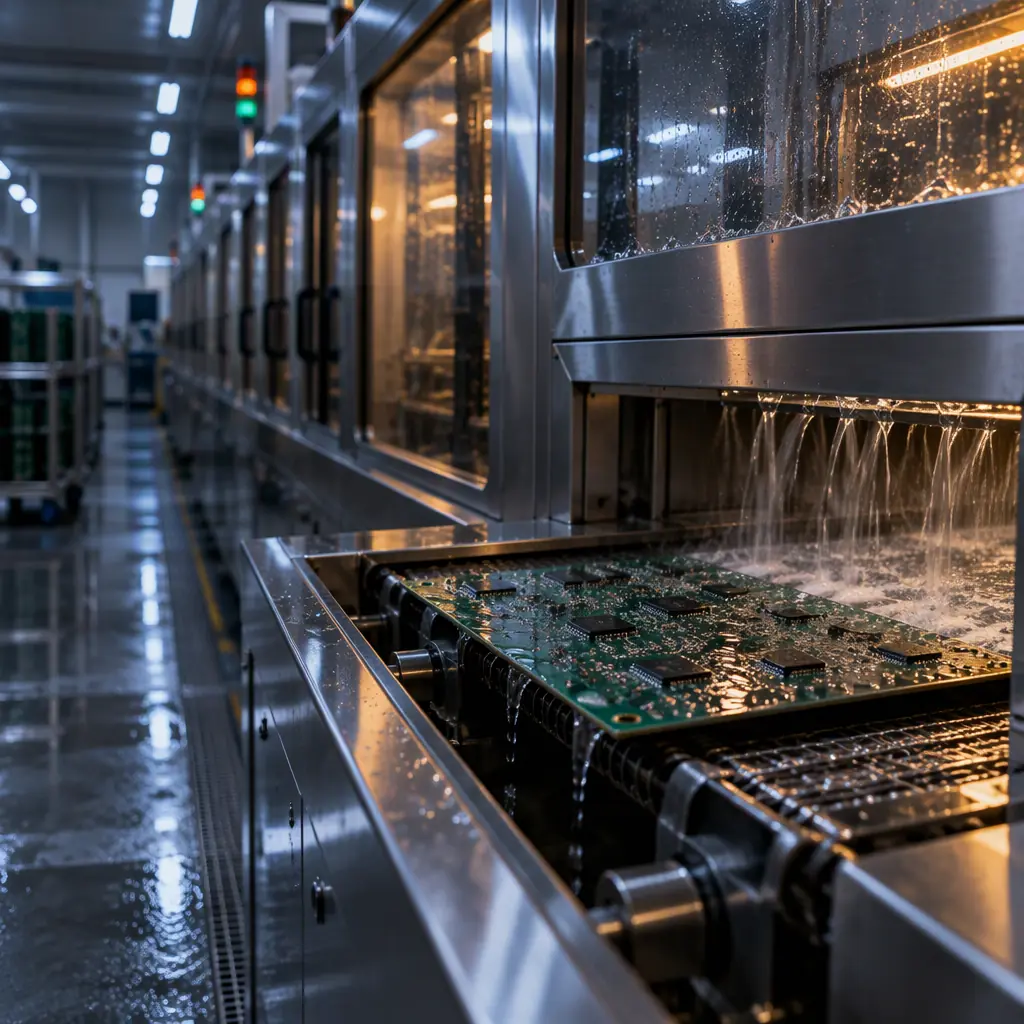
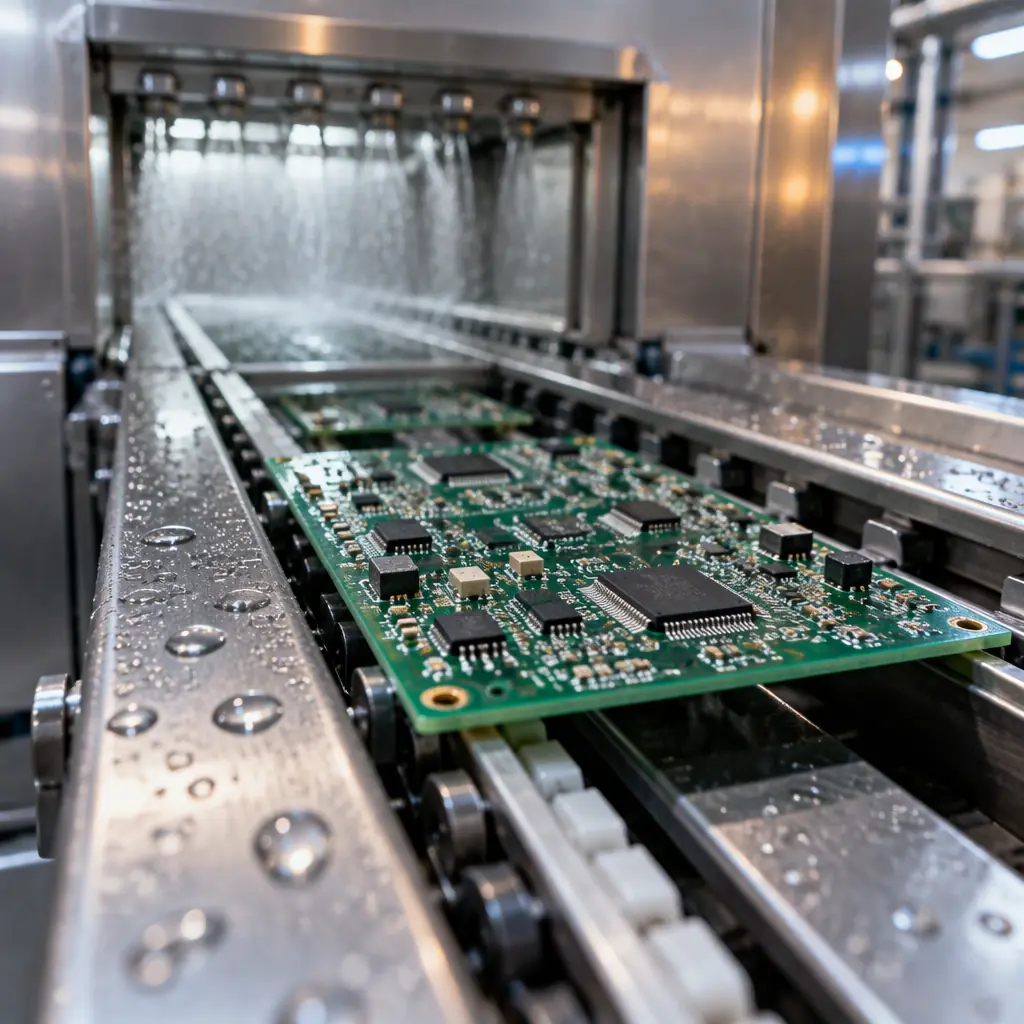
A flux designed to be removed in water, usually warm DI water with a saponifier or a mild detergent that converts the residue into a water-soluble form. It produces the cleanest board and is the standard choice for medical, aerospace and any product where residue is unacceptable. The cost is the inline or batch washer, the DI water production, the drying step and the effluent treatment of the wash water.
Solvent / semi-aqueous
Flux removed with a solvent or a solvent followed by a water rinse. It handles residues that water alone cannot, particularly from older high-activity rosin fluxes used in high-reliability and defence work where the flux must be aggressive to cope with oxidised surfaces. Solvent cleaning brings its own considerations: fire and health controls, disposal of spent solvent, and higher material cost than water.
Choosing between them is not a matter of which is "best" — it is a matter of which residue your product can tolerate, at what cost, given the components and the environment. The mechanical and chemical detail of the cleaning step itself is covered in our guide to aqueous versus solvent cleaning processes.
Residue Type Under Humidity: Why SIR Testing Decides It
The phrase "no-clean" hides a significant amount of chemistry. Residues are not uniformly inert; they range from rosin and resin-derived materials to synthetic polymers, and they are classified by their ionic content. The property that actually determines whether a residue is safe is its behaviour in the presence of moisture and an applied voltage — and that property is measured by surface insulation resistance testing under a humid, biased condition.
In a typical SIR test, a test coupon is placed in a chamber at elevated temperature and relative humidity, a bias voltage is applied across a comb pattern, and the insulation resistance is monitored over time, often for hundreds of hours. A benign residue holds the resistance high, in the hundreds of megohms or gigaohms. A residue that is ionic, hygroscopic, or simply too thick to dry will allow leakage to develop as the moisture and the bias combine to mobilise ions. That leakage is the mechanism behind the electrochemical migration that eventually bridges conductors and causes field failure.
The practical implication is that "no-clean is fine" is only true for a controlled residue that stays dry and thin. On a board that runs hot enough to keep itself dry, or in a controlled indoor environment, no-clean residues hold up well. On a board exposed to condensation, temperature cycling through the dew point, or high ambient humidity — outdoor, automotive, marine, agricultural — the residue has a much harder job, and an aggressive no-clean selection or a poorly controlled process can fail SIR where a cleaned board would not. This is the same migration mechanism treated in our article on electrochemical migration prevention, and the same one that ionic contamination testing is designed to catch in production.
Key Takeaway: The question is not whether a residue is "no-clean" but whether it stays non-conductive under your product's worst humidity and bias condition. If the answer is uncertain, clean it — a removed residue cannot fail SIR.
The Cleaning Cost Nobody Quotes
No-clean is frequently chosen because it appears free, and cleaning is deferred because its cost is real and immediate. Putting numbers on the cleaning side is what turns the debate into a decision. The following figures represent a representative inline aqueous cleaning line for a mid-volume SMT operation; exact values vary with throughput and local utility costs, but the structure and the order of magnitude are what matter.
| Cost Element | Typical Basis | Relative Impact |
|---|---|---|
| Inline washer capex | Amortised over 3–5 years of production volume | High at low volume, negligible at high volume |
| DI water production | Resin regeneration, water consumption per m² cleaned | Moderate, scales directly with volume |
| Energy and drying | Heating the wash and the dry section, continuous | Moderate, continuous cost |
| Effluent treatment | Disposal and treatment of spent wash water | Low to moderate, a compliance necessity |
| Process time and yield | Additional handling step plus any cleaning-related defects | Low at maturity, higher while the process stabilises |
Against this stands the cost of a no-clean failure. Recovering a field population with leakage-induced failures — containing the units, investigating, redesigning, recleaning or remanufacturing — routinely costs orders of magnitude more than the cleaning step would have. The correct framing is therefore not "can we afford to clean" but "can we afford the consequence of not cleaning, given this product's environment." For a mains-powered indoor industrial controller, the answer is usually that no-clean is genuinely fine. For a board that will see condensation, the answer is usually that cleaning is cheaper than the recall.
Entrapment: Low-Standoff Components and Cleaning Reach
If you decide to clean, the next constraint is whether the cleaning can actually reach the residue. Water and solvent do not clean what they cannot touch, and modern surface-mount packaging leaves very little space underneath. Low-standoff components — bottom-terminated components, land grid arrays, connectors with a small gap to the board, and dense BGA arrays — create a capillary gap that resists flow. Residue trapped under such a component cannot be removed economically, which produces a board that appears clean from above while harbouring active flux underneath.
Three mitigations exist, and picking the right one is a design decision. First, choose a no-clean flux whose residue is genuinely safe if it remains, so that entrapment is harmless. Second, specify components with a larger standoff, or add a standoff or venting feature, so the gap is cleanable. Third, wash aggressively enough — a longer wash, a higher impingement jet, or a soaking-plus-spray combination — to reach the parts others miss, verified by cleanliness testing rather than assumed. What is not a mitigation is cleaning nominally and hoping; entrapment failures pass visual inspection and fail in the field.
Regulatory and Customer Drivers
Beyond the technical case, the flux choice is often constrained by standards and by the customer. Where cleaning is specified, the acceptance criterion is usually residual ionic contamination measured in units derived from the ROSE test (IPC-TM-650 method 2.3.25), expressed as micrograms of sodium chloride equivalent per square centimetre. Many medical and high-reliability customers set a limit — commonly 1.56 µg/cm² NaCl equivalent, and tighter on the most sensitive products — above which the board is rejected. Independent of any company spec, the solder assembly standard J-STD-001 defines cleanliness requirements and the evidence that must accompany them.
The compliance direction has moved steadily toward cleaning for critical applications. Medical device reliability expectations, aerospace and defence work, and any product with long field life and high cost of failure tend to mandate it. Consumer and general industrial products rarely do. The customer's own specification will normally settle the question, which is why the flux system should be read from the PO and the applicable standard rather than chosen at the line. The acceptance criteria for the joints themselves are the subject of the IPC-A-610 acceptance criteria guide.
Decision Table by Application
The following table collapses the reasoning into the choice most buyers will face. It is a starting point for the specification conversation, not a substitute for reviewing the actual product environment and customer requirements.
| Application Characteristic | Recommended Flux System | Reason |
|---|---|---|
| Consumer/industrial, dry, cost-driven | No-clean | Residue benign in the environment; removes a process step |
| Medical, implant, or life-critical | Water-wash | Cleanliness mandated and documented; residue unacceptable |
| Outdoor / high-humidity / condensation | Water-wash | Cleaned board is far more robust under bias and moisture |
| High-reliability / defence / oxidised surfaces | Solvent or semi-aqueous | High-activity flux needed and then fully removed |
| Dense low-standoff / BGA-on-BGA | Safe no-clean, or cleanable design | Entrapment means cleaning may not reach the residue at all |
How to Specify It on the PO
The flux system should be an explicit, unambiguous line on the purchase order, not an assumption. A workable specification names the flux type (no-clean, water-wash or solvent-clean) and, if cleanliness is required, the applicable standard and the residual ionic contamination limit with its test method. It should state whether cleaning is mandatory and how cleanliness is verified, so that the assembler cannot interpret silence either way.
Two further clauses prevent disputes. First, specify the inspection evidence: the ROSE or ionic cleanliness report, and for critical products an SIR result. Second, specify the change-control expectation — a change of flux chemistry mid-programme is a change of process and should trigger notification, because a switch from water-wash to no-clean can invalidate a qualification that a customer relied on. Locking the chemistry down at the PO and treating a change as a controlled event is what keeps the reliability the qualification promised.
At Huaxing PCBA we run no-clean, water-wash and solvent processes side by side and verify cleanliness with ionic contamination testing on every build where it is specified, under IATF 16949 and ISO 9001 systems across 8 SMT lines. We will recommend the flux system for your product environment rather than default to whatever is running, and state the cleanliness evidence we will supply. Send your Gerber and BOM with your product's operating environment and we will return a process and flux recommendation with the quote, or talk to our quality team about a cleanliness specification for a critical application.