When a PCB quote comes back higher than expected, buyers reach for the obvious variables: layer count, board size, copper weight, surface finish. Drilling sits further down the list, and it is usually where the surprise is hiding. Mechanical drilling is a consumable process. Every hole is cut by a solid carbide bit spinning at high speed into a stack of copper, resin and glass fibre, and each hit wears the cutting edge a little more. After a counted number of hits the bit is spent, resharpened once or twice, and finally scrapped.
That hit count is the unit of drilling cost, and it scales brutally with bit diameter. A 0.2 mm bit is not just a smaller version of a 0.8 mm bit — it is a much more fragile tool with a far shorter life, and a board loaded with thousands of small vias can cost several times more to drill than a board of the same area with generous holes. Understanding why turns an opaque line in a quote into something you can reason about, and it also surfaces a quality question: bit wear does not only cost money, it shows up in the delivered board as hole position drift and barrel wall roughness.
This article covers the consumable side of drilling: why bits wear, how hit counts are set by diameter, how resharpening changes the economics and the accuracy, why cost per hole scales so sharply with small diameters, how worn bits reach the finished board, and what a disciplined fabricator tracks as evidence. For the choice between drilling methods, see our comparison of laser versus mechanical drilling; for the specification the drilling has to meet, see hole accuracy and drilling tolerance. This article is the cost-and-consumable companion to both.
At Huaxing PCBA we run mechanical drilling with per-diameter hit-count control as part of the documented process across 8 SMT lines under IATF 16949 and ISO 9001, with bit life and resharpening policy defined per programme rather than left to operator judgement. The policy is written down because drill consumables are one of the few places where cost pressure and quality pressure pull in exactly opposite directions.
Why Drill Bits Wear Out
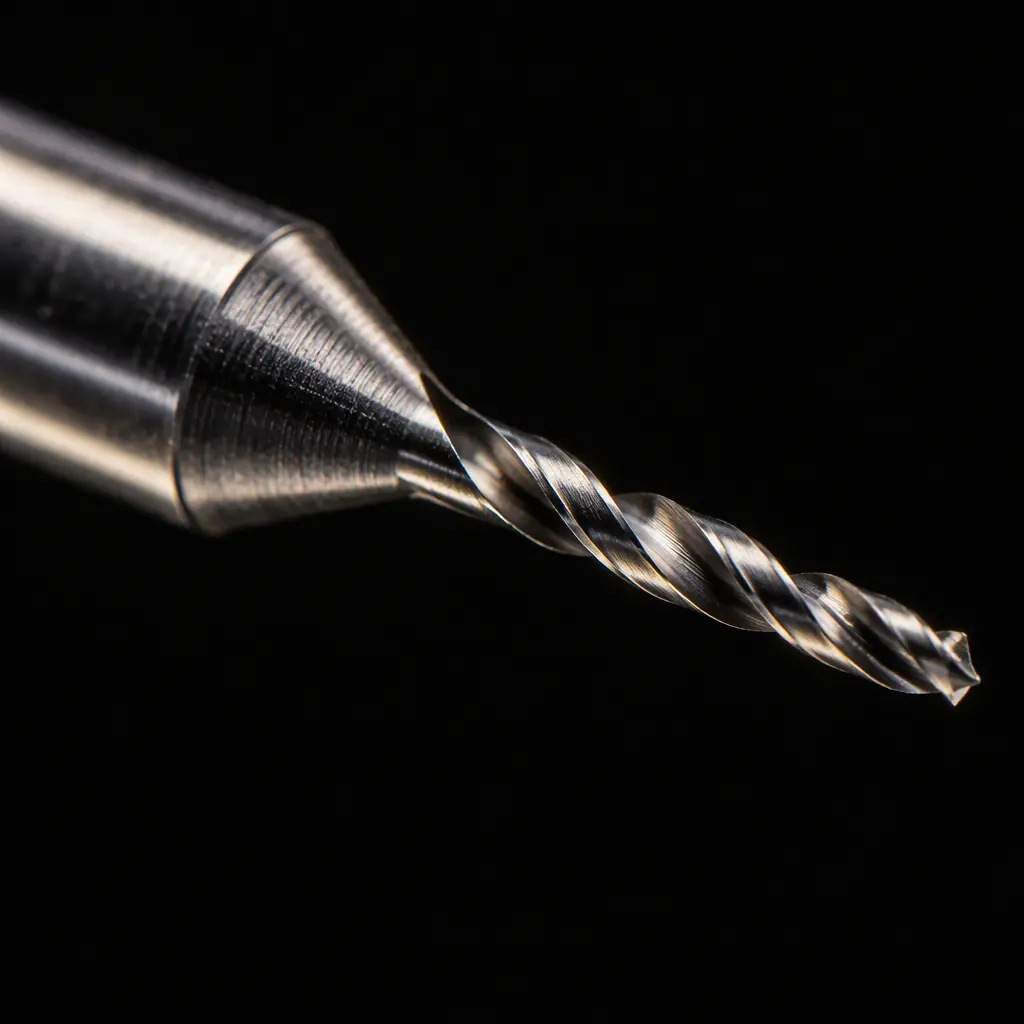
A PCB drill bit is a solid carbide tool — tungsten carbide in a cobalt binder — chosen for hardness and wear resistance rather than toughness. It has to be hard enough to cut through glass-fibre reinforced resin, which is abrasive in a way that metal cutting is not. The glass fibres act like a fine grinding medium, and the copper layers add a different wear mode as the edge moves from resin into metal.
Abrasion by the composite. FR-4 and similar laminates are glass-fibre reinforced. The fibres blunt the cutting edge gradually, and the rate depends on the glass content and the resin system. Higher-performance laminates with more filler or ceramic content wear bits faster still.
Entry and exit material effects. The entry material on top (often aluminium foil or a dedicated entry sheet) and the backup material underneath both affect hole quality and bit wear. An incorrect backup lets the exit burr form and can damage the bit as it breaks through; entry material choice affects how the bit centres and how much the first contact deflects it.
Heat and speed. Spindle speed, feed rate and retraction rate together determine how much heat builds at the cutting edge. Over-speed wears the bit quickly; under-speed can cause smear and poor wall quality. The parameter set is a balance, and it is the reason bit life cannot be stated as a single number without the parameters it was measured at.
Handling damage. A bit smaller than a fraction of a millimetre is easily chipped during loading, and a chipped bit cuts a bad hole from the first hit. This is one reason very small diameters are treated as effectively single-use in some shops.
Hit Count by Bit Diameter
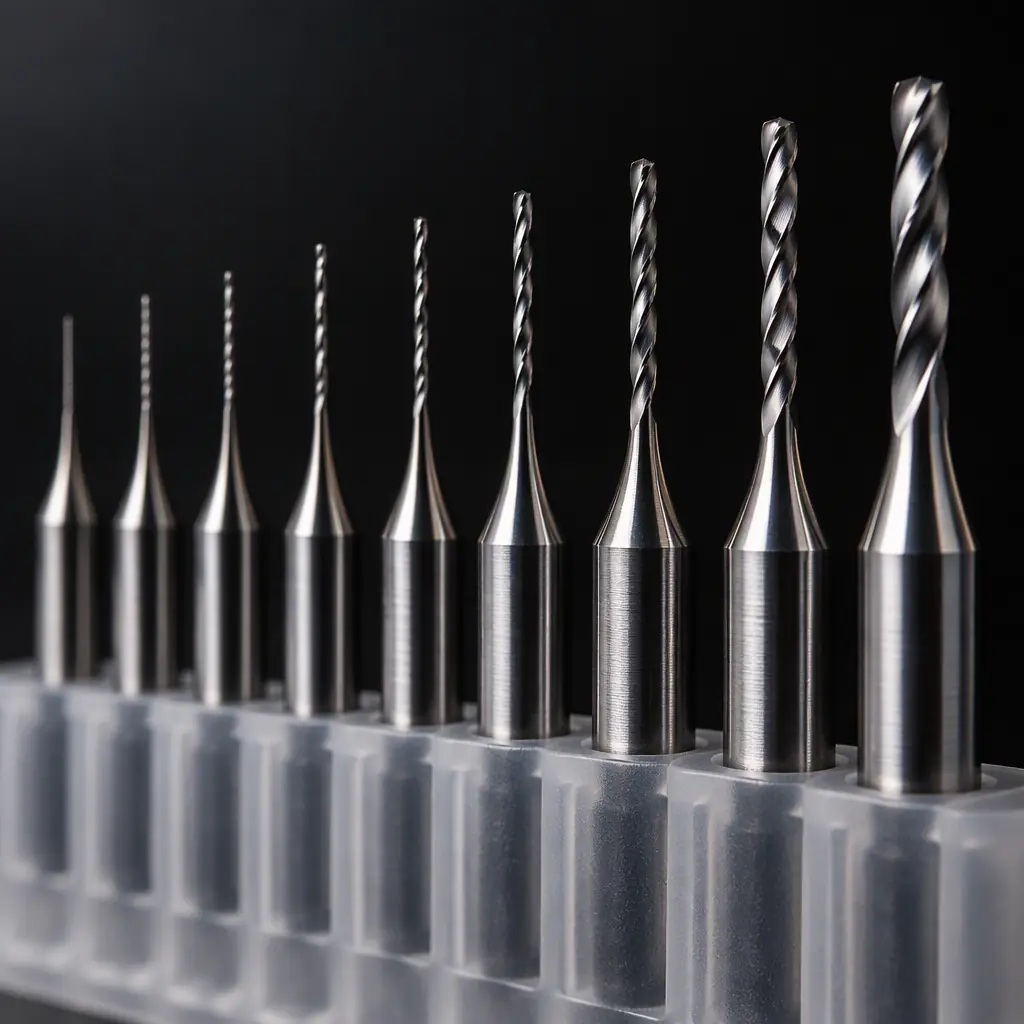
The practical control on drill bit life is a hit count: the number of holes a bit is allowed to cut before it is pulled for resharpening or replacement. The count is set per diameter, and the trend is steep. As a general shape rather than a fixed rule — actual numbers depend on laminate, stack height, parameters and the shop's own qualification — the pattern runs roughly like this:
Large holes (above roughly 1.0 mm). Robust bits with generous cutting edges and good heat dissipation. Hit counts in the thousands are common, and a bit may be resharpened several times. Cost per hole is low and drilling is not the cost driver.
Mid-range holes (roughly 0.5 mm to 1.0 mm). The workhorse band for through-hole component leads and standard vias. Hit counts drop into the high hundreds to low thousands, and resharpening is still economical.
Small holes (roughly 0.2 mm to 0.5 mm). This is where the economics turn. Bits are more fragile, cut hotter, and accumulate wear faster. Hit counts fall by an order of magnitude compared with the large-hole band, and resharpening yields fewer usable cycles before accuracy degrades unacceptably.
Micro holes (below roughly 0.2 mm). At the mechanical drilling limit, bits are extremely fragile and life is short. Many shops treat these as near-disposable, and at this scale laser drilling may be the more economical process entirely, as covered in our drilling method comparison.
Key Takeaway: Drill bit life is counted in hits and set per diameter. The count falls steeply as the hole gets smaller, which is why a via-heavy design with fine drill sizes costs far more to drill than its board area suggests.
Resharpening: How Many Times, and What It Costs
A spent bit is not automatically a scrapped bit. Carbide bits can be resharpened by regrinding the cutting edges, which extends the usable life at a fraction of the cost of a new bit. The economics favour resharpening for larger diameters and become marginal as the bit shrinks.
How many regrinds. A large bit may tolerate several regrinds before the flute geometry is consumed; a small bit may get one or two at most. Each regrind removes a little material, so the bit gets shorter and its geometry changes slightly.
The accuracy penalty. This is the part buyers miss. A resharpened bit is not identical to a fresh one — the point geometry and the cutting edge condition change slightly with each regrind. That shows up as a small degradation in hole position accuracy and wall quality. A shop that pushes a bit through too many regrind cycles to save consumable cost is trading that saving against the very hole tolerance the customer specified. The right policy ties the maximum number of regrinds to the tolerance class of the job, which is why hit-count and resharpening policy belongs in the process-control documentation rather than on the shop floor.
Cost balance. Resharpening is cheaper per hole than a new bit up to a point. Past that point the yield loss from degraded accuracy exceeds the consumable saving, and continuing to use the bit becomes a hidden cost rather than a saving. A disciplined shop tracks this rather than maximising regrind count.
The Cost Curve: Why Small Holes Dominate Drilling Cost
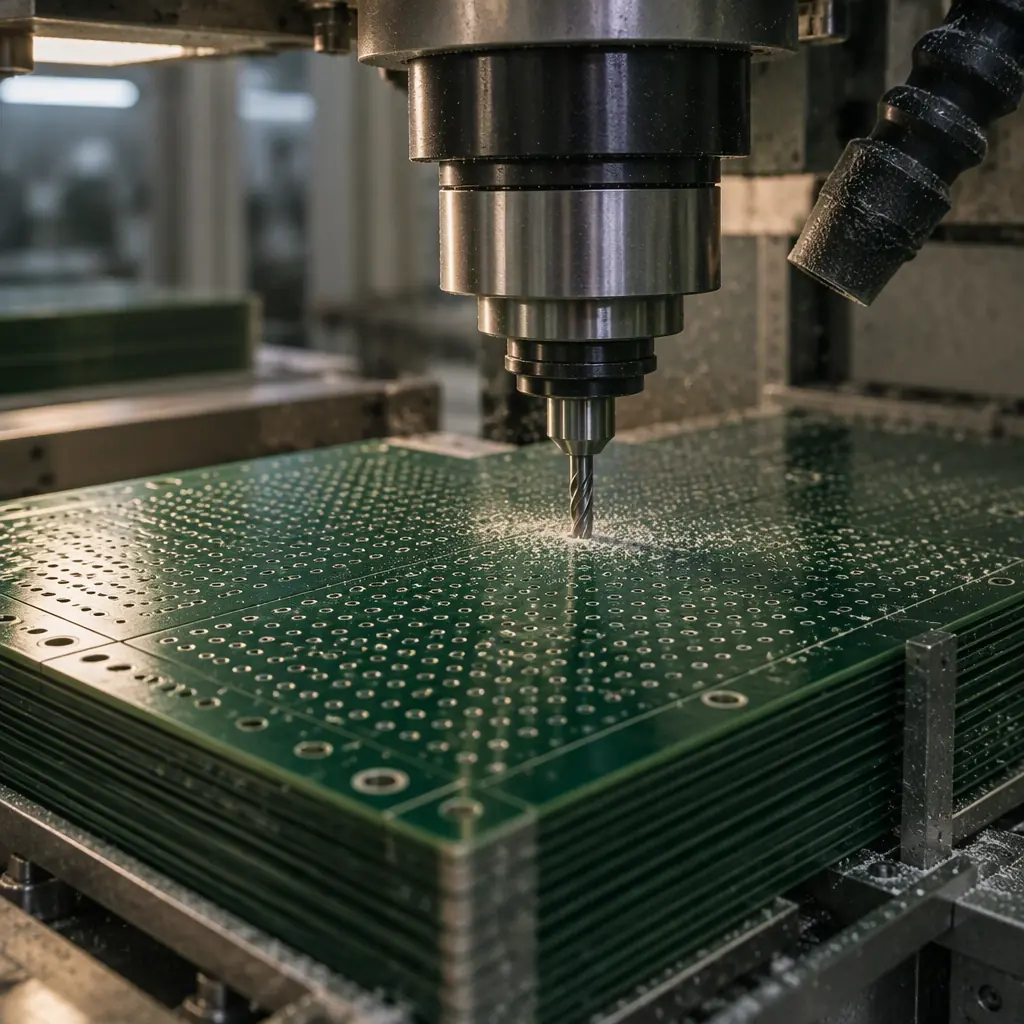
Drilling cost is not proportional to hole count. It is proportional to hole count multiplied by the cost per hole for that diameter, and that second factor climbs steeply as diameter falls. Three separate effects compound.
Tool cost per hole. A small bit costs more relative to the number of holes it can cut, because its hit count is far lower. The consumable cost per hole rises accordingly.
Cycle time per hole. Small bits must run at different parameters and often at reduced stack heights to avoid breakage, so the number of panels drilled per stack drops and the machine time per hole rises. Machine time is a large part of the drilling cost, so this multiplies the effect.
Breakage and rework. Small bits break more often. A broken bit stops the machine, may damage the panel, and requires a retool. The expected cost of breakage is loaded into the small-hole rate.
The consequence for a buyer is that the design decision dominating drilling cost is not board size but hole count and the smallest hole size. A design that adds thousands of small vias, or that pushes the minimum drill below what the design actually needs, moves the board into a different cost band. This is one of the strongest arguments for keeping the via count and the minimum drill size in view during layout rather than discovering their cost in the quote. Where vias are unavoidable, the alternative of drilling them optically is covered in the laser versus mechanical guide, and the geometry limits that cap how small and how deep a mechanical bit can go are covered in via aspect ratio.
How Worn Bits Reach the Delivered Board
Bit wear is not only a cost story. A worn bit stops cutting cleanly, and the defects it creates are the kind that inspection has to catch or the customer catches later.
Hole position drift. A dulled bit deflects more easily on entry, so the hole wanders from its intended centre. On a build with positional tolerance written into the specification, cumulative drift across a worn bit's life can push holes out of the tolerance window. This directly connects to the tolerance requirement in our hole accuracy and drilling tolerance guide.
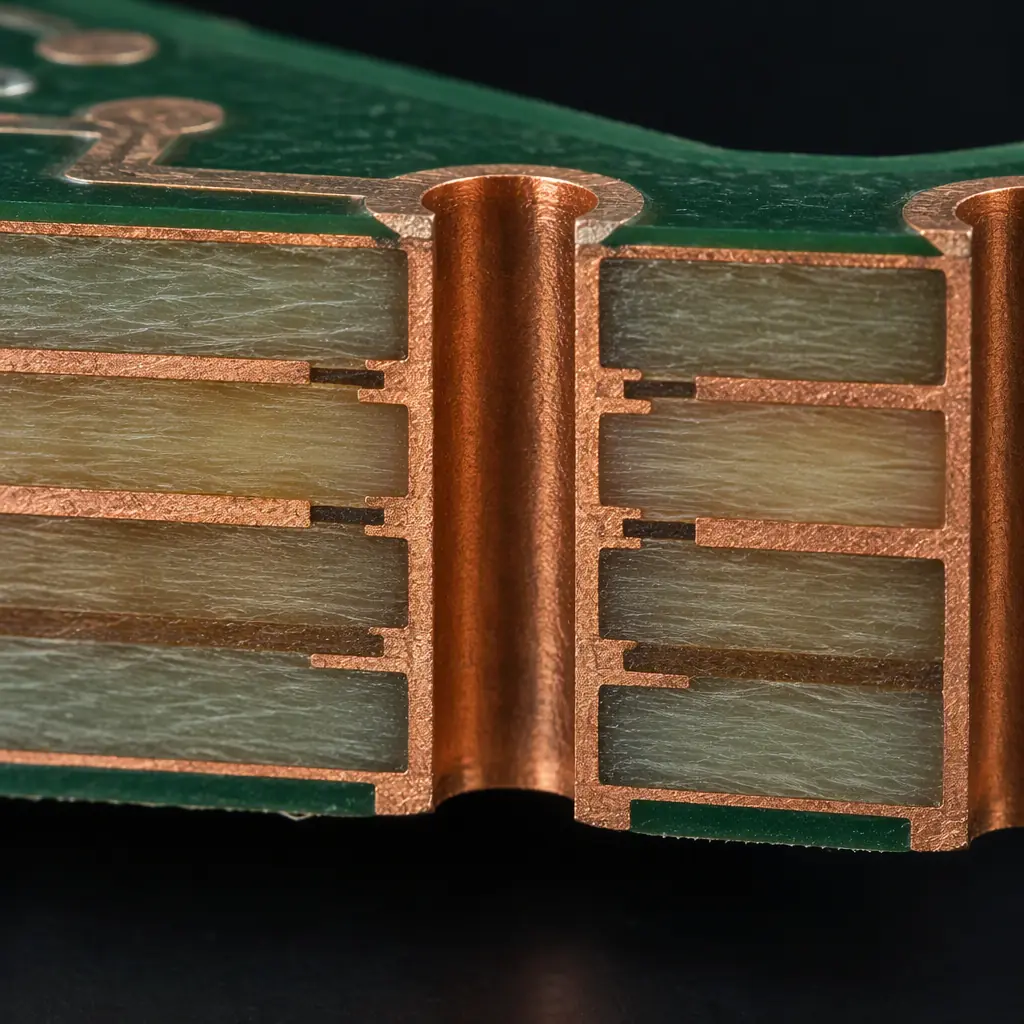
Barrel wall roughness and resin smear. A worn edge tears rather than cuts, leaving a rougher barrel wall and more resin smear. Smear must be removed by desmear before plating, and residual smear beneath the barrel is a route to poor plating adhesion and, eventually, an open or intermittent via. The reliability consequences of poor plating are covered in microvia reliability testing.
Nail-heading and burrs. Dull bits produce more burring at entry and exit, and nail-heading where the hole edge is deformed. Both are acceptance issues under the visual criteria in IPC-A-600, and both are evidence that bit life was pushed past its limit.
Entry and exit burr asymmetry. Wear combined with wrong backup material produces asymmetric burring, which can later interfere with pad formation or cause solder issues at assembly. Managing the drilling consumable is therefore also managing an assembly-side risk.
Hit-Count Control as a Quality Lever
The reason to care about hit-count policy as a buyer is that it is one of the few process controls that sits at the intersection of cost and quality, and it is invisible unless you ask. A shop can reduce drilling cost by pushing hit counts up and regrind counts higher; the saving appears immediately, and the quality consequence appears later as position drift and plating defects. A shop with a written policy links the maximum hit count and maximum regrind count to the tolerance class of the job, so the consumable discipline never undercuts the specification.
This is a good question to ask in a supplier assessment, alongside the process-control documentation covered in our control plan and PFMEA guide. The answer you are looking for is not a specific number — it depends on laminate and parameters — but evidence that a number exists, that it is set per diameter and tied to the job's tolerance, and that the shop tracks when a bit is pulled and how many times it has been reground.
What a Disciplined Fabricator Tracks
The evidence that separates a controlled drilling process from a cost-minimised one is a short list of records. Buyers who know to ask for them turn an opaque consumable into a checkable control.
Hit count set per diameter
A defined maximum number of hits per bit for each drill size, not a single blanket figure. The number should reflect the laminate and stack height in use.
Maximum regrind count tied to tolerance class
A stated maximum number of resharpening cycles, reduced or eliminated for tight-tolerance and fine-drill jobs where the accuracy penalty matters. This is the control that prevents cost pressure from quietly degrading the hole accuracy you specified.
Entry and backup material specification
Named entry and backup materials chosen for the hole size and stack, since both affect burring and bit life. See PCB manufacturing tolerances for how these feed the delivered dimensional result.
Hole position and wall-quality data on first article
First-article data showing hole position accuracy and barrel wall condition, including a cross-section, which proves the process met the tolerance rather than merely being configured to.
Drill parameters per job
Spindle speed, feed and retraction recorded per programme, since hit counts are only meaningful against the parameters they were qualified at.
Traceability of drill consumables to the lot
Which bits, at what point in their life, drilled a given lot — the consumable equivalent of material traceability. It is the record that lets a hole-quality complaint be investigated. Our lot traceability guide covers how this fits the wider traceability requirement.
Summary: The Consumable Behind the Quote Line
Drilling cost is a consumable cost, governed by how many hits a bit can take and how that count falls as the hole shrinks. Small holes dominate drilling cost not because the bits cost much individually but because each one cuts so few holes before it is spent, while consuming more machine time and breaking more often. Resharpening extends the life at the cost of a small accuracy penalty, and the discipline is knowing where that trade stops paying. Because worn bits leave evidence in the delivered board as position drift, smear, burrs and nail-heads, hit-count policy is a quality lever as much as a cost one — tracked by the shops that treat it seriously and invisible in the shops that do not. Asking how a fabricator manages bit life tells you something about how it manages everything the consumable touches.
At Huaxing PCBA we drill with per-diameter hit-count control, capped regrind cycles tied to tolerance class, and documented drill parameters across 8 SMT lines under IATF 16949 and ISO 9001. If your design is via-dense or pushes the minimum drill size, tell us early and we will help you understand the drilling cost and confirm the tolerance is achievable. Send your Gerber and BOM and we will return a quote with the drill-sensitive lines identified inside 24 hours, or talk to our engineering team about a hole-quality or cost question you are working through.