A PCB quotation arrives in your inbox, 16 line items, a unit price, and a total. You forward it to your manager with "looks reasonable." But reasonable compared to what? PCB quotes contain layers of cost structure that experienced procurement teams learn to decode over years. The line that says "Tooling: $850", is that one-time or per-order? "Surface Finish: Included", included in what, exactly? "Testing: Flying Probe". But does it cover 100% of nets or just a sample? This guide walks through every standard line item in a PCB quotation, what it should cost, what's negotiable, and the 5 red flags that signal an inflated quote.
Huaxing PCBA processes over 1,200 quotations per year across 2-layer to 32-layer boards. The patterns we see, from the line items buyers overlook to the costs suppliers inflate, form the basis of this guide.

The Anatomy of a PCB Quote, 16 Standard Line Items
A comprehensive PCB quotation breaks into three sections: one-time costs, recurring unit costs, and adders (premiums for specific requirements). Here's every line item, what it means, and what a competitive price looks like for a standard 4-layer FR-4 board, 100×120 mm, Qty 5,000:
| Line Item | What It Covers | Fair Price (Qty 5k) | Negotiable? |
|---|---|---|---|
| 1. Tooling / NRE | Drill files, routing programs, test fixtures, solder mask artwork films | $350-650 (one-time) | ✅ Yes, waive at 10k+ qty |
| 2. Film / Artwork | Photoplotter films for each layer; sometimes bundled into tooling | $0 (included in tooling) | ⚠️ Should not appear separately, if it does, it's double-counting |
| 3. Bare Board Unit Price | Raw PCB fabrication: laminate, copper, drilling, plating, etching | $2.80-3.80 | ✅ Yes, 10-15% range |
| 4. Surface Finish | ENIG, HASL (lead-free), OSP, immersion silver, immersion tin | ENIG: +$0.18/unit; HASL: included | ⚠️ ENIG premium varies by gold thickness, 0.05μm vs 0.125μm |
| 5. Solder Mask Color (non-green) | Black, blue, red, white, yellow solder mask instead of standard green | +$0.05-0.15/unit | ✅ Yes, black is cheapest non-green |
| 6. Legend / Silkscreen (2 sides) | Component outlines, reference designators, polarity marks | Included | ❌ Should be standard; extra for 2nd side |
| 7. Electrical Test (Flying Probe) | Continuity and isolation test; flying probe for prototypes/small batches | $0.08-0.18/unit | ⚠️ Verify: 100% net coverage or sample only? |
| 8. Impedance Control | TDR measurement on impedance coupons; process control for controlled impedance | +$0.20-0.45/unit | ✅ Yes, especially at higher volumes |
| 9. Controlled Dielectric | Specified laminate Dk/Df values; tighter thickness tolerance on prepreg/core | +$0.15-0.30/unit | ⚠️ Only needed for RF/high-speed designs |
| 10. Blind / Buried Vias | Laser-drilled microvias between specific layers (not through-all) | +$0.40-1.20/unit per via type | ✅ Yes, reduces with volume |
| 11. Copper Weight Premium | Copper above 1 oz (35 μm); 2 oz = +25%, 3 oz = +50%, 4 oz = +80% | 1 oz: included; 2 oz: +$0.15/unit | ❌ Material cost, limited negotiation |
| 12. Via Fill (Conductive / Non-Conductive) | Epoxy or copper-filled vias for via-in-pad designs | +$0.12-0.25/unit (non-conductive) | ✅ Yes, volume-dependent |
| 13. Scoring / Rout & Retain | Panel depanelization method; V-scoring or routed tabs | Included | ❌ Standard process cost |
| 14. Final Inspection / AOI | Automated optical inspection of outer layers | Included | ❌ Should be standard, if it's a line item, ask why |
| 15. Packaging / Export Packing | Vacuum-sealed with desiccant + humidity indicator card; export carton | $0.03-0.08/unit | ❌ Minimal, standard cost |
| 16. Freight / Logistics | Air freight (3-5 days), sea freight (15-30 days), or express courier | Air: $0.15-0.40/unit; Sea: $0.03-0.08 | ✅ Yes, use your own forwarder if cheaper |
Key Insight: The three line items that most frequently contain hidden margin, and that buyers rarely scrutinize, are electrical test, impedance control, and surface finish. A 20% markup on each of these can add $0.25/unit to a quote that looks competitive on bare-board price. Always ask for the test coverage report and the ENIG gold thickness spec.
Line Item #1: Tooling / NRE, The One-Time Cost Trap
Tooling is the most misunderstood line item in PCB procurement. It represents the fixed cost of preparing the factory to manufacture your specific design: generating drill and routing programs from your Gerber files, fabricating test fixtures (for bed-of-nails testing), and creating solder mask exposure artwork. Here's what you need to know:
Tooling Should Be a One-Time Charge, Verify It's Not Recurring
Some suppliers embed tooling costs into every order rather than charging it once. Look for language like "tooling amortization" or "engineering fee" on every invoice, that's tooling being charged repeatedly. A fair quote shows tooling as a single line item, charged once, with a note: "Tooling retained for 24 months for repeat orders." At Huaxing PCBA, we store tooling for 36 months at no additional cost. Our NRE cost guide covers tooling economics in depth.
Tooling Waiver Thresholds
At volumes above 10,000 units, tooling costs should be waived or deeply discounted. The supplier recovers tooling cost through unit margin over the production run. If a quote includes $650 tooling on a 50,000-unit order, that's $0.013/unit. Immaterial to total cost and the supplier should absorb it as a relationship investment. Ask: "Can tooling be waived at this volume?" The answer tells you about the supplier's long-term orientation.
What Tooling Actually Costs the Factory
Factory cost for a 4-layer board's tooling, drill file generation (30 min engineer time), test fixture fabrication (materials + 2 hours), and photo tooling (films + exposure), is approximately $180-300 in direct cost. The quote price of $350-650 includes overhead, margin, and a buffer for complexity. This means tooling is genuinely negotiable, you're negotiating margin, not cost recovery. Our price negotiation guide covers supplier margin dynamics.
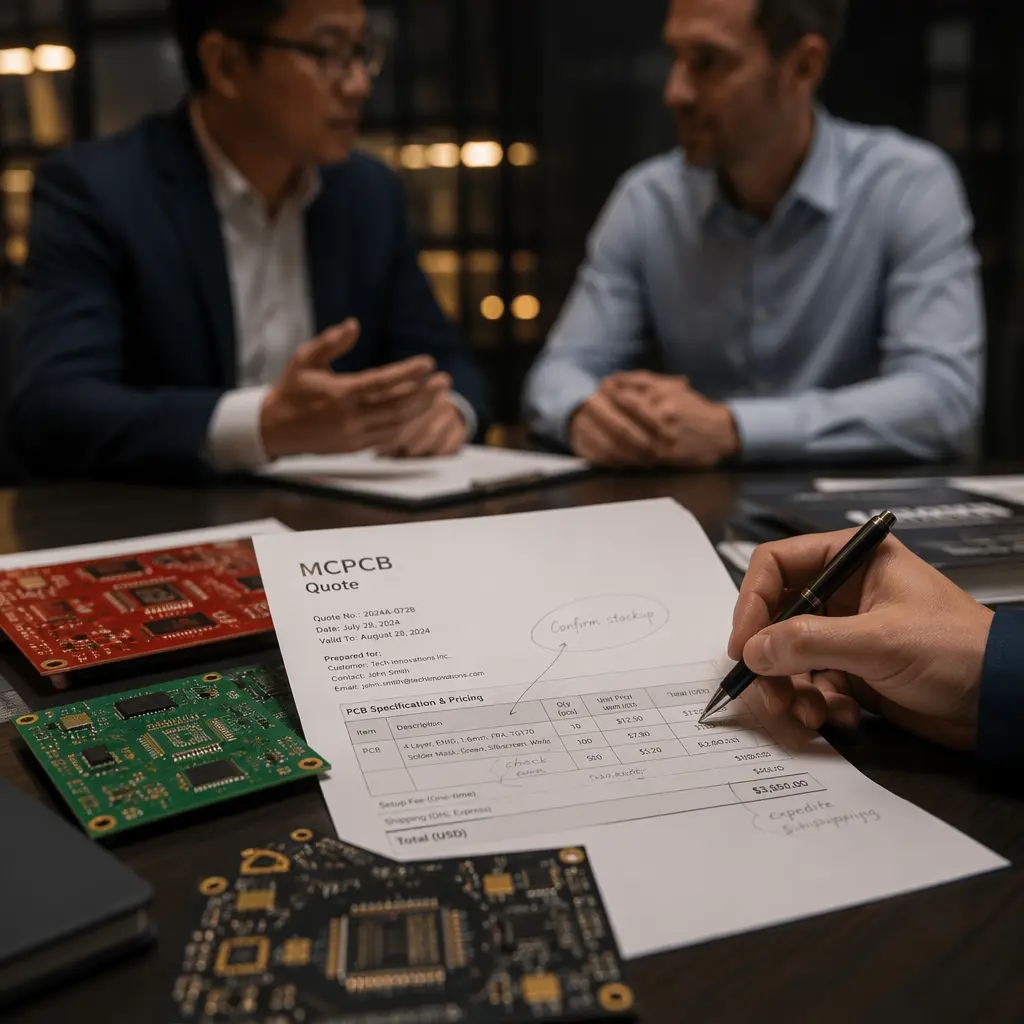
Benchmark Pricing: What Your PCB Should Cost Per Square Inch
Unit price per square inch is the quickest sanity check on any quote. These benchmarks are for standard FR-4, 1 oz copper, green solder mask, HASL finish, 2-week lead time, no impedance control:
| Layers | Qty 100 | Qty 1,000 | Qty 5,000 | Qty 20,000 |
|---|---|---|---|---|
| 2 layers | $0.08-0.12/sq in | $0.04-0.06 | $0.02-0.04 | $0.015-0.025 |
| 4 layers | $0.18-0.25 | $0.09-0.13 | $0.06-0.08 | $0.04-0.06 |
| 6 layers | $0.28-0.38 | $0.14-0.20 | $0.09-0.13 | $0.07-0.10 |
| 8 layers | $0.42-0.55 | $0.22-0.30 | $0.14-0.20 | $0.11-0.15 |
| 10 layers | $0.60-0.80 | $0.32-0.45 | $0.20-0.30 | $0.16-0.22 |
| 12 layers | $0.80-1.10 | $0.45-0.60 | $0.28-0.40 | $0.22-0.30 |
| 16 layers | $1.20-1.60 | $0.65-0.90 | $0.42-0.60 | $0.32-0.45 |
How to use this table: Calculate your board area (length × width in inches), multiply by the price per square inch for your layer count and quantity, then add surface finish premium and any technology adders. If a quote is more than 20% above the high end of the range, either the board has unusual complexity or the supplier is testing your price sensitivity. Our cost factors guide breaks down what drives deviations from these benchmarks.
Panel Utilization Matters: Board area pricing assumes 85%+ panel utilization. If your board is an odd shape that wastes laminate (e.g., a 45×45 mm board that only fits 4-up on a standard 18×24" panel), actual pricing can be 30-50% above the benchmarks. Good DFM includes panel optimization. Read our panelization guide for cost-saving layout strategies.
5 Red Flags That Signal an Inflated Quote
"Surface Finish: Included" Without Specifying Type or Thickness
ENIG at 0.05 μm gold thickness costs half what ENIG at 0.125 μm costs. If the quote says "ENIG included" without specifying the IPC-4552 class (Class 1 = 0.05 μm min; Class 2 = 0.08 μm; Class 3 = 0.125 μm), the supplier is likely quoting the cheapest grade while your design may require Class 2 or 3 for wire bonding or press-fit reliability. Surface finish selection should be explicitly specified in your RFQ, not left to supplier interpretation.
"Testing: Electrical Test" Without Net Coverage Percentage
"Electrical test included" without specifying coverage is the most common hidden cost in PCB quotes. Flying probe testing at 100% net coverage costs $0.08-0.18/unit. A "sample test" covering 10% of nets costs $0.02-0.04/unit. If the quote doesn't specify, you're almost certainly getting sample-only testing. For PCB testing methods comparison, flying probe 100% is the minimum acceptable standard for production boards.
Film / Artwork Charges in Addition to Tooling
Photoplotter film generation is part of tooling. It should never appear as a separate line item. If a quote has both "Tooling: $550" and "Film Charge: $120," you're paying for the same work twice. Ask the supplier to bundle it into tooling or remove it. This is a well-known industry practice in less transparent markets and an immediate trust signal, or warning, depending on how the supplier responds when challenged.
Impedance Control Premium on Non-Impedance Designs
If your design has no impedance requirements (no specified trace widths for 50 Ω or 100 Ω differential pairs), there should be zero impedance control line item. Some suppliers add it by default because most buyers don't question it. Check your design files: if there's no impedance coupon on the panel drawing and no controlled-impedance notes in the fab drawing, reject the adder. Our impedance control guide explains when it's actually needed.
Lead Time Surcharge Exceeding 15% of Unit Price
Expedited lead times (7 days instead of 14, or 3 days instead of 7) legitimately cost more. The factory must prioritize your job, potentially disrupting scheduled production. But an expedite surcharge above 15-20% of unit price is excessive. At 15%, a $3.80 board becomes $4.37. At 30%, it becomes $4.94, and at that premium, you're better off adjusting your production schedule. Our lead time reduction guide covers how to get faster turns without paying surcharge premiums.
How to Request Quotes That Suppliers Can't Inflate
The best defense against inflated quotes is an RFQ that leaves no room for interpretation:
Specify the IPC Performance Class in the RFQ
IPC Class 2 and Class 3 have different annular ring, plating thickness, and inspection requirements. Class 3 PCBs cost 20-30% more than Class 2 because of tighter tolerances and mandatory microsection inspection. If you don't specify the class, suppliers default to Class 2, which may be inadequate for aerospace, medical, or automotive applications. Our IPC Class 2 vs Class 3 guide helps you determine which class your product requires.
Request Itemized Quotes, Never Accept a Single "Unit Price"
A quote that says "4-layer PCB, Qty 5,000: $4.25/unit" with no breakdown is impossible to evaluate. Require all suppliers to provide the 16-line breakdown shown above. The suppliers who push back on itemization are almost certainly the ones with something to hide. Our quote comparison guide includes a supplier comparison spreadsheet template.
Include Volume Bands in the Initial RFQ
Instead of requesting a quote at a single quantity, request pricing at 3 volumes: 1,000 / 5,000 / 20,000. This reveals the supplier's cost structure. A supplier with high fixed costs will have a steeper volume discount curve; one with low fixed costs will have flatter pricing. You're not just comparing prices; you're comparing business models. Understanding cost structure gives you negotiation leverage.
Summary: Read the Quote, Don't Just Scan the Total
The difference between a well-negotiated PCB quote and an unexamined one is typically 12-25% of total cost. Not because suppliers are dishonest, but because buyers don't know which line items to question. The three highest-impact actions you can take: always request itemized quotes, verify electrical test coverage is 100%, and confirm surface finish specifications (type + thickness) are explicitly stated. The suppliers who respond to these requests with detailed, transparent breakdowns are the ones you want as long-term partners. The ones who push back or offer vague "all-inclusive" pricing are signaling how they'll handle quality discussions down the road.
At Huaxing PCBA, every quote includes a full 16-line breakdown with specifications. Not because customers always ask, but because transparency builds trust that drives repeat business. Our average customer relationship spans 4.7 years, and quote transparency is one of the top three reasons customers cite for staying. Read our supplier audit guide to evaluate your current partners, or submit your Gerber files for a transparent, itemized quote within 24 hours.