Ask two coating suppliers to quote the same 40-part-number programme at 30 boards a year each and the numbers can differ by a factor of three without either being dishonest. The difference is almost never the coating material, which is a small and predictable line item. It is masking: how long it takes to set up for a part number, how much labour each board consumes at the mask step, and whether the tooling built for that part number is amortised across 30 boards or 3,000.
At high mix and low volume, masking is a changeover problem before it is a chemistry problem. This page sets out how masking methods behave as annual quantity changes, how to amortise a masking tool across a part number properly, and what the masking data package has to contain so that the second run of a part costs the same as the first. The methods themselves, boots, tape, dispense-only and peelable resist, are compared in our conformal coating masking techniques guide; this page assumes you have chosen a method and asks what it costs at your volume.
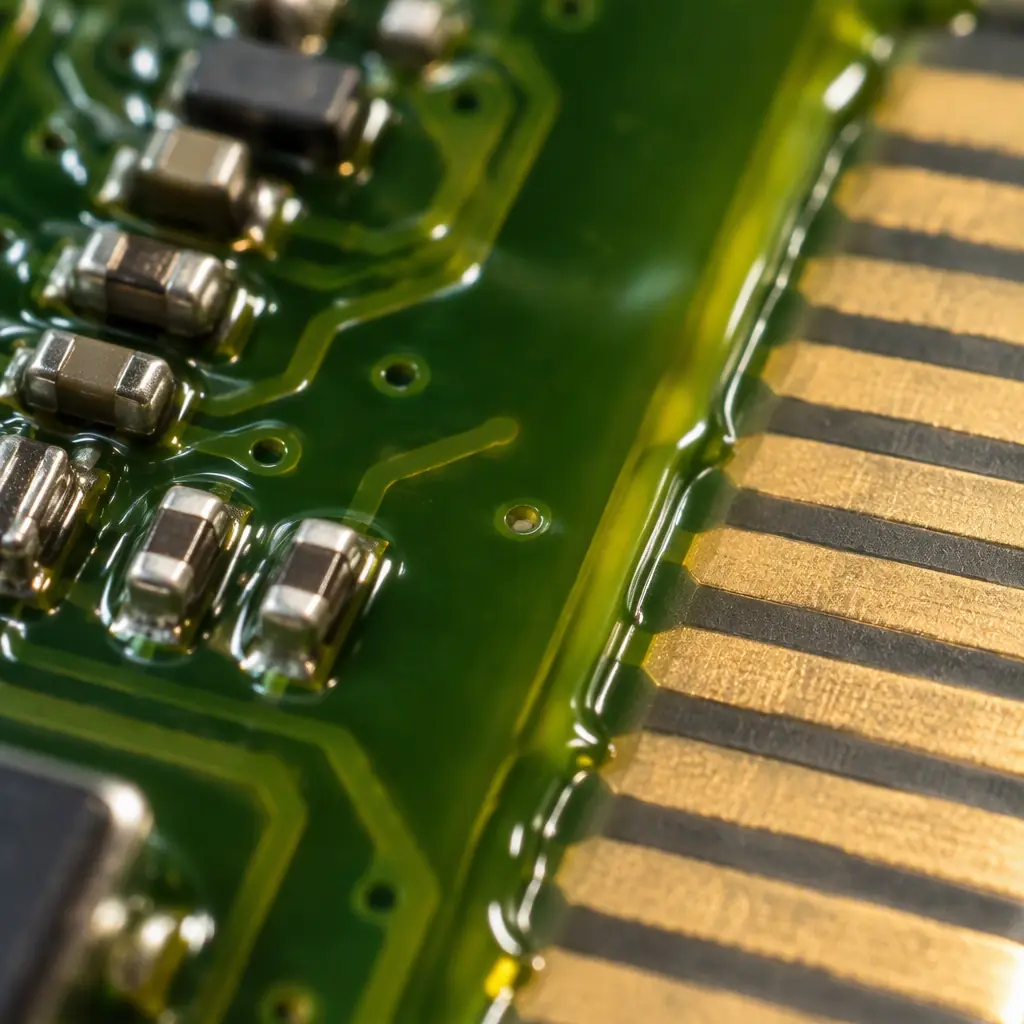
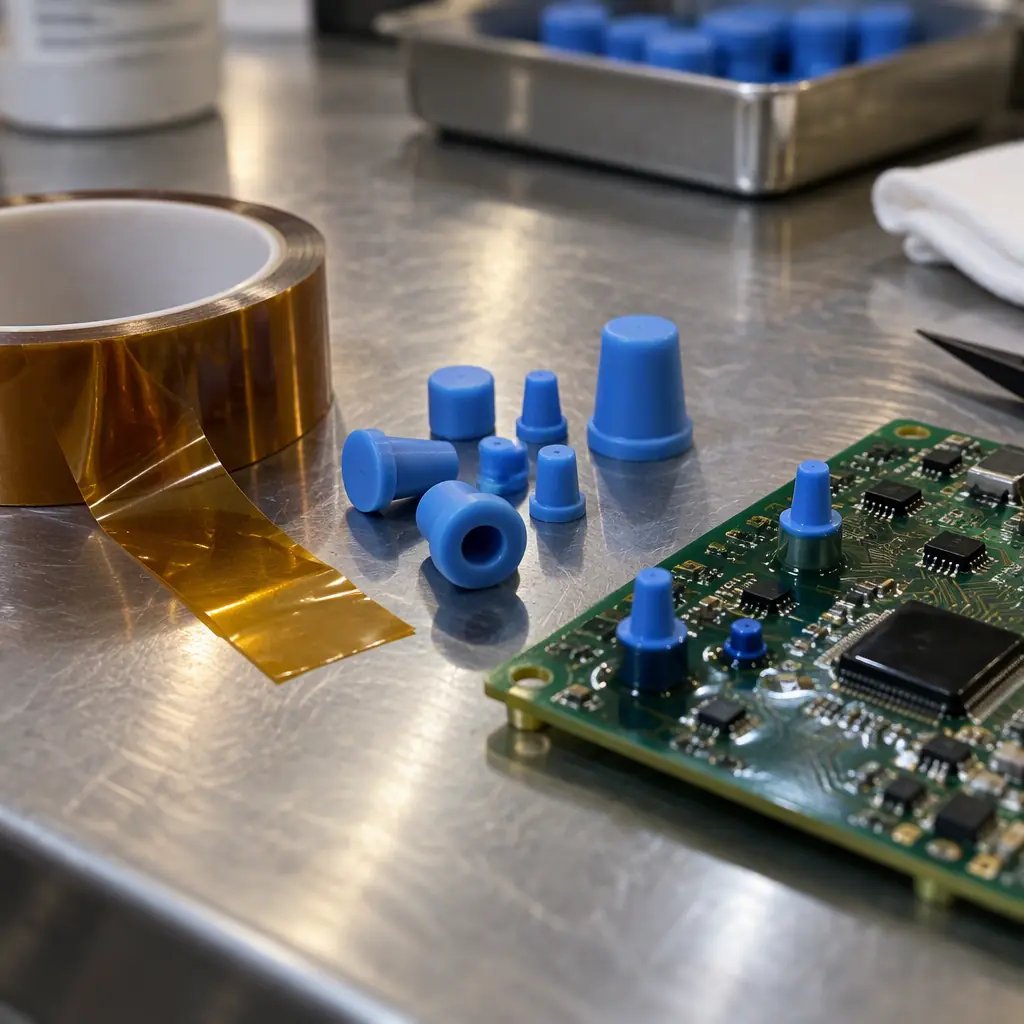
A clean coating boundary is decided by the mask, not by the spray. The mask is where the labour is.
Why Masking Dominates the Coating Cost at High Mix
Coating material cost is a function of board area and film thickness, and it does not change with order quantity. Masking labour is a function of changeover count, and changeover count per board rises steeply as lot size falls. At 1,000 boards per run, a 60-minute setup is three and a half seconds per board and irrelevant. At 30 boards per run, the same 60 minutes is two minutes per board, which is often more than the entire spray and cure cycle.
The arithmetic that matters is total labour per board, which is setup divided by lot size plus per-board handling. Everything else, material, cure energy, inspection, is comparatively stable. This is why a supplier who quotes coating by board area alone will be wrong on high-mix work and why the quote should be asked for as a setup charge plus a per-board rate.
| Masking method | Setup per part number | Labour per board (100 x 80 mm, 12 keep-outs) | Consumable per board | Rework risk | Breaks even below |
|---|---|---|---|---|---|
| Polyimide tape, hand cut | 15 to 25 min (first-off template) | 4.5 to 7.0 min | USD 0.18 | High at fine pitch; tape creep under cure | Any volume, but only for fewer than 3 runs per year |
| Die-cut tape kits | 5 to 10 min | 1.5 to 2.5 min | USD 0.85 | Moderate; adhesive residue on gold | About 200 boards per year |
| Silicone boots | 2 to 5 min | 0.4 to 0.9 min | USD 0.04 amortised tool | Low, unless a boot is worn or the wrong revision | About 60 boards per year per part |
| Dispense-only (robot keep-out) | 20 to 45 min program | 0.2 to 0.5 min | USD 0.00 | Low on flat boards; poor at vertical faces | About 150 boards per year, flat geometry only |
| Peelable resist | 10 min | 2.0 to 3.5 min | USD 0.60 | Residue and peel damage on fine pitch | About 120 boards per year |
These are the figures we work to on selective coating lines in Shenzhen, for a board of roughly 100 by 80 mm with a dozen keep-out areas and one connector that cannot be taped at fine pitch. Change the board and the numbers move; the ordering of the methods does not.
Amortising a Masking Tool Across a Part Number
A silicone boot is a moulded tool built to a specific keep-out drawing. It costs money to design and to mould, typically USD 180 to USD 450 for a simple single-cavity boot at 12 to 20 keep-outs, and it is charged once per part number. Whether it is worth building depends entirely on how many boards that part number will run.
The comparison is straightforward. Tape costs a fixed labour per board that never goes away. A boot replaces most of that labour with a once-per-part-number tool charge, but the boot has to be paid off. The annual saving from a boot is the tape labour difference times annual quantity, and the boot is worth building when that saving covers the moulding cost and the storage and revision control that comes with it.
Worked four ways
Assume tape at 5.5 minutes per board, a boot at 0.6 minutes per board, a labour rate of USD 0.22 per minute, and a boot cost of USD 320 per part number.
10 boards a year: tape costs USD 12.10, boot costs USD 1.32 plus USD 320 of tool. Annual saving USD 10.78 against USD 320 of tool. Never build the boot.
50 boards a year: tape USD 60.50, boot USD 6.60 plus USD 320. Saving USD 53.90 against USD 320. Still no.
200 boards a year: tape USD 242, boot USD 26.40 plus USD 320. Saving USD 215.60 against USD 320 in year one, and USD 215.60 per year after. Payback is 18 months, which is a yes if the part number has a two-year horizon.
1,000 boards a year: tape USD 1,210, boot USD 132 plus USD 320. First year saving USD 758, then USD 1,078 per year. Clearly build it.
The break-even sits at roughly 60 boards per year per part number at these rates, which matches the table above. The useful consequence is a rule for a high-mix programme: do not build boots for long-tail part numbers, and do not keep taping the top twenty per cent of the catalogue. Sort the part numbers by annual volume and apply the tool only above the break-even.
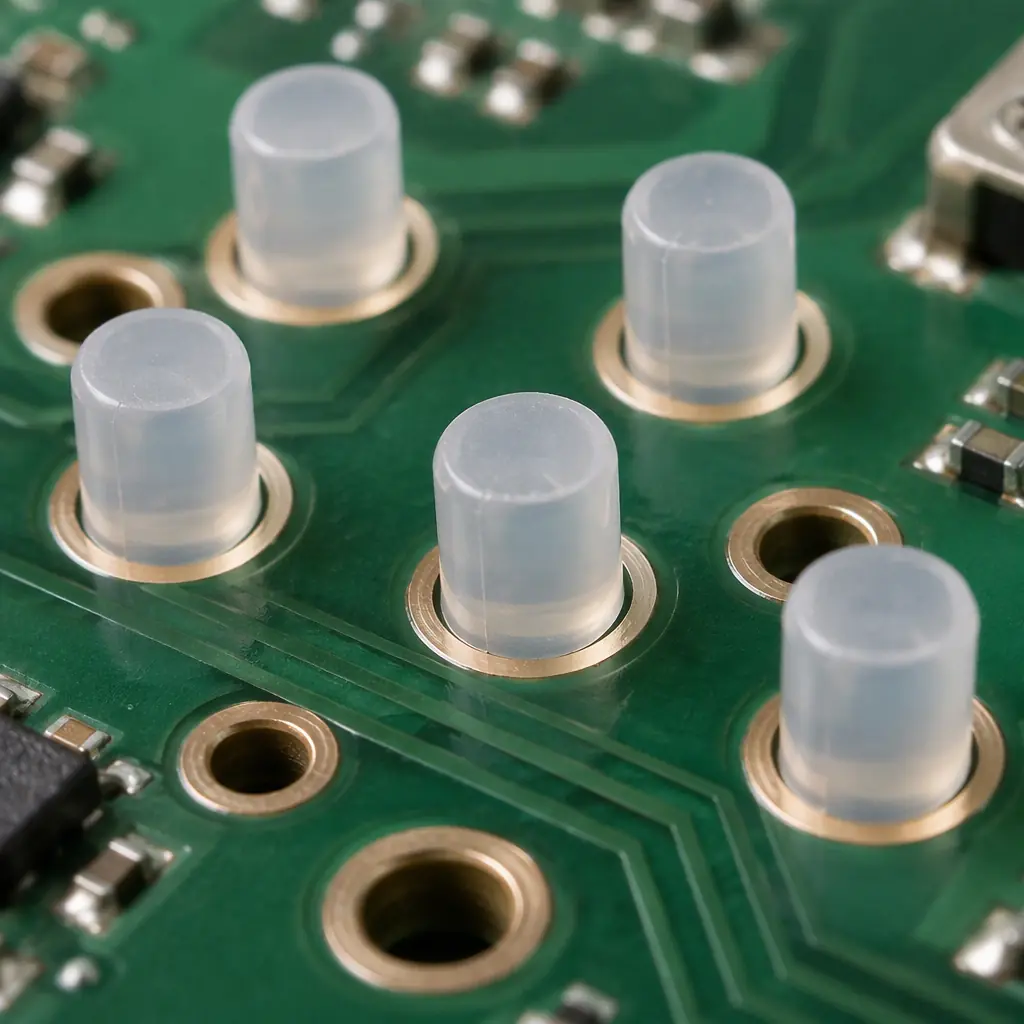
A boot or a plug is only cheaper when its tool cost is divided across enough boards to matter.
Where Boots Quietly Lose Money
Boots win on labour and lose on control, and the losses do not appear on the quote. Three that we see repeatedly:
Revision drift. The board is redesigned, a connector moves 1.5 mm, and the boot still fits well enough to pass a visual check. Coating then lands on a contact that should have been masked. The defect appears at end-of-line electrical test or, worse, in the field after a few weeks of moisture exposure. Boots must be tagged to the board revision, not to the part number alone, and any ECO that moves a keep-out must trigger a boot review. This is the same discipline our engineering change guide applies to tooling generally.
Storage and cleaning. Silicone boots attract dust and coating overspray. A boot used with the wrong chemistry swells and stops sealing. Storage in an open bin at the line is how a EUR 300 tool becomes a defect source. Boots need a closed container, a part number label and a defined cleaning interval.
Reject rate at the mask step. A boot that is hard to seat gets seated incorrectly once in a hundred boards. If the mask step is not inspected, that one board carries a defect through the entire remaining process. The inspection does not need to be elaborate, a two-second peripheral check after seating, but it has to exist.
The Masking Data Package
The reason the second run of a part number costs less than the first is that the first run produces a data package. If that package is incomplete, the second run repeats the first-off, and the saving never materialises. What has to travel with the part:
Keep-out drawing with revision
A DXF or equivalent that defines every masked area by geometry, not by description, tied to the board revision letter. Descriptions such as "mask the connector" are how two suppliers produce two different results.
Boot or plug identification
Tool number, revision, cavity count and the board revision each boot is valid for. Recorded against the board part number in the tooling register, not kept in a spreadsheet on someone's desk.
Cure window and chemistry
Which coating, what film thickness, and the cure schedule the mask was validated against. A change of chemistry invalidates tape adhesive and boot material choices, so the record has to name the chemistry explicitly.
Residue and cleanliness class
The ionic cleanliness limit the process has to hold, and the evidence that tape adhesive does not breach it. Our ionic contamination limits guide covers the measurement side.
First-off photograph
One image per part number of a correctly masked and coated board, retained with the job. Two minutes of the next operator's time saved, every run.
Verifying Coverage Without Adding an Inspection Step
High-mix programmes cannot absorb a full inspection step for every low-volume part number. The workable compromise is to verify the process rather than the boards: coat one board from each run with a UV tracer in the coating, inspect it under UV, photograph it, and pass the rest of the run on the basis of that first-off plus the process record. That gives a documented coverage check per run at the cost of one board and a few minutes.
Where the tracer is not permitted by the customer specification, the alternative is a first-off cross-section at the tightest keep-out boundary, once per run, retained. Our coating coverage verification guide covers both routes and the acceptance criteria for each. What should not happen is verifying coverage by eye under white light, which finds gross misses and nothing else.
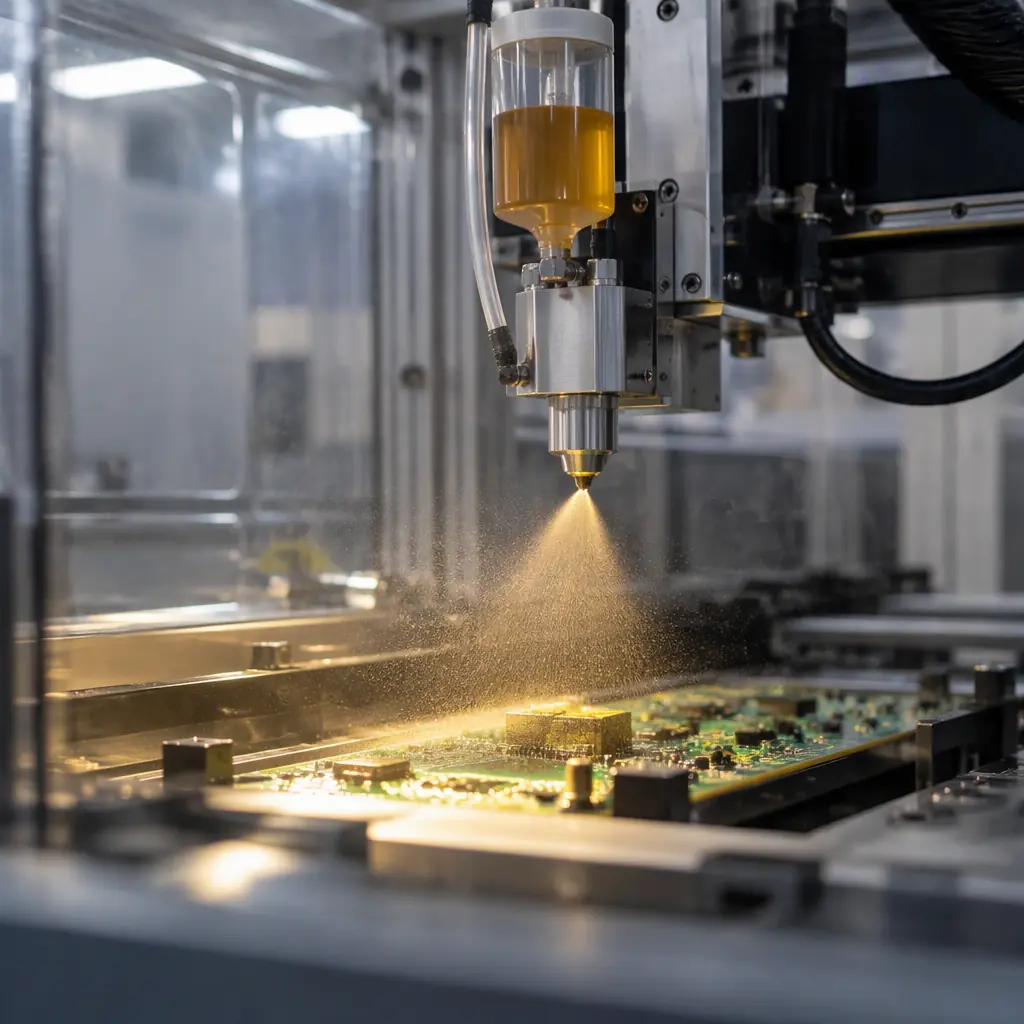
Dispense-only avoids masking entirely on flat geometry, which is why it wins on the flat parts and loses on the ones with vertical faces.
Five Questions That Separate a Real Number from a Placeholder
When a quote for high-mix coating arrives, these five questions reveal whether the masking cost is real:
Is setup quoted separately from the per-board rate? If it is folded in, the supplier has assumed a lot size and your 30-board runs are being averaged against someone else's 3,000-board runs.
What mask method is assumed, and at what labour rate? The difference between tape and boots on the same board is a factor of six on the mask step. A quote that does not say which method is assumed cannot be compared with another.
Is boot tooling charged once or per run? Once per part number is normal and fair. Per run is a hidden premium that only becomes visible over a year.
What is the minimum lot size before a surcharge applies? Most coating houses have one. Knowing it lets you batch part numbers to the right size instead of discovering the surcharge on the invoice.
How is a keep-out change handled? Whether a boot revision is recharged when a connector moves is the difference between a controlled programme and one where the supplier absorbs it quietly and compensates elsewhere.
Our practice on selective coating is to quote setup, per-board labour and tooling as three separate lines so the comparison with another supplier is arithmetic rather than judgement, and to hold the masking data package in the tooling register against the board revision so that a repeat run does not re-quote from scratch. Where a part number is near the boot break-even, we will say so and quote both ways.
If you have a high-mix coating programme and want the masking cost split by method at your actual volumes, send the part list with annual quantities and the keep-out geometry. We will return the per-part number recommendation with the tooling charge shown separately.