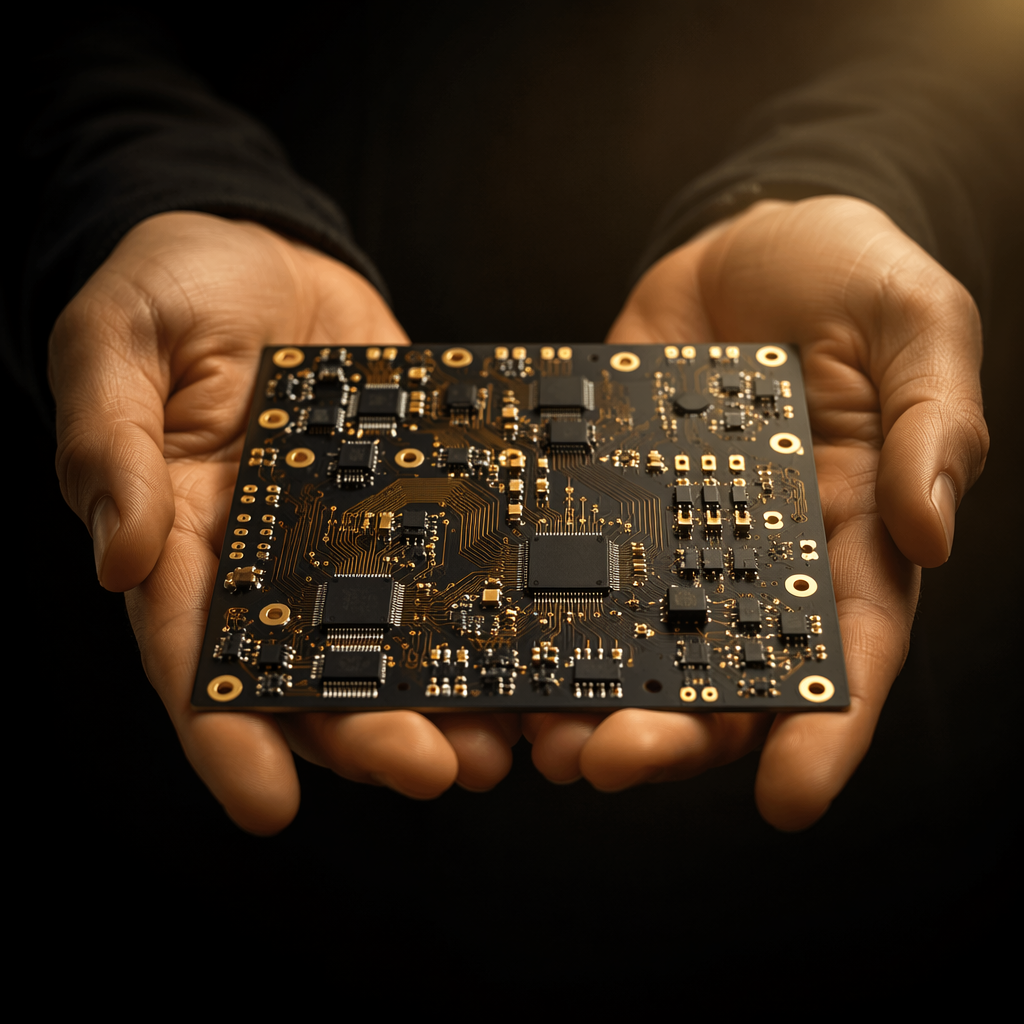
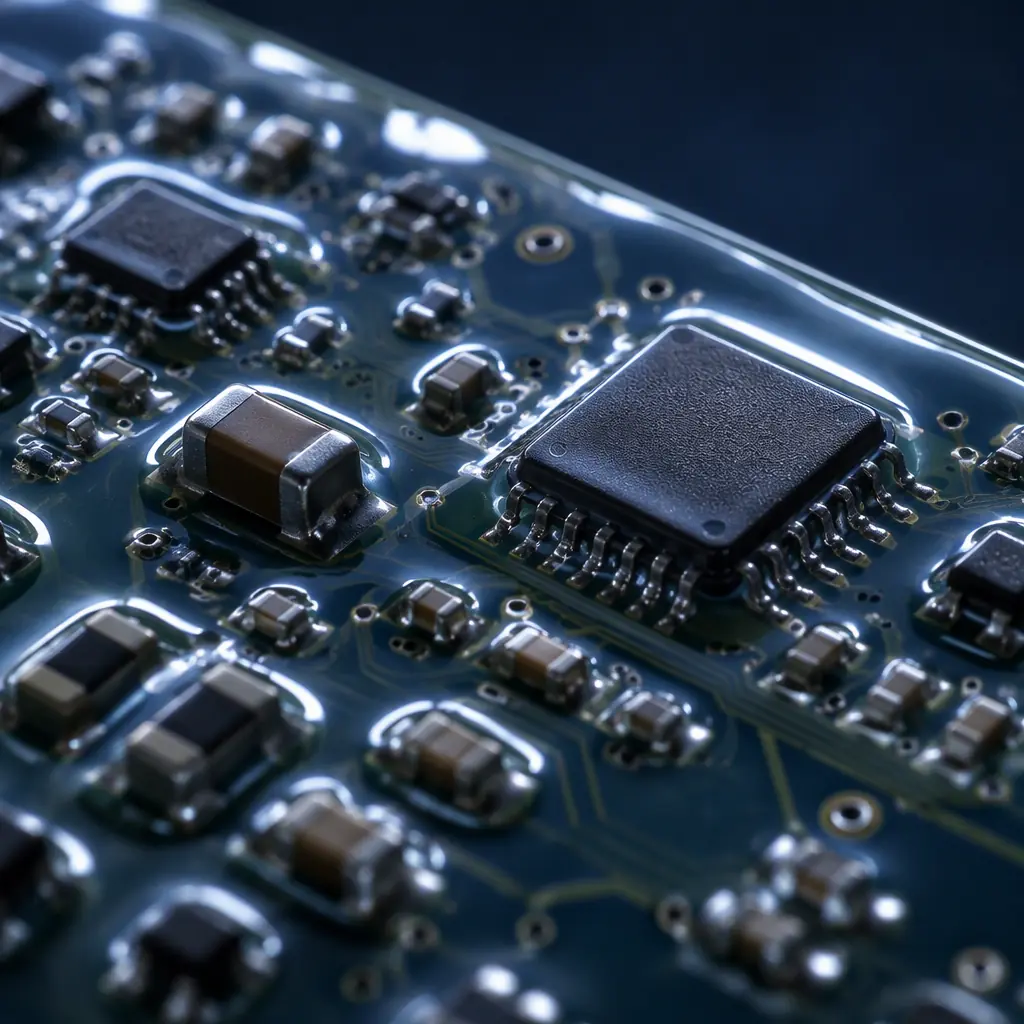
Parylene is specified for applications where a conventional conformal coating is not good enough: implanted and wearable medical electronics, aerospace and defence assemblies, sensors exposed to aggressive chemistry, and any board where a pinhole-free barrier matters more than cost or processing time. The reason is the deposition mechanism. Unlike a sprayed or dipped coating that follows line of sight and surface tension, parylene is applied in a vacuum by vapour deposition, the monomer polymerising directly on every surface it reaches, including the undersides of components, the insides of connectors and the walls of recesses.
Two consequences follow immediately, and both catch buyers who specify parylene as though it were a thicker conformal coat. The first is that thickness is not a single number: the deposit varies with geometry and with the depth of the crevices involved, so a requirement stated as one figure is ambiguous unless it says where it is measured. The second is that anything that must remain free of coating has to be masked, and masking parylene is harder than masking a spray coating because the vapour reaches places a spray cannot. Getting these two things right at the specification stage is most of what determines whether a coated lot passes and whether it is repairable afterwards.
Why Parylene Thickness Is Not One Number
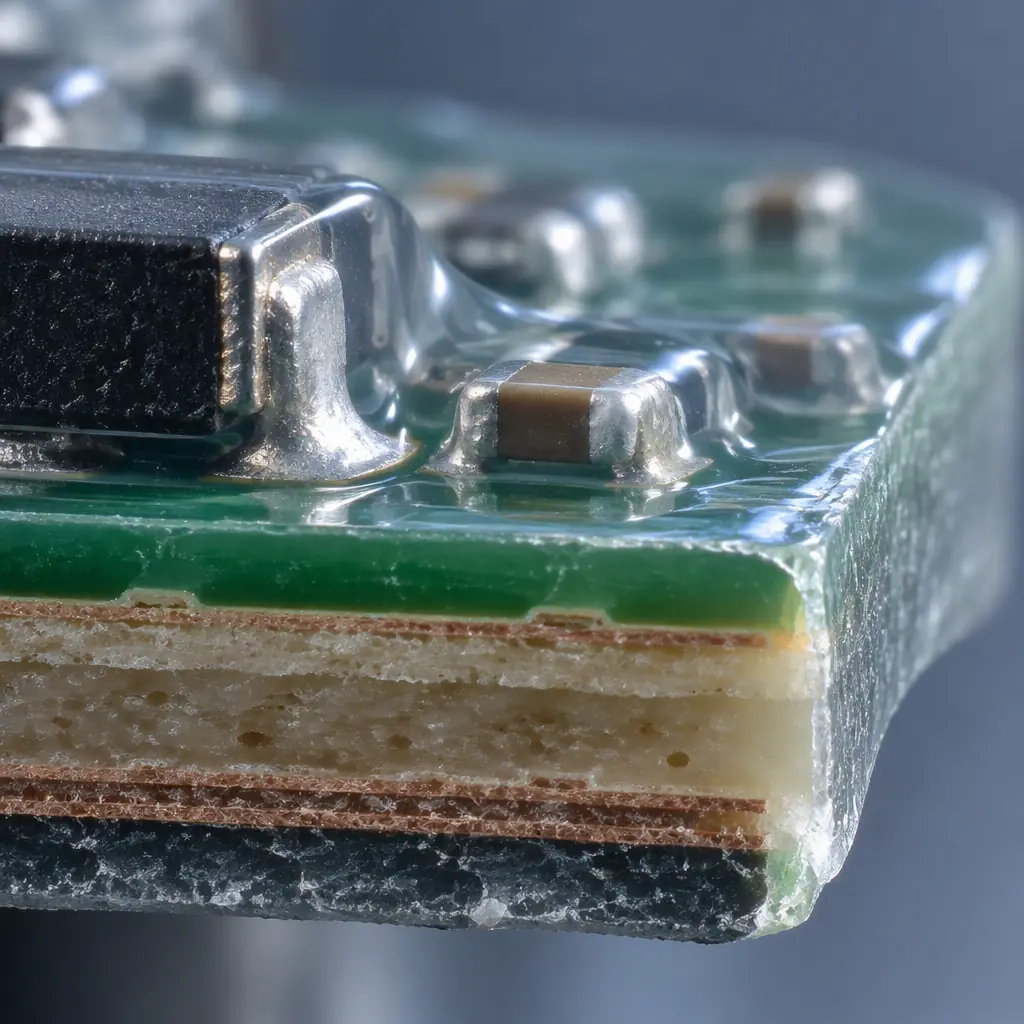
The deposition process is a surface-limited polymerisation and it proceeds from every direction a vapour molecule can reach. The practical result is that coating on a flat, externally exposed surface — the top of a die, the outer face of a component, a pad on the board surface — builds at a predictable rate governed by the amount of monomer introduced and the chamber conditions. Coating inside a narrow gap, under a component, or down a connector cavity builds more slowly, because the vapour has to diffuse in and the polymer forming near the mouth restricts the path.
That geometry dependence is why a supplier can honestly claim to have applied a coating and still deliver a surface that measures well below nominal in a critical location. It is also why a specification that names a single thickness figure without a measurement location is not enforceable. The specification has to say what thickness is required, where, and how it will be confirmed.
| Location | Typical Deposit Relative to Nominal | Specification Guidance |
|---|---|---|
| Externally exposed flat surfaces | At or near nominal | State the nominal figure here; this is the reference measurement plane |
| Component sidewalls and vertical faces | Near nominal, slightly reduced on shadowed facets | Cover under the same nominal figure where the surface is open to the chamber |
| Under low-clearance components (small gaps) | Reduced, and highly variable with gap size | Specify a minimum or specify that full coating is not required; do not assume nominal |
| Inside connector cavities, sockets and recesses | Reduced substantially at depth | Mask wherever the cavity must stay clear; specifying coating inside a deep cavity is generally a mistake |
| Sample witness coupons coated alongside the boards | At nominal by design | Use as the verification vehicle; state the coupon as the acceptance measurement location |
Key Takeaway: Specify parylene thickness against a witness coupon that is coated in the same chamber run as the boards, and separately state any minimum thickness you require in a specific location. A courier-placed coupon measures what the chamber delivered; a measurement taken on an arbitrary board surface measures the geometry of that surface. Both are legitimate, but they answer different questions and the specification has to name which one governs acceptance.
Choosing the Thickness for the Application
In production, parylene thickness is not selected freely — it accumulates in discrete deposition runs, and the common commercial grades correspond to a nominal range rather than a continuous variable. The choice is driven by the barrier and mechanical requirement, and thicker is not automatically better.
Thicker coating improves barrier performance and dielectric strength, which matters for aggressive chemistry, high humidity with bias, and any application where ionic ingress must be blocked. It also increases mechanical stress on the assembly, reduces flexibility, can bridge fine features such as tightly spaced leads and small gaps, and makes subsequent rework harder. For an assembly with fine pitch or moving parts, a thinner, uniform coating frequently outperforms a thicker one that has bridged two adjacent features.
The practical specification sequence is: establish the minimum thickness that achieves the required barrier performance for the environment, verify that the chosen thickness does not bridge critical features or exceed the allowance that keeps the assembly within its mechanical envelope, and specify that figure against a named measurement location. For the full comparison of parylene against the other coating chemistries and the environments each suits, see conformal versus parylene versus potting and our parylene coating guide.
The Mask Scheme Is Half the Job
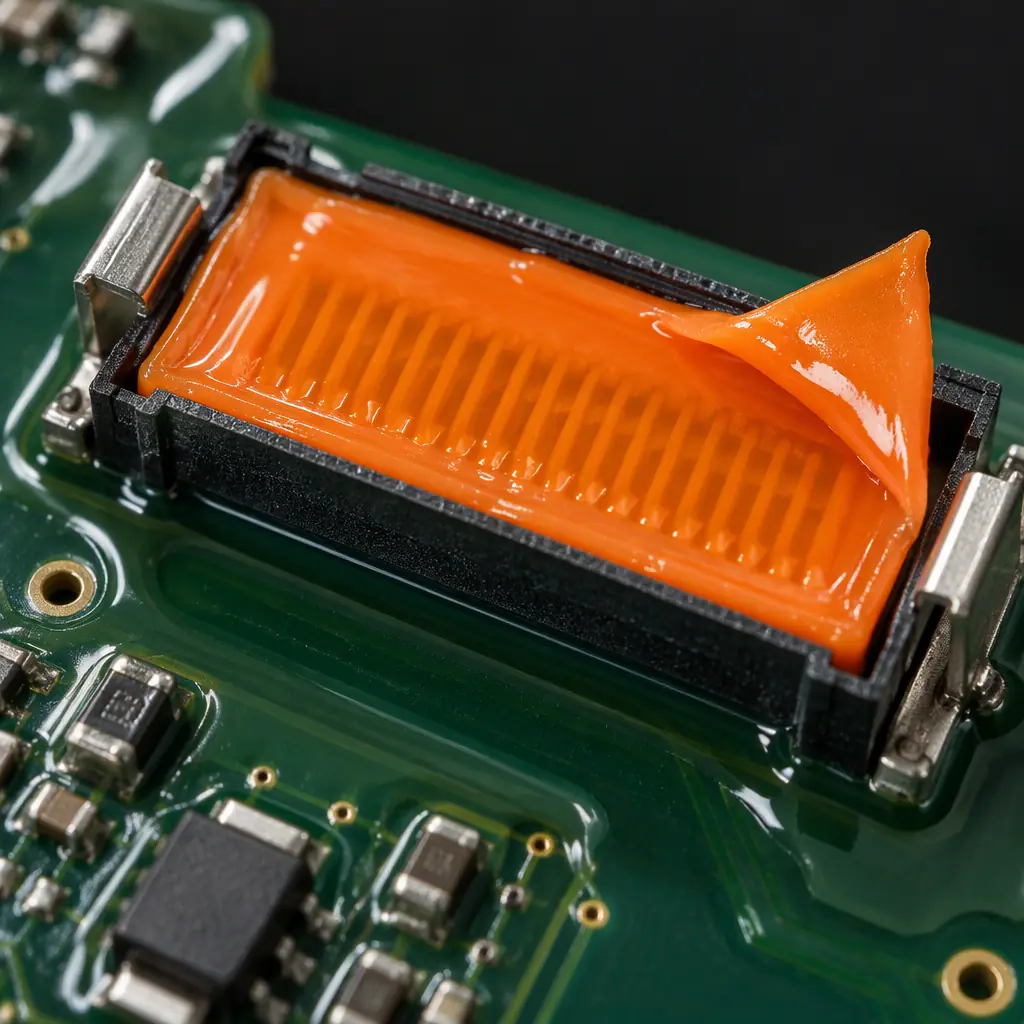
Because parylene vapour reaches everything, masking is the mechanism that defines the boundary between coated and uncoated. Get it wrong in one direction and you coat a connector that must make electrical contact; get it wrong in the other and you leave a surface bare that needed protection.
Masking approaches divide into three families, and the choice is driven by feature size, quantity and how well the mask survives the vacuum and the deposition temperature.
Peelable and latex maskants
Applied as a liquid or gel to connectors, test points, mounting holes and keep-clear zones, then stripped after coating. Well suited to irregular shapes and to areas where the mask must simply block vapour access. The limitations are practical: some maskants outgas in vacuum, which contaminates the chamber and the coating, and the stripping operation itself can damage coated surfaces nearby. Specify that the maskant is qualified for vacuum deposition and confirm the removal method before the first lot.
Mechanical masks, caps and plugs
Physical covers placed over connectors and interfaces. Highly reliable where the geometry is standard — the supplier may hold caps for common connector families — and they avoid the outgassing and stripping risks of chemical maskants. They are less flexible for unusual geometries, and a poorly seated cap is a failure that shows up as a coated connector after the run rather than before it.
Masking by design — eliminating the need
The most reliable mask is the one that is not needed. Where the layout allows, moving a connector to a board edge, providing a defined keep-clear zone, or specifying a removable connector that is fitted after coating all remove a masking operation and the risk that goes with it. This is a design-stage decision with no unit cost, and it is worth raising at DFM review on any board expected to be coated in volume.
How to Verify the Coating
Verification is where parylene specifications most often fall short, because the measurement methods have different applicability and a buyer who names the wrong one leaves themselves without a usable acceptance test.
| Method | What It Measures | Limitation |
|---|---|---|
| Witness coupon, measured directly | Coating thickness delivered by the chamber run | Measures the chamber, not the boards; assumes boards and coupon were processed identically |
| Non-destructive optical or ellipsometric measurement | Thickness on accessible flat surfaces | Needs a suitable surface and known optical properties; not usable in recesses or under components |
| Spectroscopic or infrared methods | Film presence and approximate thickness | Calibration-dependent; better as a presence-and-uniformity check than a precise thickness gauge |
| Cross-section of a coated sample | Actual thickness at a specific geometry | Destructive; requires microsection preparation and applies to the sampled board only |
| Functional test after coating | Whether the coated assembly still works | Necessary but not sufficient; a correct electrical result does not confirm the required barrier |
| Adhesion and coverage inspection per the coating standard | Film integrity, coverage of the intended area | Visual and largely qualitative; does not give a thickness figure |
The workable combination for most programmes is a witness coupon measured for thickness, plus a coverage and adhesion check against the acceptance criteria in the relevant coating standard, plus functional test on the coated assembly. Naming all three in the specification, with the coupon as the thickness acceptance vehicle and the inspection standard referenced by its designation, gives a supplier something they can actually execute and you something you can audit. The acceptance limits themselves — thickness minima, coverage requirements, adhesion criteria and the defect definitions — are set out in IPC-A-610 conformal coating acceptance criteria, and the general measurement approach in conformal coating thickness control.
Rework and the Cost of Getting It Wrong
Parylene is difficult to remove. It does not dissolve in the solvents that strip a sprayed acrylic or urethane coating, which means removing it for a repair means mechanical abrasion, plasma treatment or a targeted thermal or laser method, all of which carry a risk of damaging what is under the film. This has three consequences worth planning for.
First, test coverage before coating should be thought of as the last easy opportunity to find a fault. Once the film is on, a repair that would have been routine becomes a controlled operation with a real risk of collateral damage. Boards destined for parylene should be tested to a coverage that reflects that. Second, masking should be generous rather than minimal around any feature that might need to be accessed — a test point or an adjustment that is masked and accessible is worth far more than the small saving from a tighter mask. Third, the rework procedure and its limitations should be agreed before the first lot rather than discovered during a failure investigation. Our guide to conformal coating removal and rework covers the removal methods and their constraints.
Masking selection also interacts with the coating thickness, which is a point that surprises buyers. A maskant has to resist the same vacuum and temperature conditions as the coating, and a thicker deposit forms a stronger mechanical film over the mask boundary, so stripping it cleanly from a tightly specified edge becomes harder as deposition increases. Where the layout requires an unusually tight mask edge, the thickness specification and the mask scheme should be developed together rather than in sequence. How mask materials are selected and applied for the wider coating family is covered in conformal coating masking techniques.
Procurement Tip: A parylene requirement worth writing covers five things, and any one of them left out is where a dispute will start. State the nominal thickness and the witness coupon as the acceptance vehicle. State any location-specific minimum and how it will be measured. State the mask scheme by feature and name the maskant family required for vacuum compatibility. State the coverage and adhesion acceptance standard by designation. And state the rework policy, including how a coated board that fails test will be handled. Five sentences at the specification stage prevent the argument that otherwise arrives three weeks into production.
The Bottom Line
Parylene is the right coating for a narrow set of demanding applications, and in those applications it is difficult to substitute. The difficulty in specifying it is not the chemistry; it is that the process coats everything, which makes thickness and masking decisions rather than defaults. A specification that names a thickness against a witness coupon, defines the mask scheme by feature, references the acceptance standard, and states a rework policy is one a supplier can execute consistently and a buyer can verify. A specification that names a thickness figure and stops there will produce a coated board that passes a visual check and may still fail in the field.
At Huaxing PCBA we coat parylene and the conventional conformal chemistries in-house, coat a witness coupon with every chamber run and report its measured thickness, accept mask schemes specified by feature with vacuum-compatible maskants, and hold coverage and adhesion inspection to the referenced coating standard. Read our parylene guide or contact our coating engineering team to review your thickness and masking requirements before your next coated build.