Every coating process carries an invisible second cost. Alongside the coating material itself there is the work of not coating — masking connectors, keep-out areas, test points, mating surfaces and anything that has to be reworked later. On a board with a dozen connectors and dense keep-outs, that masking labour can exceed the cost of the coating several times over. Selective conformal coating exists to eliminate it.
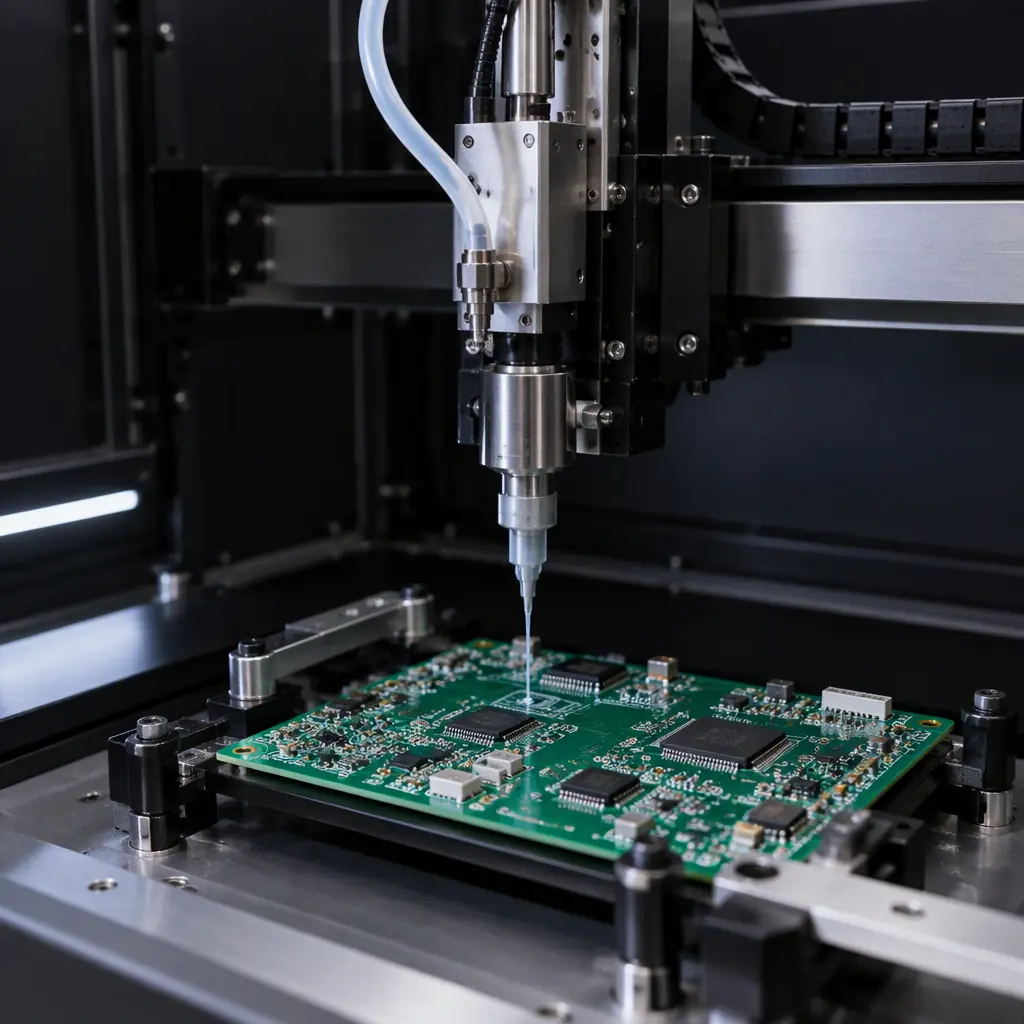
Instead of spraying or dipping the whole assembly and then protecting what must stay clean, a selective coating system applies the coating only where it belongs, using a robot that follows a programmed path. No mask, no de-mask, no residual adhesive. The catch is that the mask cost is replaced by programming and cycle-time cost, and whether that trade pays depends on the board mix, the geometry and the volume.
This guide works through how selective coating operates, what drives programming and cycle time, the break-even against spray-and-mask, and the failure modes unique to the process. It pairs with our guides to coating masking techniques, coating removal and rework and coating thickness control.
How Selective Coating Works
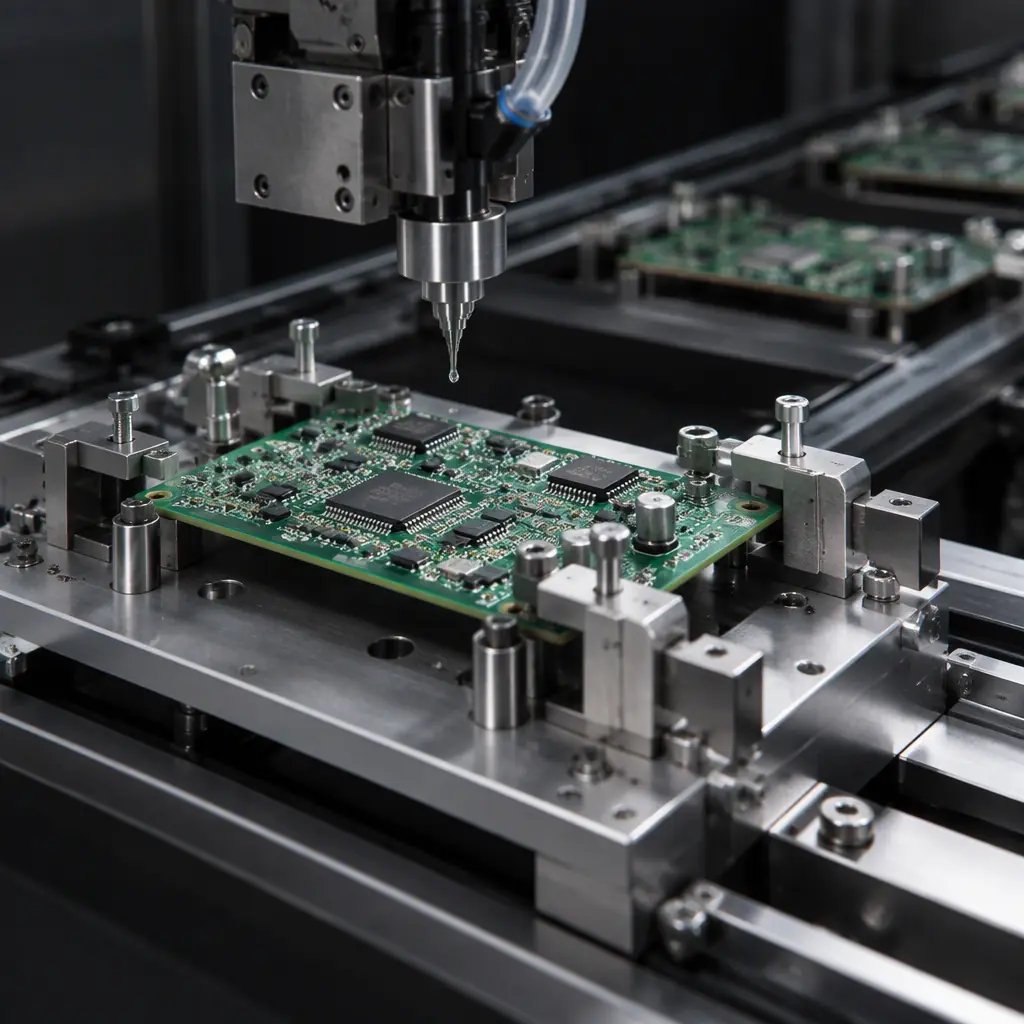
A selective coating system is a motion platform — typically three to five axes — carrying one or more dispense valves, moving over a board held in a fixture. The board is located precisely, usually by fiducial recognition, and the robot traces the programmed path for each coating region.
Three elements determine what the machine can actually do.
Axes and path capability. A three-axis system moves in X, Y and Z and can coat flat surfaces and shallow features. Adding tilt and rotation (four and five axes) lets the valve approach vertical surfaces and coat the sides of tall components — essential for connector shells and standing parts that a purely vertical approach would shadow.
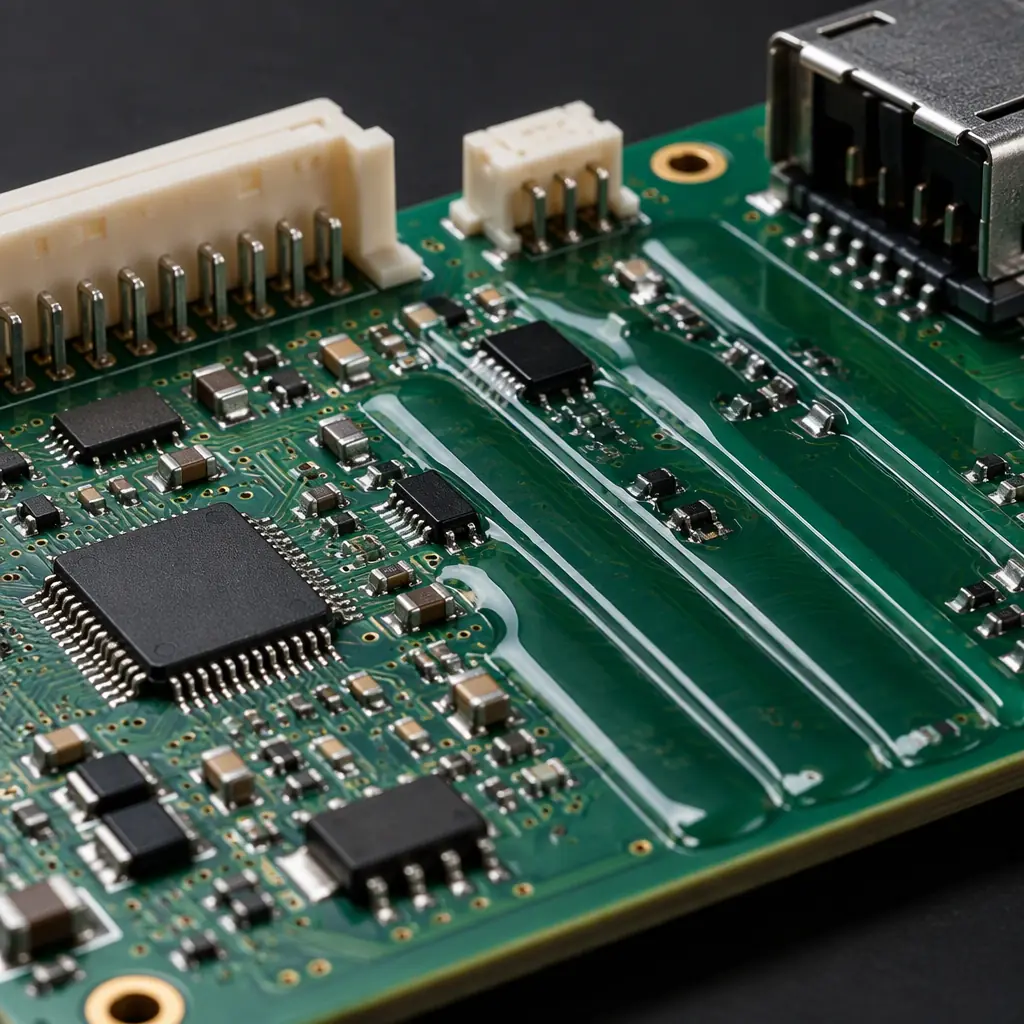
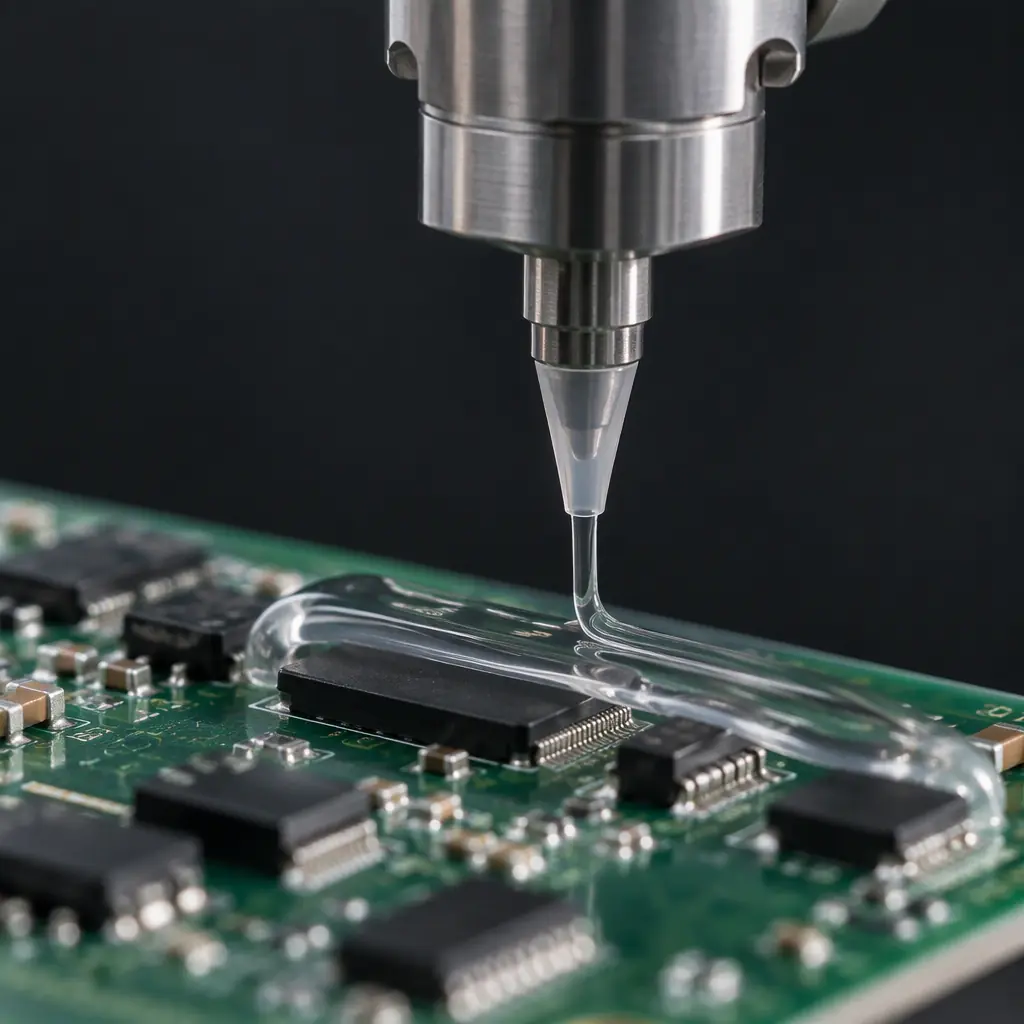
Valve type. The valve governs the coating pattern and the coating character. Spray valves produce a wide, even fan and suit large open areas. Needle or dispense valves lay a defined bead and suit precise boundaries around keep-outs. Film-coating valves produce a controlled, thin, uniform film. Boards with mixed requirements often need more than one valve, and valve changeover is itself a cycle-time cost.
Fiducial-based alignment. Program portability depends on it. A program written against fiducials survives normal board-to-board variation; a program written against board edges does not, and forces re-teaching whenever panelisation or fixture changes.
Programming: Where the Cost Actually Sits
The masking cost that selective coating removes does not vanish — it reappears as programming effort. Understanding its structure is what makes the break-even calculable.
Initial teach time. A new board has to be taught: fiducial definition, coating regions, valve parameters, path speeds and the sequence of keep-outs. For a moderately complex assembly this is measured in hours per board set, and it is a one-time cost that then amortises across the life of the program.
Program portability. Well-written programs, anchored to fiducials and parameterised for coating thickness, transfer between machines and between board revisions with modest edits. Poorly written programs — hard-coded coordinates, no fiducial anchoring — must be largely re-taught on every change. The difference between these two outcomes is entirely a matter of how the program was built, which is something a buyer can ask about.
Cycle time per board. Once taught, the per-board cost is machine time. It is driven by the area to be coated, the number of discrete regions, the valve changeovers, the path speed at which the coating can be applied without defects, and the curing allowance between passes. A board with many small coated regions costs more machine time than one with a single large region of the same total area, because of the repositioning between them.
The 40-second answer: Selective coating pays when masking labour would exceed programming plus added cycle time. It favours high-mix programs, connector-dense boards, tight keep-outs and any assembly where masking risks damage or residue. It favours spray-and-mask less as board quantity rises on a stable design, because masking cost scales with volume while program cost does not.
The Break-Even Against Spray and Mask
The comparison is not “coating cost versus coating cost.” It is the total cost of two different processes, each with its own recurring and one-time components.
| Cost element | Spray + mask + de-mask | Selective coating |
|---|---|---|
| Coating material | Higher (overspray and waste) | Lower (applied only where needed) |
| Masking labour | Scales with board volume and keep-out count | None |
| De-mask and clean-up | Scales with volume; residue risk | None |
| Programming / teach | None | One-time per board set |
| Machine cycle time | Short | Longer |
| Rework and damage risk | Higher (mask application on connectors) | Lower |
Read across the table and the break-even logic falls out. Masking labour is the dominant variable on the spray side, and it scales with volume. Programming is a one-time cost on the selective side and does not. So the two curves cross: at low volume, or high keep-out density, or high mix, selective wins; at high volume on a stable design with few keep-outs, spray-and-mask increasingly wins as the program amortises.
The practical pattern is that selective coating is most valuable precisely where high-mix manufacturing lives — many different boards, moderate volumes each, frequent changeovers. That is also the situation in which masking is most error-prone, because operators are constantly re-learning different masking schemes. The economics and the quality argument point the same way.
Count the keep-outs. Boards with many connectors, test points and mating surfaces carry the most masking labour, and gain the most from selective coating.
Check the mix. Several different board types in moderate volume favour selective; one board in very high volume favours spray-and-mask.
Price masking explicitly. Ask the supplier to quote the masking and de-masking step separately. It is often the largest single line, and it is usually buried.
Ask about program portability. A fiducial-anchored program survives revisions cheaply; a hard-coded one does not, and the cost lands on you at the next revision.
Failure Modes Unique to Selective Coating
Selective coating removes a class of defects and introduces its own. Four are worth naming, because each has a specific control.
Shadowing. A vertical spray path cannot coat surfaces hidden behind tall components or on the back side of a connector body. The result is an uncoated region where protection was intended, and it is invisible from above. Control: multi-axis approach angles for tall features, and visual verification of shadowed areas during process qualification rather than at first production.
Overspray and boundary drift. The spray fan is not perfectly sharp-edged, and small variations in valve-to-board distance widen or narrow the coated region. Where the boundary runs close to a keep-out, drift can deposit coating where it must not go. Control: conservative margins between coated regions and keep-outs, and bead rather than spray application along critical edges.
Nozzle clog and partial blockage. Coating formulations cure, and a valve left unclean between runs can clog partially, producing a thinner or discontinuous film that passes visual inspection. Control: defined purge and cleaning cycles, and periodic verification of deposit weight or thickness, not just a visual check.
Thickness variation across regions. Different regions coated with different valve settings, or with different numbers of passes, can end up at different thicknesses — which matters when the program specifies a thickness window. Control: thickness measurement across representative regions, and the same rigour applied here as in any thickness control program.
What to Ask Before Specifying It
Five questions separate a supplier genuinely set up for selective coating from one that lists it as a capability.
Axis count and valve options — does the platform handle your tall components and your mix of wide-area and precise-edge requirements?
How programs are anchored — fiducial-based or hard-coded, and whether they survive your expected revisions.
Thickness verification method for selective regions, and the records kept against production batches.
How shadowed areas are qualified — the concrete process for proving coverage behind tall parts.
Masking cost for the same board, quoted as a comparison. A supplier that can price both options honestly is the one worth using.
The Bottom Line
Selective conformal coating trades masking labour for programming effort and machine time. It wins on high-mix, connector-dense, moderate-volume programs where masking would dominate the cost and introduce residue or damage risk — and it loses to spray-and-mask on high-volume, stable designs with few keep-outs.
The break-even is not a mystery once masking is priced explicitly. Ask for the masking and de-masking step quoted separately, count the keep-outs, and check the board mix. If masking is a large line item and the design changes regularly, selective coating is usually the answer. If masking is trivial and the design is frozen, it usually is not.
Whichever direction the numbers point, the process controls are the same discipline: fiducial anchoring, defined purge cycles, thickness verification and explicit qualification of shadowed areas. Coating that is applied selectively still has to be coating that is verified.
Our coating lines run both selective and spray-and-mask processes, so we can quote either and tell you which one your board actually favours. Send us an assembly and we will run the comparison rather than assume an answer.