Every PCB project evolves. A component goes end-of-life, a customer asks for a new connector, an engineer finds a routing error, or a field failure points to a design weakness. Each of those becomes an engineering change, and each one travels through the same landscape: the board, the stencil, the assembly program, the inventory and the documentation. Treat that change as something to be managed and it costs you a day. Ignore it and it costs you a scrap pile, a rework session and a re-quote.
The difference between a change that is absorbed and a change that derails a build is almost always process. A clear change request, a single point of decision, an explicit revision history and an agreed cut-in point. On a factory running 8 SMT lines at 8 million solder joints a day, an unmanaged ECO is a hold on real throughput.
ECO vs ECN: Know The Difference
The terms get used interchangeably, but in a controlled process they are two distinct steps. Knowing which one you are looking at tells you where you are in the change cycle.
The Engineering Change Order (ECO)
This is the formal request to make a change. It states what changes, why, who approves it, and what documents are affected. The ECO is the trigger: often your procurement or quality team raises it, and it needs an owner and a justification before it moves forward.
The Engineering Change Notice (ECN)
This is the notification that the change has been approved and is being executed. The ECN is the record that tells the factory, "build to this revision from this point." It is the document that ties the change to a date, a lot and a controlled cut-in.
The Revision Letter System
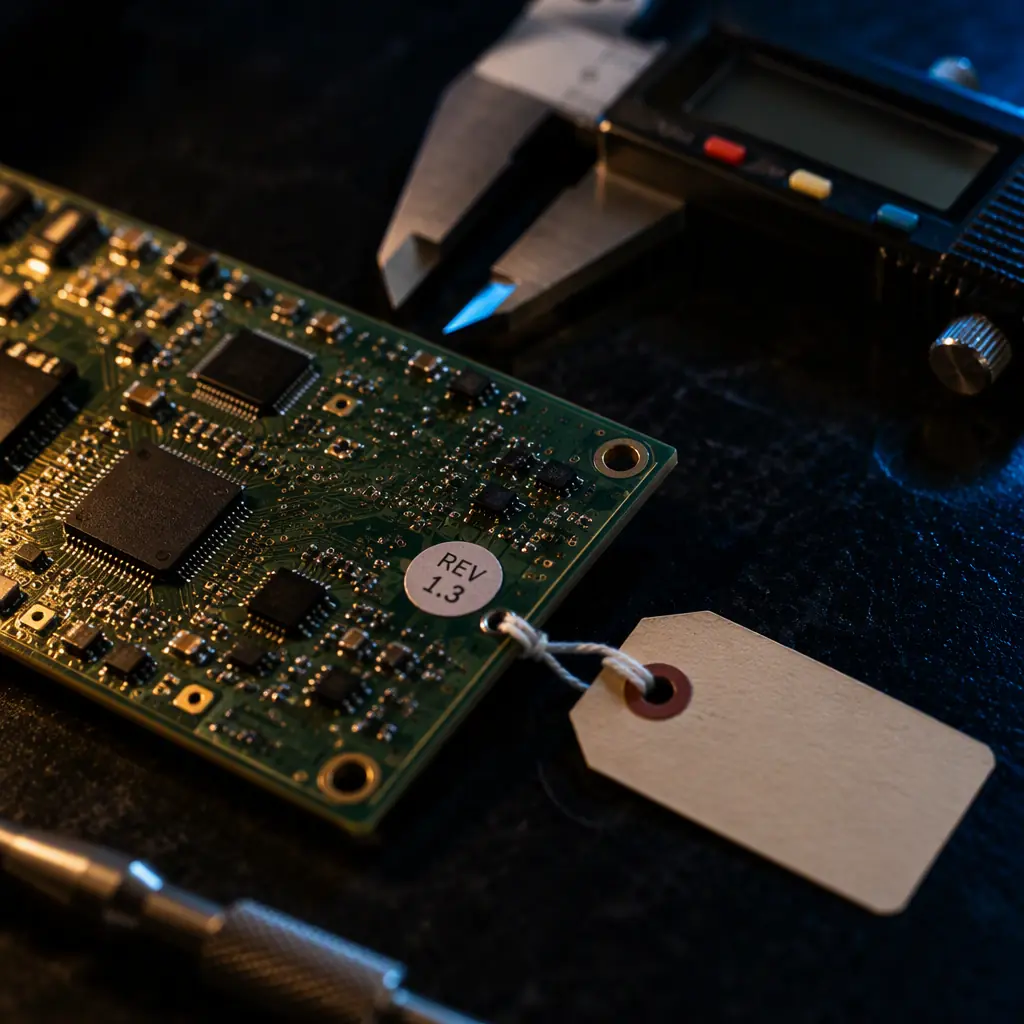
Simple and universal: go up a letter for each approved change. A board starts at REV A, the first change makes it REV B, and so on. The revision letter is stamped into the copper or silkscreen on the board itself, so anyone picking up the board can see which design it is without asking.
That letter is the anchor of the whole change-control process. It belongs in the Gerber set, the BOM, the assembly program and the test program. If the board says REV C and the BOM says REV B, the assembler has a conflict to resolve before a single part is placed. That is why our engineers treat a mismatched revision as a blocker, not a minor note. Learn what a complete design package should carry in our specification and RFQ guide.
The letter also controls which parts are still valid. A change often means a part swap, and the old part may already be on the shelf. Tracking the revision-to-part mapping is what prevents the assembler from building a new rev with an obsolete part. Our component obsolescence management guide covers that side of the problem.

Cost And Lead-Time Impact: When The Change Happens
The earlier in the cycle a change lands, the cheaper it is. This is the central rule of change control, and it holds whether the change is a connector swap or a full redesign. The table below shows a typical shape of that cost.
| When the change lands | What it costs | Typical impact |
|---|---|---|
| Before quote | A corrected quote, no physical cost | Low |
| After quote, before build | Re-quote, possible part price change | Low–moderate |
| After stencil made | New stencil, scrapped apertures | Moderate |
| Mid-production | Scrapped WIP, rework, line delay | High |
| After shipping | Field rework, warranty, recall | Very high |
The practical implication: communicate changes to the factory as soon as they look likely, even before they are final. A factory that knows a change may be coming can hold a stencil order or a component buy, saving you money even if the change later goes another way. Delaying the news in the hope the change disappears is the worst of both worlds. Our lead time reduction guide shows how early coordination pays off.
The ECO Workflow Done Properly
A controlled change moves through a defined sequence. It does not have to be heavy bureaucracy, but it does need a clear path so nobody has to guess what happens next.
Raise the change request
Document what changes, why, and which revision it affects. Assign an owner. A change with no owner is a change that stalls.
Assess the impact
Work through the effect on the BOM, the stencil, the assembly program, the test program, the inventory and the schedule. Our BOM cost review and dual sourcing strategy help here.
Approve it at one point
One decision-maker signs off on the change. Multiple parallel approvers create ambiguity about who actually said yes.
Update the documentation set
Increment the revision letter and release a new Gerber set, BOM, assembly and test program together. Never let one document run ahead of the others.
Set a cut-in point
Decide whether the change applies to WIP or only to the next lot, and communicate it as a date and a lot number. This is where a factory with lot traceability is worth its weight.
Close it out and record it
Confirm the change built, record the actual cost and date, and retain the history. An audit trail is what a PPAP package and a defensible quality record depend on.
If changes to your live production are frequent, you should also understand how to qualify a second source without disturbing the performance, see our supplier transition guide and dual sourcing strategy, which are directly affected by revision control.
WIP, Scrap And Rework: The Hard Part
The hardest change to manage is the one that lands after boards are already running. Work-in-progress may be half-built on the line, a stencil is already cut, and a stock of the old part is on the shelf. This is where the cut-in point decision is really made.
There is rarely a perfect answer. You can finish the current batch with the old revision, or halt and rework. The right call depends on how far the board is through the process, how many units are affected and how costly the change is. A clear revision record is what lets you trace exactly which lot received which revision, and it is the only thing that protects you if a field issue later points back to one specific build. The cost of that ambiguity is well documented in our warranty and RMA and quality dispute resolution guides.
Summary, Change Is Not The Enemy, Unmanaged Change Is
A PCB project that never changes is rare, and change itself is a normal part of getting a product right. What turns change into a problem is the absence of process: no single owner, no revision letter, no cut-in date, no traceability. Establish those four things and a mid-production ECO becomes a controlled, budgeted event instead of a scramble.
At Huaxing PCBA we control revisions under IATF 16949 and ISO 9001, with full lot traceability and a documented change record on every build. We can show you the impact of any change on cost and lead time before you commit, and we hold 99.2% on-time delivery because changes are never a surprise. Send your files or talk to an engineer about keeping a change under control.