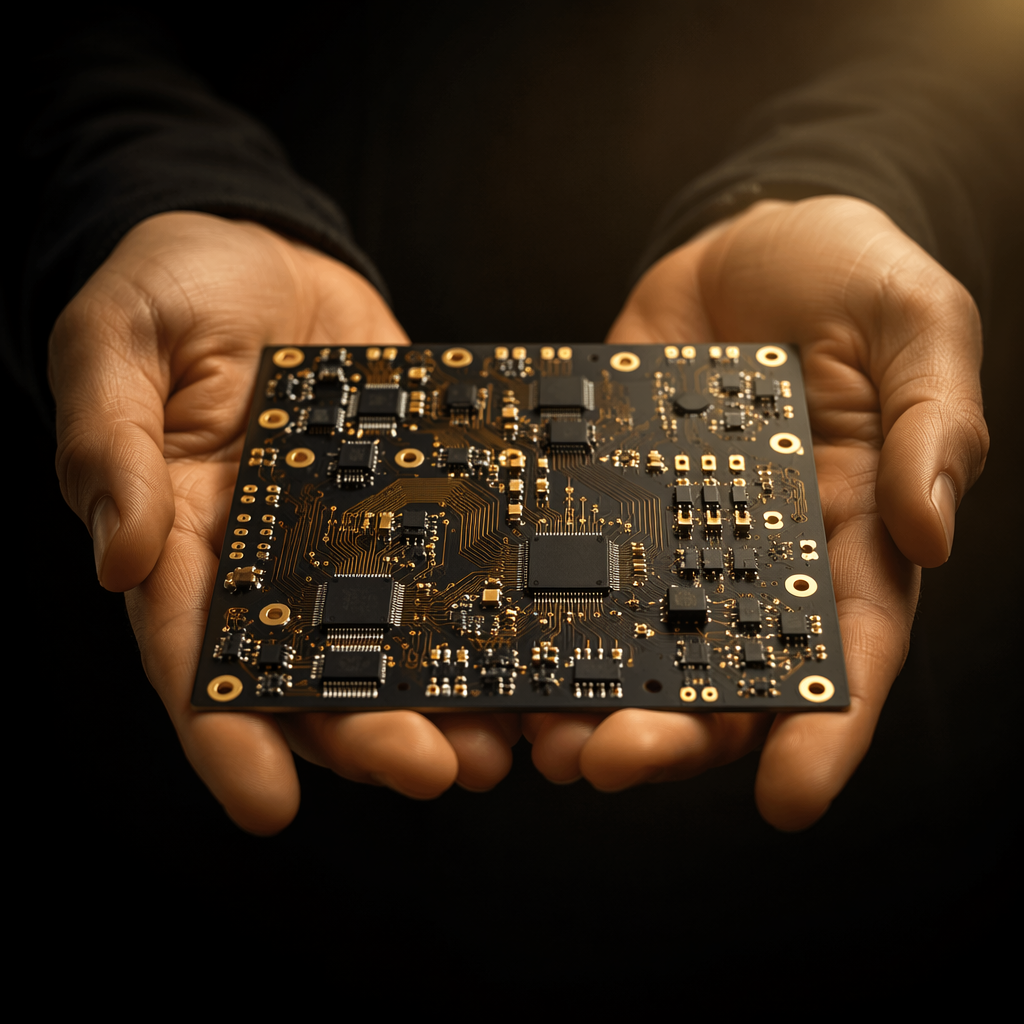
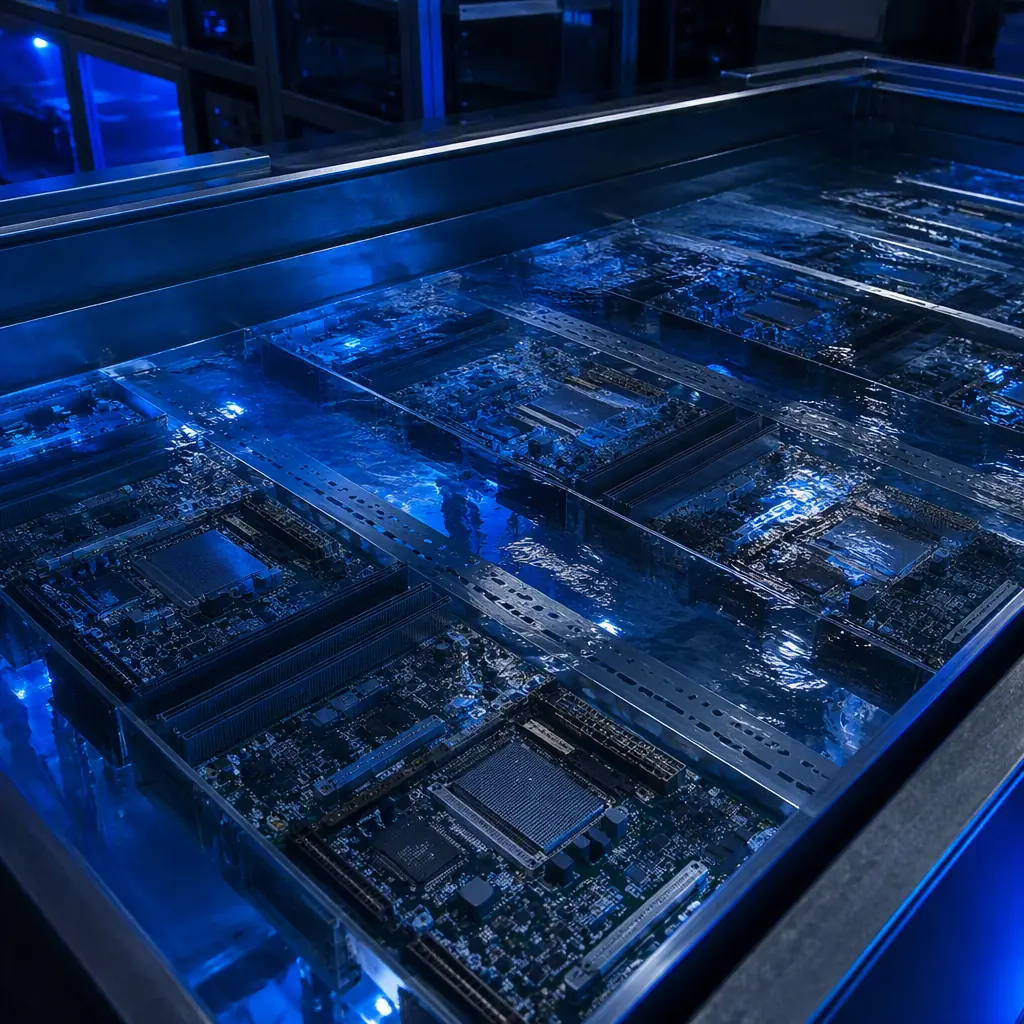
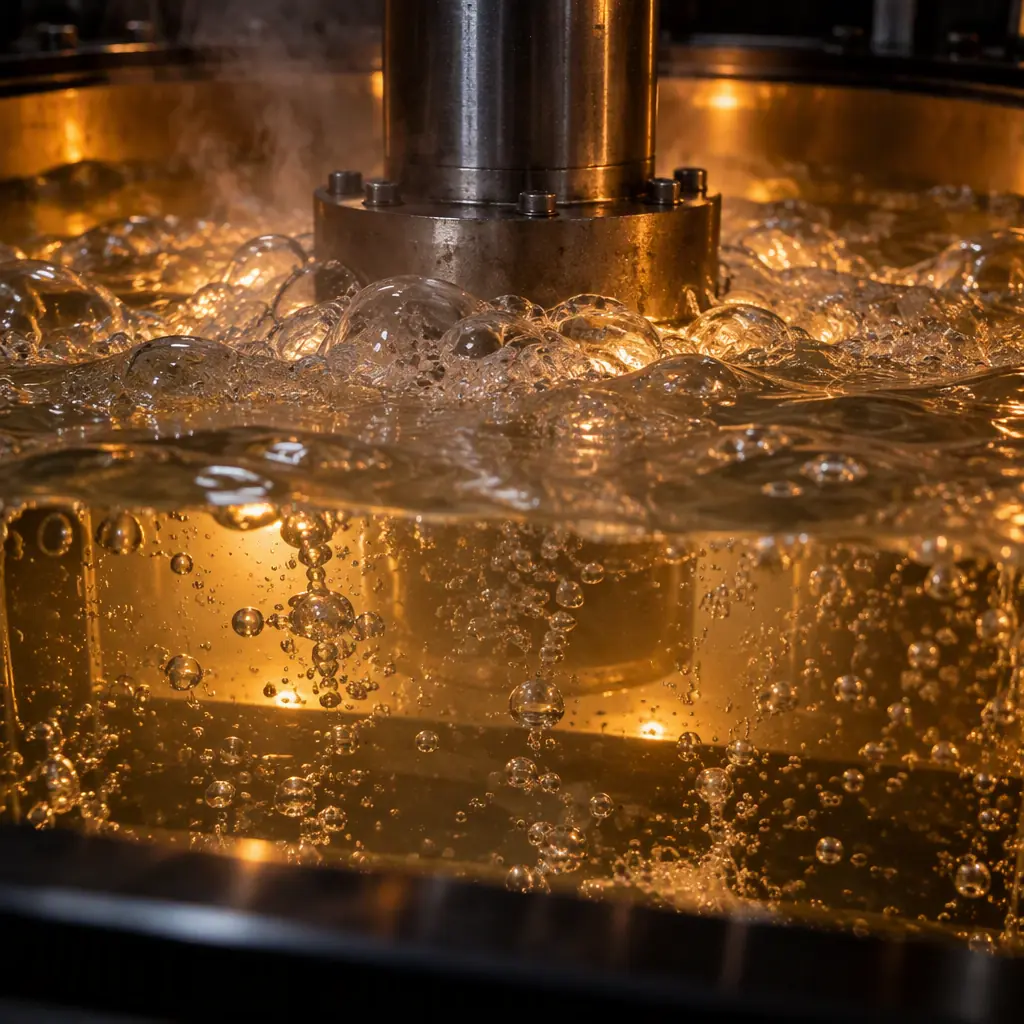
Single-phase immersion cooling is comparatively forgiving. The dielectric fluid is pumped across the boards, carries heat to a heat exchanger, and the boards themselves never see anything more aggressive than a fluid bath at a modest temperature. Two-phase immersion is a different proposition. The fluid is deliberately boiled at the component surface, and that boiling happens at a temperature set by the fluid's chemistry — often between 40°C and 60°C for the fluorocarbon and hydrofluoroether families used in data-centre applications. Every surface of the assembly is immersed in liquid and vapour simultaneously, the vapour penetrates everywhere gas can reach, and anything soluble in the fluid is free to move around the tank rather than staying where it was deposited.
For a hardware team this changes what the board has to survive, and for a procurement team it changes what the supplier has to deliver. This guide covers the assembly-level consequences: how the fluid interacts with laminate, solder mask, coating and connector materials; why ionic cleanliness becomes a system-level rather than board-level concern; and a qualification checklist for boards destined for two-phase service. Our own lines handle 8 SMT lines with in-line cleaning and coating, and the requirements below reflect what immersion hardware actually demands from the assembly process.
Two-Phase vs Single-Phase: The Difference That Matters to the Board
The engineering reason two-phase cooling exists is latent heat. Boiling a liquid absorbs far more energy per unit mass than simply warming it, so a two-phase system moves heat away from a die with a much smaller flow rate and a much smaller temperature rise across the fluid. That is why it can handle power densities that single-phase immersion struggles with. The cost of that performance is a more chemically active environment at the board surface.
| Factor | Single-phase immersion | Two-phase immersion |
|---|---|---|
| Heat transfer mechanism | Sensible heat — fluid warms up | Latent heat — fluid boils and condenses |
| Typical fluid chemistry | Hydrocarbon or synthetic oil | Fluorocarbon or hydrofluoroether |
| Board surface state | Liquid contact only | Liquid plus vapour, phase change at the surface |
| Vapour access to assemblies | Limited to the liquid in contact | Vapour penetrates all open volumes |
| Dominant compatibility risk | Long-term material swelling | Solubility, extraction and material attack |
| Cleaning consequence | Residue stays near where it was left | Residue can migrate through the whole tank |
The last row is the one most often missed during qualification. In a single-phase system, modest flux residue under a component is a local concern. In a two-phase system, the same residue can be progressively extracted into the fluid and then re-deposited elsewhere in the tank, including on surfaces that matter. The fluid is not merely a coolant; it is a solvent with a long service life, and it accumulates whatever it dissolves.
What changes for the buyer: cleaning stops being a board-quality parameter and becomes a system-compatibility parameter. A board delivered with residue the assembly house considers acceptable can contaminate a shared fluid loop and affect hardware it never touched.
What the Fluid Does to Assembly Materials
Material compatibility for two-phase immersion has to be assessed per material family on the board, not as a single pass/fail statement. The reason is that fluid attack and fluid extraction are different mechanisms, and they affect different materials. Attack means the fluid chemically degrades or swells the material. Extraction means the fluid pulls a soluble constituent — a plasticiser, a processing aid, an unreacted monomer — out of the material and into the loop. A material can pass an attack test and still be a bad choice because it leaches.
| Board material | Primary risk | What to verify |
|---|---|---|
| FR-4 laminate (mid/high Tg) | Edge absorption, minor swelling | Fluid manufacturer compatibility listing; dimensional check after soak |
| Polyimide laminate | Higher moisture uptake, similar fluid behaviour | Bake before service; verify against the fluid's compatibility data |
| Solder mask | Softening, adhesion loss, colour shift | Long-term soak test at service temperature, not a short dip |
| Conformal coating (acrylic) | Coating may dissolve or swell | Generally avoid unless explicitly approved for the fluid |
| Conformal coating (silicone) | Best general resistance; verify adhesion | Fluid-specific approval, and full cure before immersion |
| Parylene coating | High resistance, but a repair barrier | Cost and rework impact versus protection benefit |
| Connector plastics | Swelling, loss of retention force | Per-part compatibility check; do not assume the family |
| Elastomer seals and grommets | Swelling and compression set | Individual material verification; silicone grades are not interchangeable |
| Labels and marking ink | Adhesive lift and ink removal | Laser marking or fluid-compatible labels instead of paper stock |
Two practical consequences follow. The first is that the compatibility question is answered per part, and a supplier who claims "immersion compatible" at board level without part-level backup has not done the analysis. The second is that connectors and elastomers are the most common early failures, because they are selected for electrical and mechanical requirements and only later exposed to the fluid. If a board is being designed for immersion, connector material should be a selection criterion from the start rather than a compatibility check at the end.
Confirm every plastic and elastomer against the fluid supplier's list
Fluid manufacturers publish compatibility tables by material family. Work through the board's bill of materials against that table rather than testing representative samples. The part with no entry is the problem, not the family that has one.
Test at service temperature and for service duration
Two-phase fluids operate at elevated temperature all the time. A compatibility test run at room temperature for a week says very little about a material that will sit at 50°C for five years. Extrapolation from short tests is where most compatibility assumptions fail.
Watch for extraction, not only for attack
Ask whether the material leaches anything into the fluid. Extraction degrades the fluid over time and can re-deposit onto other hardware. It is often recorded as a fluid-quality problem rather than a board problem, which makes it hard to trace back.
Choose marking that survives the tank
Paper and vinyl labels with pressure-sensitive adhesive are a poor fit. Laser marking on the solder mask or a fluid-compatible label stock avoids an avoidable failure mode. See our PCB labeling and marking guide for the durable marking options.
Cleaning and Ionic Contamination in an Immersion Board
Because the fluid is a solvent in contact with the whole assembly, cleanliness requirements for a two-phase board are stricter than for an equivalent air-cooled board. The measurable parameter is again ionic contamination, expressed in micrograms of sodium chloride equivalent per square centimetre, and the target for immersion service sits at the low end of what a precision cleaning process can achieve. Reporting a limit is not enough — the process that reaches it has to be in place, and that generally means aqueous cleaning with a verified rinse rather than a no-clean flux strategy.
There is a design side to this as well. Residue trapped under a component body is far harder to clean than residue on an exposed surface, and in immersion service that trapped residue is not static. Low-standoff components, large area terminations and anything with a sealed void should be reviewed for cleanability. Where a component legitimately cannot be cleaned underneath, underfill can be used to exclude the void and immobilise the residue — our underfill selection guide covers the material families — but that is a deliberate decision, not a default.
Specify a cleanliness limit and require measured results per lot
State the ionic contamination limit in the purchase specification and require a test result with each lot rather than a statement that cleaning is performed. Our ionic contamination testing guide covers the methods and their limitations.
Review the design for cleanability before release
The assembly house should be asked which areas of the board will be difficult to clean, and the answer should influence component choice and via design rather than being handled at the cleaning stage.
Do not rely on no-clean flux in a two-phase tank
No-clean is an engineering decision that trades cleaning for a residue the assembly deems benign in service. In a fluid loop that residue is not benign — it is extractable material in a shared solvent. Plan for cleaning.
Coating and Sealing Strategy
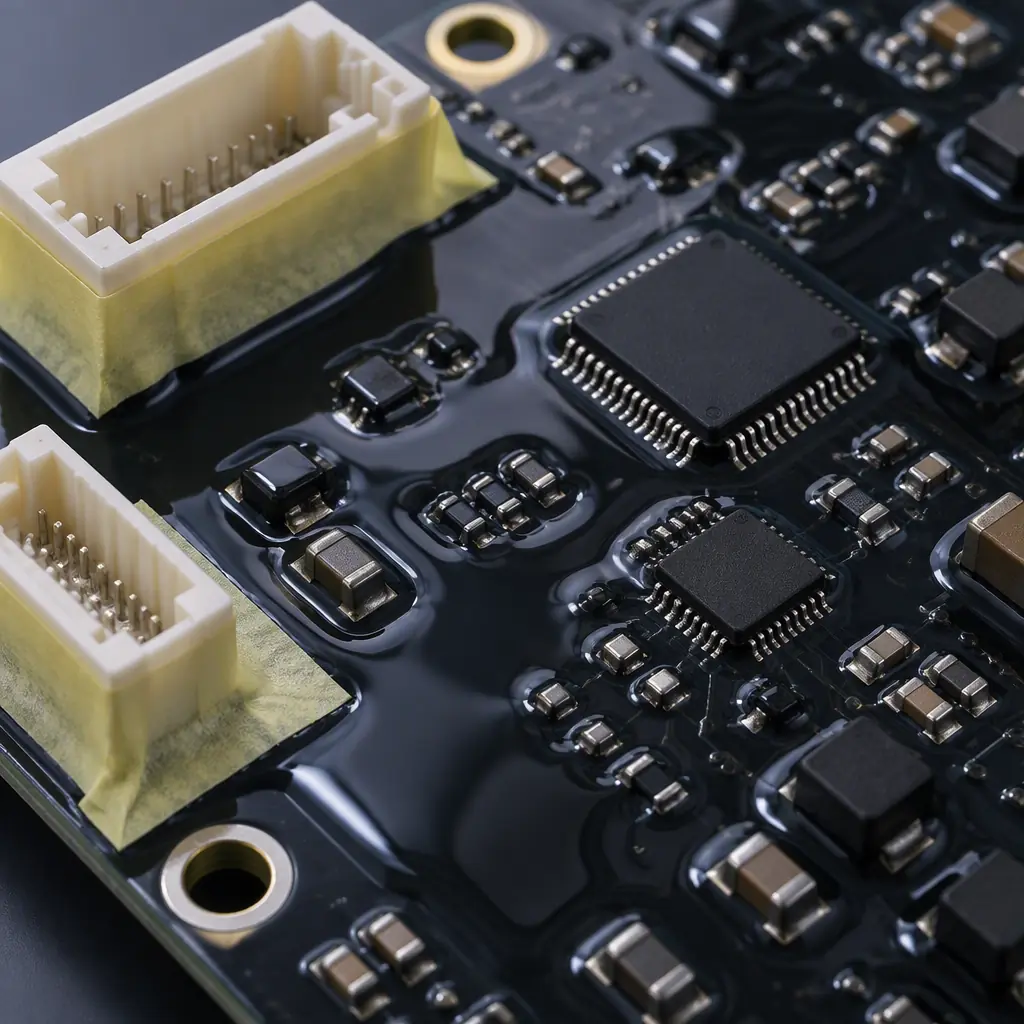
Whether to coat a board going into a two-phase tank is a genuine trade-off rather than an obvious yes. A coating adds a barrier between the fluid and the assembly, which is valuable where a component's plastic is not fully compatible or where condensation between hot and cold periods is a concern. It also adds a layer that must itself be compatible, adds a barrier to rework, and can create problems if applied unevenly or cured incompletely.
The general position supported by most fluid manufacturers is that fully cured silicone coatings offer the best practical resistance among conformal coating families, with parylene offering higher protection at substantially higher cost and difficulty of rework. Acrylic coatings are the family most likely to soften or partially dissolve and should generally be avoided unless explicitly approved. Whatever family is chosen, cure completion matters more than the datasheet: an incompletely cured coating has unreacted material available for extraction into the fluid loop.
Confirm the coating family is approved for the specific fluid
Coating approval is fluid-specific, not generic. Obtain the compatibility statement against the fluid you are actually using, not against "dielectric coolants" as a category.
Verify cure, not just application
Cure verification should be part of the process record. Where the coating is applied by the assembly partner, ask how cure completeness is confirmed. Our conformal coating guide covers the application and cure parameters in detail.
Mask connectors and optical interfaces deliberately
Coating on a mating surface degrades contact performance. Masking should be a documented part of the process with defined keep-out areas, and the masking method itself must not leave residue. Our guide to conformal coating masking and process control covers the usual failure points.
Decide the rework strategy before coating
Parylene is effectively permanent and removal risks damaging the assembly. If field or production rework is foreseeable, that argues for a silicone coating with defined removal points instead.
Power Density, Component Selection and Thermal Interface Paths
Two-phase cooling exists because air cooling and cold plates reach their limits at high power density. Once the board is in a tank, the thermal path becomes unusually short: heat moves from the die to its package, through the package surface to the boiling fluid, and away as vapour. There is no heatsink, no thermal interface pad between component and sink, and no airflow design to optimise. This changes component selection in ways that matter for procurement.
| Design element | Air-cooled board | Two-phase immersion board |
|---|---|---|
| Primary heat path | Die to heatsink to air | Die to package surface to boiling fluid |
| Thermal interface materials | Between component and heatsink | Largely eliminated at board level |
| Component priority | Thermal resistance to heatsink | Package surface area and surface finish |
| Board flatness | Affects mounting and airflow | Affects fluid access and vapour escape |
| Cleanliness | Functional | System-level compatibility |
Because the package surface becomes the heat transfer surface, surface area and finish drive performance. Components with large, flat, exposed thermal pads or metallic lids generally outperform those with textured plastic bodies, and the difference can be large enough to change the component selection outright. Board orientation also matters: vapour needs an escape path, and a board laid out so that it traps vapour under a large component can develop a local dry-out that turns into a hot spot. If your system relies on cold plates rather than immersion, our guides to liquid cooling and cold plate design and single-phase immersion PCB design cover the alternative paths.
Supplier Qualification Checklist for Immersion-Cooled Boards
The checklist below is for the buyer qualifying an assembly partner for two-phase immersion hardware. The theme running through it is that this application requires the assembly house to think beyond board quality and consider the board's effect on a closed fluid system.
Does the supplier ask what fluid you are using?
This is the single fastest qualifier. Cleaning limits, coating choice and material compatibility all depend on the fluid, and a supplier who does not ask cannot be giving you a compatible assembly.
What cleaning process and verified limit applies?
Expect a named cleaning process, a measured ionic contamination result per lot, and a limit agreed against your fluid system rather than a generic industry default.
Which coating family, and how is cure verified?
Coating selection and cure verification are separate questions. A supplier who answers only the first has not covered the failure mode that actually causes extraction into the loop.
How are connectors and mating surfaces protected?
Ask for the masking plan and the keep-out definition, and confirm the masking method itself leaves no residue. This is where contamination of mating interfaces most often originates.
Does the supplier review component material compatibility, or only the bare board?
Compatibility questions live in the bill of materials, not the laminate. A supplier who can walk through the connectors and elastomers against the fluid's compatibility table is doing the work that matters.
What is the packing specification, and does it keep the board clean until installation?
A clean, coated board in open packaging picks up contamination before it reaches the tank. Moisture barrier packing with defined exposure limits is the expected answer.
Is there prior immersion hardware experience, and can you see it?
Two-phase assembly discipline is not universal. Ask what immersion programmes the supplier has delivered and what cleaning verification records accompanied them. The answer is a reasonable proxy for whether the process exists or would be invented on your project.
Summary and Next Steps
Two-phase immersion cooling changes the problem from board quality to system compatibility. The fluid boils at the component surface, wets every part of the assembly and acts as a solvent on everything it contacts, which means laminate swelling, connector material attack, coating dissolution and residue migration all become live failure modes. Material compatibility must be assessed per part against the specific fluid, cleaning requirements are stricter than for air-cooled boards, coating is a deliberate trade-off rather than a default, and component selection shifts toward parts with large flat package surfaces. The buyer's leverage is in asking about the fluid early and requiring evidence — measured cleanliness, verified cure, documented compatibility — rather than accepting a general compatibility claim.
At Huaxing PCBA we build immersion-ready assemblies across 8 SMT lines with in-line aqueous cleaning, ionic contamination verification, silicone and parylene coating, and per-lot process records. Our facilities hold IATF 16949 and ISO 9001 certification. Read our single-phase immersion cooling design guide or tell us which fluid you are using and we will review your assembly for compatibility — free DFM feedback and a quote within 24 hours.