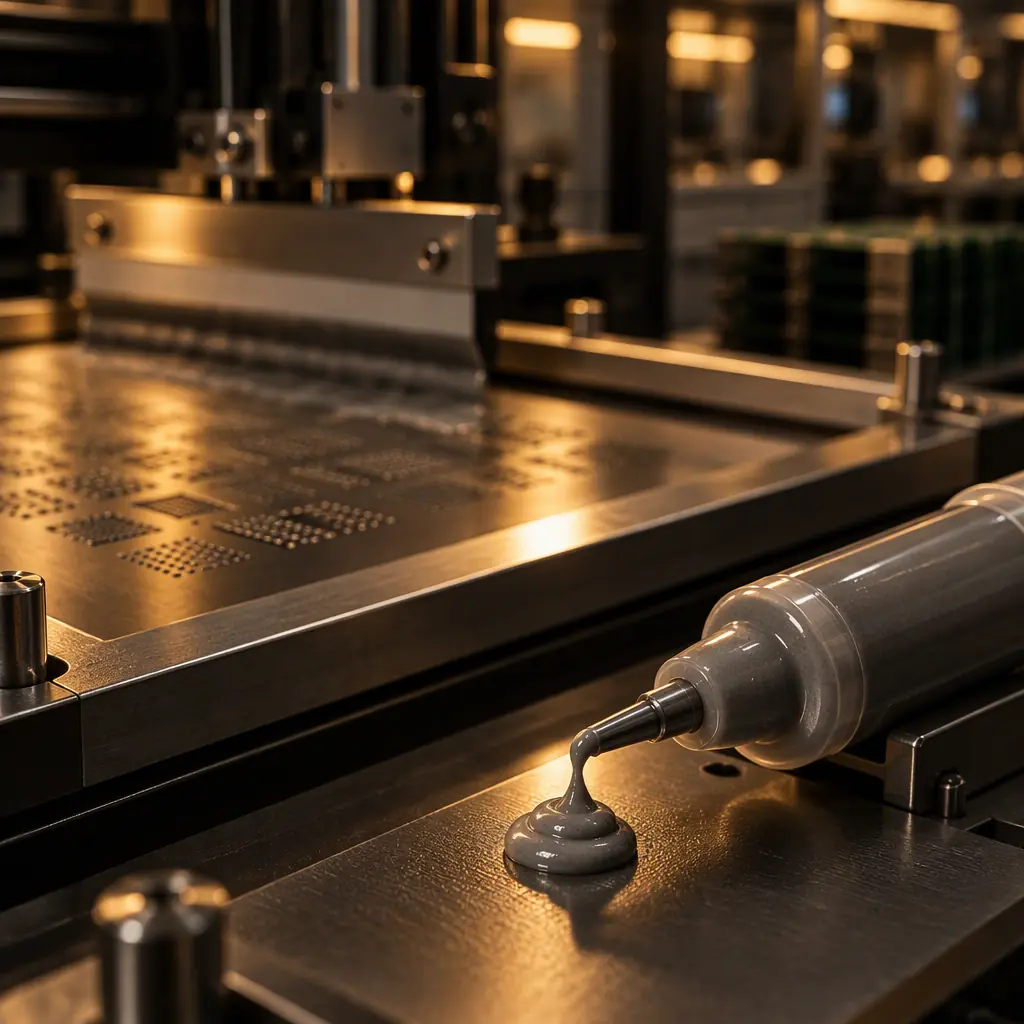
Solder paste is a suspension, not a liquid. Metal powder — typically 88 to 89% by weight in a SAC305 Type 4 paste — sits in a flux vehicle whose viscosity changes by more than an order of magnitude between the squeegee stroke and the moment the board leaves the printer. Printability is therefore not a single property you can put on a purchase order. It is the balance of four measurements: viscosity, thixotropic index, metal content, and the slump behaviour that decides whether a deposit holds its shape in the ten minutes between printing and reflow. This guide explains what each test measures, what the numbers mean in practice, and how to write a paste specification that actually controls what lands on the pad.
Why Viscosity Alone Is a Nearly Useless Specification
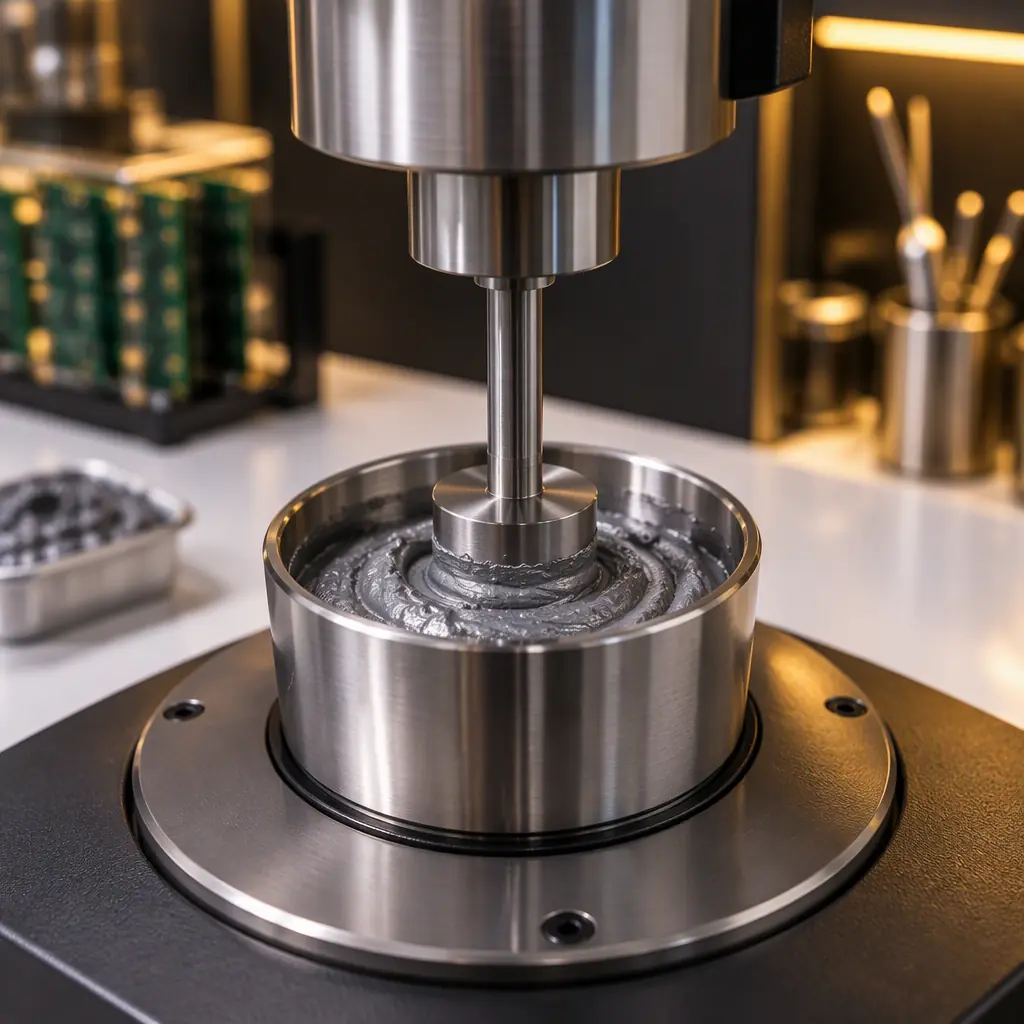
Every solder paste datasheet quotes a viscosity figure — commonly something between 150 and 250 Pa·s measured on a Brookfield spindle at one speed. Buyers reasonably assume that if two pastes have similar viscosities they will print similarly. They will not.
The reason is that a single viscosity number describes the paste at one shear rate. In a print cycle the paste experiences a wide range: near-zero shear as it sits on the stencil before the stroke, high shear under the squeegee blade, and moderate shear as it is pushed through the aperture, then low shear again as the deposit releases and stands on the pad. A paste that measures 180 Pa·s at 10 rpm might be 40 Pa·s under the squeegee and 900 Pa·s after standing. Two pastes with identical single-point viscosities can have completely different behaviour across that envelope.
This is why a print defect that appears after a paste change is often blamed on "bad paste" when the real issue is that the new paste is faster-shearing, or slower to recover its structure. Both are printable — they need different print speeds and different waits.
The Four Measurements That Actually Predict Print Behaviour
| Property | Typical range (SAC305, Type 4) | What it controls | Failure if out of range |
|---|---|---|---|
| Viscosity (single point) | 150–250 Pa·s at 10 rpm | Rolling behaviour on the stencil | Too thin: paste bleeds under stencil, bridging. Too thick: poor release, incomplete fills |
| Thixotropic index | 0.50–0.65 (ratio of low-speed to high-speed viscosity) | Shear-thinning and recovery speed | Low index: paste flows after printing, slump and bridging. High index: poor aperture fill at fast speeds |
| Metal content | 88.0–89.0 wt%, 50–52 vol% | Deposit volume after reflow, slump resistance | Low metal: insufficient joint volume, voids. High metal: dry paste, poor coalescence |
| Slump (ASTM/IPC test) | No bridge at 0.63 mm pitch, no spread after 10 min idle | Deposit shape retention before reflow | Bridging on fine pitch, solder beading, tombstoning on 0402 and smaller |
Two of these four — viscosity and metal content — are on every certificate of analysis. The other two, thixotropic index and slump, usually are not, and they are the two that explain most field complaints. Requesting them is a reasonable qualification step for any paste you intend to run for more than a single build.
Thixotropic Index in Plain Terms
The thixotropic index is measured by running the same viscosity test at two speeds — commonly 5 rpm and 50 rpm — and taking the ratio. A paste with an index of 0.55 is ten times less viscous under high shear than at rest. That is exactly what you want during the print stroke: the paste must flow like a liquid to fill the aperture, then recover its structure within seconds so the deposit stands up instead of slumping across the solder mask.
Recovery speed matters as much as the ratio and is harder to find on a datasheet. A paste with good shear-thinning but slow structural recovery will print clean deposits on a slow line and slumped deposits at 60 mm/s. When a customer reports "the same paste printed fine at the other factory", print speed and squeegee pressure are the first two parameters to compare — not the paste lot.
Slump: the Defect That Shows Up Two Stations Later
Slump is the tendency of a printed deposit to spread after the stencil lifts. It is driven by gravity, by the paste's own residual stress, and by how long the board waits before reflow. The mechanism is worth understanding because it produces defects that get attributed to the printer when they are actually a paste-and-timing problem:
- Bridging on fine pitch. Deposits on adjacent 0.4 mm pitch pads grow toward each other and touch before reflow, producing a bridge that no printer parameter will fix except a faster line or a lower-slump paste.
- Solder beading. Slumped paste spreads onto the solder mask; during reflow, the portion on mask does not wet the pad and balls up into isolated beads that can become conductive debris.
- Tombstoning on passives. Uneven slump between the two pads of an 0402 or 0201 changes the wetting force balance at reflow, lifting one end of the part.
The practical control is a maximum print-to-reflow queue time. Most pastes specify a working window; a common and defensible figure for SAC305 Type 4 is 4 hours from print to reflow at controlled room humidity, with no re-mixing of paste that has sat on the stencil for more than an hour. Beyond that, the flux vehicle has begun to separate and both slump and voiding get worse.
Factory reality: the single largest cause of "the paste went bad" complaints we investigate is not the paste — it is a line that stopped for a changeover with printed boards waiting on the conveyor. Boards printed 90 minutes before reflow behave like a different paste. Check the queue-time log before you open a supplier complaint.

Matching Paste Rheology to Aperture Size
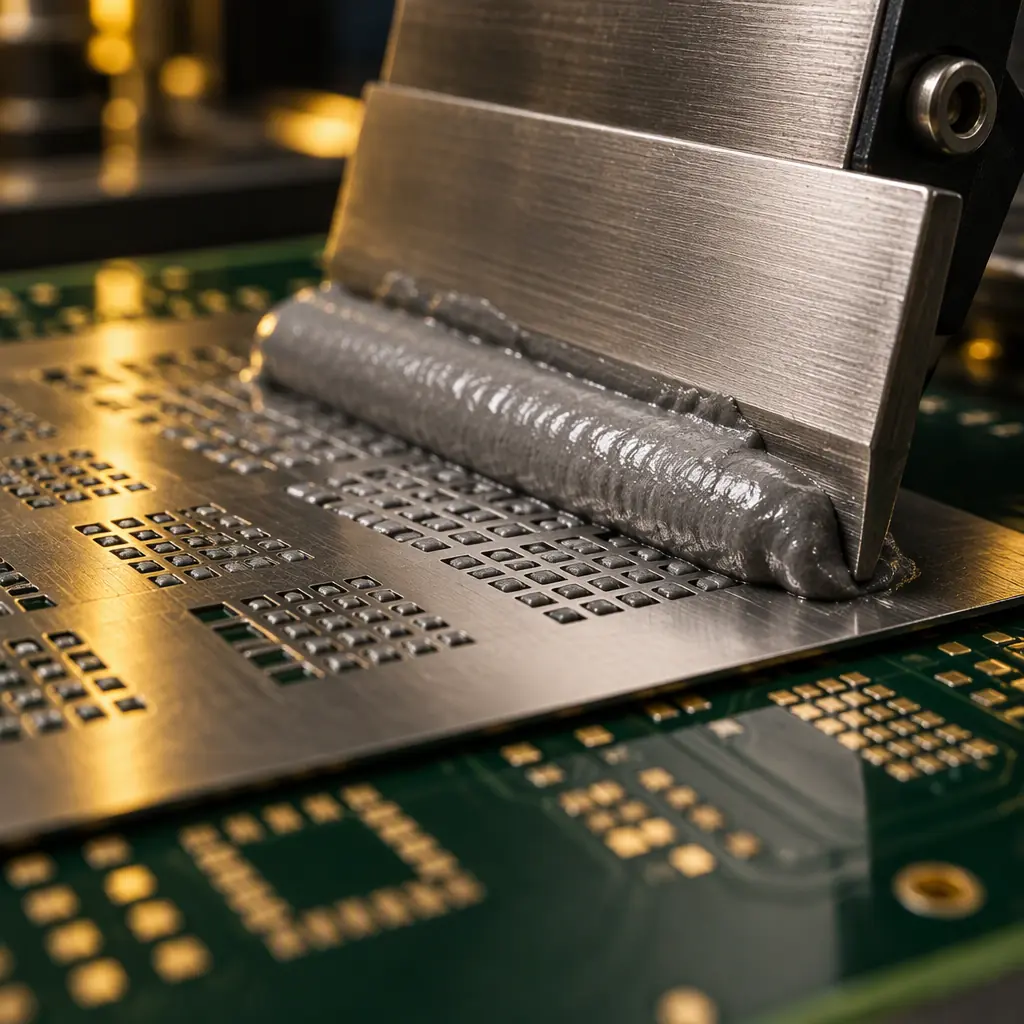
Powder size class and rheology have to be chosen together. A Type 3 paste in a 0.3 mm aperture has too few particles across the opening to release consistently; a Type 5 paste in a 0.6 mm aperture is over-specified and ages faster because the finer powder oxidises more quickly.
- Apertures 0.50 mm and larger: Type 3, thixotropic index 0.50–0.55. Forgiving, good for through-hole and coarse SMT.
- Apertures 0.30–0.50 mm: Type 4, index 0.55–0.60. The mainstream choice for fine-pitch QFP and 0402 assemblies.
- Apertures below 0.30 mm, or area ratio under 0.66: Type 5, index 0.60–0.65, and expect the paste to be significantly less forgiving of room humidity and queue time.
The corresponding stencil aperture work — area ratio, wall taper, nano-coating — is covered in our SMT stencil aperture design guide, and the defect patterns that result when paste and aperture are mismatched are catalogued in solder paste printing defects.
What to Put on the Purchase Specification
A paste specification that actually controls the process has five lines, and all five are verifiable by the supplier on request:
- Alloy and powder size class, with the particle size distribution standard referenced (IPC J-STD-005 or J-STD-006 as applicable).
- Metal content as a range by weight, not a single figure, with the test method stated.
- Viscosity at a stated spindle and speed, plus the thixotropic index at the two speeds used to derive it.
- Slump result at the finest pitch on your board, tested to the standard method rather than to a supplier's internal judgment.
- Shelf life at refrigerated and at room temperature, and the working life after the container is opened.
The storage and handling discipline around these numbers is covered in solder paste storage and handling, including the warm-up rule that causes more condensation-related defects than any paste batch. Where volume control downstream of the printer is the concern, solder paste volume and SPI control covers the Cpk targets and how to react when the printer drifts.
At Huaxing PCBA, paste is received with a certificate of analysis, held under refrigeration with FIFO lot control, and qualified against the aperture set of each specific board before production release. Printing runs on 8 SMT lines with inline SPI on fine-pitch builds. We assemble to IPC-A-610 Class 2 and 3 and work to J-STD-001 process requirements. Send your board and paste requirement for a quote or talk to a process engineer about which paste class suits your aperture set.