

Send three PCB factories the same Gerber files and a one-line email, "please quote this board", and you will get three quotes that cannot be compared: different materials, different surface finishes, different tolerances, different test coverage, different prices. Send them a written specification and the quotes converge, because every factory is now bidding on the same board. The specification is the single highest-leverage document in PCB procurement, and most buyers never write one.
This guide is the template we give to buyers who send Huaxing PCBA their RFQs, the eight sections that turn a file drop into a contract-grade specification. It reflects what our engineers need to quote accurately across 32 layers and 8 SMT lines: every parameter that changes cost, lead time or quality, in the order that makes quoting fastest. For the commercial side of the same document, our supplier RFP guide covers the process around the spec, and the quote comparison guide explains how to evaluate what comes back.

The Eight Sections Every PCB Specification Needs
A complete PCB specification answers eight questions, in a fixed order. Missing sections do not stop a factory from quoting, they stop it from quoting correctly, and the cost of guessing lands on your side of the contract.
General information: quantity, timeline, and the files themselves
State the target quantity (prototype, pilot, or production volumes), the required delivery date, and exactly which files define the board: Gerbers, drill files, netlist, fabrication drawing, and BOM for assembly. Name the data format, our Gerber file guide covers what a complete set looks like, and IPC-2581 vs Gerber explains the modern alternative.
Materials and stackup: the biggest cost driver
Specify the base laminate (FR-4, high-Tg, Rogers, PTFE, metal core), the layer count, the finished copper weight per layer, and the target impedance for controlled layers. If you do not specify the stackup, the factory designs one. And its choice of cheaper materials is how quotes drift apart. The stackup design guide shows how to write a stackup table, and the materials guide compares the options.
Electrical requirements: impedance, current, and signal integrity
List every controlled impedance target (value, tolerance, layer, reference plane), the maximum current per trace or plane for power nets, and any high-speed requirements, differential pairs, length matching, backdrilling. Writing "all 90 ohm differential pairs" is better than silence, but a table with per-net values is what removes quoting ambiguity.
Mechanical and fabrication requirements
Board dimensions, finished thickness, minimum trace width and spacing, minimum hole size, via types (through, blind, buried, via-in-pad), and any special processes, edge plating, castellated holes, press-fit holes, countersinks. The tolerances guide lists which dimensions you should tighten and which you should leave standard.
Surface finish and solder mask
Specify the finish (HASL, ENIG, ENEPIG, OSP, immersion silver) and the reason it matters to your product, shelf life, flatness for fine-pitch, wire bonding, or high-frequency performance. The ENIG vs HASL vs OSP guide and the solder mask guide cover the trade-offs; your spec should also state mask color and legend requirements.
Quality class and acceptance criteria
State the IPC class (Class 1, 2, or 3) for fabrication and assembly, and the acceptance standard (IPC-A-600 for bare boards, IPC-A-610 for assembly, J-STD-001 for solder). Class 3 is roughly 20-40% more expensive than Class 2 for the same board. Specifying it when you do not need it inflates every quote. The Class 2 vs Class 3 guide helps you choose honestly.
Testing and inspection requirements
Specify the electrical test method (flying probe for prototypes, fixture/ICT for volume), AOI and X-ray coverage, impedance test coupons, and any functional test you will provide fixtures for. Testing is where factories cut corners to win price, naming the tests in the spec removes that option. The test method comparison maps methods to volumes.
Packaging, marking and documentation
State packaging requirements (vacuum-sealed moisture-barrier bags, ESD-safe packaging, board separators), silkscreen marking (date code, UL marking, your part number), and the documents you want with the shipment: test reports, material certificates, photos. The ESD packaging guide covers the transport side.
Key Takeaway: Every section you leave blank is a decision the factory makes for you, and its decision optimizes its margin, not your product. A two-page specification removes most of that discretion.
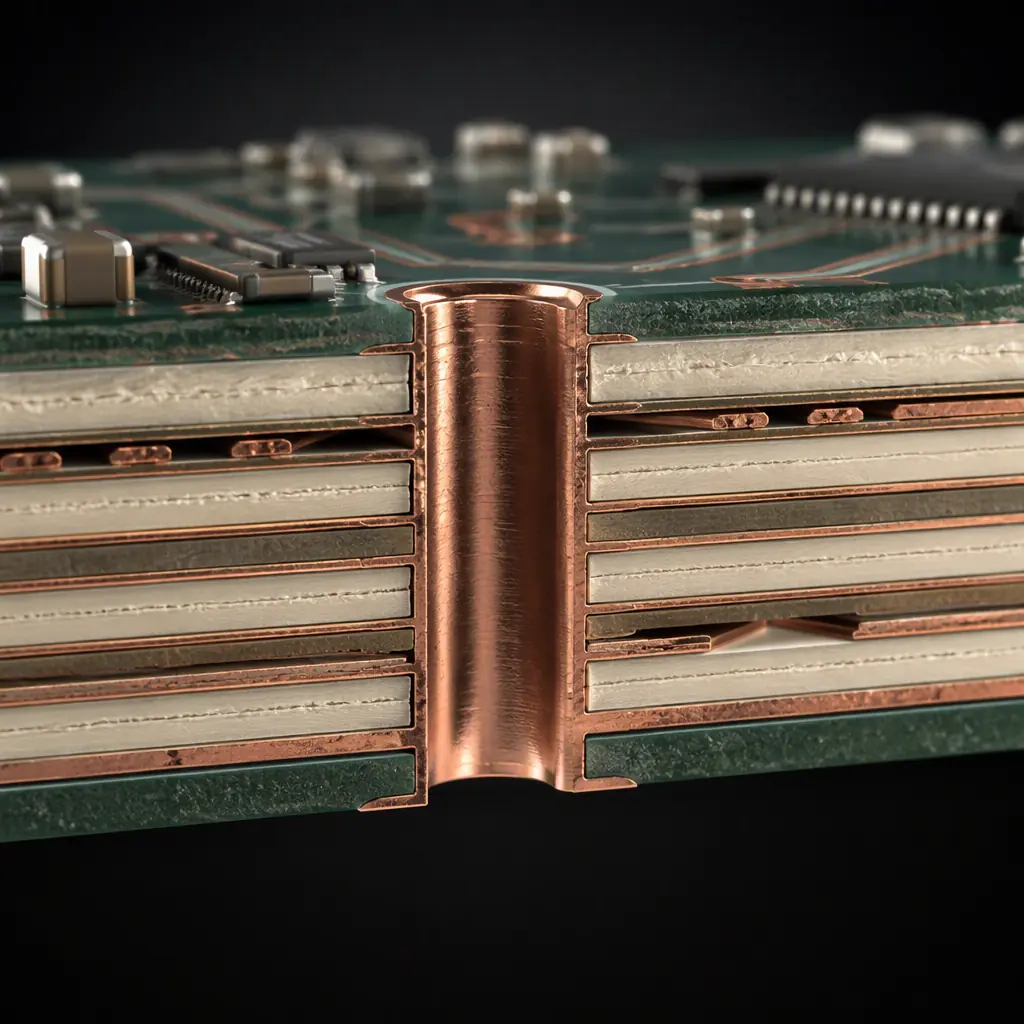
Writing the Stackup Table That Ends Guesswork
The stackup is the most misunderstood section of a PCB spec. A good stackup table lists each layer from top to bottom: layer name, function (signal/power/ground), copper weight, dielectric material and thickness, and the impedance targets on signal layers.
| Layer | Function | Copper | Dielectric | Impedance Target |
|---|---|---|---|---|
| L1 (top) | Signal + components | 1 oz | , | 50Ω single-ended |
| L2 | Ground plane | 1 oz | FR-4, 0.2 mm core | Reference for L1 |
| L3 | Power plane | 1 oz | FR-4, 0.35 mm prepreg | , |
| L4 (bottom) | Signal | 1 oz | FR-4, 0.2 mm core | 90Ω differential |
Two rules make the table bulletproof. First, specify the finished board thickness. A 1.6 mm board and a 1.2 mm board with the same layer count are different products. Second, state whether the factory may substitute the dielectric brand (FR-4 from different suppliers is not identical at high frequencies); for high-speed boards, name the approved materials or reference the laminate selection guide for the options.
Turning Requirements Into Tolerances
Tolerances are where specifications silently multiply cost. Standard fabrication tolerances are cheap; every tightened tolerance adds process control, inspection and scrap. The table below is the standard-versus-tight comparison our quoting team uses:
| Parameter | Standard | Tight | Cost Impact |
|---|---|---|---|
| Finished hole diameter | ±0.10 mm | ±0.05 mm | Low (drill program) |
| Trace width/space | ±20% | ±10% | Medium (etch control) |
| Board outline | ±0.15 mm | ±0.10 mm | Low (routing) |
| Impedance | ±10% | ±5% | High (material + testing) |
| Registered layers (drill-to-copper) | ±0.15 mm | ±0.075 mm | Medium (layer alignment) |
Only tighten what your design actually needs. Impedance at ±5% for a 100 Mbps Ethernet trace is money spent on nothing, the impedance control guide explains when tight tolerance pays. When in doubt, put the standard value in the spec and flag the tight values with a note explaining the requirement; factories quote honestly when they understand the reason.
Specifying Testing and Quality So It Is Not Negotiated Away
Testing is the section most often cut from a spec. And the first thing a factory drops when the price pressure arrives. Write it as a fixed requirement list:
Electrical test: 100%, method tied to volume
State "100% electrical test" and the method: flying probe below ~500 boards, fixture-based ICT at higher volumes. A board that ships without electrical test ships with unknown opens and shorts, the most common field failure. The testing methods guide covers the full toolbox.
AOI and X-ray: define the coverage
Specify 100% AOI after reflow, and X-ray inspection of BGA and QFN solder joints (sampling rate or 100% depending on class). The inspection methods guide explains what each machine can and cannot see. Your spec should not ask for X-ray of joints it cannot evaluate.
Acceptance sampling: name the AQL
For incoming inspection at your dock, reference the AQL level in the spec: typically AQL 0.65 for critical defects, 1.0 for major, 2.5 for minor per ISO 2859-1. This makes your incoming inspection and the factory's outgoing inspection the same process.
Certifications: reference, don't assume
State the certifications the factory must hold (ISO 9001, IATF 16949 for automotive, UL for North America, ISO 13485 for medical) and require certificates with the shipment. The certifications guide lists which ones apply to which market.

Five Specification Mistakes That Inflate Your Quotes
These five errors appear in a surprising share of the RFQs we receive, and each one adds cost or risk that ends up in the price:
Over-specifying class and finish
Class 3 fabrication plus ENEPIG plus full X-ray on a consumer board is a specification that exists because nobody questioned it. Match the spec to the product's real environment, the surface finish selection guide and the Class 2 vs Class 3 comparison will tell you where you can relax.
Contradicting the Gerbers
When the spec says 4-layer but the Gerbers are 6-layer, or the spec's impedance table does not match the stackup in the fabrication drawing, the factory must decide which document wins. And the decision goes into the quote as risk. Keep the spec, the fabrication drawing and the Gerbers consistent, and state the precedence order in the spec (typically: fabrication drawing > spec > Gerbers).
Silence on assembly scope
A bare-board spec quoted against a populated-board expectation produces a quote that looks cheap and a change order that is not. State clearly whether the RFQ covers fabrication only, turnkey assembly, or consignment, the consignment vs turnkey guide shows how scope changes the price structure.
Forgetting the panel and the edges
Panelization, tooling holes and edge rails are manufacturing details that affect cost per board. If you do not specify them, the factory decides, and its panel design may not match your SMT process. The panelization guide covers what to put in the spec.
No revision control
A spec without a revision number and date is a spec that silently changes between quotes and production. Add a revision table to the document and require that both sides work from the same revision, the discipline alone prevents most "but the spec said" disputes.
From Specification to Apples-to-Apples Quotes
Write the specification once, and every subsequent RFQ, new supplier, new volume, new revision, becomes a comparison instead of a gamble. The eight sections above are the core; the details worth adding grow with your product's complexity, from controlled impedance tables to burn-in requirements. When you send an RFQ, the factories that respond with clarifying questions rather than instant quotes are usually the ones that read the document, treat their questions as a good sign. And when the quotes come back, the line-by-line quote guide shows how to read them against your spec, line by line, without surprises.
Huaxing PCBA quotes from your specification, send the stackup table, the tolerance list and the testing requirements, and we return a 24-hour quote with a DFM report that flags every spec-vs-file conflict before production, not after. Read our RFP framework to structure the whole process, or send your files and spec for a quote you can compare honestly.