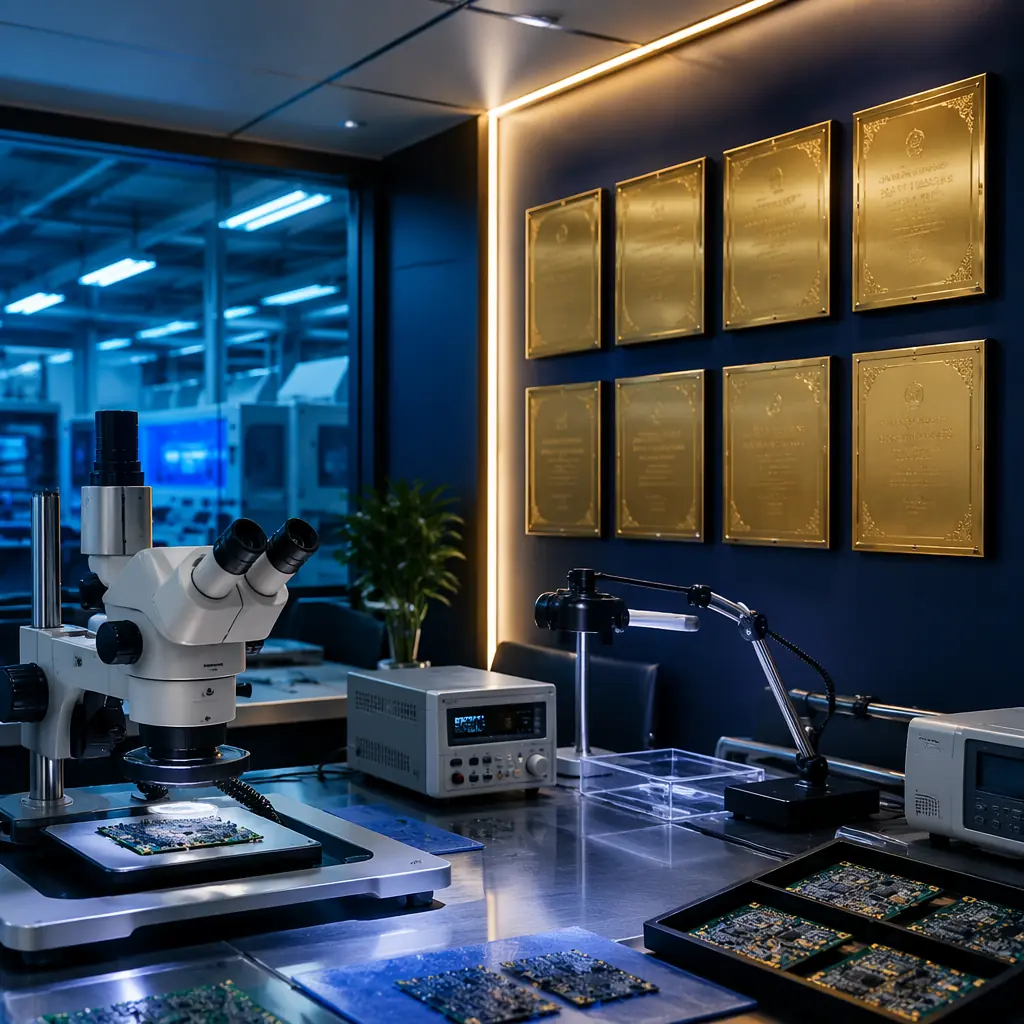
The single most expensive mistake a procurement team can make isn't choosing the wrong PCB material or misjudging lead times. It's trusting a supplier's certification claims without verifying them. A framed ISO 9001 certificate on the factory wall proves exactly nothing. What matters is whether the certificate is current, covers the specific processes your boards require, and was issued by an accredited body with real audit teeth.
Huaxing PCBA holds 6 active certifications spanning quality management (ISO 9001:2015), automotive-grade manufacturing (IATF 16949), product safety (UL), workmanship standards (IPC-A-610 Class 3), and environmental compliance (RoHS, REACH). Every certificate is verifiable through its issuing body's public registry. And we provide the certificate numbers to every customer before the first PO is cut. Here is what each standard actually means, and how to verify it.
ISO 9001:2015, The Non-Negotiable Baseline
ISO 9001 is the most widely recognized quality management standard in the world, and the most frequently misrepresented. Over 1.1 million organizations hold ISO 9001 certification globally, which means a supplier claiming it tells you nothing unless you dig deeper.
Verify the Certification Body, Not Just the Certificate
A legitimate ISO 9001 certificate is issued by an IAF-accredited certification body, examples include SGS, TÜV, BSI, and Bureau Veritas. Certificates from unaccredited "consultants" or self-declared bodies are worthless. Check the issuing body against the IAF CertSearch database: every accredited body is listed. Cross-reference the certificate number directly on the certification body's own registry, not just the supplier's website. Our ISO 9001 certificate (issued by SGS) is verifiable at sgs.com/certified-clients.
Check the Scope, It Must Cover PCB/PCBA Manufacturing
ISO 9001 certificates have a defined "scope of certification." A supplier might hold ISO 9001 for "trading of electronic components", not for PCB manufacturing. The scope must explicitly list PCB fabrication and/or PCB assembly. Read it on the certificate itself. If a supplier won't share the full certificate with scope details before you place an order, walk away.
Confirm the Certificate Is Current, Not Expired or Suspended
ISO 9001 certificates are valid for three years with annual surveillance audits. A certificate with an expiry date in the past, or one issued five years ago with no current version, means the supplier let it lapse. Most certification body registries show status (Active / Suspended / Withdrawn). Always verify status before engaging.
Procurement Reality: ISO 9001 is the floor, not the ceiling. It confirms the supplier has documented processes and follows them, but it says nothing about the quality of those processes or the technical capability of the factory. For PCB manufacturing, you need additional standards that speak to product quality directly.
IATF 16949, The Automotive-Grade Standard That Raises the Bar for Everyone
IATF 16949 is built on ISO 9001 but adds 71 additional requirements specific to automotive production. The key differentiator: defect prevention rather than defect detection. While ISO 9001 allows you to catch and correct defects, IATF 16949 demands that your processes be designed so defects cannot occur in the first place.
This matters even if you don't make automotive PCBs. A factory running under IATF 16949 discipline applies the same rigor, statistical process control, PFMEA (Process Failure Mode and Effects Analysis), measurement system analysis, to every production line, including your consumer or industrial boards. For a detailed look at what automotive PCB requirements demand, see our automotive PCB requirements guide.

IATF 16949 Requires Product-Safe Traceability, Not Just Lot Tracking
Under IATF 16949, every PCB must be traceable back to its raw material batch, production machine, operator shift, and test results, not just the production lot. This traceability chain must be demonstrable within 24 hours during an audit. For buyers, this means if a field failure occurs two years after shipment, we can identify the exact scope of affected units in under a day.
Customer-Specific Requirements (CSRs) Are Part of the Audit
IATF 16949 requires suppliers to incorporate each customer's specific quality requirements into their management system. This isn't optional, auditors check for it. When you work with an IATF 16949-certified factory, your specific quality requirements (AQL levels, inspection criteria, packaging specs) get baked into the production control plan, not just noted in an email.
Surveillance Audits Are Annual, and Real
IATF 16949 audits are conducted by IATF-oversight-approved certification bodies only, a much smaller pool than ISO 9001 auditors. The audit lasts 3-5 days on-site. A supplier with a valid, current IATF 16949 certificate has been through a genuine, intensive process audit within the last 12 months. Verified our certificate through the IATF database.
UL Certification, Safety, Flammability, and Market Access
UL (Underwriters Laboratories) certification for PCBs focuses primarily on flammability rating and electrical safety. The most critical specification is UL 94 V-0 . The highest flame-retardant classification. Which means the PCB substrate self-extinguishes within 10 seconds of flame removal and does not produce flaming drips. For products sold in North America, UL recognition on the PCB itself is often a hard requirement from regulatory bodies, insurance providers, and end-customer procurement policies.
| UL Rating | Max Afterflame | Drips Allowed | Required For |
|---|---|---|---|
| UL 94 V-0 | ≤10 seconds | None (non-igniting) | Consumer electronics, medical, automotive interior |
| UL 94 V-1 | ≤30 seconds | None (non-igniting) | Industrial equipment, less critical applications |
| UL 94 V-2 | ≤30 seconds | Allowed (igniting) | Low-voltage, non-safety applications |
| UL 94 HB | Slow burn rate | Allowed | General purpose, non-critical |
A legitimate UL-certified PCB manufacturer has a UL file number (E-number format) that is publicly searchable in the UL Product iQ database. The file lists the specific PCB constructions (materials, layer counts, minimum trace/space, copper weights) covered by the certification. A manufacturer claiming UL certification but unwilling to share their file number is almost certainly not certified, or their certification doesn't cover your specific board design.
Key Verification Step: Search the supplier's UL file number at iq.ulprospector.com. The database shows: certification status (Active/Inactive), authorized factories with addresses, and the exact PCB construction parameters covered. If the file doesn't list the materials and layer count your design requires, the certification is irrelevant to your project.
For medical device PCBs, UL recognition is often combined with additional requirements, see our medical device PCB manufacturing guide for the full regulatory landscape. Aerospace and defense applications impose even stricter material traceability requirements covered in our aerospace & defense PCB guide.
IPC Standards, Workmanship and Performance Requirements
Unlike ISO and IATF which govern management systems, IPC standards define the physical quality of the finished PCB: what constitutes an acceptable solder joint, what level of via voiding is permissible, how much annular ring breakout is allowed. The two standards buyers need to specify are IPC-A-610 (acceptability of electronic assemblies) and IPC-6012 (qualification and performance of rigid printed boards).
IPC-A-610 Class 2 vs Class 3, The Difference Is Field Reliability
Class 2 (Dedicated Service Electronics) permits minor cosmetic imperfections as long as they don't affect function. Class 3 (High-Performance Electronics) demands near-perfect workmanship, no solder voids exceeding 15% of joint area, no lifted lands, no exposed copper on plated through-holes. The cost difference between Class 2 and Class 3 typically adds 5-15% to assembly cost, but for medical, aerospace, or automotive applications, Class 3 is non-negotiable. Our IPC Class 2 vs Class 3 comparison breaks down every acceptance criterion side by side.
IPC-6012, Qualification Testing for Bare PCBs Before Assembly
IPC-6012 governs the bare PCB before a single component is placed. It defines thermal stress testing (solder float at 288°C for 10 seconds), peel strength minimums, and plating thickness requirements. A PCB that passes IPC-6012 Class 3 qualification has been verified for structural integrity at the bare board level. Meaning assembly defects are far less likely to originate from the PCB itself. This is especially critical for heavy copper PCBs where plating thickness directly determines current-carrying capacity.
IPC Certification Is Operator-Level, Not Just Factory-Level
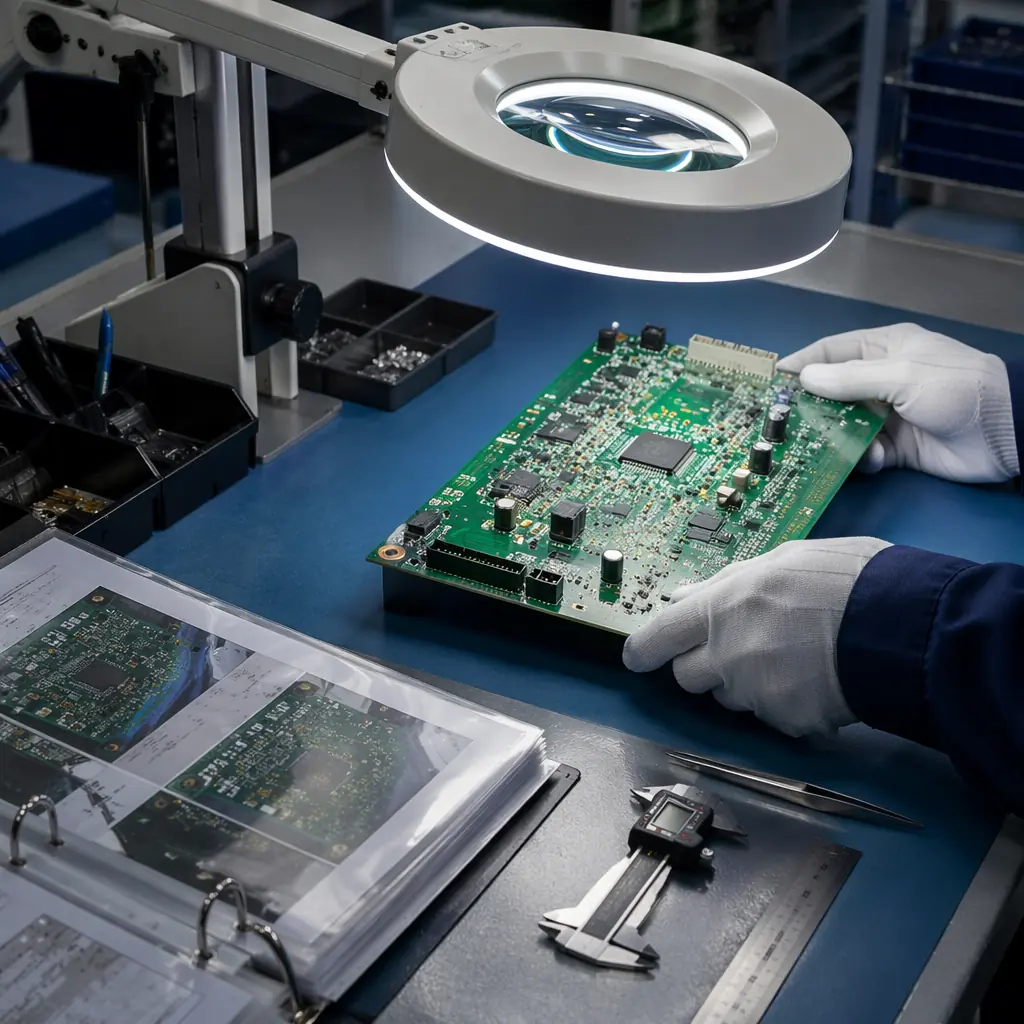
A factory can claim "built to IPC standards" without a single IPC-certified operator on the floor. What matters is whether operators hold CIT (Certified IPC Trainer) or CIS (Certified IPC Specialist) credentials. And whether those credentials are current (recertification is required every 24 months). Ask for the number of IPC-certified personnel on each shift, not just whether the factory "follows IPC standards." Combined with rigorous PCB testing methods, certified operators deliver consistently verifiable quality.
RoHS & REACH, Environmental Compliance for EU and Global Markets
These two regulations are the most frequently confused by buyers. And the most devastating when non-compliance is discovered at customs. The distinction is simple but critical:
| Regulation | Scope | Restricted Substances | Applies To | Enforcement |
|---|---|---|---|---|
| RoHS (2011/65/EU) | Electrical/electronic equipment | Lead, mercury, cadmium, hexavalent chromium, PBB, PBDE (and 4 phthalates since 2019) | Products sold in EU/EEA | Customs seizure, fines up to €200,000 per violation |
| REACH (EC 1907/2006) | All chemical substances | SVHC Candidate List (235+ substances), Annex XVII restrictions | Products manufactured in or imported to EU | Market withdrawal, criminal liability |
RoHS compliance for PCB manufacturing means: every laminate material, solder alloy, surface finish chemistry, solder mask, and silkscreen ink must contain less than 0.1% by weight of each restricted substance (0.01% for cadmium). For lead-free assembly, this means SAC305 (Sn96.5/Ag3.0/Cu0.5) solder. Not just "lead-free" which can mean cheaper alloys with worse reliability characteristics.
REACH compliance goes deeper: the EU's SVHC (Substances of Very High Concern) Candidate List is updated every six months. A PCB that was REACH-compliant in January might not be compliant in July if a new substance has been added. This requires active supply chain management, not just a one-time declaration. For buyers targeting European markets, request REACH compliance declarations updated within the last six months, and verify they cover the current SVHC list.
Cost of Non-Compliance: In 2024, EU member states issued over €8.2 million in RoHS-related fines. More damaging than fines: customs holds that delay shipments by 2-4 weeks while compliance documentation is verified. For a production line waiting on PCBs, that delay costs far more than the fine. Always request material-specific RoHS/REACH declarations, not a generic "our products are compliant" statement.
A Practical Verification Checklist, Before You Cut the First PO
You have a supplier's list of certifications. Here is the verification workflow that separates documented capability from marketing claims:
Request Certificate Numbers and Issuing Bodies, Not Just Certificate Images
A JPEG of a certificate is trivially forged. Ask for: certificate number, issuing body name, scope statement, and expiry date. Cross-reference every number independently on the issuing body's public registry. A supplier that hesitates or offers "we can send you the certificate later" is a red flag. For a complete supplier evaluation framework, see our PCB supplier audit checklist.
Verify Scope Coverage for Your Specific PCB Technology
A UL file might cover 2-layer FR-4 boards but not the 8-layer impedance-controlled design you need. An IATF 16949 certificate might cover "PCB assembly" but not bare board fabrication. Match the certification scope to your exact requirements, layer count, materials, surface finish, and assembly complexity. For complex assembly processes, confirm the certification covers your specific SMT requirements.
Check Audit Dates, Certificates Expire and Audits Have Gaps
ISO/IATF certificates are valid for 3 years with mandatory annual surveillance audits. A certificate that was last audited 18 months ago is out of compliance. It should have had a surveillance audit within the last 12 months. Request the most recent audit report summary (non-conformities found, corrective actions taken) to see what the auditors actually discovered.
RoHS/REACH: Request Material-Specific Declarations, Not Generic Statements
A compliant supplier can provide RoHS declarations for each material in your PCB stackup: laminate supplier + grade, solder mask brand + type, surface finish chemistry, solder alloy composition. Generic "our products are RoHS compliant" statements are insufficient for EU customs clearance. REACH declarations must reference the current SVHC Candidate List publication date.
Cross-Check the Factory Address on Every Certificate
Certifications are tied to specific physical addresses, not to a company name alone. If a supplier's ISO certificate lists Factory A in Shenzhen but your boards are being produced at Factory B in Dongguan, the certification doesn't apply. Certificates from different standards should list consistent addresses. Mismatched addresses are a common sign of subcontracting without disclosure. Our industrial control PCB clients routinely audit this detail.
Certifications Are a Starting Point, Not the Final Answer
Every certification discussed above is verifiable, standard-specific, and independently auditable. A supplier that holds all of them and transparently shares certificate numbers for independent verification has demonstrated organizational commitment to quality. But certifications alone don't guarantee your specific boards will be manufactured correctly. That requires direct communication with the engineering team, DFM feedback before production begins, and documented quality control at every process step.
At Huaxing PCBA, we provide every customer with our certification package before the first purchase order: current ISO 9001, IATF 16949, UL file number, IPC operator credentials, and material-specific RoHS/REACH declarations, all verifiable through their issuing bodies' public registries. Our engineering team provides free DFM review within 24 hours. Understand PCB cost drivers before you quote, or contact our engineering team with your Gerber files for a project-specific compliance assessment.