A PCB can survive 260°C reflow soldering, pass flying probe testing with zero faults, and meet IPC Class 3 inspection criteria, then arrive at your facility with latent ESD damage from inadequate packaging. Electrostatic discharge doesn't always kill a board instantly; it creates weakened junctions that fail in the field months later, generating warranty returns you can't trace back to their root cause.
The ocean freight journey from Shenzhen to Rotterdam or Los Angeles takes 2–4 weeks. During that time, your PCBs experience temperature swings of 15–35°C, humidity from 30% to 95%, vibration, and, in poorly packaged shipments, direct exposure to static-generating packaging materials. This guide covers the exact packaging specification you should include in your purchase order to ensure boards arrive in the same condition they left the factory.
IPC-1601: The Standard That Most Buyers Overlook
IPC-1601 is the industry standard for "Printed Board Handling and Storage Guidelines." While most PCB buyers know about IPC-A-600 (acceptability) and IPC-6012 (performance specification), relatively few specify IPC-1601 compliance. Yet it's the standard that directly governs how your boards are packaged, handled, and protected during shipment.
Key Takeaway: Adding "Packaged per IPC-1601 Section 5" to your purchase order costs nothing extra at a qualified manufacturer but ensures your boards receive moisture-proof, ESD-safe packaging with documented humidity control. At our facility, this is the default standard, not an upsell.
What IPC-1601 Section 5 Requires for Packaging
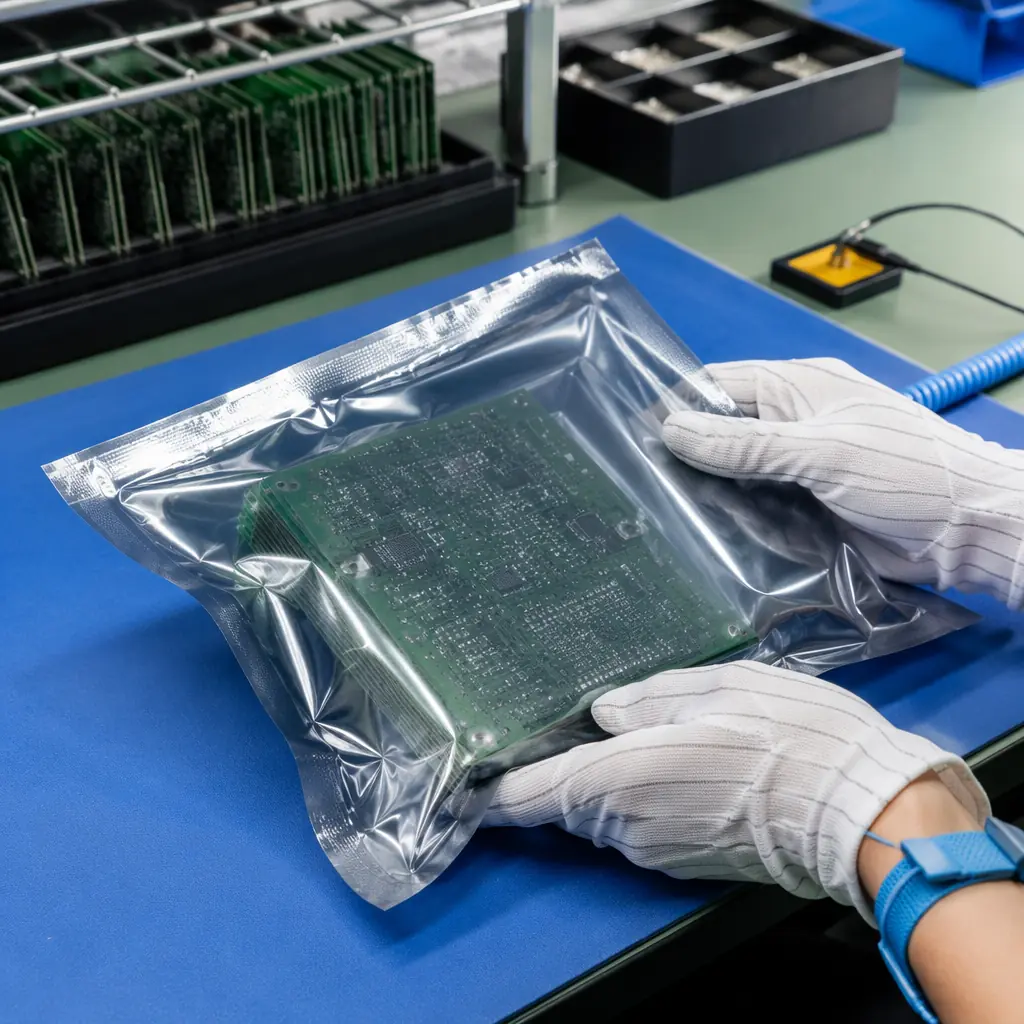
The standard mandates moisture barrier bags (MBB) with a minimum water vapor transmission rate (WVTR) below 0.02 g/100 in²/24hr, desiccant sufficient for the bag volume, a humidity indicator card (HIC) visible without opening the bag, and ESD-shielding construction meeting ANSI/ESD S20.20 surface resistance requirements of 10⁴ to 10¹¹ ohms.
The Three-Layer Moisture Barrier Bag Construction
A proper MBB has three functional layers: an outer polyester layer for puncture resistance, a middle aluminum foil layer (0.00035 inch minimum) for moisture and static shielding, and an inner polyethylene layer for heat-sealability and low-static generation. Single-layer pink poly bags, still used by some low-cost suppliers, provide zero moisture protection and minimal ESD shielding. They are not IPC-1601 compliant.
Desiccant Specification: Not Just Any Silica Gel Packet
IPC-1601 specifies desiccant quantity based on bag surface area using MIL-D-3464 Type II or III desiccant. For a standard 16 × 20 inch MBB, you need approximately 8–10 units of desiccant (one unit = the amount that absorbs 3.0g of water vapor at 20% RH). The desiccant must be placed inside the sealed bag, not taped to the outside. Pre-conditioned desiccant (baked at 120°C before packing) is essential, ambient-stored silica gel may already be saturated before it enters the bag.
Humidity Indicator Cards: The 60-Second Quality Check
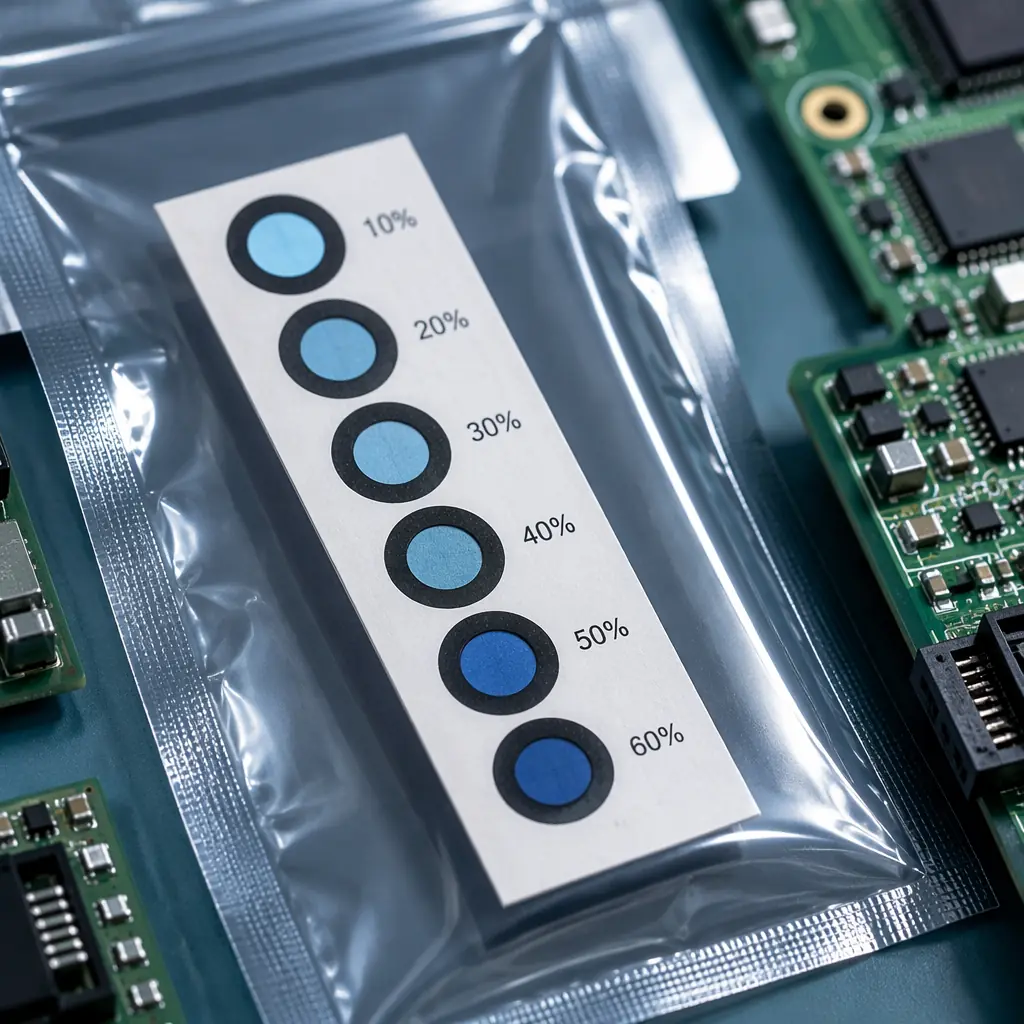
A humidity indicator card (HIC) is the simplest, most powerful tool you have for incoming inspection. It's a small card with moisture-sensitive spots that change color at specific relative humidity thresholds: typically 10%, 20%, 30%, 40%, 50%, and 60% RH.
How to Read an HIC at Receiving Inspection
Open the outer carton, locate the sealed MBB, and check the HIC through the transparent side of the bag. The 30% RH spot must be blue (dry). If the 30% spot shows pink, or worse, if the 40% or 50% spots have changed, the bag seal has failed or desiccant was inadequate. Reject the shipment or bake boards per J-STD-033 before assembly. This is the #1 missed check in PCB incoming quality inspection.
Why Moisture Matters for Unassembled PCBs
Bare PCBs without components still absorb moisture into the laminate. FR-4 can absorb 0.1–0.3% moisture by weight. When a moisture-laden board hits reflow temperatures, the rapid vaporization can cause delamination, measling (white spots in the weave), or, in the worst case, blistering that destroys the board. The MSL rating system mainly applies to components, but bare boards benefit from the same moisture discipline.
Vacuum Sealing: When and Why
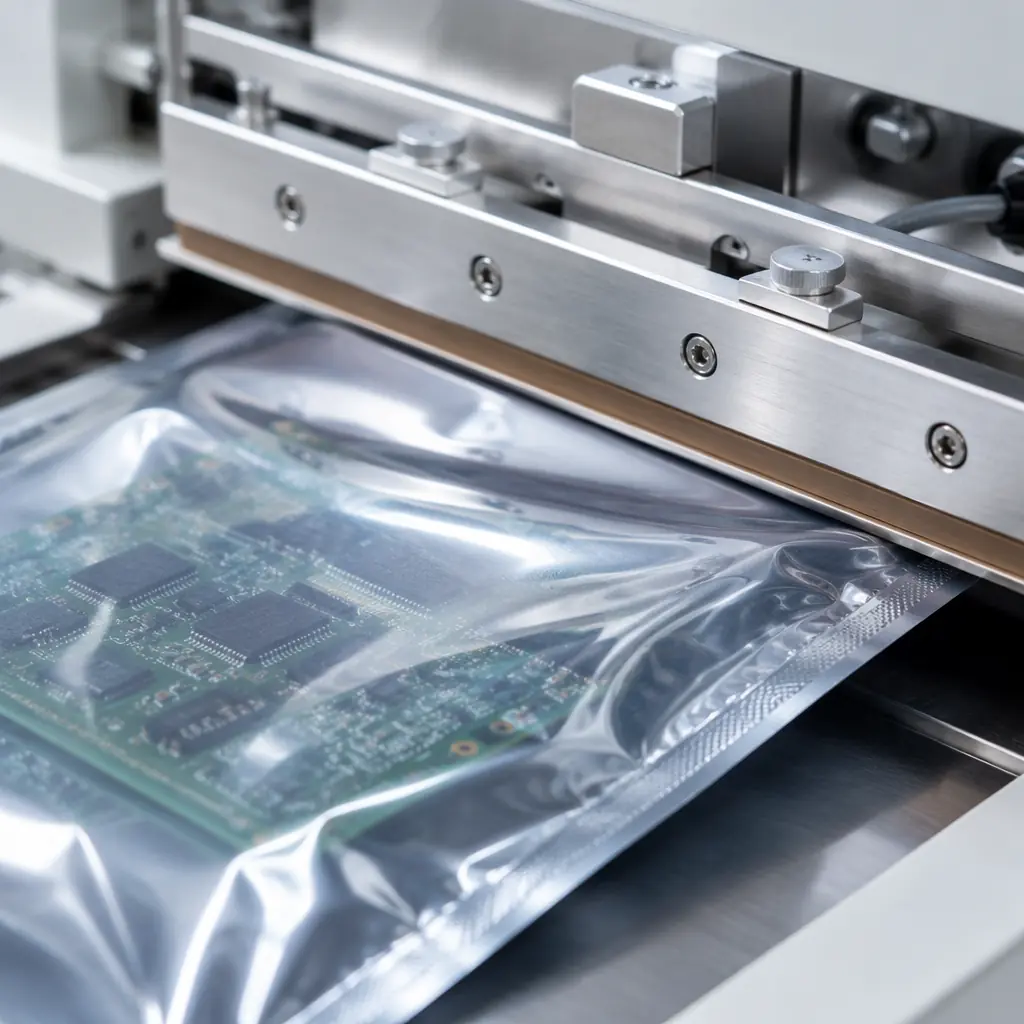
Vacuum sealing takes moisture barrier protection one step further. By removing air from the bag before heat-sealing, you eliminate the moisture source that desiccant must fight against. This is especially important for long ocean freight journeys (3+ weeks) or destinations with high ambient humidity (Southeast Asia, Gulf states, Central America).
| Packaging Level | Method | Moisture Protection | ESD Shielding | Best For |
|---|---|---|---|---|
| Basic | Pink poly bag + bubble wrap | None | Minimal | Not recommended for export |
| Standard | MBB + desiccant + HIC, heat-sealed | Good (6–12 months shelf life) | Full (foil layer) | Air freight, short ocean trips |
| Premium | Vacuum-sealed MBB + desiccant + HIC | Excellent (12–24 months shelf life) | Full (foil layer) | Long ocean freight, high-humidity destinations |
| IPC-1601 Full | Vacuum-sealed MBB + preconditioned desiccant + HIC + ESD-safe outer carton | Maximum | Full system | IPC Class 3, medical, aerospace, military |
Factory Reality: At Huaxing PCBA, every bare PCB and assembled PCBA shipment includes: vacuum-sealed moisture barrier bag, MIL-D-3464 desiccant, humidity indicator card, ESD-safe bubble wrap between boards, and ESD-shielded outer carton with tilt/watch indicators. For IPC Class 3 orders, we add nitrogen purging before vacuum sealing, an extra step that removes residual oxygen and extends bag shelf life to 24+ months.
ESD-Safe Outer Packaging and Carton Design
The moisture barrier bag handles humidity. But ESD protection is a system, from the board surface to the warehouse shelf, and the outer carton is a critical link in that chain.
Conductive vs Static-Dissipative Cartons
Conductive cartons (surface resistance 10²–10⁴ ohms) rapidly drain static charges to ground. Static-dissipative cartons (10⁵–10¹¹ ohms) drain charges more slowly, which is actually safer for sensitive electronics, a too-rapid discharge can itself cause damage. For PCBs and PCBA, static-dissipative outer cartons meeting ANSI/ESD S20.20 are the industry standard. Mark them with the ESD susceptibility symbol (yellow hand in triangle) on at least two sides.
Interleaving Material: No Newsprint, No Regular Bubble Wrap
The material placed between stacked PCBs inside the MBB is as important as the bag itself. Ordinary bubble wrap generates surface charges exceeding 5,000V when unwrapped. Always specify ESD pink bubble wrap (amine-free, surface resistance 10⁹–10¹¹ ohms) or ESD foam sheets. Never allow newsprint or regular polyethylene foam, both are static generators. Our pre-shipment inspection guide includes packaging material checks.
Shock and Tilt Indicators: Proof of Handling Quality
For shipments above $5,000 in value, specify shock watch indicators (set to 25G or 50G threshold) and tilt indicators on the outer carton. They cost $3–$8 each and provide irrefutable evidence if a freight handler drops or inverts your pallet. Without them, you have no proof when you open a carton of cracked BGA packages and the carrier denies liability. This is standard practice in PCB supplier audits for ISO 9001-certified facilities.
What to Write in Your Purchase Order
Don't assume your supplier knows your packaging requirements. Here's the exact line to add to your PO:
PO Packaging Clause: "All PCBs and PCBAs shall be packaged per IPC-1601 Section 5: vacuum-sealed moisture barrier bag (WVTR ≤ 0.02 g/100 in²/24hr) with MIL-D-3464 Type II desiccant and humidity indicator card. ESD-safe interleaving material between boards. Outer carton: static-dissipative (10⁵–10¹¹ ohms) per ANSI/ESD S20.20. Include shock watch indicator (50G) and tilt indicator on outer carton. Photograph packaging at each stage and include with shipping documents."
At Huaxing PCBA, IPC-1601 packaging is our factory default, not a premium option. Every order, from a 5-board prototype to a 5,000-board production run, receives the same vacuum-sealed, desiccant-protected, HIC-verified packaging that our aerospace and medical customers require. Review our certifications or contact our team to discuss packaging specifications for your next order.