
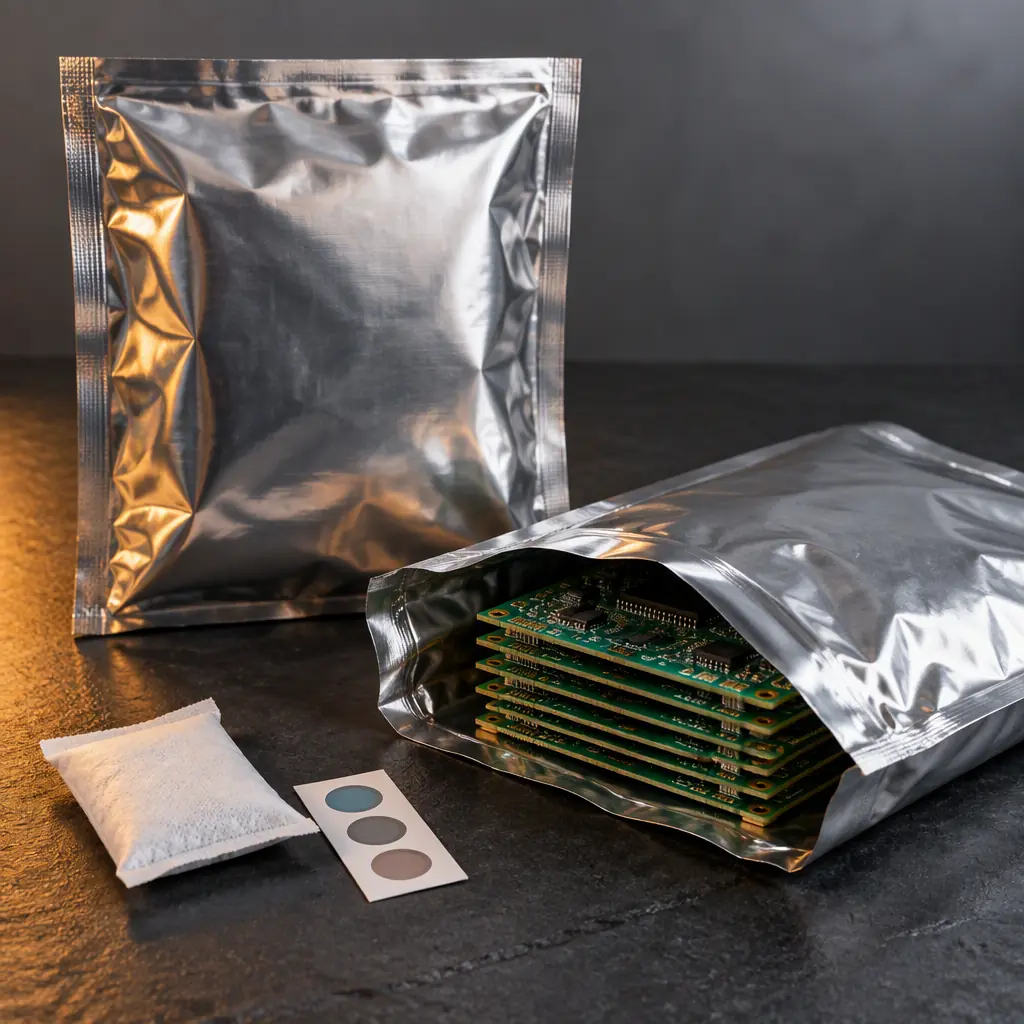
Most PCB damage happens after the board is finished. A board that passed electrical test, final inspection and outgoing quality control can be scrap, or worse a returned lot, because of a moisture-barrier bag that was heat-sealed with the wrong desiccant load, a stack that was too tall for the carton, or a bag that was opened at receiving and then sat open for a week.
Packaging is also the part of a purchase order that is written last, in the fewest words, and audited least. "Standard export packing" is a phrase that means almost nothing and covers almost nothing. This page sets out what a PCB packaging specification should actually contain, the arithmetic behind a compliant moisture-barrier pack, how to read a humidity indicator card at receiving, and how a transit-damage claim is proven.
The underlying standard is IPC-1601, which governs handling and storage of printed boards, including the moisture-barrier bagging requirement. Our PCB storage and moisture control guide covers the storage side; this page covers the pack, the transit and the receiving inspection sequence.
What Must Be In A Moisture-Barrier Pack
A compliant moisture-barrier pack has five elements and all five are inspectable in thirty seconds. If any one is missing, the pack does not preserve the boards and the whole point of the bag is lost.
- A metallised moisture-barrier bag with a specified moisture vapour transmission rate. The bag is not a plain antistatic bag; a plain pink or black antistatic bag controls static, not moisture, and using one as a moisture barrier is one of the most common packaging errors we see on incoming lots.
- Desiccant in a quantity matched to bag internal area and transit duration, in a unit-dose sachet, not loose beads. The arithmetic is below.
- A humidity indicator card (HIC) inside the bag, visible through the bag wall or readable without breaking the seal.
- A heat-sealed closure across the full bag width, with a seal that is continuous and free of folds. A folded or taped closure leaks at a rate that makes the desiccant calculation meaningless.
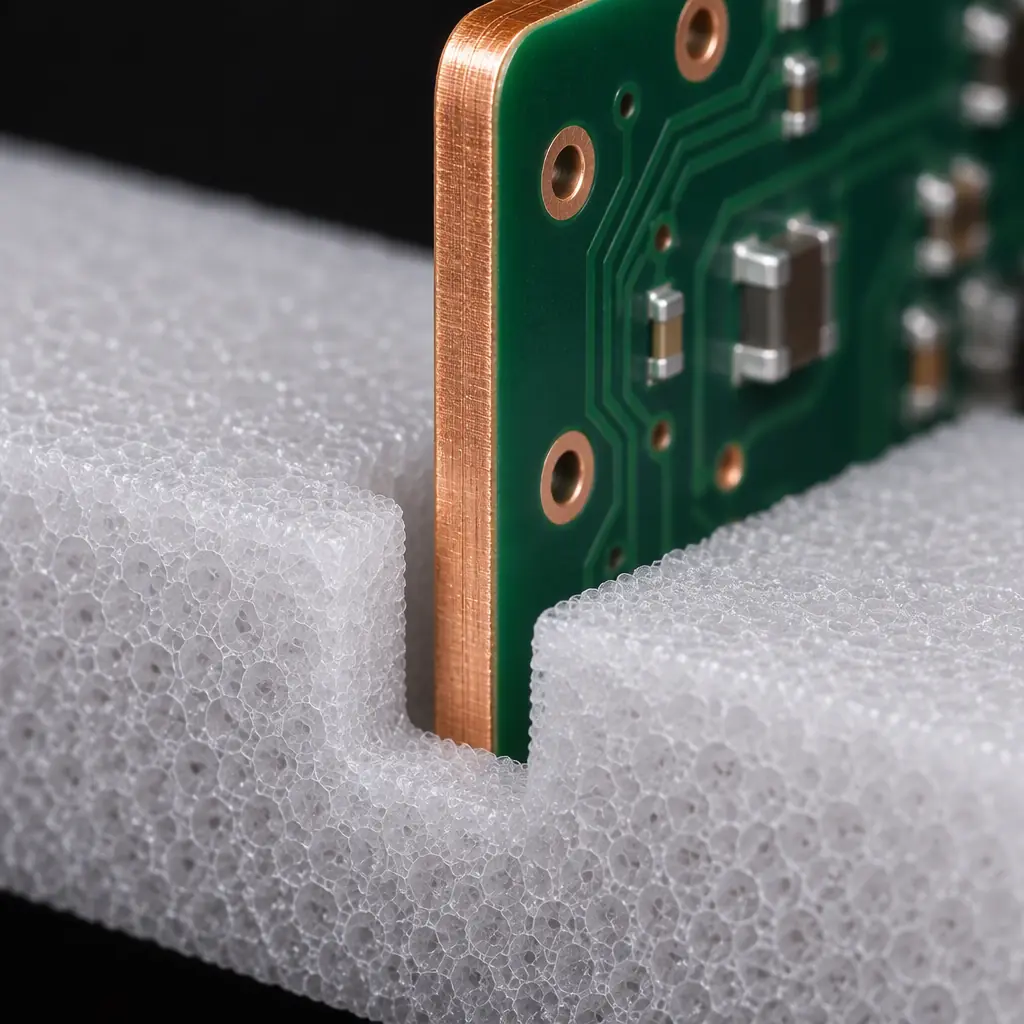
- Mechanical protection inside the bag or immediately outside it: foam interleaves, edge protectors, or a slotted foam block so boards cannot abrade against each other.
A sixth element is often written into contracts and almost never verified: the bag must not be punctured by board corners. On thin boards with sharp routed edges, a corner puncture during transit is the single most common cause of a bag that was compliant when it was sealed and non-compliant when it arrived.
The Desiccant Arithmetic
Desiccant quantity is calculated, not guessed. The unit-dose method works from bag surface area and the target internal humidity.
For a bag of dimensions L × W in inches, the internal surface area is approximately 2 × L × W square inches. For a 12 × 16 inch bag that is 384 square inches. Industry desiccant unit tables allocate roughly one unit of desiccant per 100 square inches of barrier area for a transit duration of up to one year at moderate humidity, so a 12 × 16 bag needs about four units. For a 20 × 24 inch bag the area is 960 square inches and the requirement is about ten units.
Two corrections apply on top of the table figure. First, add desiccant for entrapped air: a bag that is not vacuum-compressed holds more moisture-laden air to dry out. Second, add for the board area itself, because bare laminate and solder mask both adsorb moisture, and the bag has to hold both the air and the boards below the target humidity. A practical rule we use is to add 25% to the table figure whenever the boards are not vacuum-packed, and to use the next size up when the pack will be stored for more than six months.
The consequence of getting this wrong is not a dramatic failure at receiving. It is a bag that reads acceptable at day one and unacceptable at month four, on boards that were never baked because the pack was assumed to be intact.
Reading A Humidity Indicator Card At Receiving
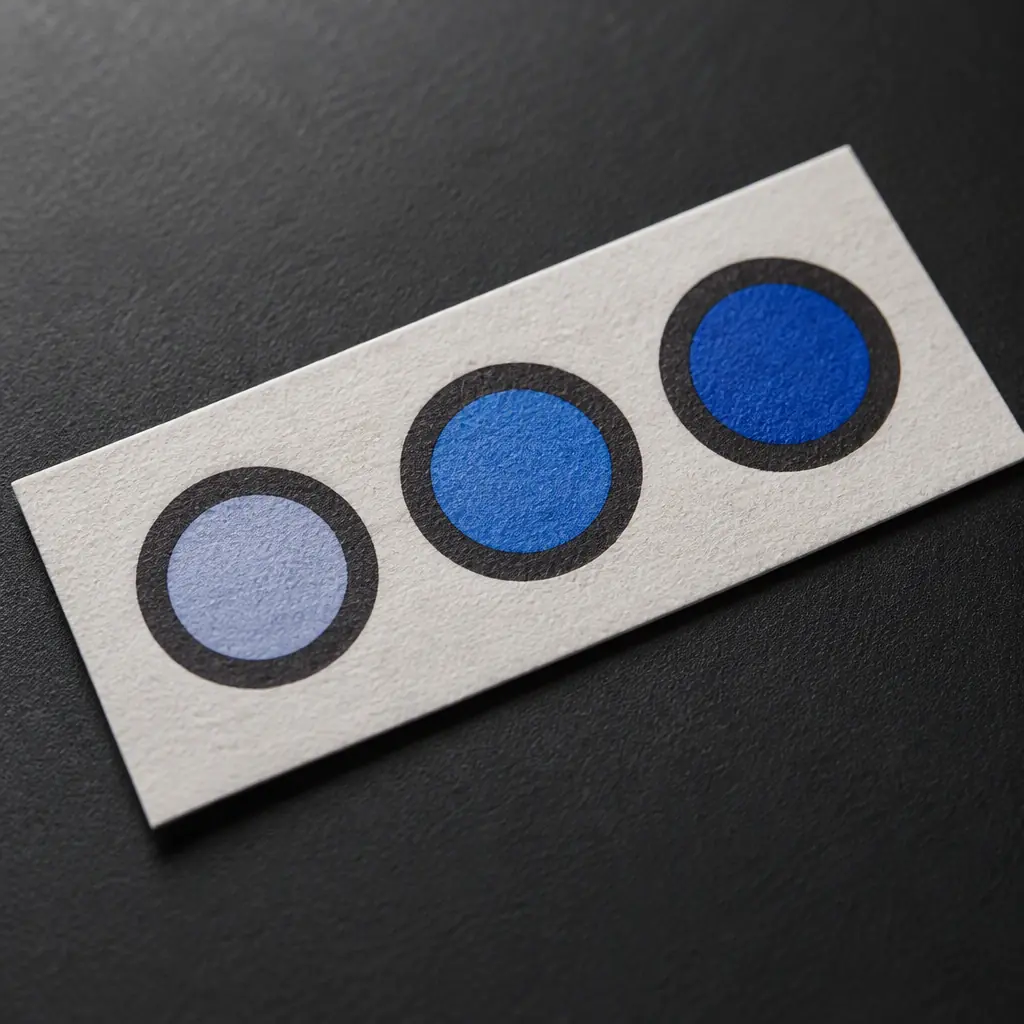
The HIC is a three-spot or five-spot card with cobalt chloride or a cobalt-free equivalent, and each spot changes colour at a threshold: typically 30%, 40% and 50% relative humidity for the common three-spot card. The reading rule is not "check whether the spots are blue." It is a decision tree.
| HIC reading at opening | Meaning | Action |
|---|---|---|
| 30% spot still blue | Pack held. Boards are dry. | Accept. Move to controlled storage if not used within the floor life of the material class. |
| 30% spot pink, 40% spot blue | Marginal. Moisture ingress occurred but is limited. | Accept only if the boards will be reflowed within 24 hours, or bake before use. |
| 40% spot pink, 50% spot blue | Pack failed. Boards have absorbed moisture. | Bake per the material's specification before any reflow. Do not accept into stores as dry. |
| All spots pink | Pack failed, and for some time. | Bake, then inspect for oxidation and solderability. If solderability is doubtful, run a wetting balance test. |
| HIC absent or unreadable | No evidence either way. | Treat as failed. The pack cannot be verified, so it cannot be accepted as dry. |
The 30%-pink row is the one that produces the most disputes, because the pack technically held and technically did not. Our position, and what we write into shipping documentation, is that a 30% spot shifting while the 40% spot holds is acceptable for boards reflowed within 24 hours of opening and requires a bake otherwise. Agreeing that rule before the first shipment removes the argument at the second.
ESD Packaging: Three Different Jobs
Static packaging is frequently specified with one word and three different requirements get conflated. They are not interchangeable.
- Dissipative or antistatic bags prevent charge generation and allow slow discharge. They do not shield against external fields. Suitable for a board that will be handled at an ESD-protected bench.
- Static shielding bags (metallised, with a Faraday-layer construction) block external electrostatic fields and are what a board needs when it leaves a controlled environment and travels. This is the correct outer bag for almost all export PCB shipments.
- Moisture-barrier bags control humidity. A metallised moisture-barrier bag is usually also static shielding, which is why one bag can serve both purposes, but the specification must state both requirements explicitly, because a supplier optimising for moisture alone may select a barrier film without the shielding layer.
Inside the bag, the board still needs mechanical protection and, on assemblies with connectors or tall components, a standoff so the components are not load-bearing. Our ESD control program guide covers the bench and floor requirements that the packaging has to be compatible with.
Carton, Stack Height And Transit
Packaging inside the carton protects against moisture and static. The carton protects against mechanical load, and mechanical load is where the damage is. Three parameters are worth specifying explicitly in the order.
Stack height limit. State the maximum number of cartons that may be stacked, and state the maximum number of boards or bagged packs per carton. The board count matters more than the carton count: a carton rated for 20 kg loaded with 31 kg of 2.0 mm boards will fail at the bottom of a pallet, and the failure looks like impact damage rather than compression damage.
Drop and vibration criteria. International parcel networks subject cartons to drops that are far more severe than the ISTA sequence an export crate is designed for. If your boards ship by express courier rather than pallet freight, say so, because the packaging requirement differs. Our bow and twist acceptance guide explains why compression load shows up as a flatness failure on thin boards even when nothing visibly broke.
Edge and corner protection. Corner protectors on the carton and edge protectors on the board stack. Racked boards shipped without edge protection show dents at the panel rail, which is a functional defect if the rail carries a card-edge connector.
Proving A Transit Damage Claim
Claims fail for evidentiary reasons, not for lack of damage. The pack that arrived crushed cannot prove whether it left the factory sound, and without that proof the claim becomes a negotiation about reputation.
The evidence set that works has four parts, and all four should be produced before the carton is fully opened:
- Photographs of the carton exterior before opening, including the seal, all four sides and the corner protectors, with the shipping label visible and legible.
- The carrier's delivery record and, where the carrier offers it, the dimensional and weight scan data. A carton that arrives lighter than its despatch weight has lost contents, and a carton whose dimensions changed has been re-packed.
- Photographs of the inner pack at each layer as it is opened: the outer bag seal, the HIC reading before the bag is breached, the foam interleaves, then the boards.
- A defect map of the boards with panel position, defect type and a measured value where possible. A claim that says "some boards are damaged" is not a claim.
The HIC photograph before breaching the bag is the one that is most often missing and most valuable, because it separates moisture damage from mechanical damage in one frame. If the card is read after the bag has been open for an hour, its reading is no longer evidence of anything.
What To Write Into The Order
Four lines in the purchase order close most of the exposure, and they take ten minutes to write.
Pack specification line. Reference IPC-1601 for handling and bagging, state the bag type with both moisture-barrier and static-shielding requirements, and state the desiccant method (unit-dose per bag area). This is the line that makes "standard export packing" enforceable.
Evidence line. Require a HIC photograph inside the sealed bag on the outgoing inspection record for every carton, and require the desiccant lot to be recorded. Our outgoing quality control guide explains where this sits in the OQC gate, and the pre-shipment inspection checklist covers the rest of the outgoing checks.
Incoming acceptance line. State the HIC decision table above as the receiving criterion, so that a marginal card has a rule rather than a debate. State also the bake obligation and who pays for it when the pack fails.
Liability line. State that transit damage is the seller's responsibility until the carrier's proof of delivery, and that the seller will supply the evidence package within 48 hours of a damage notification. When a claim does occur, our warranty and RMA guide covers how the return and credit process runs once liability is agreed.
None of these lines adds cost to a well-run supplier. They add cost only to a supplier who was relying on the ambiguity, which is precisely the supplier whose packaging you needed to specify.
The Receiving Sequence, In Order
The order in which a carton is opened matters, because three of the checks destroy evidence for the others. Do them in this sequence and the evidence chain survives.
- Before opening: photograph the carton. Six faces, the seal, the shipping label. Check the declared weight against your own scale reading and note any discrepancy.
- Open and photograph the void fill. The inner pack position tells you whether the contents moved in transit. A bag resting against one carton wall with all the void fill on the opposite side is evidence of a shift.
- Read the HIC through the sealed bag and photograph it. This is the one check that cannot be repeated. Once the bag is breached, the card begins to equilibrate with room air within minutes.
- Check the seal integrity. Run a thumb along the heat seal looking for channels, folds and punctures. A seal with a fold has a leak path even if it looks continuous.
- Open the bag and count. Panel count, board count and serial range against the packing list. A count discrepancy is a separate finding from moisture or mechanical damage and should be recorded separately.
- Inspect the boards. Edge dents, corner cracks, scratches, solder-mask scuffs and flatness. For thin boards, check flatness after a 24-hour relaxation at room temperature rather than immediately, because a board that was compressed in a carton will read a false bow while it is still warm and loaded.
Steps one to three take under five minutes and are the ones that decide whether a claim survives. The common error is to open everything first and photograph the damage second, at which point the moisture evidence is gone and the mechanical evidence has been contaminated by handling.
Packing For The Shipment You Actually Have
Pack specification is usually written once and reused, which is why so many packs are wrong for the shipment in front of them. Four variables change the requirement, and each one should be answered on the order rather than assumed.
| Shipment variable | Effect on the pack | What to state |
|---|---|---|
| Transit mode | Express courier exposes cartons to repeated single-parcel drops; pallet freight exposes the bottom carton to sustained compression | Name the mode. Courier shipments need carton drop rating, not just stack strength |
| Transit duration | Desiccant load and barrier grade both scale with time | Expected door-to-door days. Air freight is 3–7 days; sea is 30–45 and needs the next barrier grade up |
| Board thickness | Thin boards (≤1.0 mm) deflect under stack load and read as flatness rejects | Maximum boards per pack and per carton, stated separately from the carton's weight rating |
| Board finish and cleanliness | ENIG and OSP surfaces are sensitive to humidity and to sulphur-bearing packaging materials | Barrier grade and a statement that packaging materials are sulphur-free and low-outgassing |
The sea-freight row is where the arithmetic above changes most. A 40-day transit with a non-vacuum pack needs both the additional 25% desiccant allowance and one additional unit per 100 square inches, and the HIC should be a 5-spot card so that an intermediate reading is distinguishable from an outright failure at receiving. On a 20 × 24 inch bag that is roughly a doubling of the desiccant load compared with a one-week courier shipment, for a cost increase measured in cents per pack.
The Cost Of Getting It Wrong
Packaging is the cheapest control in the whole process and the one with the largest asymmetric downside. A moisture-barrier bag, unit-dose desiccant matched to area, a HIC and a heat seal cost a few dollars per pack on a mid-size shipment. A failed pack costs a bake cycle at minimum, and a bake cycle on a fully assembled board with moisture-sensitive components carries its own risk: repeated bakes consume floor life and, on some component classes, degrade solderability and internal joints.
Where the pack fails badly enough to reach reflow without a bake, the cost is not a bake but a batch of popcorning, delamination and open joints that presents as a process defect and is attributed to the assembly line. That is the expensive version of this failure, and it is why the HIC photograph belongs in the outgoing record: it converts an attribution argument into a documented data point, and it costs a phone camera and ten seconds per carton.
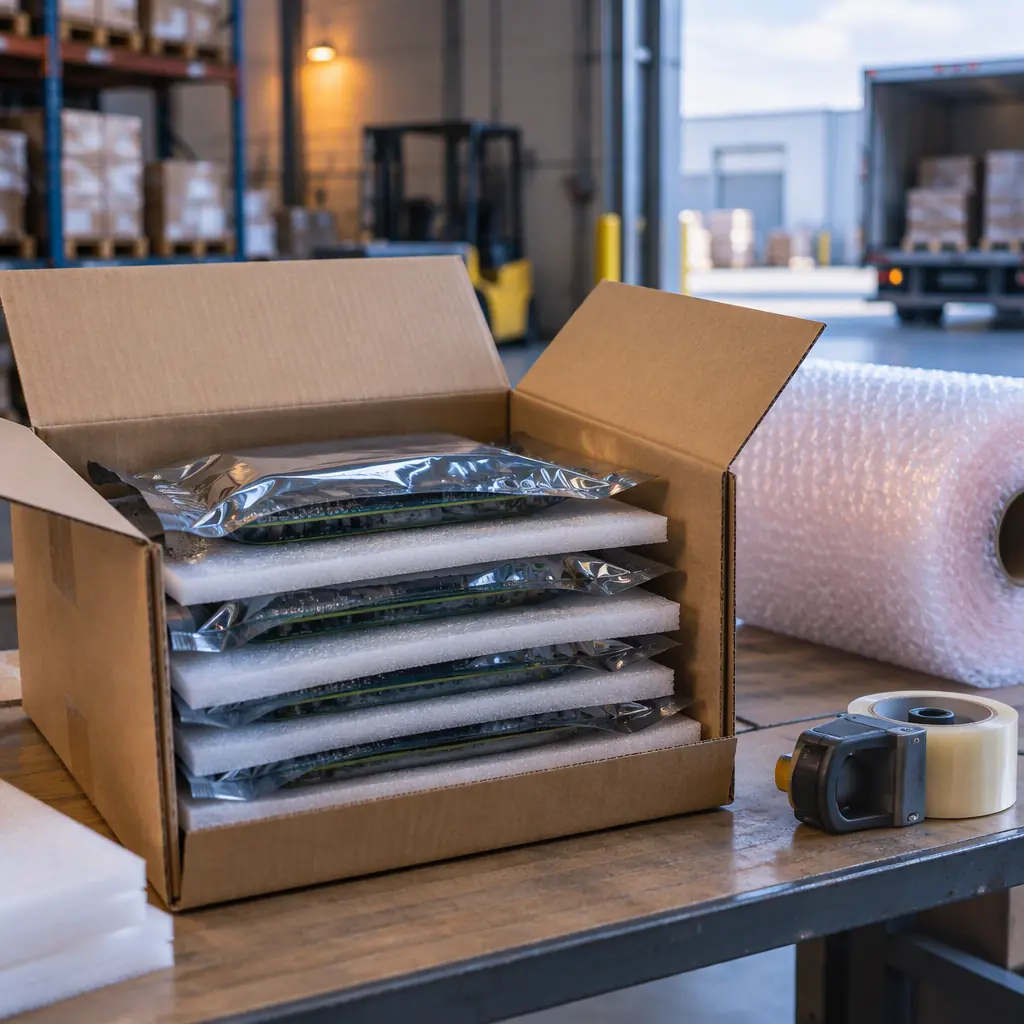
The summary that matters for a buyer: the pack is part of the product. A board that arrives dry, flat and undamaged is a board whose supplier controlled the last mile of the process. A board that arrives with a marginal HIC reading and a corner dent has already lost some of the process control you paid for, and the cost of that loss appears later, in reflow defects and in flatness rejections that get blamed on fabrication.