

Industry studies attribute 8-33% of electronic product failures to electrostatic discharge, with annual losses to electronics manufacturers estimated in the billions of dollars. The painful part: most ESD damage is latent. A chip weakened by a 200V discharge at an unprotected workstation can pass final test, ship, and fail in the customer's hands a year later. That is why an ESD control program is not a quality nicety — it is a reliability requirement, and for most regulated industries it is a contractual one. ANSI/ESD S20.20 is the standard that defines what a compliant program looks like, and it is the benchmark your assembler should be able to demonstrate, certificate in hand.
Huaxing PCBA operates 8 SMT lines inside ESD-protected areas (EPAs) built to ANSI/ESD S20.20, with ionizers on every placement and rework station, daily wrist-strap testing, and compliance verification on a documented schedule. This guide explains the three damage models, what S20.20 actually requires, where assemblies get damaged in a real factory, and the audit checklist we recommend you run on any assembly partner.
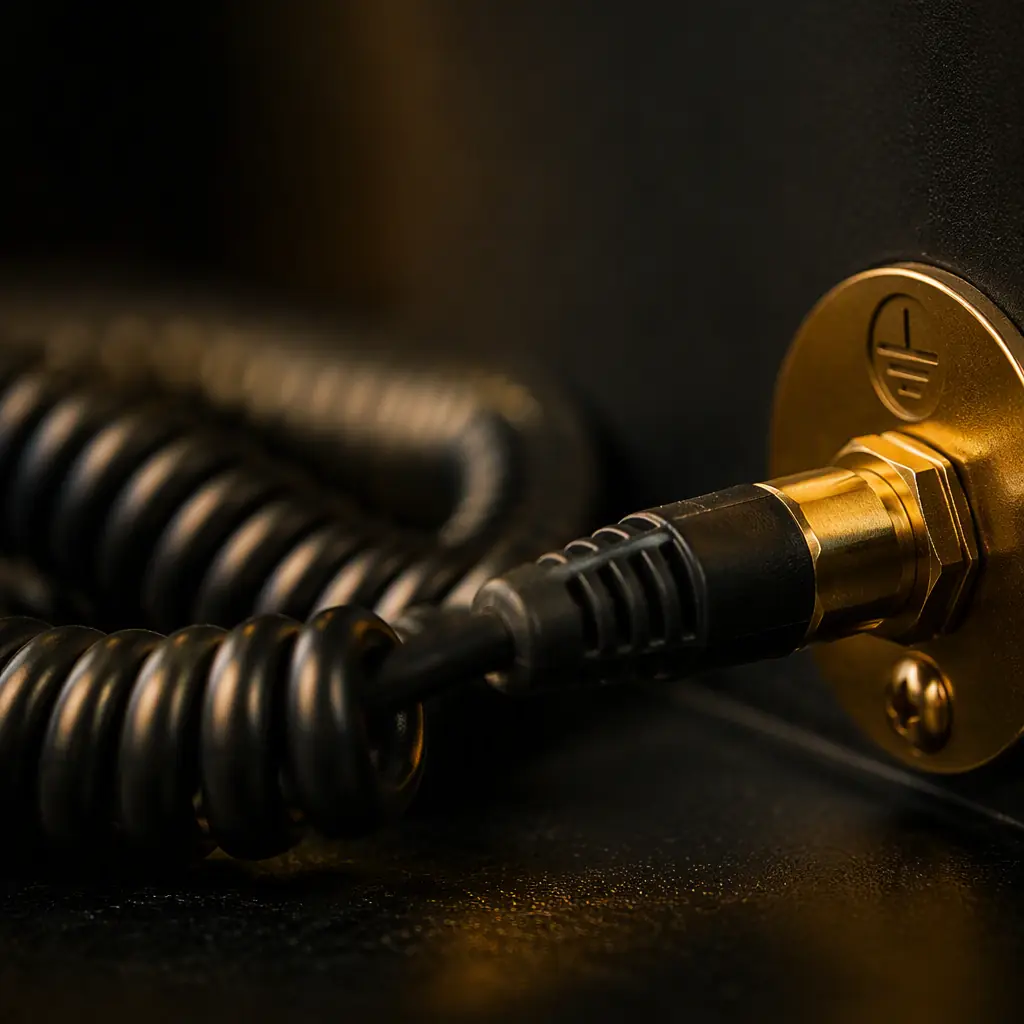
The Three Damage Models Every Buyer Should Know
ESD damage is characterized by three discharge models, and each one is addressed by different controls inside a program:
| Model | Source | Typical Voltage | Damage Mechanism | Primary Control |
|---|---|---|---|---|
| HBM (Human Body Model) | Charged person touches a device | 500 V - 15 kV | Junction damage in I/O structures, metal melt | Wrist straps, grounded workstations, ESD footwear/flooring |
| CDM (Charged Device Model) | Device itself charges, then discharges to ground | 50 - 1,000 V (modern chips fail at 100-250 V) | Gate oxide punch-through in the chip core | Ionizers, conductive handling, low-charging materials |
| MM (Machine Model) | Charged machine/tool contacts a device | 50 - 500 V | Similar to HBM, lower energy | Grounded equipment, bonding |
The critical insight for buyers: CDM is the model that modern, small-geometry chips are most vulnerable to, and it is the hardest to control because it does not involve a person at all. A chip can charge triboelectrically as it slides in its tape-and-reel pocket, then discharge through a grounded placement nozzle — no human ever touches it. That is why a program built only around wrist straps (HBM control) is incomplete; the S20.20 program explicitly requires charge-generation control (ionization) for processes where CDM risk exists.
What ANSI/ESD S20.20 Actually Requires
ANSI/ESD S20.20 is a program standard: it defines the elements a compliant ESD control program must contain and the verification schedule to prove it is working. The required elements:
An ESD Control Plan and Designated ESD Coordinator
The program must be a written, documented plan with a named owner. It covers training, product protection requirements, and the compliance verification plan. If a factory cannot produce its ESD control plan document on request, it does not have a program — it has procedures.
Grounding and Bonding: The Backbone
All conductors in the EPA (workstations, equipment, shelving, carts) must be grounded or bonded, with resistance to ground below 1 Ω for equipment and tooling per ESD TR53 verification methods. This is the element most often "assumed" rather than measured — verification records are the proof.
Personnel Grounding
Standing workers use wrist straps with a 1 MΩ ± 10% series resistor, tested daily (continuous monitors preferred); seated or mobile workers use ESD footwear with conductive flooring in the 1×10⁶ to 1×10⁹ Ω range. The wrist-strap tester logs are one of the fastest audit signals: empty log = no program.
Protected Areas (EPAs) With Marked Boundaries
Every area where ESD-susceptible items are handled is a marked EPA: ESD-protective flooring, worksurfaces (1×10⁶ to 1×10⁹ Ω), seating, and clearly posted boundary signs. The requirement is that no unprotected item — including a bare assembled board — crosses an EPA boundary outside ESD-protective packaging.
Charge Generation Control (Ionization)
Wherever static-generating processes exist — pick-and-place heads, rework, handling of insulative component carriers — ionizers are required, with offset voltage (balance) within ±35 V and discharge time verified on a schedule (typically quarterly or per the manufacturer's recommendation). This is the CDM control layer.
ESD-Safe Packaging per ESD S541
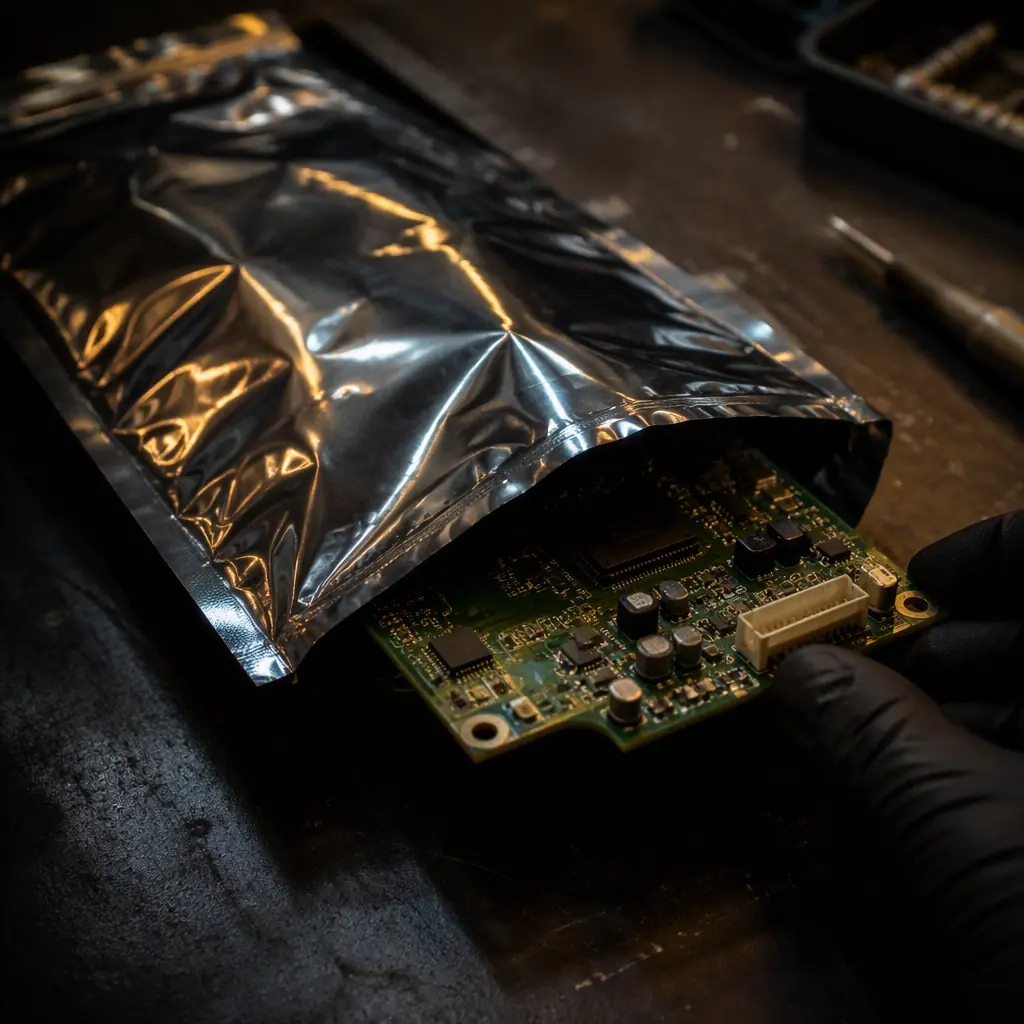
Packaging for storage and transport must meet ESD S541: shielding bags with surface resistance below 1×10¹¹ Ω, dissipative trays, and proper labeling. This is the same packaging family we cover in detail in our ESD packaging standards guide — the program requirement and the packaging requirement are two halves of the same system.
Training and Compliance Verification
All personnel handling ESD-sensitive items are trained (typically on hire and annually), and the program is audited on a fixed schedule — S20.20 certification bodies audit annually, and internal compliance checks run more frequently. The compliance verification plan is itself a required document.
Key Takeaway: An S20.20 certificate (issued by an accredited body, valid 3 years with annual surveillance audits) is the strongest single signal that a program is real. But certificates expire and audits are snapshots — the verification records (wrist-strap logs, ionizer test sheets, resistance measurements) are the live evidence. Ask for both.

Where Assemblies Actually Get Damaged in a Factory
Even inside a certified EPA, specific operations concentrate ESD risk. These are the five hotspots we see in audits and our own line design:
Incoming Kitting and Component Decanting
Components removed from tape-and-reel or trays for kitting are handled outside their ESD-protective carriers. Triboelectric charging during tape unwinding is a documented CDM source — kitting stations need dissipative worksurfaces and ionizers, not just mats.
Pick-and-Place Heads (The CDM Zone)
The component charges in its pocket, the vacuum nozzle is grounded — the discharge path goes straight through the chip. Ionizers over placement heads, conductive tape and cover, and humidity control at 40-60% RH are the controls. This is why our placement lines run ionizers as standard equipment, not an option.
Rework and Manual Soldering
Hand soldering, hot-air rework, and component replacement are the highest-touch operations in assembly. The station must be a complete EPA: grounded soldering iron (3-wire, tip grounded to < 2 Ω), grounded wrist strap, dissipative mat, and — for hot-air tools that generate ionizing airflow — ionizer verification. Our rework and repair guide covers the process side.
Test and Programming Fixtures
Boards are plugged into fixtures, probed, and programmed — each contact is a discharge opportunity. Fixtures need grounded beds, ESD-safe handles, and ionizers where boards are loaded by hand. Electrical test areas are also where latent damage first surfaces as marginal failures; see our testing methods guide for the test coverage discussion.
Packing, Labeling, and Storage
Boards packed into non-dissipative foam, bubble wrap, or unlabeled bags lose their protection at the exact moment they leave the EPA. Packaging must follow ESD S541 (shielding bags, dissipative trays), and storage racks and carts must be grounded or made of dissipative material. Our box-build guide covers the full integration and packing flow for turnkey products.
The 10-Point ESD Audit Checklist for Buyers
Use this when you audit an assembly partner — on-site or remote video audit:
Certificate and Scope
Valid ANSI/ESD S20.20 certificate (not expired), scope covers the assembly operations you are buying, issued by an accredited body.
ESD Control Plan Document
Written plan exists, current revision, names the ESD coordinator, and includes the compliance verification plan.
EPA Boundaries
Marked EPAs around all handling areas; no unprotected boards crossing boundaries outside ESD packaging.
Wrist-Strap Testing Logs
Daily tester logs for the last 90 days, with continuous monitors where operators are seated.
Ionizer Verification Records
Offset voltage within ±35 V and discharge-time test sheets within the required interval for all ionizers.
Resistance Verification (ESD TR53)
Worksurface, flooring, and grounding-point resistance measurements on the required schedule (typically 12 months).
Grounding Point Integrity
Equipment grounding verified to < 1 Ω; visible grounding points on benches, racks, and carts.
Packaging Materials
ESD bags and trays meet ESD S541 (surface resistance < 1×10¹¹ Ω), correct bags used for the sensitivity level, proper labeling.
Training Records
Training matrix covers all ESD-sensitive-handling personnel, initial and annual refresher, signed records.
Humidity Monitoring
EPA humidity maintained and logged at 40-60% RH; low-humidity periods (winter/dry climate) covered by increased ionization.
Fold this checklist into your broader supplier audit program and pair it with the documentation checks in our incoming inspection guide — ESD compliance is verified at the factory, but its failures show up at your incoming inspection and in the field.
ESD in the Contract: What to Write
ESD protection should be contractual, not assumed. Three clauses to include in your assembly agreement:
Program Requirement
"Assembler shall maintain an ESD control program compliant with ANSI/ESD S20.20, covering all handling, assembly, test, and packing operations for the products under this agreement, and shall provide its current S20.20 certificate upon request."
Documentation Deliverables
Require the verification records to travel with each shipment or be available on request: wrist-strap test logs, ionizer verification sheets, and — for high-reliability products — the ESD audit report from the last internal or third-party audit.
Packaging Specification
Reference ESD S541 for all storage and transport packaging, with explicit labeling requirements. Cross-reference our packaging standards guide when you draft the clause.
How Huaxing PCBA Runs Its ESD Program
Every Huaxing assembly line operates inside an S20.20-conformant EPA: grounded worksurfaces and flooring, 1 MΩ wrist straps with daily tested logs, ionizers on every placement, kitting, rework, and test station, humidity held at 40-60% RH, and packaging per ESD S541. We maintain an internal compliance verification schedule beyond the certificate cycle, and the records are available to customers on request. If your product is sensitive — and most modern ICs are — ask us for the current S20.20 certificate and a sample of the verification logs; we will send them with your first quote.
Request our ESD program documentation and a quote for your assembly project — or read our factory compliance audit guide to see the full set of audits a serious buyer runs before awarding volume.