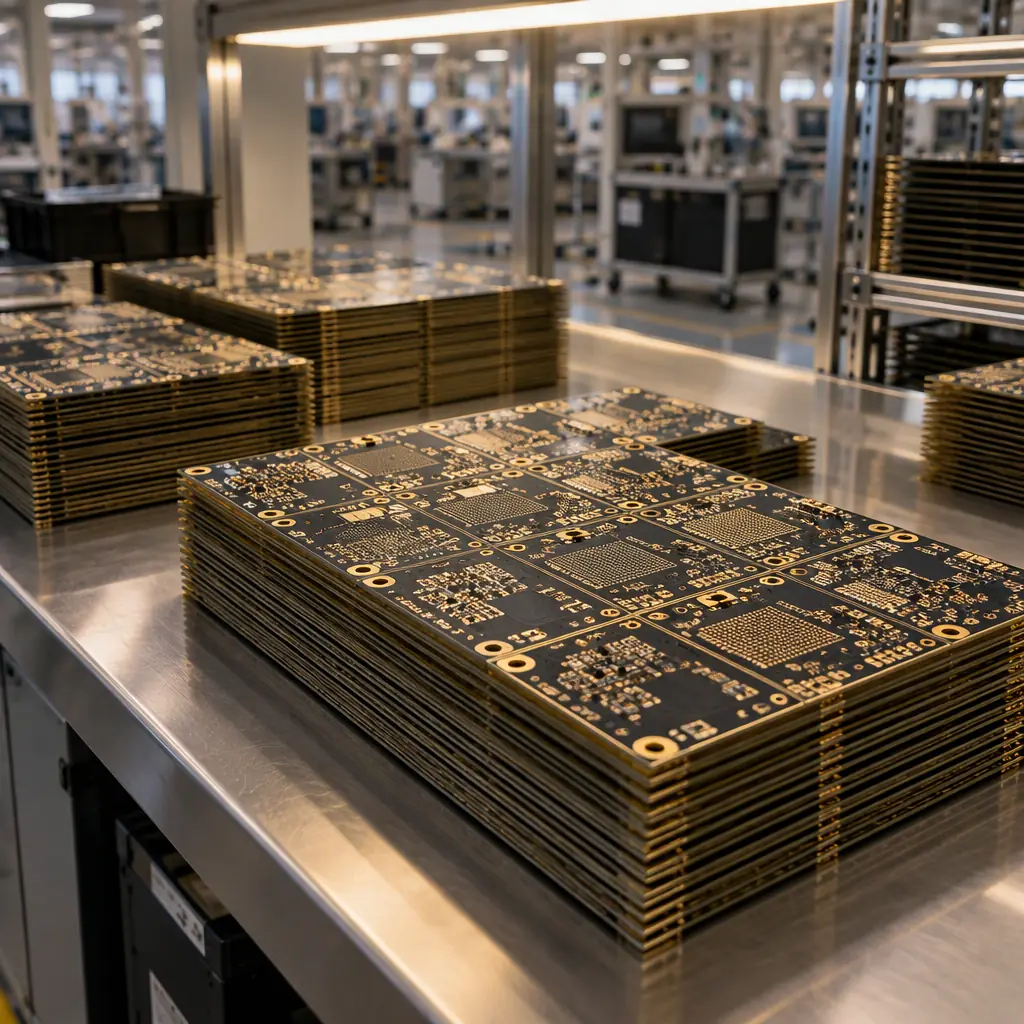
Most purchase orders end with a clause that says the supplier will perform outgoing inspection to an agreed standard. Very few buyers ever see the evidence. That gap is where a shipped lot with a systematic defect escapes a factory, crosses an ocean, and lands on your own assembly line — where the defect cost is no longer measured in rework minutes but in a stopped line, a missed delivery, and a customer escalation.
Outgoing quality control (OQC) is the final gate a board passes before it is packed. It is distinct from incoming quality control on the raw-material side and distinct from the in-process AOI and electrical test every board already receives. Its purpose is not to find defects — by this point, most have been caught. Its purpose is to prove, on a sample basis with traceable data, that the process that produced this specific lot was in control, and to stop the lot at the factory door if it was not. At Huaxing PCBA, every outgoing lot passes an 8-point OQC gate before the shipping carton is closed, and the data pack travels with the boards.

What OQC Is Not
The most common confusion is between outgoing quality control and electrical test. They answer different questions and neither substitutes for the other.
Electrical test — flying probe, ICT or functional test — confirms that the copper pattern conducts the way the netlist says it should. It is a hundred-percent, per-net check. It cannot tell you that the silkscreen on the connector designator is one character-position off, that the solder mask registration is drifting at the panel edge, that the surface finish is discoloured, or that the panel has taken on a permanent bow of 0.9 percent after the reflow pass. None of those are electrical properties.
Similarly, final AOI on an assembled board checks component presence, polarity and solder joint appearance against a programmed recipe — but only on assemblies where AOI is deployed, and only against the features the recipe was taught. A bare board or a box-build with cable assemblies passes through no AOI stage at all.
Key Takeaway: Test proves electrical correctness. OQC proves manufacturing conformance plus documentation completeness. A supplier that answers "we test everything" when asked about OQC has told you that no one is checking appearance, dimension, finish or packaging against the specification.
What a Functional OQC Gate Actually Checks
A gate worth the name covers eight observation classes. Each maps to a documented specification, and each produces a record.
Workmanship Against the Applicable Inspection Standard
For bare boards the accept/reject basis is IPC-A-600 in its current revision; for the finished circuit card assembly it is IPC-A-610, with the class agreed at order placement. The standard must be named in the OQC instruction, not "visual inspection." The distinction between a Class 2 and Class 3 acceptance decision is not cosmetic — it changes whether a specified via void percentage or a 90-degree solder fillet is acceptable. The full comparison is in our guide to IPC Class 2 versus Class 3, and the bare-board criteria set is detailed in IPC-A-600 acceptance criteria.
Registration and Dimensional Conformance
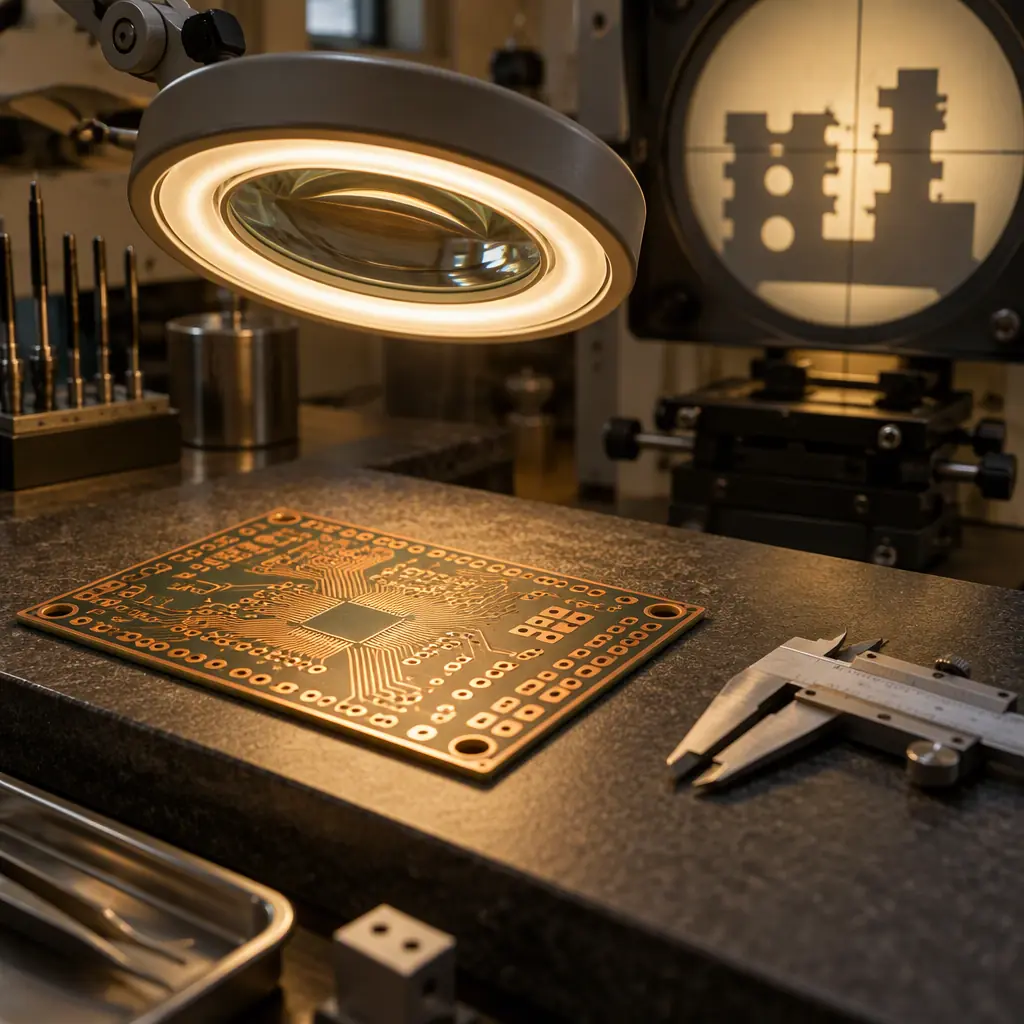
Solder mask-to-copper registration, legend-to-pad clearance, hole-to-pad concentricity and board outline dimensions are checked against drawing tolerances, normally to a sampled gauge plan rather than by eye. Outline dimensions belong on a coordinate measuring routine for any board with a mating connector, a card-edge interface or a mechanical cut-out — a 0.15 mm outline error is invisible in a photograph and fatal in a chassis. Where edge interfaces are involved, the finish and geometry requirements are covered in our guide to edge connector and gold finger design.
Surface Finish and Solderability Confirmation
Finish appearance (colour uniformity, absence of oxidation or galvanic burn marks, plating thickness on a coupon) plus a solderability check. The quantitative form is a wetting balance test on a process coupon from the same plating batch. The thickness methods and the wetting test procedure are set out in PCB solderability testing.
Cosmetic and Legend Audit
Scratches, laminate voids, resin bleed, marker legibility, component designator accuracy and polarity markings. This is the class most likely to be skipped and the most likely to generate customer-facing complaints, because cosmetics are what a client sees first.
Solder Mask and Legend Adhesion
Tape test and, on sampled coupons, a cross-hatch adhesion check after thermal excursion. Mask that passes at room temperature and lifts after one reflow cycle is a reliability problem that only shows up in the field.
Cleanliness Where Specified
Ionic contamination is measured by resistivity of solvent extract (ROSE) or by ion chromatography where a tighter limit applies. This step is mandatory for high-reliability and conformal-coated assemblies and is often omitted on commodity boards. The test methods and limits are covered in PCB ionic contamination and cleanliness testing.
Packaging Conformance
Moisture barrier bag integrity, desiccant quantity, humidity indicator card reading, vacuum condition and the MSL floor-life label. Packaging is the step a buyer never inspects and the step where most latent damage is created. Board-level requirements are in our article on PCB ESD packaging standards.
Documentation and Traceability Closure
Lot code, date code, material lot linkage, panel utilisation, test log reference, and an OQC record signed with the inspected quantity and the accept/reject disposition. Traceability that ends at the carton is not traceability. The lot-linking requirements are set out in PCB lot traceability under IPC-1782.
Sampling, Not Screening — Getting the Sample Plan Right
OQC is a sampled gate. Screening every board for cosmetic conformance is uneconomic and, in practice, less reliable than a disciplined sample, because inspectors lose attention over a long run. The two defensible bases are AQL sampling per ANSI/ASQ Z1.4 and a C=0 plan.
| Plan | Sampling Basis | Typical Use Case | What It Tells the Buyer |
|---|---|---|---|
| ANSI/ASQ Z1.4, Level II, AQL 1.0 | Sample size scales with lot size; accept on a permitted number of defectives | Commercial and industrial boards, general production | Lot is no worse than the agreed quality level, with a defined consumer's risk |
| ANSI/ASQ Z1.4, Level II, AQL 0.65 | Same structure, tighter acceptance number | Industrial control, instrumentation, telecom | Tighter escape rate; larger sample for the same lot size |
| C=0 (zero acceptance) | Any defect in the sample rejects the lot | Automotive, medical, aerospace, Class 3 | No tolerance for defectives in the sample; drives the supplier toward process control |
| Reduced / tightened switching | Normal plan tightened after two rejected lots, reduced after a run of accepted lots | Mature production with history | Whether the supplier uses switching rules at all — a strong signal of QMS maturity |
The detail that separates a live sampling system from a paper one is whether the plan switches. Z1.4 defines normal, tightened and reduced inspection with explicit switching rules based on the last ten lots. A supplier whose OQC plan has never once been tightened in a year of production is either running at a defect rate that justifies reduced inspection, or is applying the normal plan mechanically to every lot and not reading the results. The discrete-attribute structure of sample plans and how to read them is covered in our guide to AQL sampling plans.
How Incoming and Outgoing Control Connect
OQC does not stand alone. It is the closing half of a loop whose opening half is incoming quality control on laminate, solder mask, surface-finish chemistry and components. A supplier with a strong OQC gate and no incoming gate is inspecting the symptom: defects in shipped boards that trace back to a raw material lot are caught at the end of the line instead of the beginning, which inflates cost and shortens the reaction window.
For the buyer, the practical link is that OQC data should be able to name the material lot behind any failure. Where the two gates are connected, a marginal plating chemistry batch is caught at incoming inspection; where they are not, it is discovered as a cosmetic or solderability failure on finished boards with the money already spent. The incoming side is described in our guide to PCB incoming quality inspection.
The OQC Data Pack — What Should Travel With Each Lot
Ask a supplier to describe their OQC process and you will usually get a description of activity. Ask for the artifact and the conversation changes. A complete lot data pack contains six items, and all six are cheap to produce for a supplier that is genuinely running the gate.
Lot traveller with process signatures
Every operation from inner-layer imaging to final packing, each with an operator or station ID and a time stamp. This is the skeleton of traceability and it is the first thing an automotive or medical auditor reads.
Electrical test report
Test method, fixture or flying-probe program revision, net count, pass/fail counts and the test file checksum. Net count matters: a test report showing 412 nets for a board whose CAD netlist has 438 is reporting a test that did not cover the whole board.
OQC record with sample plan and disposition
Lot size, sample size, the standard and class applied, the AQL or C=0 plan, defects found by code, and the accept/reject decision with the inspector's identification. Defect codes force the supplier to classify what they found rather than record "minor."
Material and finish certifications
Laminate supplier and grade, Tg and Td values where specified, surface finish type and measured thickness, and any compliance declarations the order requires.
Coupon results
Microsection report from the process coupon attached to the panel — plating thickness by layer, and thermal stress results where the order specifies them. This is the evidence that the process, not just the visible board, was in control. Coupon design that makes those readings meaningful is covered in PCB test coupon design.
Packaging and MSL record
Bag seal condition, humidity indicator card reading at packing, desiccant quantity, and the MSL classification with floor life. This item exists so that when a defect appears downstream, the packaging path can be ruled in or out rather than argued about.
Eight Questions That Expose a Supplier Shipping on Trust
These are audit questions, not a checklist to send over email and wait on. They are designed to be asked in a video or on-site audit where the answer is a document being opened rather than a sentence being spoken.
| # | Question | Weak Answer | Strong Answer |
|---|---|---|---|
| 1 | What standard and class does OQC inspect against? | "IPC standards" | Names the revision and the class, and the instruction sheet shows the same text |
| 2 | What is the sample plan for a 2,000-piece lot? | "We check a few percent" | Names Z1.4 Level II with AQL, or a C=0 plan, and states the sample size |
| 3 | Has the plan ever been tightened? | "No, it works fine" | Shows switched state and the lot history that drove it |
| 4 | May I see the last rejected lot? | "We don't reject lots" | Opens a non-conformance report with root cause and disposition |
| 5 | How is cleanliness verified on coated assemblies? | "The boards look clean" | Names ROSE or ion chromatography with limits and sampling frequency |
| 6 | What does the OQC record contain? | Shows a signature page | Shows defect codes, quantities, sample size and disposition |
| 7 | Who owns the disposition decision? | "Production" | Quality function signs the release, independent of the line that built it |
| 8 | Can OQC block a shipment on a schedule pressure? | Hesitation, or "only serious problems" | Points to a documented case where a lot was held and the customer notified |
Procurement Tip: Question 8 is the one that predicts your experience. A gate that has never held a shipment is not a gate. Ask for one instance where OQC rejected a lot against a delivery deadline and the customer was informed before the ship date. A supplier who can produce that example has demonstrated the organisational independence that makes every other answer credible.
Where OQC Fits in the Cost Picture
Buyers sometimes resist a sampled OQC gate on price. The economics are not close. A defect that is caught at the factory door costs the supplier a rework hour and a phone call. The same defect delivered to your line costs the inbound inspection you were not budgeting for, a production interruption whose value depends entirely on your own schedule, a rework or replacement cycle across an ocean, and the engineering time spent proving the failure was not your design. For any board carrying a certification obligation — automotive under IATF 16949, medical, aerospace — the escaping lot also carries a reporting burden.
Because our OQC stage runs on the same lot data that already exists from in-process testing, it adds inspection minutes rather than a separate information system. That is the reason it can be offered on production volume rather than only on premium orders.
Summary
Outgoing quality control is the only stage in the manufacturing flow whose entire purpose is to protect the buyer rather than the build. Electrical test proves a board works; OQC proves the lot was produced under control, packaged correctly and documented completely enough to be traced if something goes wrong six months later.
The purchase-decision consequence is simple. Ask for the OQC record with the shipment, and ask for one example of a shipment that was held. If the record exists and the example exists, you are buying from a process. If neither does, you are buying a promise — and a promise has no defect code.
At Huaxing PCBA we run OQC against IPC-A-600 and IPC-A-610 with class agreed at order placement, apply AQL sampling with switching rules, and ship a lot data pack including coupon microsection and packaging records. Our quality team holds shipment release independently of production scheduling. See the quality metrics we publish or contact our team to review our OQC instruction sheet for your next order.