A conformal coating is engineered to be chemically inert, tightly adherent and pinhole-free. That is exactly what makes it valuable. And exactly why removing it is the single hardest step in any coated-board rework. The coating does not want to come off, and every method you can use to force it off is also a method that can attack the solder mask, the connector housings and the components underneath. Removal is a decision before it is a technique.
This matters to anyone holding a coated board that needs a component replaced. Procurement teams discover the problem late: the board was specified as coated for a reason (moisture, salt fog, vibration, or a safety standard), a field failure or an ECO demands a rework, and suddenly the question is whether the assembly can be de-coated at all without destroying it. At Huaxing PCBA, coating removal and re-coat runs as a documented process under the same quality system as our 8 SMT lines and 4 DIP lines . Not as an improvisation at a bench. This guide is the method framework and the acceptance standard you need to judge it.
Why Conformal Coating Removal Destroys More Boards Than It Saves
Removal is by definition a hostile act against a substrate that was designed to resist it. Three damage vectors open up the moment you start, and they are the reason so many "simple" reworks end in a scrapped lot.
Solder mask and legend attack
Aggressive solvents and over-abrasion both eat into solder mask edges and silkscreen legend. The result is a witness mark or a green haze that fails visual acceptance even though the copper is untouched.
Component and plastic-body damage
Dichloromethane-based strippers attack polycarbonate connector bodies, relay housings and wire insulation. Solvent also wicks by capillary action under nearby parts and stays there.
Latent thermal and ESD damage
Thermal softening and reflow expose joints and plastic parts to stress that does not fail immediately but shows up as a field return. Open handling of a de-coated board also invites ESD damage.
Quick Answer: Conformal coating removal is the selective removal of a protective polymer film from a PCB so that a joint can be reworked. The method depends entirely on chemistry. Acrylics dissolve in IPA or acetone, urethanes and epoxies need xylene, dichloromethane-based stripper or NMP, silicones must be peeled or micro-blasted, and parylene has no solvent at all.
Step 0, Identify the Coating Chemistry Before You Touch the Board
Every decision below hangs on one question: what is actually on this board? Get it wrong and you will either waste days on a solvent that cannot work or attack the assembly with something far too aggressive.
Four identification routes, in order of reliability:
| Method | What you look for | Reliability |
|---|---|---|
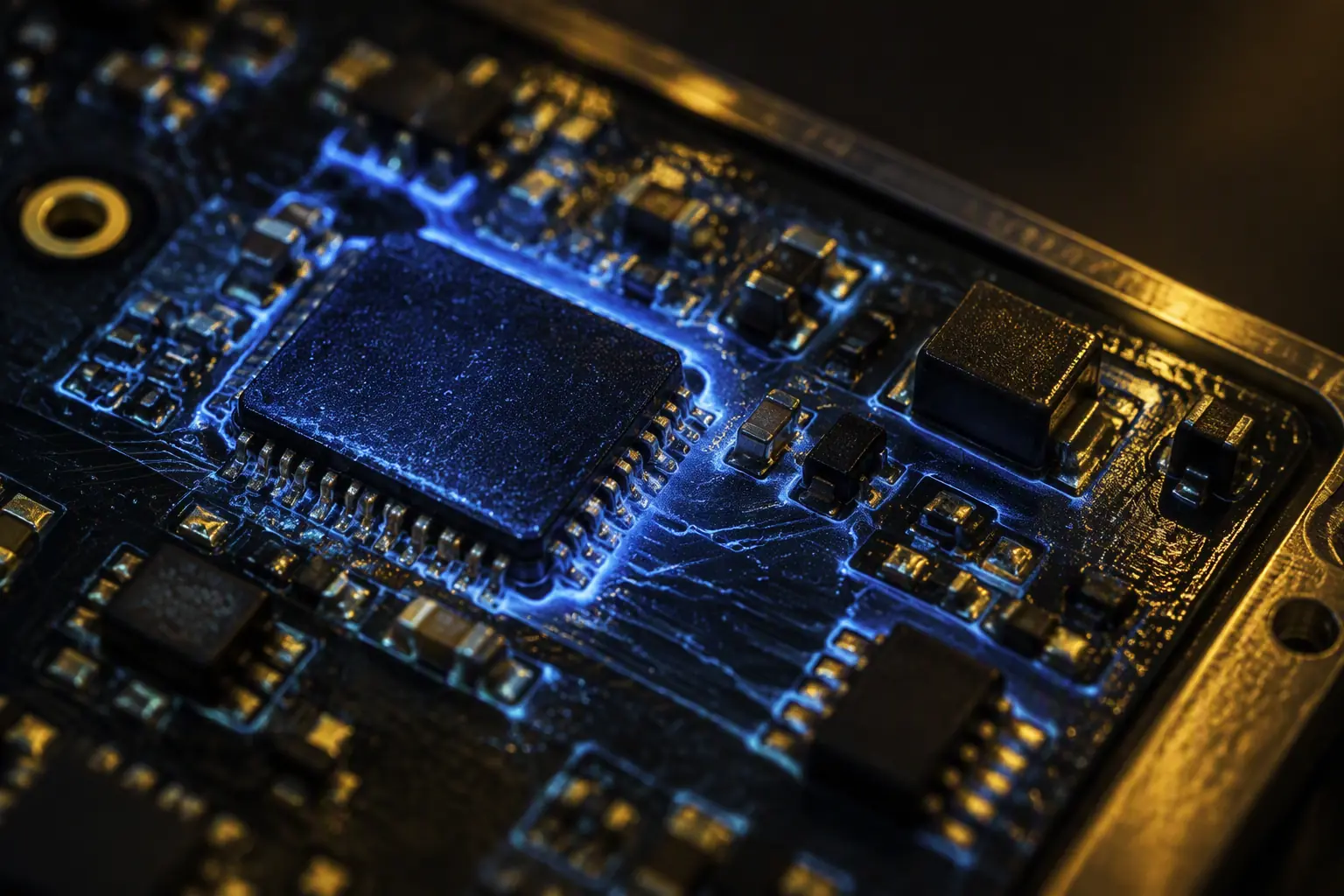
| UV tracer inspection | Most acrylic, urethane and silicone films fluoresce blue-white under 365 nm UV. Parylene typically does not. | High for confirming a coating is present and roughly where |
| Cure / process records | The coating callout on the drawing, batch records, supplier data sheet. IPC-CC-830 qualification and UL 746 class markings. | Highest, this is the authoritative source |
| Solvent spot test | A drop of IPA on a corner: acrylic softens within seconds, urethane and epoxy barely react. | Good as a confirmation, not as a first step |
| Appearance and feel | Acrylic is translucent and slightly tacky; urethane is amber or clear and tough; silicone is soft and rubbery; parylene is ultra-thin and coats edges perfectly evenly. | Indicative only, use to shortlist |
Coatings are classified by chemistry under IPC-CC-830: AR (acrylic), UR (urethane), SR (silicone), ER (epoxy) and XY (parylene). The class letters are the fastest way to talk to your supplier about removal, because the removal method follows the class, not the brand. If you are still choosing a coating rather than removing one, our comparison of coating chemistries covers selection and application.
The Removal Method Matrix, One Table That Decides Your Approach
This is the decision table the industry rarely publishes, because the companies that rank for coating-removal searches sell solvents. And there is no solvent to sell you for parylene.
| Method | Acrylic (AR) | Urethane (UR) / Epoxy (ER) | Silicone (SR) | Parylene (XY) | Damage risk |
|---|---|---|---|---|---|
| Solvent soak / brush | Yes, IPA, acetone | Only with xylene, DCM or NMP | Swells, does not dissolve | No effect | Medium, mask and plastics |
| Stripper (DCM-based) | Overkill | Yes, effective, aggressive | Limited | No effect | High, carcinogen, attacks plastics |
| Thermal softening | Yes, ~80–150 °C | Yes, ~80–150 °C | Assist only | ~150–200 °C regime | High, approaches reflow |
| Mechanical peel | Possible when thick | Difficult | Primary method | Not viable | Medium, pad lift |
| Micro-blasting | Yes | Yes | Yes | Yes, primary | Medium, media selection critical |
| Laser ablation (UV) | Yes | Yes | Yes | Yes, primary | Low, with depth control |
Chemical Removal, What Actually Dissolves What
Solvent vendors publish method lists in parallel, as if you could pick any of them. You cannot. The chemistry of the film decides which chemical family has any chance of working, and the substrate decides how much collateral damage you accept.
Acrylic (AR), the easy case
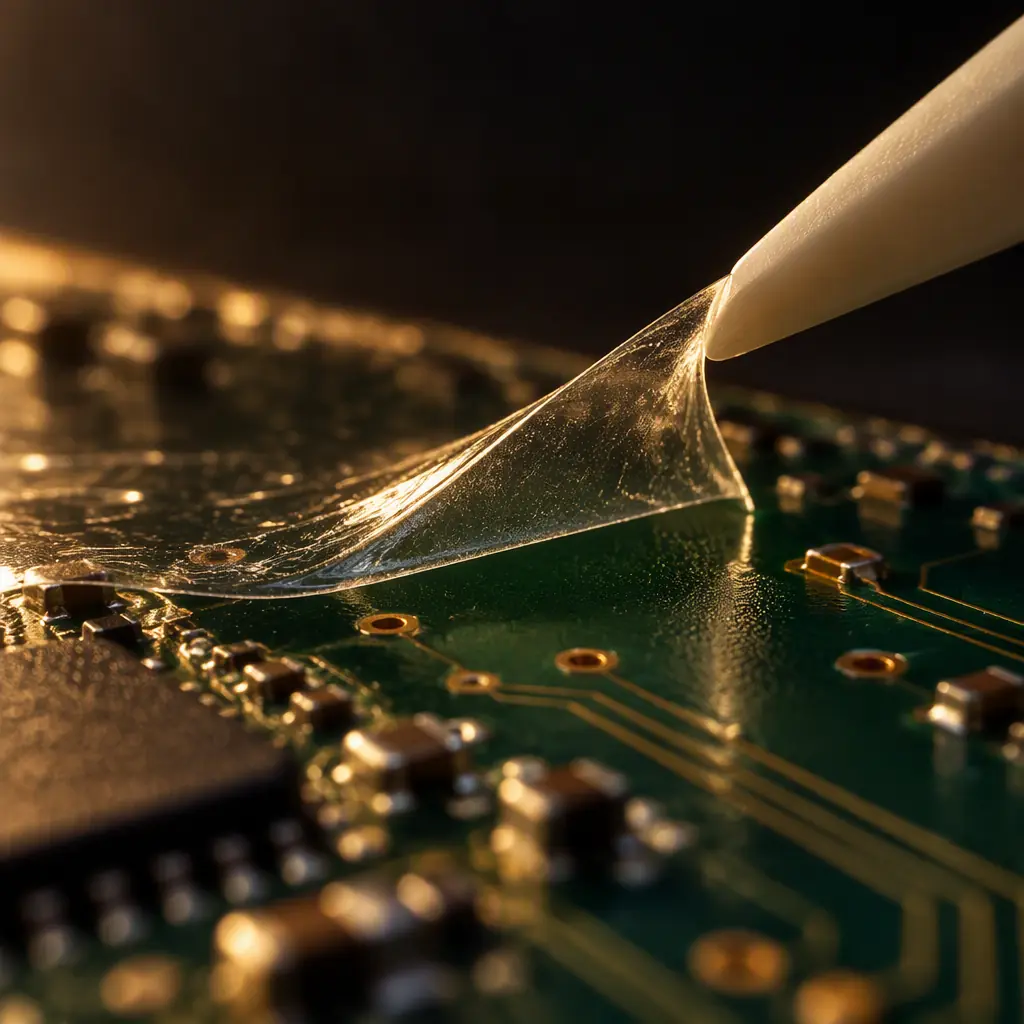
Acrylic coatings are thermoplastic and re-soluble, which makes them by far the most reworkable. Isopropyl alcohol will soften and lift an acrylic film; acetone works faster but is hostile to polystyrene and polycarbonate housings and to some connector bodies, so it must be applied locally and never allowed to pool against plastic. For bench-level work, a solvent-soaked swab applied to the window, a short dwell, then mechanical lift with a non-metallic tool is the standard sequence.
Urethane (UR) and epoxy (ER), where IPA fails
Urethanes and epoxies are thermosetting: they cross-link during cure and do not re-dissolve. IPA is effectively useless here, and this is the single most common mistake made on coated-board rework. You need aromatic hydrocarbons such as xylene or toluene, a halogenated stripper based on dichloromethane (methylene chloride), or the slower and more substrate-friendly N-methyl-2-pyrrolidone (NMP). Warm solvent works measurably faster than cold. Expect a residue film even after the bulk coating lifts. Urethane removal leaves a tacky layer that must be fully cleaned before any re-coat, or the new coat will lift.
Silicone (SR), peel, do not dissolve
Silicone is not truly dissolved by common solvents; aliphatic and naphthenic hydrocarbons swell it. The practical method is to score the film at the repair boundary, lift an edge and peel it away mechanically, using solvent only as an assist to break the bond at the interface. Note that silicone's very low surface energy makes it difficult to re-coat over without a primer or complete removal of the window.
Parylene (XY), there is no solvent
Parylene is applied by chemical vapour deposition, forming a pinhole-free, chemically inert film that is insoluble in essentially every common solvent at room temperature. This is not a limitation of the solvent catalogue. It is the entire reason parylene is chosen for aerospace, military and implantable medical hardware. If a supplier tells you they will "dissolve" parylene, they have not understood the material. Removal is mechanical (micro-blasting or controlled abrasion) or by laser ablation, and nothing else. Our parylene coating guide explains the deposition process that produces this property.
Key Takeaway: Can parylene be chemically removed? No. Parylene has no room-temperature solvent, which is precisely why it is specified where chemical resistance is the requirement. Mechanical or laser removal are the only viable routes.
Mechanical and Thermal Removal Methods
Controlled abrasion and micro-blasting
Where solvent cannot work, media can. Micro-blasting with plastic media or sodium bicarbonate at low pressure strips the film without cutting into the solder mask. The critical variable is pressure: the goal is to remove the polymer and stop at the solder-mask interface. Uncontrolled sanding, by contrast, is a pad-lift and mask-removal risk. Particularly near fine-pitch devices at 0.4 mm pitch and below, where the pads have very little adhesion margin.
Thermal softening and its limits
Hot air or infrared can soften acrylic and urethane enough to allow mechanical lift, typically in the 80–150 °C band. Parylene works in a higher regime, roughly 150–200 °C. The trap is that these windows collide with reflow: eutectic Sn63Pb37 melts at 183 °C and SAC305 at roughly 217–220 °C. Once you are heating a board into that range you are no longer only changing the coating. You are stressing solder joints, plastic bodies and absorbed moisture. Thermal removal must be localised and time-bounded.
Laser ablation
Ultraviolet laser systems around 355 nm perform what is often called cold ablation: the coating is broken down photochemically with very little heat transferred to the substrate. This makes UV ablation well suited to fine-pitch areas and to parylene, with no media residue to clean. The trade-offs are capital cost and throughput, plus the need to control ablation depth precisely so the beam stops at the coating / solder-mask boundary rather than cutting into mask or copper.
Local-Area Removal vs Full-Board De-Coating, Two Different Jobs
One of the least-discussed distinctions in the field is that bench rework and lot-level de-coating are different processes with different risk profiles. Confusing them is how a manageable repair becomes a scrapped lot.
Local-area rework
This is the technician workflow for a single board or a handful: mask adjacent parts to protect them, apply the appropriate solvent or localised heat to the target window only, remove the film, clean the window, verify under magnification and UV tracer, then re-coat just that area. Masking order matters, because the mask must survive the removal chemistry, our guide to coating masking techniques covers the tape, boots and peelable masks that are compatible with this sequence.
Full-board de-coating
When an entire lot must be reworked or re-verified, local technique does not scale. Full-board chemical stripping uses immersion tanks or conveyorised spray, with batch process control on dwell time, temperature and concentration, and a controlled dry or bake-out between steps. The risks multiply sharply: the board is fully exposed to the chemistry, connector bodies and wire insulation are all in contact with it, and the solder mask sees the full dwell. This is the section where a procurement manager decides whether to send the boards out. Because lot-level de-coating is a genuine manufacturing capability, not a bench skill.
Damage Risks and How to Avoid Them
Solder-mask and substrate damage
Solvent attack shows up first at solder-mask edges and over legend. Over-abrasion removes mask outright and exposes copper. Both produce the witness marks and discolouration that fail visual acceptance under IPC criteria, and both are avoidable with correct chemical selection and controlled media pressure.
Fine-pitch components and connectors
At 0.4 mm pitch and below, solvent wicks under connector bodies by capillary action and remains there. DCM-based strippers attack polycarbonate housings outright. Before any removal step, run a component-compatibility check against the specific chemistry: which parts are exposed, what plastics they use, whether any part is moisture-sensitive. This check is the difference between a clean rework and a field failure six months later.
ESD, moisture and latent damage
De-coating removes a protective barrier and opens the assembly to handling damage. Components that have absorbed solvent, and moisture-sensitive devices that have been exposed to ambient humidity, need a controlled bake-out before any reflow or re-coat. ESD controls apply throughout, and the reworked area must be re-verified by AOI or optical inspection rather than assumed good.
What IPC-7711 and IPC-7721 Require of Your Rework
This is the standard the whole cluster skips. IPC-7711 covers rework and modification procedures for electronic assemblies, including coating removal as a documented procedure. IPC-7721 covers repair of the base board itself. Together they define acceptable methods for coating removal and for the restored assembly, and they are the reason a certified shop can offer a documented de-coat instead of an improvisation.
Acceptance ties back to IPC-A-610 §10.8 for coating criteria, our IPC-A-610 coating acceptance guide walks through the visual requirements, and to J-STD-001 §8 for coating and encapsulation requirements during assembly. IPC-CC-830 covers the qualification of the coating material itself. For a traceable rework, expect operator certification to IPC-7711/7721 (CIS or CIT level) and a rework entry recorded in the traveller.
Procurement Tip: Ask your supplier which standard governs coating removal and who holds the operator certification. A supplier who cannot name IPC-7711/7721 has no documented rework procedure for coated boards, however good their coating line is.
Re-Coating After Rework, The Step Everyone Forgets
Removing the coating is half the job. A board specified as coated must leave the process coated, and the re-coat is where most rework programmes quietly fail.
Cleaning and preparation
All residual old coating and all solvent must be removed. Trapped solvent or a tacky urethane residue is the number one cause of adhesion failure and film lifting.
Adhesion and compatibility
The new coat must be chemically compatible with the surviving film. Re-coating over acrylic is forgiving; re-coating over silicone is not, because of its low surface energy. It needs a primer or full removal of the window.
Re-acceptance and documentation
Verify adhesion with a cross-hatch or tape test per the relevant IPC method, confirm coverage with UV tracer, inspect the re-coated window against IPC-A-610 §10.8, and record the rework in the traveller.
When to Rework and When to Respin
The honest decision rule is economic: cost of rework labour plus de-coat risk plus re-coat plus re-test, weighed against the cost of a new board and the schedule impact of a respin. The threshold moves sharply against rework in two cases. A parylene film, where removal is slow and largely manual, and a full-board chemical strip of a densely populated lot, where the exposure risk to mask and connectors is real. Our PCB rework and repair guide works through the cost comparison in detail; the point here is that a supplier who cannot tell you when not to rework is not giving you engineering advice.
Frequently Asked Questions
Can conformal coating be removed? Yes. The method depends on the coating chemistry: acrylics dissolve in IPA or acetone, urethanes and epoxies need xylene, dichloromethane-based stripper or NMP, silicones are peeled or micro-blasted, and parylene must be mechanically or laser ablated.
Does IPA remove conformal coating? It removes acrylic coatings. It is ineffective against urethanes and epoxies, which require aromatic or halogenated solvents, and it does not dissolve parylene at all.
Can you solder through conformal coating? Not safely. Coating must be removed locally from the joint and a defined window opened first. Soldering through a film traps decomposition products, prevents proper flux activity and produces a joint that will fail acceptance.
Does solvent damage the PCB? It can. Aggressive solvents attack solder mask edges, silkscreen legend, polycarbonate connector bodies and wire insulation, and can wick under nearby components. Solvent selection and masking are what prevent this.
Can parylene be removed? Yes, but only mechanically or by laser ablation. There is no room-temperature solvent for parylene, which is one of its defining properties.
Do you have to re-coat after rework? Yes, if the board was specified as coated. The re-coated window must be cleaned, verified for adhesion and inspected against IPC-A-610 §10.8 criteria.
Conformal Coating Rework Without Scrapping the Board
Coating removal is an engineered process, and it rewards a supplier who treats it as one. Huaxing PCBA runs conformal coating in acrylic, polyurethane, silicone and parylene inside the same facility as 8 SMT lines and 4 DIP lines, processing over 8 million placements per day for customers in 30+ countries. Quality is managed under ISO 9001, IATF 16949 and UL certification, with IPC-A-610 Class 2 and Class 3 acceptance and AOI, X-Ray, ICT and FCT verification available on the reworked area.
Every rework is performed to a documented procedure under IPC-7711/7721, by operators trained to that standard, with UV-tracer coverage verification and a rework entry recorded in the traveller. That means a de-coated and re-coated board reaches you with the same traceability as a first-pass build, inside a 15,000 m² facility with 500+ staff and a 98.7 % first-pass yield. Upload your coating specification and board file for a rework and re-coat quote, or talk to our engineering team about whether your boards are reworkable before you commit to a respin.