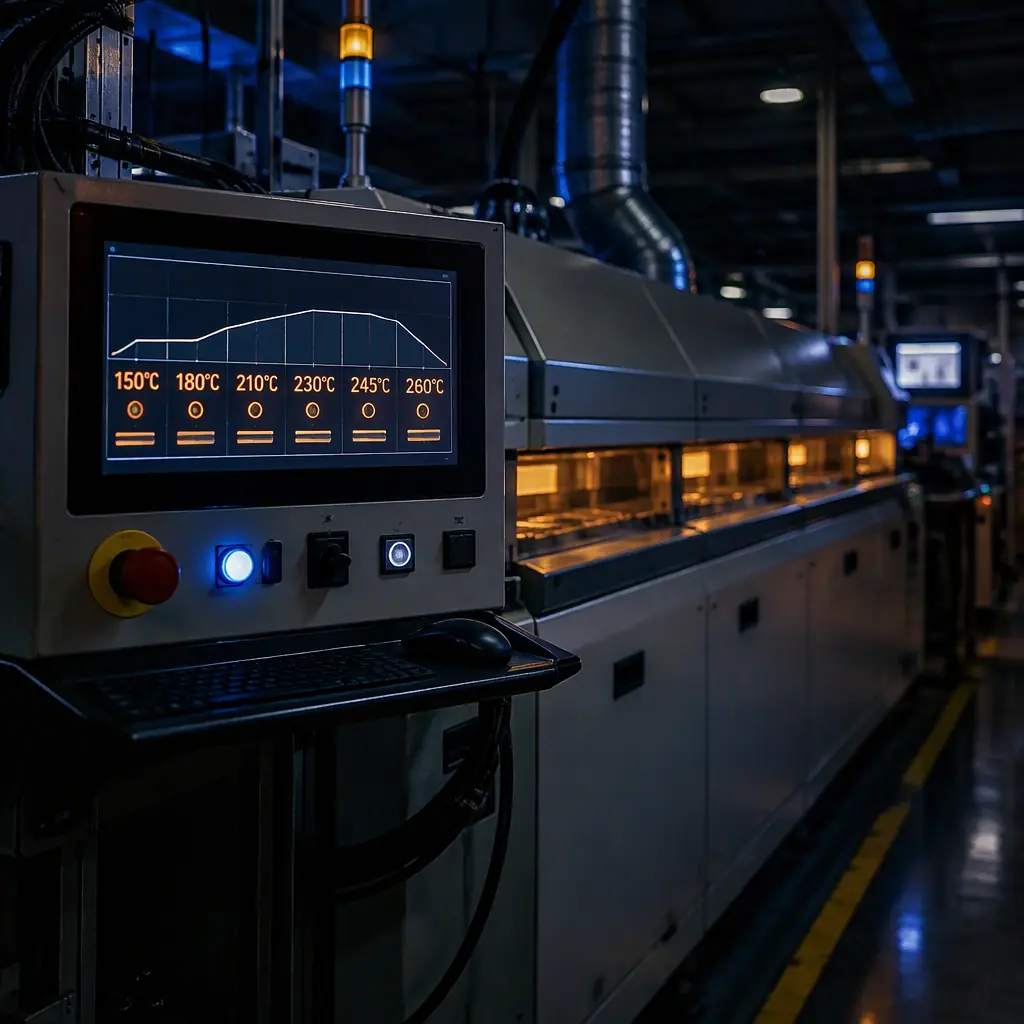
Every assembly house has a reflow profile, a stencil design and a set of print parameters. The question a buyer should ask is not whether those settings exist, but how they were arrived at. There are two ways to get a process window: change one knob at a time until the defects go away, or run a planned experiment that varies several factors together and measures which ones actually matter. The first produces a setting that works today on this board. The second produces a window — a region of settings within which the process is robust, and a defensible statement of what will happen when a factor drifts. The tool for the second is design of experiments, and it is the clearest single marker of a mature assembly process.
This guide explains what DOE is and why one-factor-at-a-time methods fall short, the main families of experiment and what each is for, a worked SMT example, how to read a DOE report when a supplier sends one, and how DOE sits alongside the other quality tools — SPC, FMEA, 8D. It complements our reflow profile optimisation guide, which covers what the profile itself should look like, and our control plan and PFMEA guide, which covers how the process is documented and controlled once the window is known.
At Huaxing PCBA we use DOE to establish and prove process windows for new programmes across 8 SMT lines under IATF 16949 and ISO 9001, and the results are retained as part of the qualification record. The point is not to sound sophisticated; it is that a proven window is what lets us tell a customer where the process will hold and where they need to design differently.
Why One-Factor-at-a-Time Fails
The intuitive approach to tuning a process is to change one variable, watch the result, and move to the next. It is intuitive because it is how we adjust things in daily life, and it is inadequate for a process with several interacting variables.
The problem is interaction. In SMT, factors rarely act independently. Peak temperature and soak time do not produce the same outcome separately as they do together; the effect of one depends on the level of the other. Change peak temperature alone and you may conclude it has little effect, when in fact its effect is large but only at certain soak levels. One-factor-at-a-time studies change each factor from a single starting point and therefore measure each factor against one fixed setting of all the others. That is exactly the situation where interactions are invisible. The method can also miss a better combination entirely: the optimum may sit at a corner of the factor space that the one-factor study never visits.
A planned experiment addresses this directly. By varying several factors together in a defined pattern, it can estimate each factor's main effect and the interactions between them, from a relatively small number of runs. The output is not a single best setting but a map of how the response behaves across the factor space — which is a far more useful thing to hand to a production line.
Key Takeaway: The difference between trial-and-error and DOE is the difference between a setting and a window. A setting works until something drifts; a window tells you how much each factor can drift before the process leaves the safe region. Only the second supports a claim that a process is robust.
The Main Families of Experiment
DOE is not one method. It is a family of designs chosen for what you need to learn and how many runs you can afford. In practice they are used in sequence.
| Stage | Design type | Question it answers | Typical runs |
|---|---|---|---|
| Screening | Fractional factorial | Which of many factors actually matter? | 8-16 |
| Characterisation | Full factorial, response surface (central composite, Box-Behnken) | How do the important factors behave, and where is the optimum? | 15-30 |
| Confirmation | Confirmation runs at the predicted optimum | Does the model predict reality? | 3-5 |
| Robustness | Taguchi-style / noise-factor design | How sensitive is the window to factors you cannot control? | Depends on layout |
Screening comes first when you have many candidate factors and want to find the few that matter. A fractional factorial design tests many factors in a small number of runs by deliberately aliasing some effects — accepting that you cannot resolve every interaction, in exchange for cheaply ruling factors in or out. In SMT screening, candidate factors might include paste type, stencil coating, aperture design, print speed, print pressure, separation speed, peak temperature, soak time and conveyor speed. Screening narrows this to the handful that move the defect rate.
Characterisation then takes the important factors and maps them properly, usually with a full factorial or a response surface design. A response surface design fits a curved model — because real optima are usually curved, not flat — and finds the combination that gives the best response. This is where the actual process window comes from: the region of factor combinations that keeps the response inside spec.
Confirmation closes the loop. The model predicts a certain response at the chosen optimum; confirmation runs at that setting test whether reality agrees. A model that is never confirmed is a hypothesis, not a result.
A Worked SMT Example
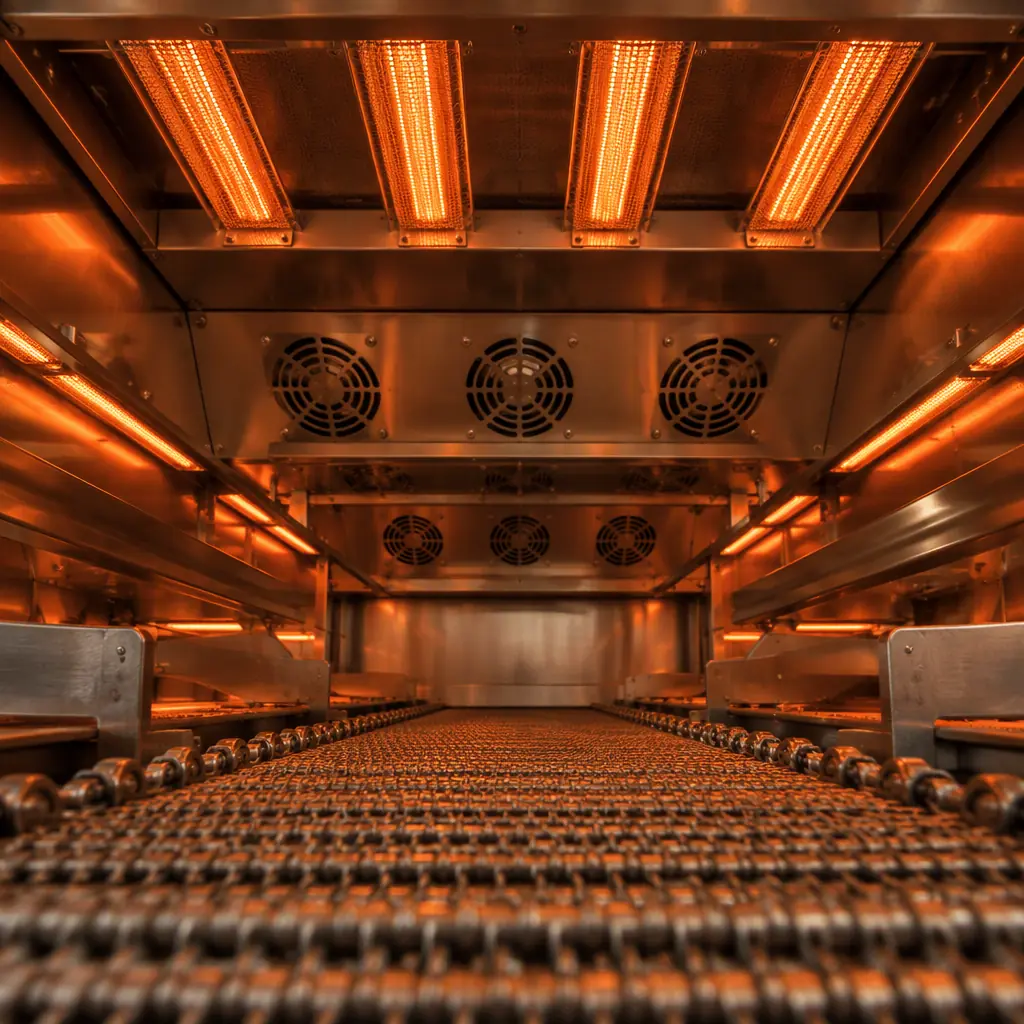
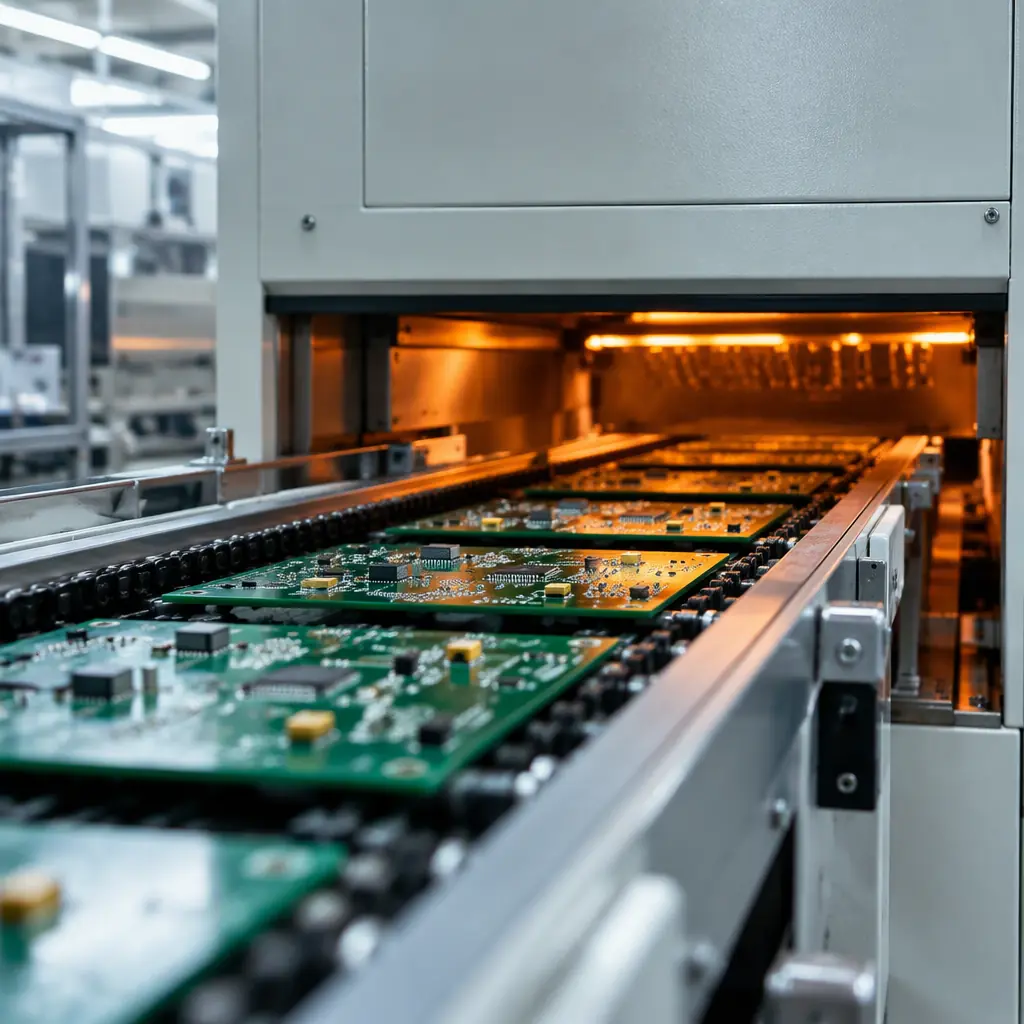
The application that most clearly shows the value of DOE is a reflow window for a mixed board — fine-pitch components alongside a large thermal mass. The two pull the profile in opposite directions, and the answer is not obvious.
Take three factors: peak temperature, time above liquidus, and conveyor speed. The response is the defect rate, broken down by defect type — voiding, head-in-pillow, and tombstoning. A screening design would first establish which of these three (plus any others) actually drive the defects. The characterisation stage would then map, say, peak temperature and time above liquidus against the combined defect rate. The result is typically not a single optimum but a band: too little heat and the large mass does not reflow properly; too much and the fine-pitch parts suffer; the safe window is the strip between them, and its width tells you how much process margin you have. Confirmation runs at the centre of that strip check that the model is honest.
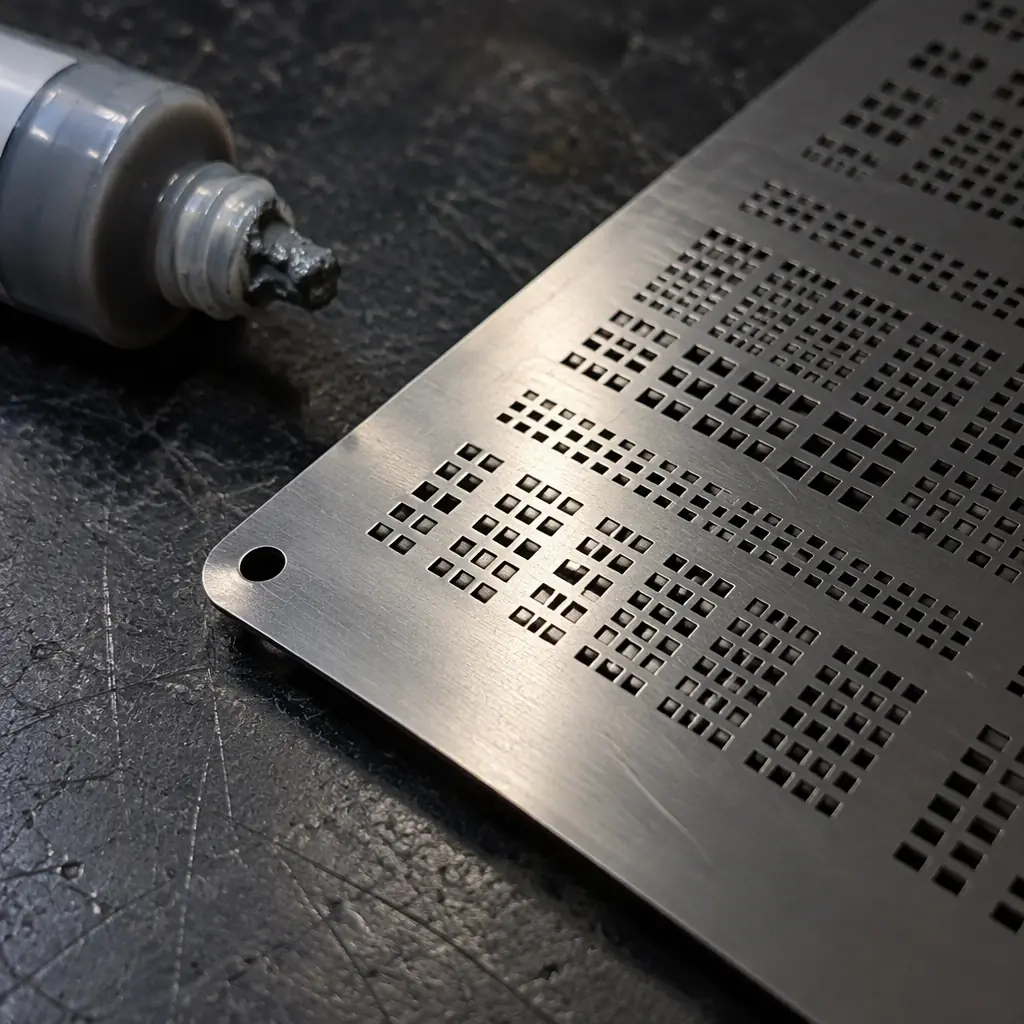
The output is directly useful to a buyer. A wide window means the process is forgiving and a normal amount of day-to-day variation is fine. A narrow window means every factor has to be tightly controlled, and it flags the parts of the design that are pushing the process to its limit. This is also where DOE meets the reliability data: void limits under IPC-7095 x-ray acceptance criteria, for example, are only meaningful once you know the process window that reliably meets them. The same logic applies to print-related defects — see stencil aperture design and paste release and solder paste volume and SPI control for the factors a print-focused DOE would vary.
How to Read a Supplier's DOE Report
When a supplier claims a process window was established by experiment, the report either supports that claim or it does not. Four things tell you which.
Are the factors and levels stated?
A real DOE report names every factor that was varied, the levels used for each, and the response that was measured. "We optimised the profile" is not a DOE report; it is a conclusion with the evidence removed. If you cannot see what was varied and by how much, there is no experiment to evaluate.
Is there a model, and is significance addressed?
The report should show which factors and interactions were statistically significant, not merely list numbers. A model that claims a factor matters without a significance measure — an effect size, a p-value, a confidence interval — is asserting a relationship it has not demonstrated. You do not need to be a statistician to check this; you need to see that the question was asked.
Were the runs randomised and replicated?
Randomising the run order protects against drift in the equipment or the environment being mistaken for a factor effect, and replication gives an estimate of pure experimental error. A design run in a tidy sequence with no repeats has a hidden assumption that nothing else changed over the study, which is rarely true on a production floor. See SPC control charts and Cpk for the complementary view of process variation once the window is set.
Is the window stated as a region with margin?
The most useful output is not a point but a region plus the margin around it: the setting chosen, the range on either side that still meets spec, and a confirmation that the production line runs inside it. If the report gives a single "best" setting with no window, it has answered a narrower question than you need answered. Narrow windows should be flagged explicitly, because they are a warning about the design.
Procurement tip: When you qualify a supplier for a demanding programme, ask to see the DOE behind the process window for a comparable board. A supplier who can produce one is controlling the process by design; a supplier who cannot is controlling it by hope and rework. The report does not have to be elaborate — it has to show factors, levels, significance and confirmation.
Where DOE Sits Alongside SPC, FMEA and 8D
DOE is one of four quality tools, and buyers often conflate them. Each answers a different question, and the mature process uses all four in their proper places.
| Tool | Question it answers | When it is used |
|---|---|---|
| FMEA | What could go wrong, and how bad would it be? | Before the process exists — risk anticipation |
| DOE | Which factors matter, and where is the robust window? | When establishing or improving a process — the window |
| SPC | Is the process still inside the window, right now? | Ongoing production — detection of drift |
| 8D / CAPA | What went wrong, why, and how do we stop it recurring? | After a failure — corrective action |
The sequence is: FMEA anticipates the risks and points to where control is needed; DOE establishes a window that addresses those risks; SPC monitors production to confirm it stays inside the window; and 8D handles the occasions when it does not. See PCB FMEA for the risk step, the control plan and PFMEA guide for how the window becomes documented control, and 8D report and CAPA for the corrective-action step. A supplier who uses DOE to set the window and SPC to hold it is one whose process you can trust to stay where it was qualified. A supplier who uses only one of the four has a gap.
Summary: A Window Is Worth More Than a Setting
Design of experiments is not a statistical luxury; it is the difference between a process setting and a process window, and therefore between a claim of robustness and the evidence for it. Screening designs find the factors that matter, characterisation designs map the window, and confirmation runs keep the model honest. When you read a supplier's DOE report, look for stated factors and levels, a significance treatment, randomisation and replication, and a window with stated margin. Those four things separate an experiment from a story.
At Huaxing PCBA we use DOE to establish process windows for new programmes and to close out yield problems across 8 SMT lines under IATF 16949 and ISO 9001, with the results retained in the qualification record. If your programme has a demanding profile or a wide mix of thermal masses, that is exactly where a proven window earns its keep. Send your Gerber and BOM and we will tell you how we would qualify the process for your build and return a quote inside 24 hours, or talk to our process engineering team about a yield or reliability problem you are chasing.