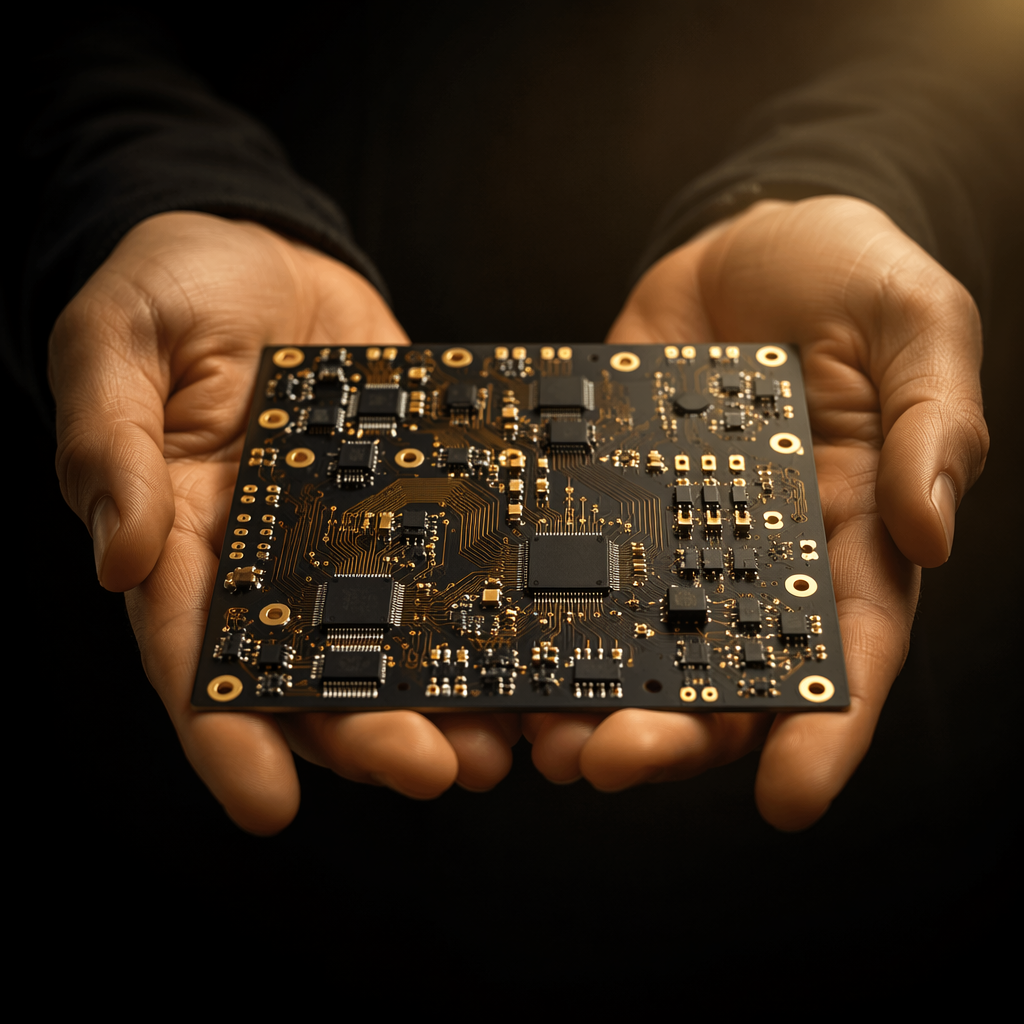

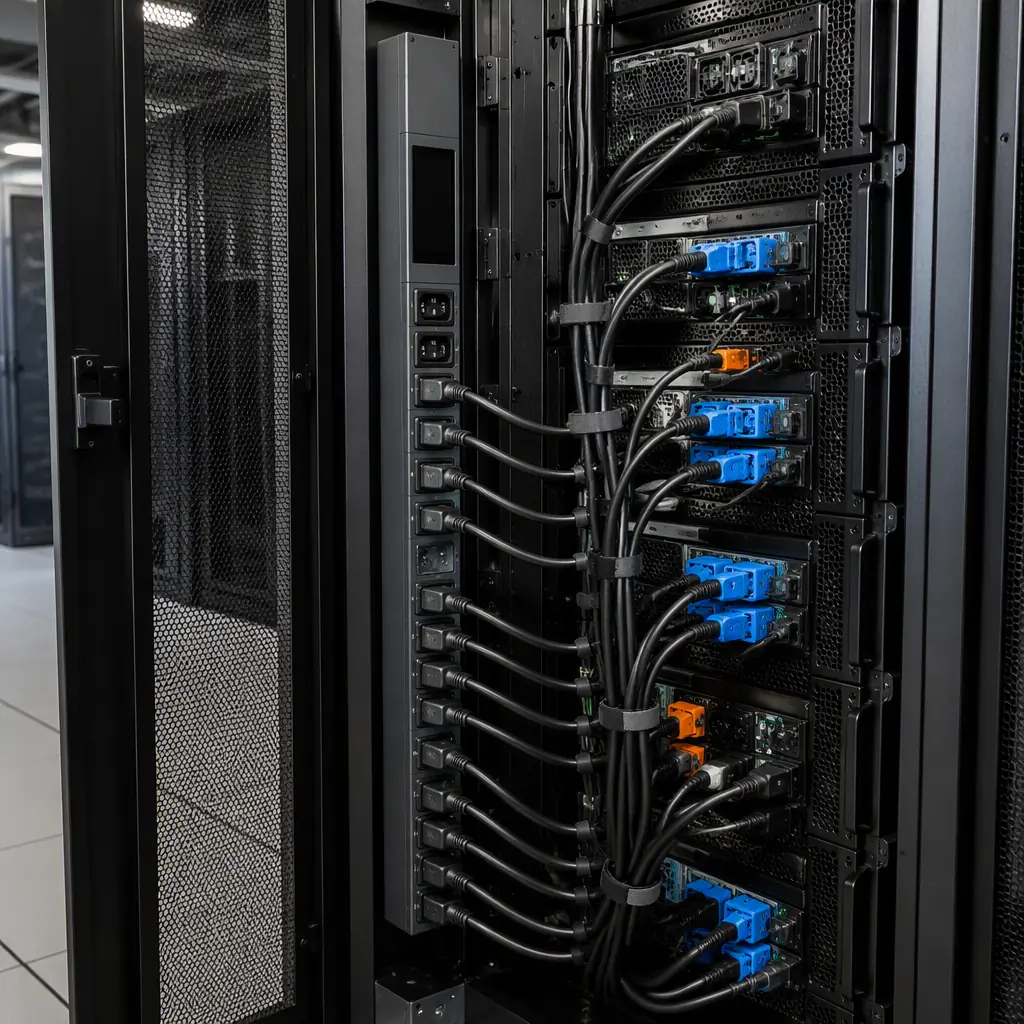
Ask a data center operator what fails and they will usually name the servers, the network, or the cooling. Ask an experienced facilities engineer and they will point at the power distribution unit, the PDU, the device sitting in every rack that decides what that rack is allowed to draw. A PDU is not glamorous, but it is the single point where a monitoring fault, a metering error, or a hot-swap failure becomes a whole-rack outage and a very expensive invoice. At Huaxing PCBA we build the boards that carry that responsibility, from 6 oz high-current copper on the power path to precision current sensing for the metering channel.
This guide is the engineering framework to judge a PDU control board. Whether you are an OEM designing one, or a procurement team qualifying a supplier. It is the same discipline our PCB power integrity & PDN design guide applies at the board scale, extended to the high-current, agency-certified world of facility power.
The Five Types of PDU, and What Changes on the Board
A PDU is not one product. The board complexity scales with the PDU's intelligence, and the type you are building decides the electronics you need.
| PDU type | Metering | Switching | Board content | Typical use |
|---|---|---|---|---|
| Basic | None | None | Bus bar + outlet wiring only | Rack power only | Metered | Voltage/current | None | Sensing + display | Capacity monitoring | Monitored | Full power at inlet/outlet | None | Metering + comms + sensors | Remote feedback | Switched | Full power | Remote on/off | Metering + relay + comms | Cascade/reboot | Intelligent | Per-outlet + environmental | Per-outlet control | Full control + monitoring board | High-density colo |
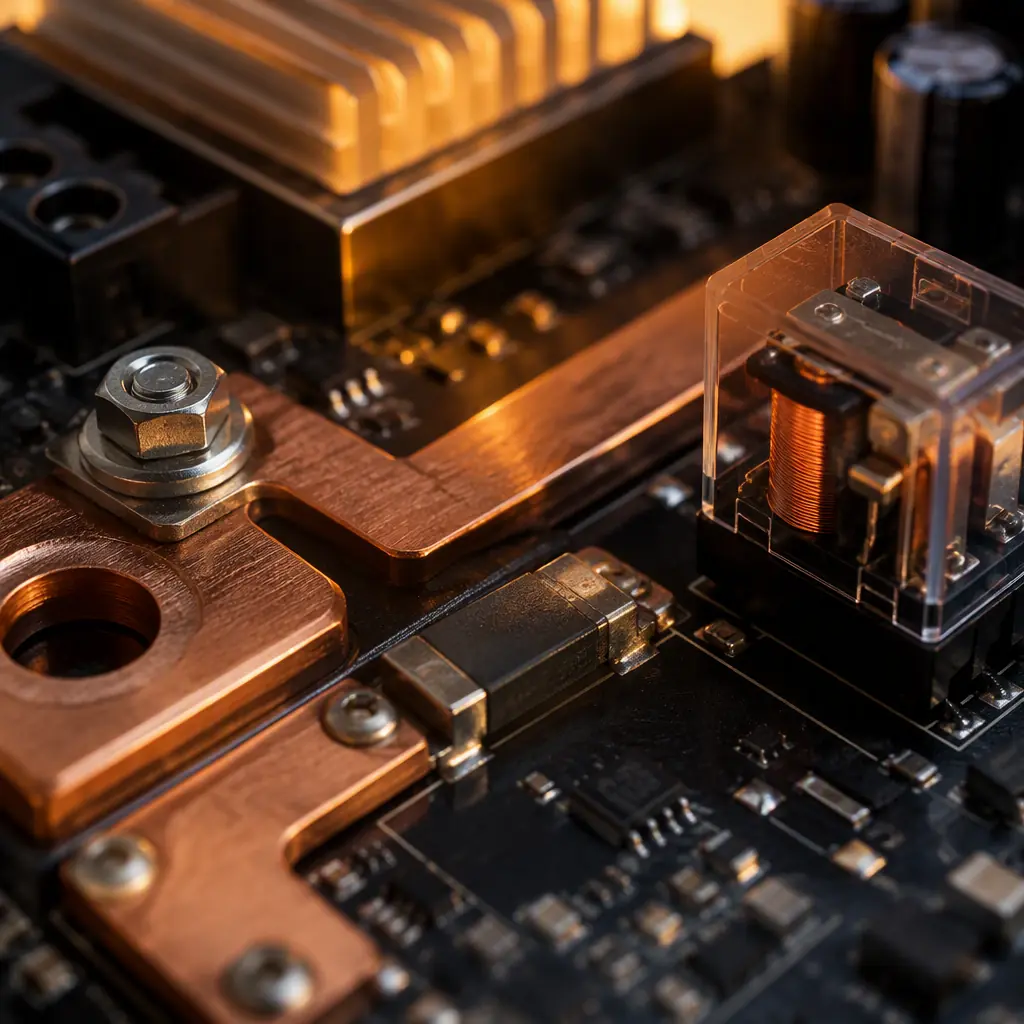
The step from “metered” to “switched” to “intelligent” is where the PCB does real work: adding relays, current sensors, a microcontroller, communications and, on the high-end, per-outlet metering. The board must carry a high-current power path and a low-signal sensing and control layer in the same enclosure. Which is why PDU board design is a genuine mixed-power-and-signal problem.
The Power Path: How High-Current Copper Decides Your PDU
The largest determinant of PDU reliability is the power path. The copper that carries the full rack current from input to outlet. Electricians size wire by ampacity; PCB designers size copper weight by the same logic in ounces per square foot. The choices:
Copper weight: 2 oz, 4 oz, or 6 oz+
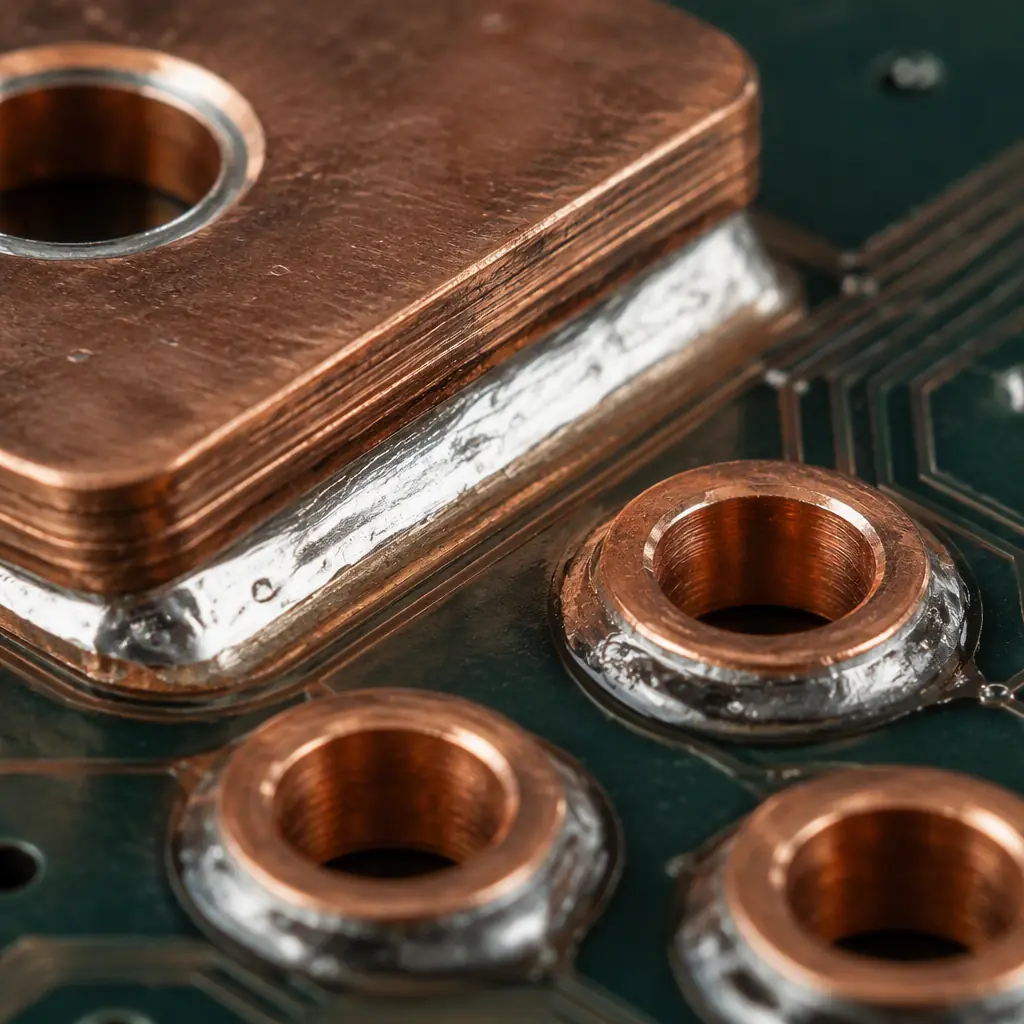
A high-density PDU at 30–60 A per phase needs heavy copper on the power plane to stay within an acceptable temperature rise. Our copper weight guide walks through the ampacity trade-off. 6 oz is the high end we build for the truly high-current lane.
Trace width and the thermals that follow
Trace width and ampacity are linked; widening a trace to carry current without heating is the same math in our trace width & current capacity guide. But wide traces are also a thermal problem, because heat wants to stay in the copper.
Low-inductance return path for transient load
A rack that suddenly loads a GPU node draws a fast current step. A low-inductance power return prevents a voltage droop that resets the outlet. The power integrity guide covers the plane and decoupling reasoning.
Engineering Note: Do not size a PDU power path on nominal current alone. A rack's transient and inrush current is often 2-4x the steady-state draw, and it is transient load that sends a poorly-sized board into thermal derating or a voltage droop. Design the copper for the transient, not the label.
Current Metering: Getting to ±0.5% Accuracy
The metering channel is what separates a cheap PDU from a useful one. A data center bills on measured power, so the accuracy is a direct financial number. Two approaches dominate:
Shunt-based metering
A low-value precision shunt in the current path, measured with a high-resolution ADC and isolation. Shunts are accurate, cheap and temperature-stable, but they add a small insertion loss and need a good Kelvin sense pair to avoid layout-induced error.
Current transformer / Rogowski
A CT or Rogowski coil measures current via the magnetic field, galvanically isolated from the power path. Good for high current and no insertion loss, but the phase and gain accuracy depend on the coil and the integrating electronics.
The trace routing of the Kelvin sense pair is the make-or-break detail on a shunt-based board. A single stray millivolt in the sense path shows up as a metering error you cannot calibrate away. Getting ±0.5% means treating the sense routing with the same care as a high-speed differential pair, the discipline detailed in our signal integrity guide, applied to the analog domain.
Procurement Tip: Ask any PDU supplier for the metering accuracy number and the test method. “±1%” with no stated method is not a specification; “±0.5% over the full power and temperature range, verified on a calibrated reference” is.
Hot-Swap, Inrush and the Relay/Contactor
Safely switching a rack load on and off is a transient-engineering problem. A relay or contactor that closes into a capacitive load draws a large inrush current, and that inrush can weld the contacts or reset the control electronics.
Inrush current management
A soft-start or pre-charge path, or a contactor rated for the inrush, prevents a destructive current spike. The back-EMF from switching an inductive load also needs a flyback path, most often a TVS or a snubber across the relay.
Hot-swap and the safe-stop fault path
A hot-swap controller stages the rise of the supply voltage to the load, preventing the inrush from tripping the circuit breaker. It also provides an over-current and over-voltage protection that is a hard requirement for a “switched” or “intelligent” PDU.
Thermal and relay life
Relays are mechanical parts. The contact material, the holding current and the ambient thermal in a sealed rack all move the cycle life. The thermal management guide covers the enclosure thermal budget.
Communications, Sensors and the Control Bus
An intelligent PDU is an IoT device. It reports to a DCIM system, so its board carries a communication stack and a set of sensors in addition to the power and metering paths.
Ethernet, Modbus, RS-485
Which protocol depends on the building-management layer. RS-485/Modbus is rugged and cheap for a serial bus; Ethernet is the modern default for per-outlet monitoring. Our RS-485 & RS-232 guide and industrial Ethernet guide cover the layout rules.
Environmental sensing
Temperature and humidity sensors inside the PDU give early warning of a hot spot. Route the sensing channels independent of the switching stage and isolate the cold junction from heat, or the reading lies.
Isolation between control and power
This is non-negotiable: the microcontroller and comms side of the board must be isolated from the high-voltage power path. Our high-voltage PCB design guide details the creepage, clearance and isolation boundaries.
Agency Safety and Where It Fails
A PDU carries mains-class voltage, and safety is a certification question, not a design preference. The standards that govern a PDU board are the same family that governs IT equipment:
| Standard | Region | What it governs |
|---|---|---|
| UL 62368-1 / IEC 62368-1 | North America / global | IT-equipment safety: shock, energy, fire | UL 60950-1 (legacy) | North America | Older ICT safety standard | IEC 61010 | International | Measurement and control equipment | CE (EMC) | Europe | Electromagnetic compatibility |
The two failure points buyers should probe are creepage/clearance on the power path, and the actual hold-up of the isolation barrier. A PDU board that saves $0.30 by narrowing a creepage gap to a marginal value is a board that fails the surge test in the field. Our UL certification guide and certifications & compliance guide cover the certification evidence to demand.
Summary: The PDU Board Is a Mixed-Fidelity Problem
A rack PDU control board is the exact opposite of a mainstream commodity board. It carries a high-current, agency-certified power path side by side with a precise metering channel and an isolated low-signal control plane, three classes of requirement in a single enclosure. Get the copper right and the metering accurate and the comms isolated, and you have a PDU that quietly earns its keep for a decade. Skimp on any one of them and it becomes the failure that takes down an entire rack.
At Huaxing PCBA we build this tier of mixed-power-and-signal boards: up to 32 layers, 6 oz copper on the power path, ±5% impedance on the control lanes, 0.075 mm laser vias, across 8 SMT lines in a 15,000 m² facility serving 30+ countries under ISO 9001, IATF 16949 and UL. Bring us your PDU design for a free DFM review of the power path, metering, isolation and agency compliance. Upload your files or talk to our engineering team about your intelligent PDU specification.