You receive a PCB quote. The unit price looks competitive, $4.80 per board at 1,000 units. Then you scroll down. Setup: $850. Stencil: $350. ICT fixture: $4,200. Programming: $600. Suddenly your $4,800 production order has $6,000 in non-recurring engineering (NRE) charges attached to it. This is not a mistake, it is how PCB manufacturing economics work. NRE covers the one-time costs of preparing a factory to build your specific design. The question is whether you are paying the right amount for the right things.
At Huaxing PCBA, we process over 8,000 unique designs annually, each with its own NRE profile. The difference between a well-quoted NRE and an inflated one can be $3,000–8,000. Especially for first-time buyers who do not know which charges are standard vs which are optional markups. This guide breaks down every NRE category in a typical PCB or PCBA quote, with real cost ranges from our Shenzhen factory in 2026.
What Exactly Is NRE and Why Does It Exist?
Non-recurring engineering (NRE) is the one-time cost of preparing tooling, programs, and processes for a specific PCB design. Once the NRE is paid, it covers all production units of that design. You do not pay it again for repeat orders. NRE exists because every PCB design requires custom physical tooling (stencils, fixtures, test programs) that cannot be reused across different designs. Think of it as the factory's setup cost: they need to create the tools before they can make your boards efficiently. The alternative, building without proper tooling, means slower production, lower yield, and higher per-unit cost. In our prototype vs production guide, we cover how NRE scales differently for low and high volumes.
| NRE Category | Typical Range (2026) | Applies To | Recurring? |
|---|---|---|---|
| PCB Tooling / Setup | $150–800 | Bare PCB fabrication | No |
| SMT Stencil (Laser-Cut SS) | $150–500 | PCBA (assembly) | No, but stencil wears out after 10k–20k prints |
| ICT Test Fixture | $3,000–8,000 | PCBA with ICT testing | No, fixture lasts 500k+ cycles |
| Flying Probe Program | $200–800 | PCBA with flying probe test | No |
| Functional Test Fixture | $1,500–6,000 | Custom functional test | No |
| AOI Programming | $150–400 | PCBA with AOI inspection | No |
| Conformal Coating Mask | $200–600 | Boards requiring coating | No, mask wears after 500–1,000 cycles |
| Programming/Engineering | $100–500 | Any order with custom setup | No |
Procurement Reality: A simple 2-layer prototype board with flying probe test typically has $400–700 in NRE. A complex 12-layer HDI board with ICT fixture, conformal coating mask, and functional test can have $10,000–15,000 in NRE. The NRE-to-unit-cost ratio matters: on a 100-unit order, $5,000 NRE adds $50/board, doubling the apparent unit price. On a 10,000-unit order, the same NRE adds just $0.50/board. Always calculate total landed cost including NRE, not unit price alone.
PCB Fabrication NRE: Tooling, Films, and Setup
Bare PCB fabrication NRE covers the phototooling and process setup for your specific board design. Modern factories use laser direct imaging (LDI), which has largely eliminated traditional photoplotter film costs, but there are still setup charges for drill programs, routing programs, electrical test fixtures, and first-article inspection (FAI).
Engineering / CAM Setup: $100–300
An engineer loads your Gerber files into CAM software, verifies the design rule check (DRC), adjusts for manufacturing tolerances (etch compensation, solder mask expansion), and generates the production tooling files. This is non-negotiable: every new design requires CAM review. Some factories bundle this into the tooling charge; others list it separately. If the quote shows both "CAM" and "Tooling" as line items with similar prices, ask if they overlap.
Electrical Test (E-Test) Fixture: $150–500
Bare PCB testing verifies that every net on the board is electrically continuous and that there are no shorts between nets. The fixture is a dedicated jig with spring-loaded pins that contact each pad. Flying probe testing (no fixture, but slower) is an alternative for low volumes. Most factories waive the e-test fixture fee for orders above 500 units or absorb it into the unit price. See our PCB testing methods comparison for fixture vs flying probe trade-offs.
Impedance Control Coupon: $50–150 per impedance set
If your design specifies controlled impedance (±10% or tighter), the factory adds an impedance test coupon to the panel. This is a small test structure with the same trace geometry as your controlled-impedance nets, used for TDR measurement. Each unique impedance target (50Ω single-ended, 100Ω differential, etc.) typically adds one coupon. This is a legitimate charge. Do not negotiate it away, as skipping impedance verification on a controlled-impedance board means you are trusting the stackup calculation without measurement proof.
SMT Assembly NRE: Stencils, Programming, and Fixtures
PCBA (assembly) NRE is typically larger than bare PCB NRE because it involves physical tooling that must be precisely manufactured: laser-cut stainless steel stencils, pick-and-place programs, reflow profiles, and test fixtures. These costs are design-specific and cannot be shared across different projects.
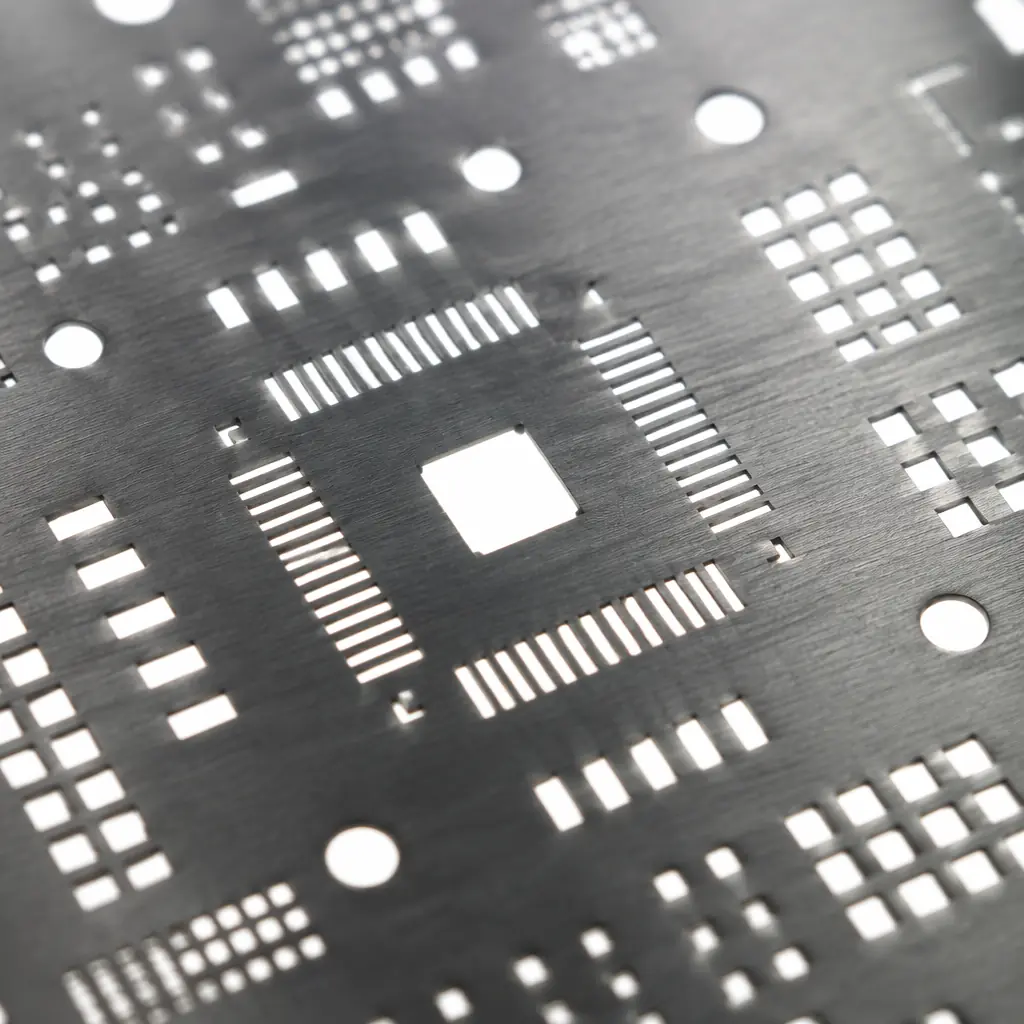
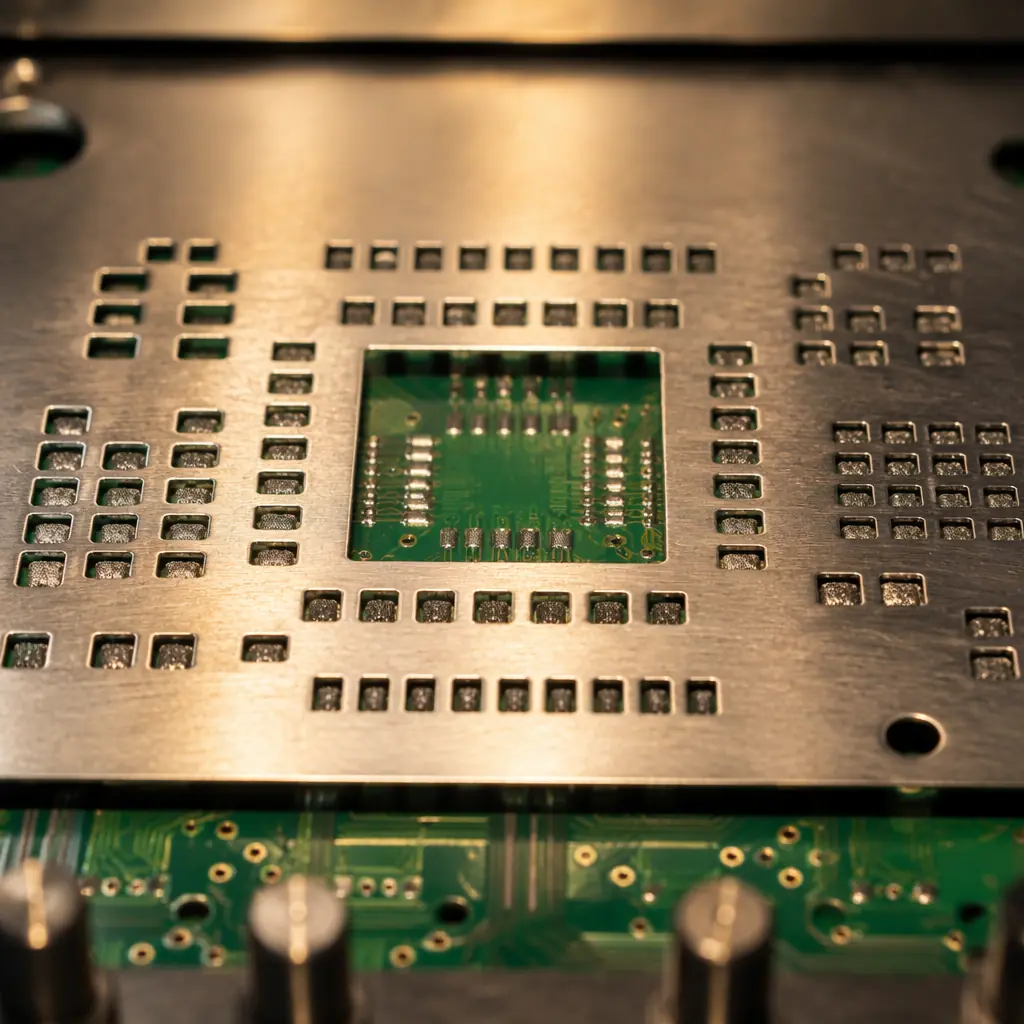
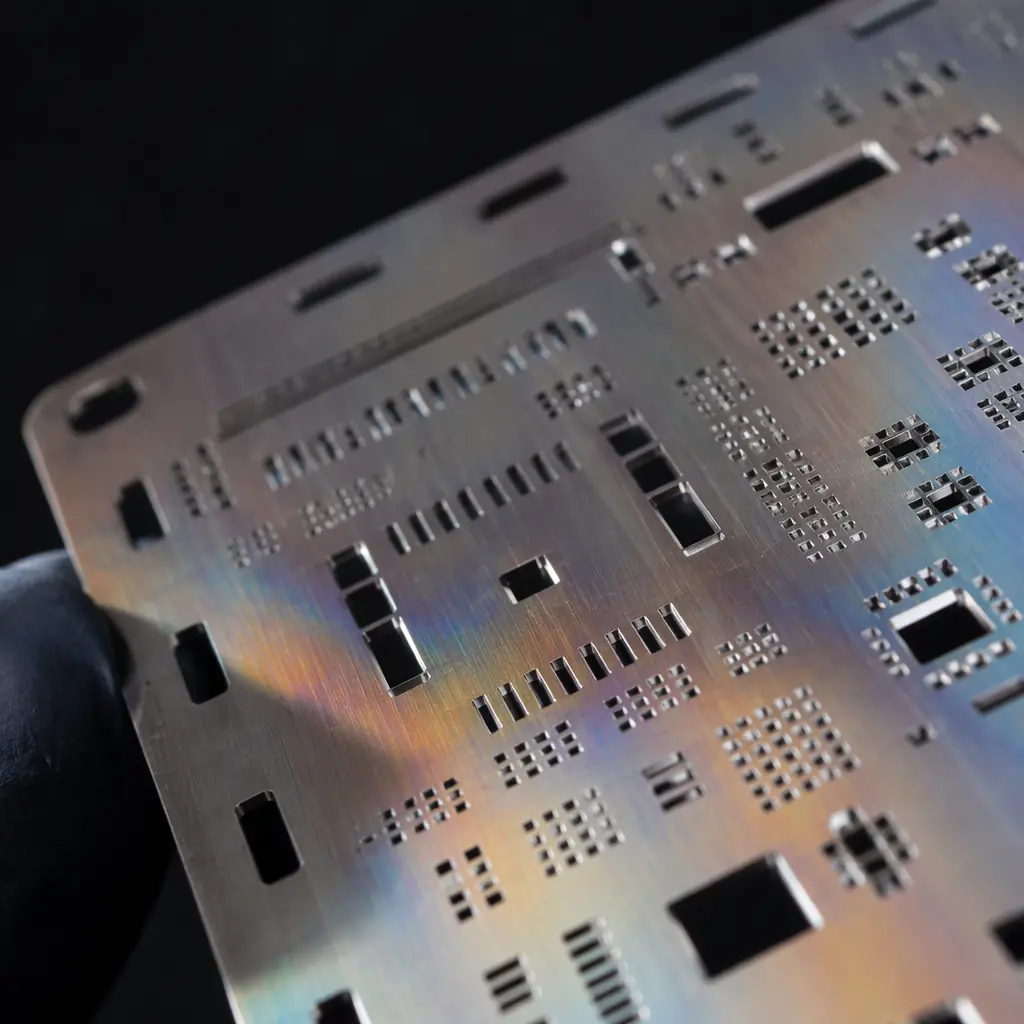
SMT Solder Paste Stencil: $150–500
A laser-cut stainless steel stencil (typically 0.1–0.15 mm thick) is placed over the bare PCB to apply solder paste precisely onto component pads before pick-and-place. Stencil cost depends on size (standard 29"×29" frame), thickness, and aperture count. Step stencils (multi-thickness for mixed-pitch designs) cost $50–150 more. Stencils wear out after approximately 10,000–20,000 print cycles due to paste abrasion and cleaning damage. You will need a replacement for long production runs, but this is included in the per-unit cost for volume orders. Our PCB assembly process guide covers where the stencil fits in the SMT line.
Pick-and-Place Programming: $100–400
The SMT machine needs a placement program that tells it which component goes where, at what orientation, from which feeder. This is generated from your BOM and centroid (pick-and-place) file. Programming cost scales with component count: a 50-component board takes 30–60 minutes to program, a 500-component board takes 3–5 hours. Providing clean, well-formatted centroid and BOM files reduces programming time. And some factories discount the charge if your files are error-free on first import.
AOI Programming: $150–400
Automated Optical Inspection (AOI) machines compare each assembled board against a "golden board" reference or CAD-derived image. Programming involves teaching the AOI system what a correct assembly looks like, setting inspection thresholds for solder joint quality, component presence, and polarity. AOI programming is a one-time charge per design. For production volumes above 1,000 units, many factories include AOI programming at no charge because the recurring inspection value offsets the setup cost.
Test Fixture NRE: The Largest Single Line Item
Test fixtures, particularly ICT (in-circuit test) fixtures, are typically the largest NRE line item, and the one most first-time buyers do not anticipate. A proper ICT fixture is a precision mechanical assembly with 200–800+ spring-loaded pogo pins, a vacuum-actuated press, and custom wiring to the test system. It is essentially a one-off machine built specifically for your board.
ICT Fixture: $3,000–8,000 (Single-Sided), $8,000–15,000 (Double-Sided)
ICT fixtures test every net on an assembled board for shorts, opens, component values, and polarity in 15–30 seconds. Single-sided fixtures (all probes on bottom) cost $3,000–8,000 and take 3–4 weeks to build. Double-sided fixtures (probes on both sides) cost $8,000–15,000 and take 5–6 weeks. The cost difference comes from mechanical complexity: double-sided fixtures need synchronized top and bottom press mechanisms with precise alignment. If your NRE quote shows two ICT-related line items (e.g., "ICT Fixture" and "ICT Programming"), the programming charge is typically $400–800 for test program development. Good DFT reduces fixture cost, see our Design for Testability guide for test point placement rules that keep your board in the single-sided fixture range.
Functional Test Fixture: $1,500–6,000
Functional test fixtures simulate the board's operating environment, applying power, injecting signals, and measuring outputs to verify system-level functionality. These are custom-designed per product and can range from simple bed-of-nails interfaces ($1,500) to fully enclosed test stations with integrated power supplies, signal generators, and automated data logging ($6,000+). Unlike ICT fixtures, functional test fixtures often include active electronics (load boards, relay matrices, microcontroller-based sequencers), which drive up cost. If your product has firmware, the functional test fixture cost typically includes initial test script development.
Hidden NRE: Charges That Should Not Be There
Some factories inflate NRE with redundant or unnecessary line items. Here are the most common ones to question:
"First Article Fee", Legitimate at $50–150, Suspicious Above $300
A first article inspection (FAI) verifies that the first board off the production line matches the design. It is a standard quality control step that most factories include in their overhead. A separate charge above $150 typically means they are billing for something their process already does. If the quote includes both "FAI" and "Engineering Review," they may be charging twice for the same work.
"Panelization Fee", Should Be Included in Tooling
Panelization, arranging multiple copies of your board on a production panel, is part of the CAM engineering process. It should be covered by the standard tooling/engineering charge, not billed separately. A separate $100–200 panelization line item suggests the factory is unbundling standard engineering work to inflate the NRE total.
Negotiation Tip: The single most effective NRE negotiation tactic is to ask for "NRE amortization." Instead of paying the full NRE upfront, the factory spreads it across the first production run's unit price. For example: $5,000 NRE on a 2,000-unit order = $2.50/board premium. This aligns incentives. The factory is motivated to keep NRE low because they carry the risk until the units ship. Most Shenzhen factories (including Huaxing PCBA) offer NRE amortization for orders above $10,000 total value. Read our PCB quote comparison guide for more strategies to evaluate competitive bids.
How to Budget NRE: A Pre-Quote Worksheet
Before you request quotes, estimate your NRE using these rules of thumb. The actual quote should fall within ±30% of these estimates. If it does not, ask for a line-item breakdown to understand the discrepancy.
| Board Type | Test Method | Volume | Estimated NRE | NRE per Unit |
|---|---|---|---|---|
| 2-layer, 50 components | Flying Probe | 100 units | $500–900 | $5.00–9.00 |
| 2-layer, 50 components | Flying Probe | 1,000 units | $500–900 | $0.50–0.90 |
| 4-layer, 150 components | ICT (single-sided) | 1,000 units | $4,500–8,500 | $4.50–8.50 |
| 4-layer, 150 components | ICT (single-sided) | 10,000 units | $4,500–8,500 | $0.45–0.85 |
| 8-layer HDI, 300+ components | ICT + Functional | 5,000 units | $12,000–22,000 | $2.40–4.40 |
The pattern is clear: NRE matters most at low volumes. At 100 units, NRE can exceed your total unit cost. At 10,000 units, NRE is a rounding error. Plan your production ramp accordingly, start with flying probe test for prototypes and low volumes, then invest in ICT fixtures when volumes justify the upfront cost. At Huaxing PCBA, we help procurement managers model total landed cost including NRE before the first purchase order. Read our PCB cost factors guide for a complete picture of manufacturing economics, or request a quote with transparent NRE line items, we respond within 24 hours.