
Every panel a fabricator ships carries some amount of test evidence, but the amount and the form of it are rarely specified by the buyer. That gap is where disputes live. A coupon that was never requested cannot be missing, and a coupon positioned badly on the panel can pass its test while the boards beside it fail theirs.
This guide covers what a test coupon is actually evidence of, the six coupon types worth specifying, where each one has to sit on the panel to be representative, and the drawing and purchase-order language that removes ambiguity. It sits above the interpretation layer: for reading a cross-section once you have one, our guide to microsection analysis and our article on interpreting cross-section reports cover that in detail.
What a Test Coupon Actually Proves
A test coupon is a structure built onto the same panel, from the same materials, through the same process steps as the production boards beside it. That shared provenance is the entire basis of its value. A coupon is not a sample of your product; it is a witness sample of the process that produced your product.
This gives the coupon two important limitations that buyers frequently overlook. First, a coupon proves something about the panel it came from, not about a batch — a coupon from one panel tells you nothing about panels processed later on a different plating bath condition or a different lamination cycle. Second, a coupon only covers the characteristics it was designed to measure. An impedance coupon says nothing about hole wall quality, and a microsection coupon says nothing about electrical performance.
Key Takeaway: Ask for the coupon set that matches the risks you actually care about. A generic coupon on the panel edge that proves plating thickness is not the same evidence as an impedance coupon that proves your controlled-impedance traces landed in tolerance.
The Six Coupon Types You Can Specify
These are the coupon types worth naming explicitly in a purchase specification. Each one maps to a specific risk and, in most cases, a specific test method.
Impedance Coupon
A coupon containing traces built to the same width, dielectric spacing and layer stack as your controlled-impedance nets, so that a time-domain reflectometry measurement on the coupon reports on your production traces. This is the coupon to specify whenever your drawing carries an impedance requirement, and it needs to be declared in the same stackup context as the product. The design rules behind controlled impedance are covered in our guide to impedance control.
Microsection Coupon
A coupon designed to be sectioned and examined for plating thickness, hole wall quality, registration and laminate integrity — including the copper-to-resin adhesion and drilled-hole quality that the relevant acceptance standard governs. This is the coupon that provides the physical evidence behind the cross-section reports discussed in our cross-section report guide.
Solderability Coupon
A coupon with finish-representative pads used to test wetting. Solderability degrades with storage time and with finish thickness, so a solderability coupon is only meaningful when its test date is recorded alongside it. Our guide to solderability testing covers the wetting-balance methods and their acceptance criteria.
Plating Thickness Coupon
A coupon with exposed, measurable plating areas for the finishes you have specified — surface finish, copper, and where relevant the coating thickness. This is the coupon type most commonly supplied by default, and it is also the one most commonly assumed to cover more than it does: it says nothing about solderability or impedance performance.
Electrical Continuity and Isolation Coupon
A test pattern that allows net-level continuity and isolation measurement. Useful where you want evidence of electrical integrity without probing the product board itself, particularly for thin or high-density designs where probe damage is a risk. The broader menu of electrical test options is compared in our article on PCB testing methods.
Reliability or IST Coupon
A coupon with via chains built to your production via geometry, used for accelerated reliability testing such as interconnect stress testing or thermal cycling. This coupon matters when via reliability is a design concern, and it is the appropriate evidence for the qualification requirements in our guide to IPC-6012 qualification.

Where the Coupon Sits on the Panel
A coupon that is correctly designed but badly positioned is worse than no coupon, because it produces evidence that looks authoritative and is not representative.
Position Determines What the Coupon Represents
Plating thickness, etch uniformity and lamination pressure all vary across a panel, generally decreasing toward the panel centre for plating and varying with distance from the panel edge for other parameters. A coupon placed in a favourable location can report values your production boards never achieve. Specify the location rather than leaving it to the fabricator's panelisation defaults.
Coupon Orientation and Copper Distribution
For impedance coupons, orientation matters: the coupon traces should run in the same direction relative to panel edges as the production traces they represent, because etch behaviour is directionally affected by tank geometry. For microsection coupons, the copper distribution around the coupon should not be wildly different from the production area, since grossly different copper density changes local plating current density and therefore local thickness.
How Many Coupons Per Panel and Per Lot
One coupon per panel is a common default and is usually adequate for thickness verification. For impedance, a coupon on the production panel itself is more defensible than one on a separate test panel, because it shares the exact process conditions. If the requirement is statistical rather than documentary, specify coupon frequency per lot — for example, one microsection coupon per panel in the first and last panel of each lot.
Removability and Breakaway Design
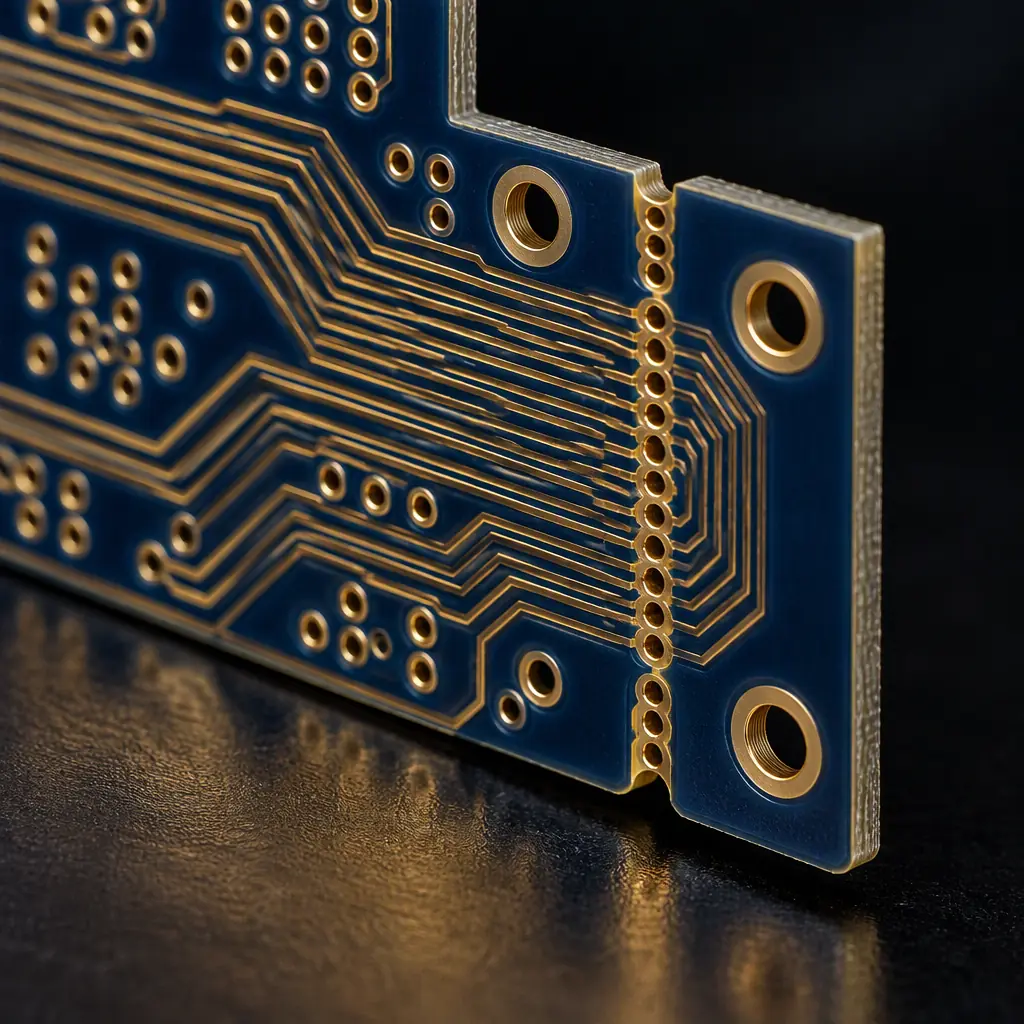
Coupons are normally designed as breakaway tabs routed or V-scored from the production area, which keeps the fabricator from having to hand-cut them and keeps the coupon traceable to its panel. Specify how the coupon is separated, and note that the separation method can itself affect a microsection result if it disturbs the structure being sectioned.
Coupon Set by Product Class
A product class maps reasonably consistently to a coupon set. This table is a starting specification, not a ceiling.
| Product Characteristic | Minimum Coupon Set | Additional Where Risk Is High |
|---|---|---|
| IPC Class 1, no impedance requirement | Plating thickness coupon | Electrical continuity coupon |
| IPC Class 2, standard commercial | Plating thickness + microsection coupon | Solderability coupon on stored stock |
| IPC Class 3, high reliability | Microsection + solderability + electrical coupon | Reliability or IST coupon |
| Controlled impedance, any class | Impedance coupon on the production panel | Impedance coupon per lot position |
| High layer count or high aspect ratio | Microsection coupon at worst-case hole | Reliability coupon with production via geometry |
| Long storage before assembly | Solderability coupon with test date | Repeat solderability test before assembly |
The class definitions behind that table are set out in our article comparing IPC Class 2 and Class 3, and the acceptance framework the coupons feed into is covered in our testing methods overview.
What to Put in Your PO and Drawing
The reason coupons go missing is almost always that they were never unambiguously requested. Four elements close that gap, and all four belong in the fabrication drawing notes rather than in a separate email thread.
Name the Coupon Types Explicitly
Write "impedance coupon required on each production panel, traces per controlled-impedance note 4" rather than "test coupon to be supplied." A generic request lets the fabricator satisfy it with whichever coupon is cheapest to add to their existing panelisation.
State the Quantity and Frequency
Per panel, per lot, or per first article only. These are very different commitments and the price differs accordingly. If you need coupons only on the first article for qualification, say so; if you need them on every panel across the order, say that instead.
Require the Test Data as a Deliverable
A coupon that is supplied but never measured is a decoration. Specify that coupon test results ship with the order, and specify the acceptance values: impedance within plus or minus 10 percent unless your design requires tighter, plating thickness against the applicable standard, and wetting results against the relevant test method. The report structure that data typically arrives in is described in our cross-section report guide.
Define What Happens on Failure
State whether a failed coupon means the panel is rejected, the lot is held pending investigation, or a re-test is permitted. Without this, a marginal coupon result leads to a negotiation rather than a defined outcome. Where a failure triggers a corrective action process, the quality metrics that frame that discussion are covered in our guide to PCB quality metrics and DPPM benchmarks.
Procurement Tip: On a first order from a new fabricator, specify the full coupon set and require the data. It costs little, it gives you a documented baseline of that supplier's process capability, and it makes any later drift in quality visible against a real number rather than a memory of how the boards looked.
Summary
Test coupons are the cheapest quality instrument available to a PCB buyer, and they are only as useful as their specification. A coupon proves something about the specific panel and process that produced it, so it has to be typed to the risk you care about and positioned so that what it measures is representative of your production area.
The practical rule is to specify by risk: impedance coupons when you have controlled-impedance nets, microsection coupons when plating integrity matters, solderability coupons when stock will sit before assembly, and reliability coupons when via geometry is critical. Then require the measured data as a deliverable, with acceptance values and a defined failure consequence, in the drawing notes rather than in correspondence.
At Huaxing PCBA, we build coupons onto production panels as standard for impedance, microsection, solderability and thickness verification, position them per the customer's drawing notes rather than by panelisation default, and ship the measured data with the order. Our engineering team reviews coupon requirements alongside stackup at DFM stage. Read our microsection analysis guide or contact our engineering team to agree a coupon specification for your build.