
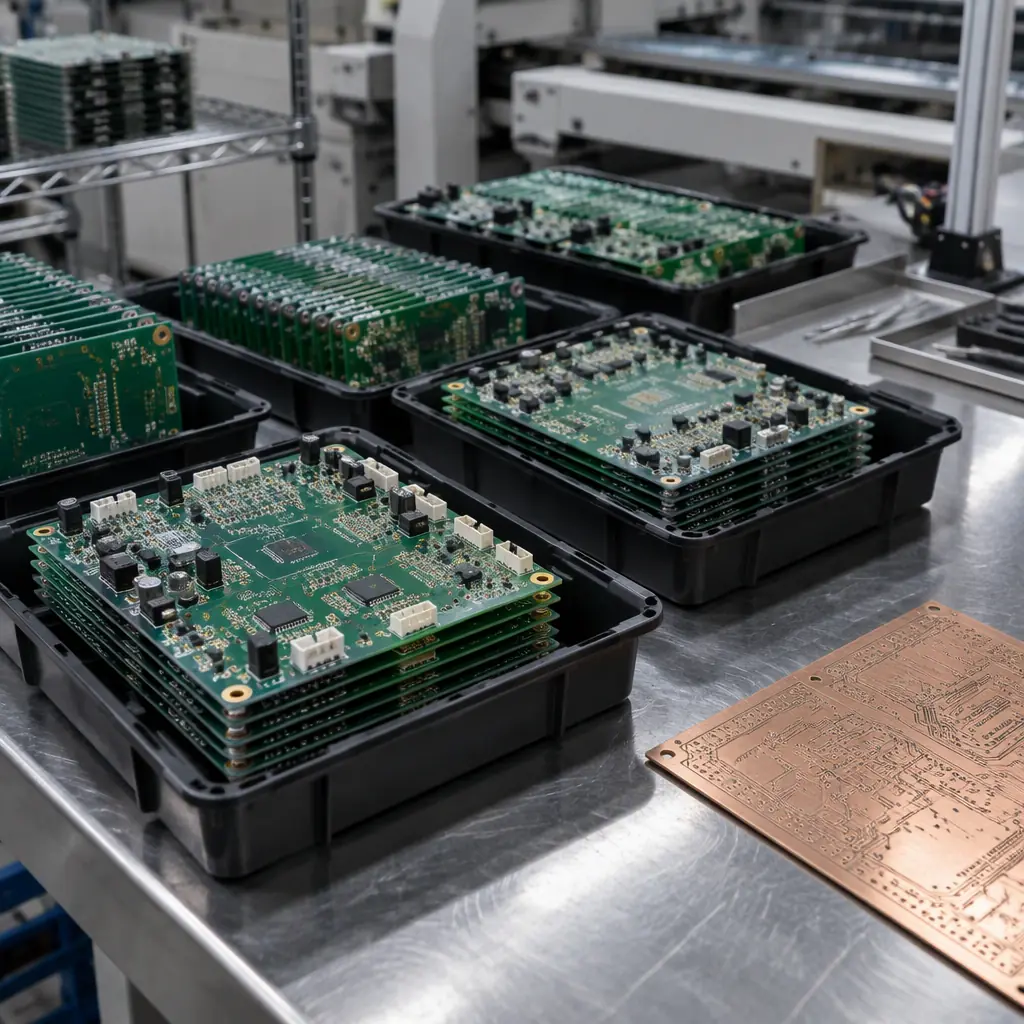
A change order issued after a lot is released has a price, and the price is set almost entirely by where the boards were when the change arrived. Buyers tend to think of it as a paperwork problem, an ECO number, a revision letter, a note in the file. Suppliers tend to quote it as a single lump: scrap the lot, re-run it. Neither view survives contact with a real 1,000-board order, where the same change can cost two hundred dollars or twenty thousand depending on which day it landed and which decision was made in the first two hours.
This page is the arithmetic behind that decision. It sets out what each stage of a build has already consumed, how to compare cutting the change in against scrapping through, where the hidden costs sit in tooling and approvals, and the six lines that belong in a purchase order so the number is agreed before it is needed. The workflow side, revision letters and how an ECO is raised and approved, is covered in our engineering change order guide; this page assumes the change is legitimate and asks only what it costs.
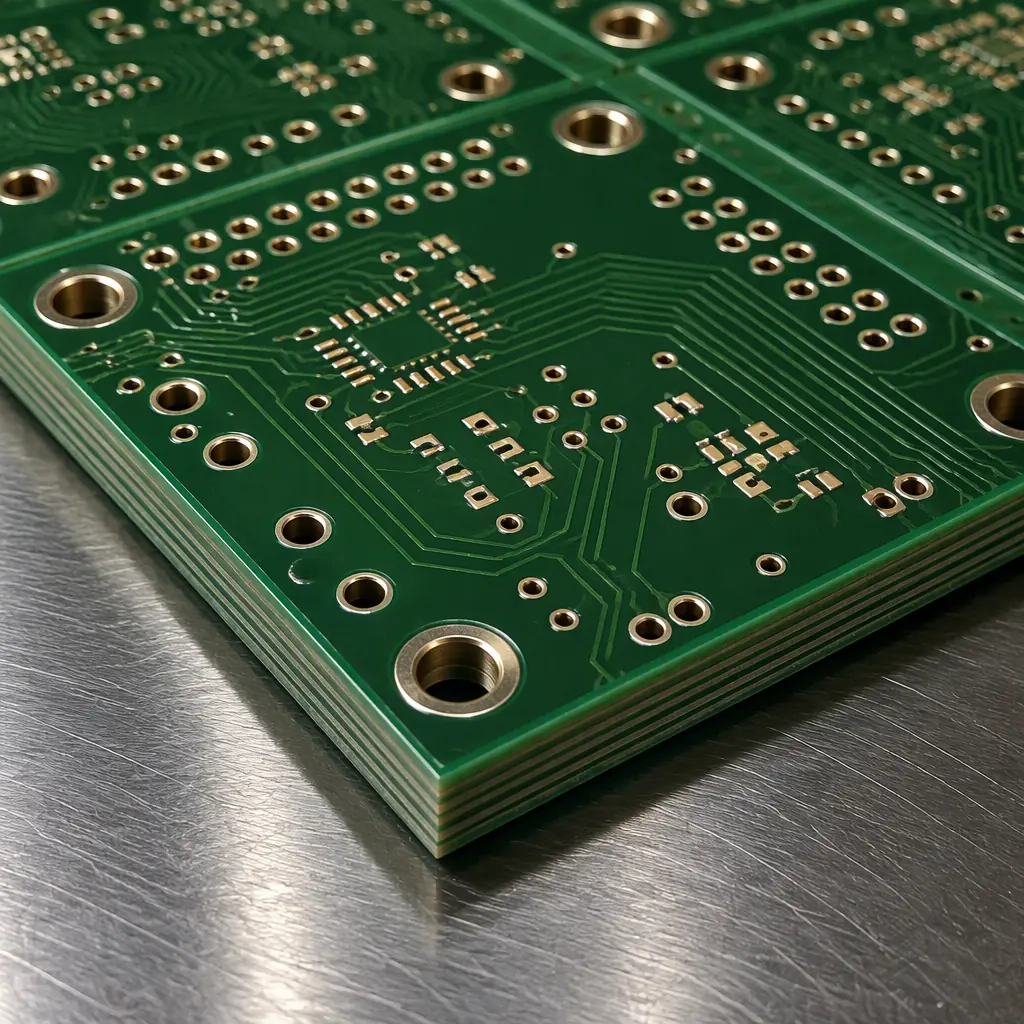
Once a panel is drilled, most of the fabrication cost is spent. The copper change is cheap; the panels it invalidates are not.
Why a Change Has Four Different Prices
An engineering change touches a sequence of operations that each add irreversible value. The value is irreversible because none of the operations can be undone without losing more than the operation cost. When a change lands, everything already completed on the affected boards is either kept, if the change allows it, or lost.
The four price points map to the four operations that commit material: fabrication commit, SMT first pass, test and conformal coat, and pack and ship. A fabrication change, meaning a copper, drill or mask change that alters the bare board, invalidates every panel already drilled. An assembly change that only touches component placement can often be handled at the next SMT run without losing the bare boards, provided the boards have not already been populated. A change that arrives during test invalidates functional test fixtures and program versions as well as the boards. A change that arrives after packing costs the boards, the protection, the freight booking and the schedule slot.
The practical consequence is that the cheapest change is the one that arrives before the tooling is cut, and the second cheapest is the one that arrives before reflow. Everything after that is a negotiated settlement rather than a change.
What Each Stage Has Already Consumed
To price a change you need the sunk value per board at each stage, not the total of the order. The table below uses a representative six-layer, 1.0 mm, ENIG, 800-component mixed-technology board at 1,000 units, with a bare-board value of USD 12, SMT value of USD 9 and test value of USD 3. These numbers are typical for this class in Shenzhen and are what we use when quoting; substitute your own and the arithmetic holds.
| WIP stage | Sunk value per board | What a change can still save | What a change destroys | Typical settlement |
|---|---|---|---|---|
| Before panel release | USD 0 to 0.30 (engineering only) | Everything | Nothing but engineering hours | ECO handling fee only |
| Panels drilled, not plated | USD 3.50 | Plating, mask, finish, test | Drill time and panel laminate | Rework at drill stage, usually absorbed |
| Bare board finished | USD 12 | Assembly, test, packing | The entire fab value | Buyer pays fab or supplier scraps at cost |
| Post-SMT, pre-test | USD 21 | Test, coat, packing | Fab plus placed components | Buyer pays fab plus components, not labour |
| Post-test | USD 24 | Packing only | Everything, plus fixture and program versions | Full material plus test time, fixture re-charge if structure changed |
| Packed, awaiting shipment | USD 25 | Nothing | Everything, plus packaging and freight slot | Full value, plus repack and rebook cost |
Read the third column carefully. The column that matters commercially is not what was spent, it is what remains savable. At the bare-board stage, a change that only affects assembly can still be absorbed with a low cost because the 1,000 finished boards are still good; they simply go to a different build. At post-test, there is nothing left to redirect.

Laminate that has not been drilled is still generic stock. Laminate that has been drilled is your design.
Worked Example: The Same Change at Four Moments
Take a 1,000-board order, six layers, 800 placements, USD 12 bare board and USD 9 assembly. The change is a component swap on a 24-pin device, plus a copper trace widening on layer three to carry more current. That combination is deliberate: the component part is assembly-only, the trace is fabrication.
Day 1, before panel release. Cost is engineering time: new Gerber, new fab data, new paste layer, new AOI program. Two to four hours of engineering at internal cost, plus the ECO record. The order ships on the original schedule. Total impact is measured in hundreds of dollars and a day of schedule.
Day 4, panels drilled, plating not started. The drill program is already run. The trace widening on layer three means the drill pattern itself does not change, so the panels can be recovered if plating has not started. Settling this costs the panel handling plus a rescreen of the inner-layer artwork. On this order that is roughly USD 900 to USD 1,400, and about two working days. The single most useful question a buyer can ask in this situation is whether plating has started, because the line item moves by a factor of four on that answer.
Day 11, bare boards finished, SMT not started. The 1,000 bare boards cannot be modified for the trace widening; a three-layer copper change on finished boards is a scrap decision, not a rework decision. The component swap, however, costs nothing extra because the boards have not been populated. Two options exist. Scrap the boards and rerun: USD 12,000 of fabrication plus the original lead time. Or hold the boards and issue the trace change on the next revision of a future build, absorbing USD 12,000 of unusable stock but keeping this programme on schedule with the component change only. Most programmes we see choose the hold, because the trace widening is a robustness improvement rather than a functional fix.
Day 19, post-test. Both changes are now material. The boards are populated, tested and accepted against the old specification. There is no recovery: the value at risk is the full 1,000 times USD 24, plus the functional test fixture if the change moves a test point. A fixture built for this board costs USD 3,500 to USD 8,000 depending on the number of nets and whether boundary scan is used. This is the case where a change that was worth USD 400 on day one becomes USD 24,000 plus a fixture.
Cut In or Scrap Through: The Decision Rule
The choice is rarely "change everything or change nothing". It is whether to introduce the change part-way through the lot, accept mixed WIP, and manage two configurations through test, traceability and shipping, or to finish the lot on the old revision and start the new one cleanly.
Mixed WIP looks cheaper because the immediate scrap number is lower. It is not cheaper once the control costs are counted. Two configurations in one lot means two test programs, two AOI libraries, two sets of serial number records, two acceptance criteria in the quality file and a segregation step at pack. For a 1,000-board lot, that overhead is typically USD 1,200 to USD 2,500, plus a real risk that one board gets packed in the wrong carton. Below a certain lot size, clean scrap through and a fresh start is genuinely less expensive.
The rule we apply
Cut in if the change is assembly-only and the boards are pre-SMT. Scrap through if the change is fabrication-level and the boards are already fabricated, unless the lot is large enough that the trace change is required for compliance rather than improvement. Never cut in a fabrication change mid-lot; the bare boards cannot be made compliant, so a mixed lot is a mixed-specification lot that will be rejected at the buyer's incoming inspection anyway.
Where the Cost Actually Hides
Buyers budget for material and labour and are surprised by the invoice. The four items that are usually missed:
Tooling re-charge. Stencils, test fixtures, AOI libraries and programming fixtures are built against a specific revision. A trace change can invalidate a fixture even when it does not change the netlist, because probe coordinates move. Our tooling and design file ownership guide covers who owns these assets and how the re-charge should be worded.
Approval and requalification. If the product carries a safety or automotive approval, a copper change can trigger a delta qualification even when no functional parameter changes. That is weeks, not days, and the cost sits outside the assembly quote entirely.
Schedule slot. Cutting in is not free in time. A line stop to swap stencils, reload feeders and rescreen runs one to three hours; losing a reserved test slot can push the lot a week. Our line stop and restart control procedure exists precisely because these interruptions are where restart defects enter.
The second change. Roughly half of the changes we process at post-test are a follow-on correction to a change made two weeks earlier. The first change was under-specified, so the second one lands when the value at risk is highest. This is the strongest argument for taking an extra day at day one.
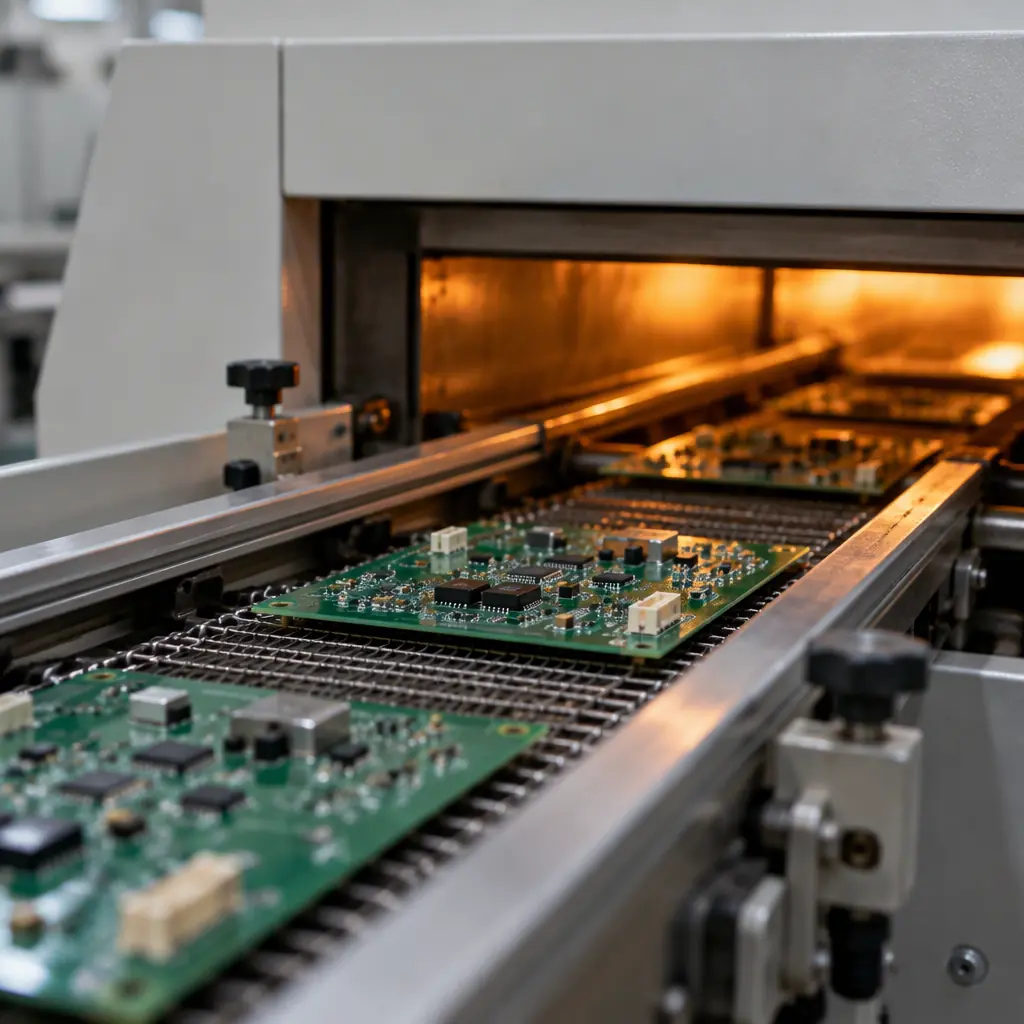
Every metre of conveyor travel converts a cheap change into an expensive one.
The Six-Line Change Clause
None of this is controllable unless the cost rule is agreed before the first change. Six lines in the purchase order do the work:
Cost bands by WIP stage
State the cost basis for changes received before panel release, at bare board, at post-SMT and at post-test, with the per-board value used for each. Bands, not formulas, because formulas invite argument about which costs are included.
Who authorises scrap
Name the person or role at the buyer who can authorise scrapping a lot, and the threshold above which a written confirmation is required. Without this, the supplier either stops and waits for days or scraps at risk.
Change window and cut-off
Agree the latest point in the schedule at which a change will be accepted on the current lot, expressed in days before ship date rather than as a stage name, because stage names differ between suppliers.
Tooling re-charge cap
Cap the re-charge for stencil and fixture rebuild per change, or require a quotation before work starts above a stated amount.
Mixed-lot prohibition
State explicitly whether two revisions may ship in one lot. If not, the supplier knows a cut-in is not an option and will price a scrap-through instead.
Configuration record per carton
Require the revision letter on every carton label and in the shipping data file. If a mixed lot is ever permitted, this is the only thing that makes the segregation auditable.
The commercial counterpart is the dispute path. Where a change cost is contested because the WIP stage is in doubt, the resolution depends on whether the supplier kept dated stage records. Our quality dispute resolution process sets out what evidence resolves a WIP-stage disagreement, and it is worth reading before you need it.
What We Record During a Change
Our own practice, since it is what the clause is designed to work with: every change is logged with the WIP quantity at each stage, the date and time the change instruction was received, the date and time the line was stopped, and photographs of the work in progress at the stop. The lot is segregated immediately and physically, not just in the MES, because a boundary that exists only in software gets crossed at the pack station. Engineering change response within the working day is standard for existing customers, and we will price the options before executing any of them.
Where the change is large enough to justify it, the clean answer is often to freeze the current lot at the last good stage, ship what is already complete on the old revision if the programme permits it, and start the new revision as a fresh NPI gate with its own first article. That costs a schedule slot and a fixture, and it avoids the far larger cost of discovering the change was wrong halfway through a mixed lot.
If a change is already in flight and you need the cost by WIP stage rather than an estimate, send the lot position and the change description. We will return the stage-by-stage cost and the two options priced side by side.