
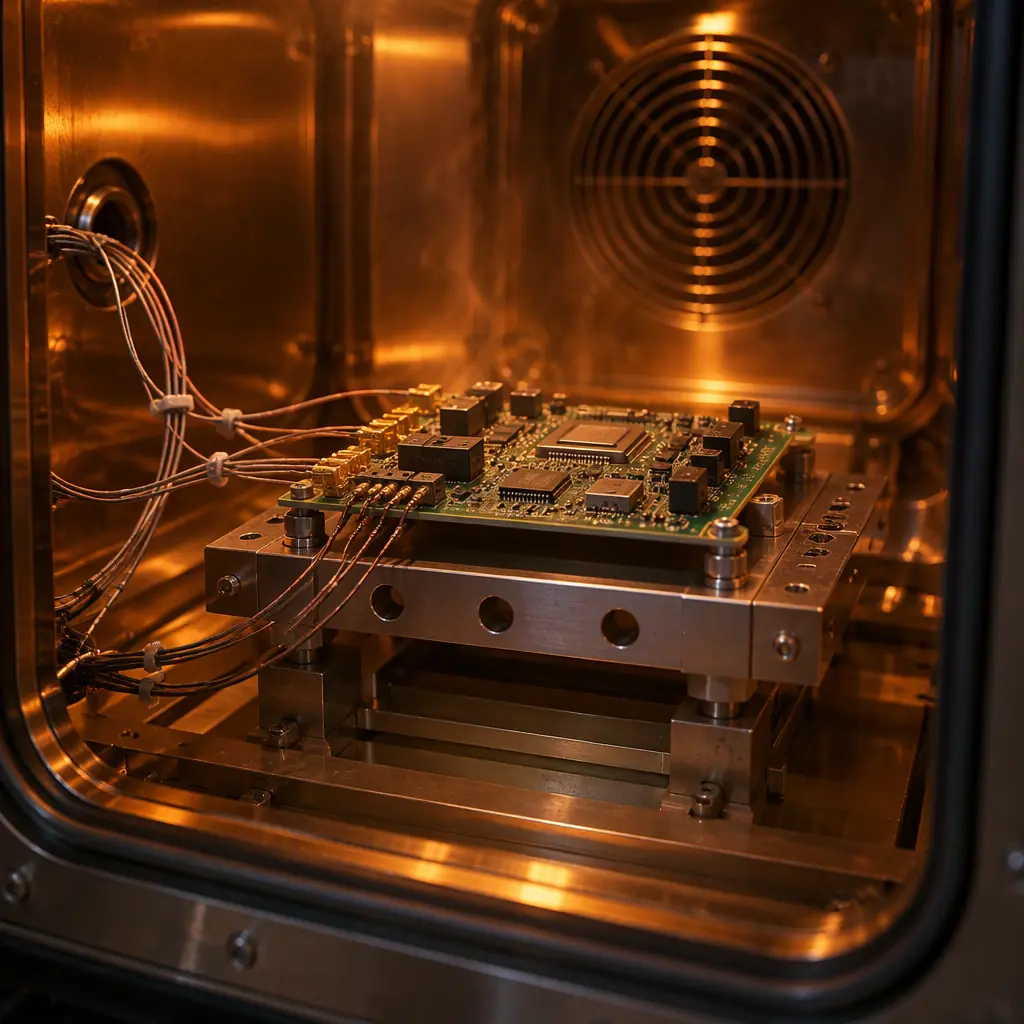
When an automotive, industrial or energy customer asks a supplier for "reliability data," what they usually receive is a thermal cycling report. Cycling is valuable, and it is the right test for one family of failures. But it is not the same test as high-temperature operating life, and the two are frequently presented as though they were. That confusion costs buyers real information: a supplier can show a clean cycling report and still have an assembly that will fail early in the field through a wear-out mechanism cycling never touched.
The distinction matters because the two tests attack different physics. Thermal cycling works the board mechanically: the assembly expands and contracts against the differing expansion rates of its materials, and the failure modes are fatigue cracks — in vias, in solder joints, at interfaces. High-temperature operating life, usually abbreviated HTOL, holds the board at an elevated temperature while it is electrically powered, and the failures it accelerates are the wear-out and bias-driven mechanisms: degradation of materials, growing leakage under voltage, contamination-driven ionic migration, and marginal timing or parametric drift that only appears when the circuit is running hot for a long time.
This guide covers the aging side of the reliability argument: what HTOL actually tests, how a test is configured with bias and temperature, which standards apply, what aging catches that cycling does not, how to read the extrapolation in a life report, and when specifying HTOL is worth the spend. For the cycling side, the companion is our guide to thermal cycling testing; for via-level fatigue methods, see IST versus thermal shock. Together the three cover the thermal reliability toolbox.
At Huaxing PCBA we support HTOL and aging programmes for assemblies across 8 SMT lines under IATF 16949 and ISO 9001, with the bias conditions, temperature and duration specified per programme and the results reported against the model used to extrapolate them. The conditions are written into the test specification because an aging result quoted without its test conditions cannot be interpreted at all.
Three Tests, Three Mechanisms
The first step to using aging evidence correctly is separating it from the two other thermal tests it is usually bundled with. They are not interchangeable, and a report that conflates them is telling you less than it appears to.
Thermal cycling. The board is cycled between a low and a high temperature, typically with a controlled ramp and dwell, for many cycles. The driving force is the mismatch in thermal expansion between materials — copper, laminate, solder, component bodies. The failure modes are fatigue: barrel cracks in vias, cracked solder joints, delamination at interfaces. Cycling tests the mechanical robustness of the assembly against repeated thermal excursions. It is covered in depth in our thermal cycling guide.
Thermal shock. The same expansion mismatch, but driven much harder — the board is transferred between two extreme temperature zones with no controlled ramp, so the transition is nearly instantaneous. The failure modes overlap with cycling but arrive faster and can include brittle fracture that cycling would not provoke. This is the distinction explored in the IST versus thermal shock comparison.
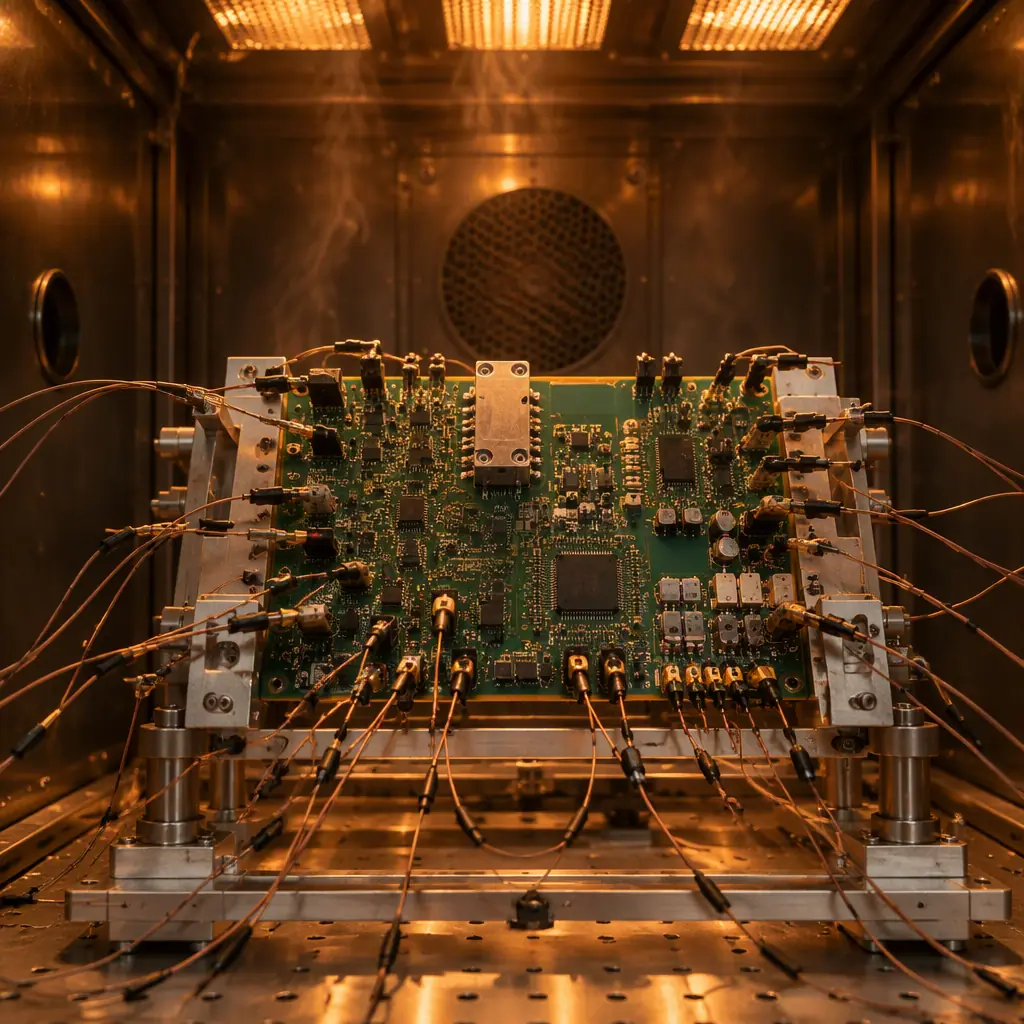
HTOL / thermal aging. The board is held at a steady elevated temperature for an extended period — hundreds to a thousand hours is typical — while powered and biased as it would be in service. There is no cycling: the temperature is constant. What stresses the assembly is the combination of sustained heat and sustained electrical bias. The failure modes are wear-out and bias-driven degradation rather than mechanical fatigue. This is the test this article covers.
Key Takeaway: Cycling and shock test mechanical fatigue from expansion mismatch. HTOL tests chemical and electrical wear-out under sustained heat and bias. A clean cycling report says nothing about wear-out, and a clean aging report says nothing about fatigue. Specify the one that matches the failure you are worried about.
How an HTOL / Aging Test Is Set Up
An aging test is defined by four things: the temperature, the bias, the duration, and the fixturing that holds the board in its powered state. Changing any one changes what the test means.
Temperature. The chamber is held at an elevated temperature chosen to accelerate the mechanism of interest — commonly in the range of 100 °C to 125 °C for many industrial and automotive programmes, with the exact value drawn from the applicable standard or the product's own mission profile. Higher temperature accelerates faster but risks introducing a failure mechanism that would not occur in service, so the acceleration has to stay within the mechanism's valid range.
Bias. The board is powered during the test, and the bias arrangement is part of the specification: which rails are energised, at what voltage, and whether the circuit is actively switching or held in a static state. Bias is what makes HTOL an operating life test rather than a storage test. Many wear-out mechanisms — dielectric degradation, ionic migration, parametric drift — need voltage present to progress. A board held hot but unpowered will not reveal them.
Duration. Typically several hundred to a thousand hours, sometimes longer for high-reliability programmes. The duration sets the confidence of the result: a longer test with the same sample size gives a tighter estimate of the failure distribution, and a shorter test forces more extrapolation.
Fixturing and monitoring. The boards are mounted in a fixture that supplies bias and, ideally, allows in-situ monitoring so that a failure is detected when it happens rather than only when the test ends. Intermittent and parametric failures are easily missed by end-of-test functional checks alone, which is one of the most common weaknesses in how aging is run.
The Applicable Standards
Aging tests are anchored to published methods, and the method determines what the result is evidence of. A buyer reading a report should be able to trace the test conditions back to one of these.
JESD22-A108 — temperature, bias, and operating life. This is the standard most closely associated with HTOL for semiconductor devices: it defines the accelerated operating-life test with bias, the conditions, and the failure criteria. When a supplier says it ran an HTOL test, this or its equivalent is what the test should be traceable to. Note the qualifier "for devices" — the same method applied to an assembled board tests the assembly under the same physics, but the interpretation has to account for the fact that the population under test is a board, not a die.
JESD22-A104 — temperature cycling. The cycling counterpart, defining the cycling conditions and the mechanical fatigue context. It belongs beside an aging report to show the assembly was tested for both mechanisms, and it is the standard behind the cycling guide linked above.
Arrhenius acceleration. The mathematical model that relates failure rate at an elevated temperature to failure rate at service temperature, via an activation energy. It is not a test standard but the extrapolation method almost every life report relies on, and it is where reports most often overreach — see below.
Where the end product falls under a sector standard — automotive, medical, energy — the product standard will reference these methods and add its own conditions. The sector standard, not the generic method, is what governs when they differ, just as our certifications and compliance guide describes for the wider standard landscape.
What Aging Catches That Cycling Does Not
The reason to insist on aging evidence where it matters is the set of failure modes that cycling is structurally unable to find. These are the mechanisms that need sustained heat plus voltage, and that progress slowly rather than through mechanical fatigue.
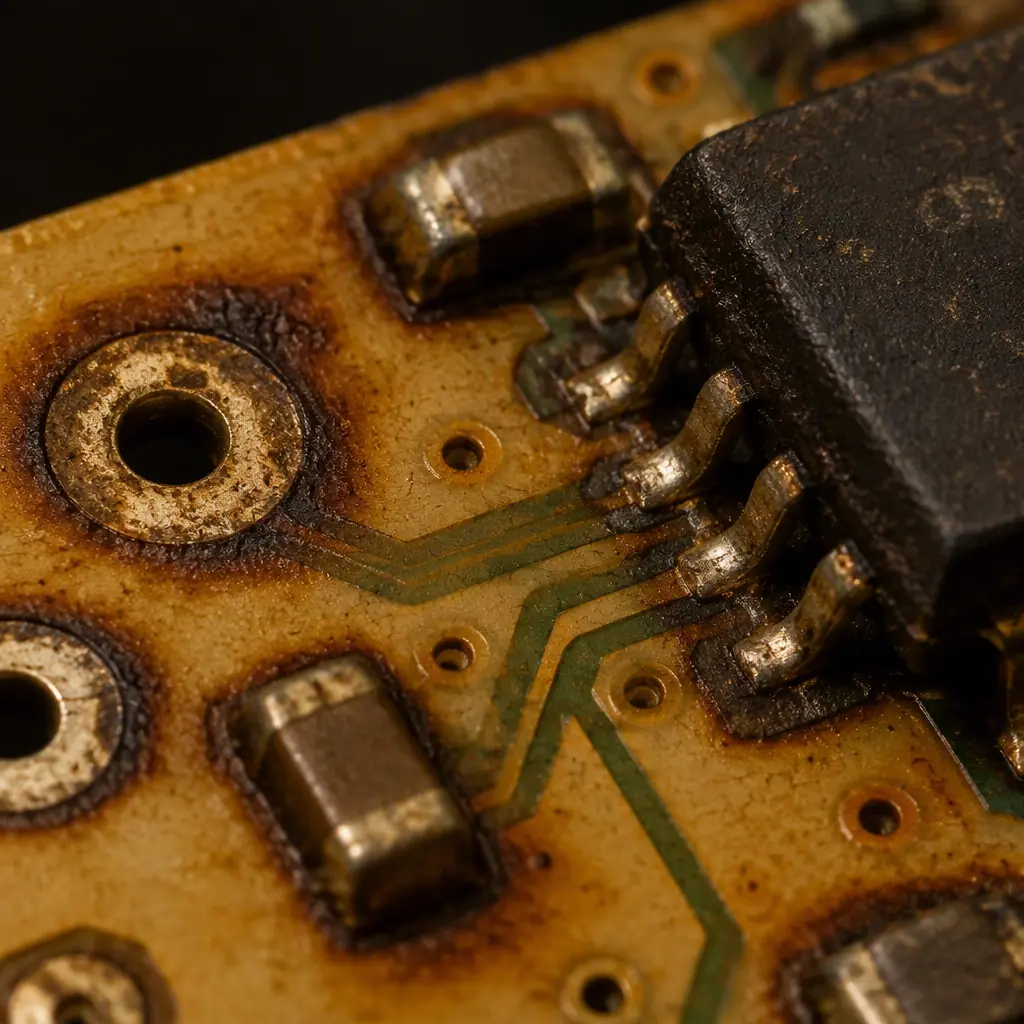
Electrolyte and interconnect wear-out. Capacitors and other components degrade with sustained temperature and voltage. Their wear-out is a function of time at temperature under bias, not of how many times the board changed temperature. A cycling test does not accelerate it.
Contamination-driven ionic migration under bias. Residual ionic contamination plus moisture plus voltage produces electrochemical migration — conductive growth between conductors. The driving force is the electric field acting over time at temperature, which is exactly the HTOL condition. The mechanism and its prevention are covered in our electrochemical migration guide; aging under bias is the test that reveals it.
Parametric drift and marginal timing. Circuits that work at room temperature can drift out of specification when hot for prolonged periods. A component at the edge of its tolerance, or a timing margin that is adequate when cold, may fail only after the assembly has soaked at temperature under load. Aging finds these marginal cases that a functional test at ambient does not.
Leakage growth and dielectric degradation. Insulation resistance falls and leakage current climbs as materials age under bias at temperature. Where a product has an isolation barrier, this gradual degradation is a safety-relevant trend, and aging is the test that graphs it.
None of these appear in a thermal cycling report, because cycling does not stress them. This is why "we ran thermal cycling" is not an answer to "how do you know the assembly will not wear out early."

Reading an Aging Report Honestly
The value of an aging report depends entirely on how the result was extrapolated, and this is where reports most often promise more than the data supports. Four things to check.
Sample size. A life estimate from a handful of boards carries wide uncertainty. The report should state how many units were tested and how many failed, and the confidence of any derived life figure follows from those numbers.
The test conditions stated in full. Temperature, bias, duration and monitoring method. A life figure without its conditions is not reproducible and cannot be compared against another supplier's figure. This is the test analogue of the point made throughout our buying guides: a number without its conditions is not evidence.
The extrapolation model and its activation energy. Almost every report converts "1,000 hours at 125 °C" into a claimed service life using the Arrhenius relation with an assumed activation energy. The activation energy is a modelling assumption, and the claimed life scales with it — a different but equally defensible assumption can change the extrapolated figure substantially. Two suppliers can both run a clean 1,000-hour test and report very different service lives purely from this choice. When a report gives a service-life number without stating its activation energy, treat the number as indicative rather than as a guarantee.
The valid range of the model. Acceleration is only valid within the mechanism's range. Pushing temperature higher to shorten the test can shift the dominant failure mechanism, so that the accelerated test measures something the product will never experience in service. A report that asserts a very long life from a very short, very hot test deserves a question about mechanism validity.
When HTOL Is Worth Specifying
Aging is not free, and not every programme needs it. The decision follows from the consequence of an early wear-out failure.
Automotive. Long service life, wide temperature excursions, safety consequences and sector expectations all point toward aging evidence alongside cycling. Where a failure is safety-related, the case is strong.
Energy and industrial power. Equipment expected to run continuously for years at temperature, often in inaccessible locations, makes wear-out the dominant risk. For these, aging is more informative than cycling, because the mechanism that ends the product's life is time-at-temperature-under-load, not thermal fatigue. Our energy storage and industrial application guides describe the mission profiles that make this the case.
Medical. Where the device is implanted or critical, wear-out prediction is part of the regulatory argument, and aging evidence is expected. See medical device PCB manufacturing for the broader reliability context.
When cycling plus burn-in is the better spend. For a product with modest thermal excursions, a short service life, or a failure consequence that is inexpensive, an aging programme can cost more than the risk it retires. Environmental stress screening, covered in our guide to burn-in and ESS, catches a different problem — infant mortality in the shipped population — at lower cost. Choosing between aging and screening is really choosing which risk you are buying down: wear-out over life, or early failure in the field.
Procurement tip: When a supplier offers "reliability data," ask which mechanisms it covers before you read the numbers. A cycling report and an aging report answer different questions. If your concern is long-term wear-out and you are handed a cycling report, you have not received the evidence the decision needs.
Summary: The Right Test for the Right Failure
HTOL and thermal aging hold an assembly hot and powered to accelerate wear-out: dielectric degradation, ionic migration under bias, parametric drift, leakage growth and component wear. Thermal cycling and shock work the same assembly mechanically to fatigue its vias and joints through expansion mismatch. The two are complementary, not interchangeable, and the most common mistake in reading reliability evidence is treating a cycling report as though it covered wear-out. Used correctly, aging is the test that answers "how long will this last, and how do you know" — provided the report states its conditions, its sample size, its extrapolation model and the limits of that model. Read that way, an aging report is one of the strongest pieces of reliability evidence a supplier can offer; read as a bare service-life number, it is a claim with the working hidden.
At Huaxing PCBA we run HTOL and aging programmes under JESD22-A108-equivalent methods with the bias, temperature and duration specified and documented per programme, across 8 SMT lines under IATF 16949 and ISO 9001, and we report results against the model used to extrapolate them rather than as a headline figure. If your product needs life data for a reliability case, tell us the mission profile and the failure you are worried about and we will build the right test programme around it. Send your Gerber and BOM and we will confirm the test approach for your build and return a quote inside 24 hours, or talk to our reliability team about a life-testing question you are working through.