In a vacuum, materials do not simply stay where they are. Anything volatile inside a coating — residual solvent, unreacted monomer, plasticiser, absorbed moisture — will migrate out under low pressure and deposit itself on the coldest surface it can find. On a satellite, that surface is often an optical window, a detector, or a thermal control film. The deposit is a thin, stubborn, performance-destroying film, and it came from a coating that passed every ordinary material inspection at sea level.
This is why space and high-vacuum programs do not select coatings on the same basis as consumer electronics. The governing test is ASTM E595, and the numbers it produces — TML and CVCM — are the ones that decide whether a coating is allowed anywhere near a payload. This guide explains what those numbers mean, which coating chemistries can meet them, and what has to happen in the process for a passing material to stay passing.
It complements our guides to parylene conformal coating, coating chemistry selection and aerospace and defense PCB manufacturing.
Why Vacuum Changes Everything
Outgassing is the release of volatile compounds from a material. In atmosphere, those compounds escape slowly and dissipate. Under vacuum, they escape more readily and, crucially, they cannot dissipate — they travel in straight lines until they hit something, where they condense.
For a coated PCB, three consequences follow. The first is contamination: volatiles released by the board condense onto optics, sensors and thermal surfaces elsewhere in the assembly, degrading their function. The second is mass loss: the coating itself loses volatile content, potentially changing its mechanical and electrical properties over the mission. The third is condensation on the board, where the same volatiles can redeposit across keep-out areas and create leakage paths.
None of these failure modes is caught by ordinary visual inspection or electrical test at build. They appear in orbit, months or years later, which is precisely why the screening happens once, up front, in a standardised test cell.
ASTM E595: What the Test Measures
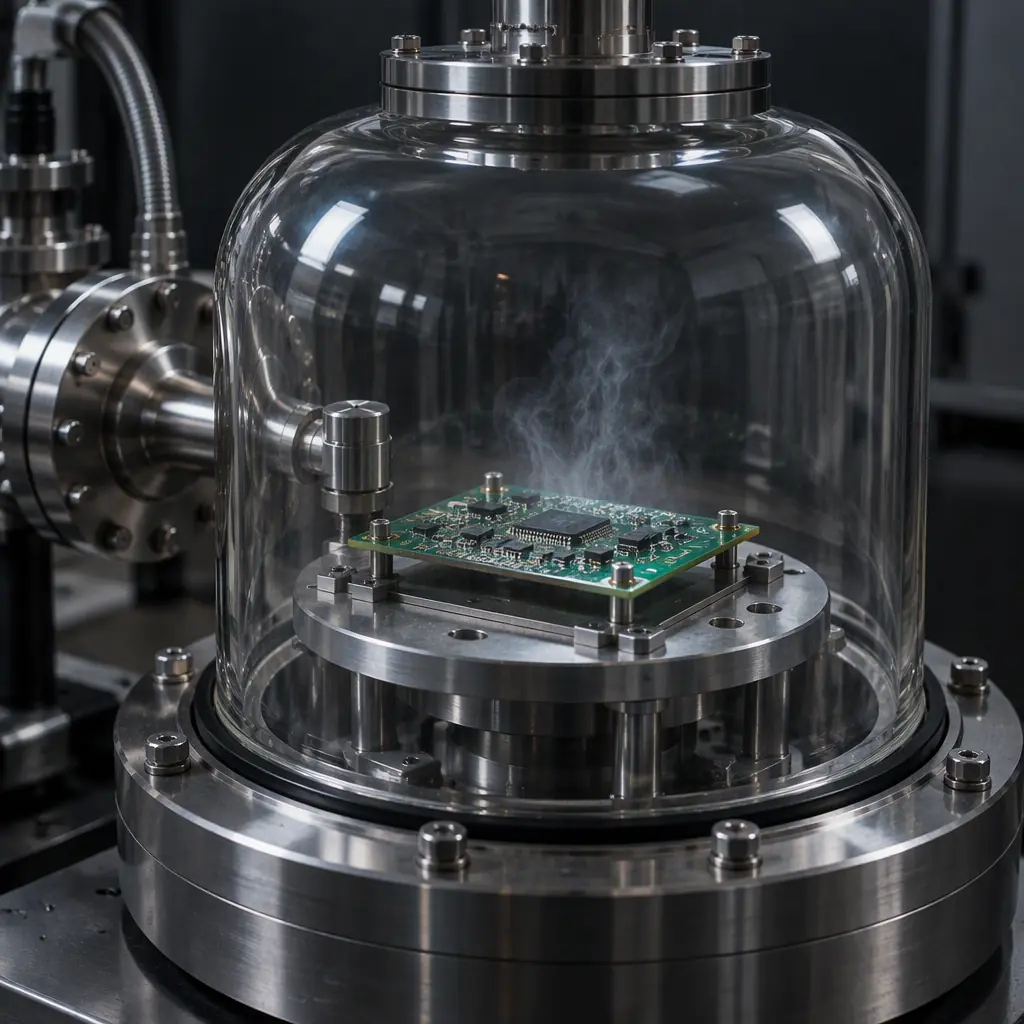
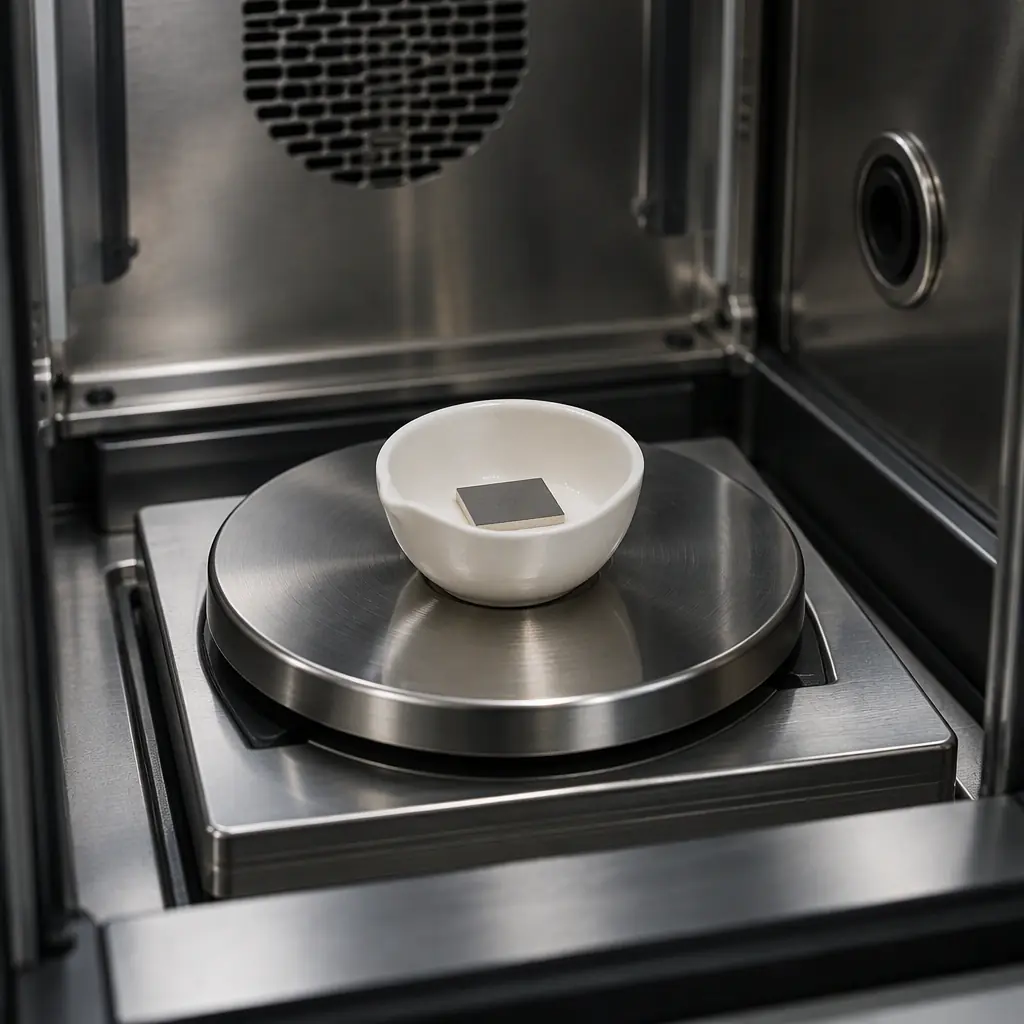
ASTM E595, Standard Test Method for Total Mass Loss and Collected Volatile Condensable Materials from Outgassing in a Vacuum Environment, is the reference method for screening materials for space use. A sample is held at 125 °C for 24 hours under a vacuum of roughly 5×10⁻⁵ torr, with a collector plate held at 25 °C. Every volatile component that escapes and sticks to the collector is measured. From this come three numbers.
| Metric | What it measures | Typical screening limit |
|---|---|---|
| TML — Total Mass Loss | Total percentage of the sample’s mass that volatilised | ≤1.0% |
| CVCM — Collected Volatile Condensable Materials | Percentage that condensed onto the 25 °C collector | ≤0.10% |
| WVR — Water Vapour Regained | Moisture reabsorbed after the test (informational) | Reported, not pass/fail |
Of the three, CVCM is the one that most often disqualifies a material, because it directly predicts what will deposit on your optics and sensors. TML tells you how much the material gives up overall; CVCM tells you how much of that will land on something important. A material can pass on TML and fail on CVCM, which is why programs screen on both.
The 40-second answer: ASTM E595 screens materials for space use at 125 °C, 24 h, ~5×10⁻⁵ torr. The standard screening limits are TML ≤1.0% and CVCM ≤0.10%. CVCM usually decides acceptance, because it predicts what condenses onto optics and sensors. WVR is reported for information only.
Which Coating Chemistries Pass
Outgassing behaviour is largely a function of chemistry, and the coating families sort into recognisable groups. The general pattern is that fully cross-linked, low-solvent, high-purity films outgas least, while films that retain solvent, plasticiser or unreacted material outgas most.
- Parylene (Type C and N). Applied by vapour deposition in vacuum with no solvent, parylene is the chemistry most naturally suited to vacuum service. It produces thin, pinhole-free, uniform films and is a common first choice where CVCM margins are tight. Its limits are cost, deposition time and the difficulty of removal.
- Silicone coatings. Silicones are widely used in space because base silicones can be formulated to low outgassing, and they tolerate wide temperature ranges. But low molecular weight siloxanes are the classic contaminant, and the formulation matters enormously — some silicones pass E595 while others are actively prohibited near optics.
- Polyurethane and acrylic. Both can be formulated to pass E595, and both are used in space hardware. They are sensitive to cure completeness: a partially cured film retains solvent and unreacted material and will fail on CVCM even when the fully cured material would have passed.
- Chemistries to treat with caution. Formulations containing volatile plasticisers, solvent-based systems with incomplete drying, and materials whose qualification data is for a different revision than the one supplied. Any of these can move a coating from passing to failing without a single visible change.
The practical lesson is that chemistry is necessary but not sufficient. A qualifying material that is applied outside its cure window will outgas on the numbers even though the datasheet says it should not.
Process Control: Keeping a Passing Material Passing
Qualification data describes a material tested under ideal laboratory preparation. Production reality adds solvent, moisture, contamination and cure variability. Four controls keep the delivered coating on the right side of the E595 limits.
Cure completeness. This is the dominant variable. A coating cured at the low end of its window, or pulled from the oven early to meet a shipment date, retains volatiles that will outgas in vacuum. Cure time and temperature should be logged per batch, and the process window should be narrow enough that the difference between “cured” and “nearly cured” cannot hide.
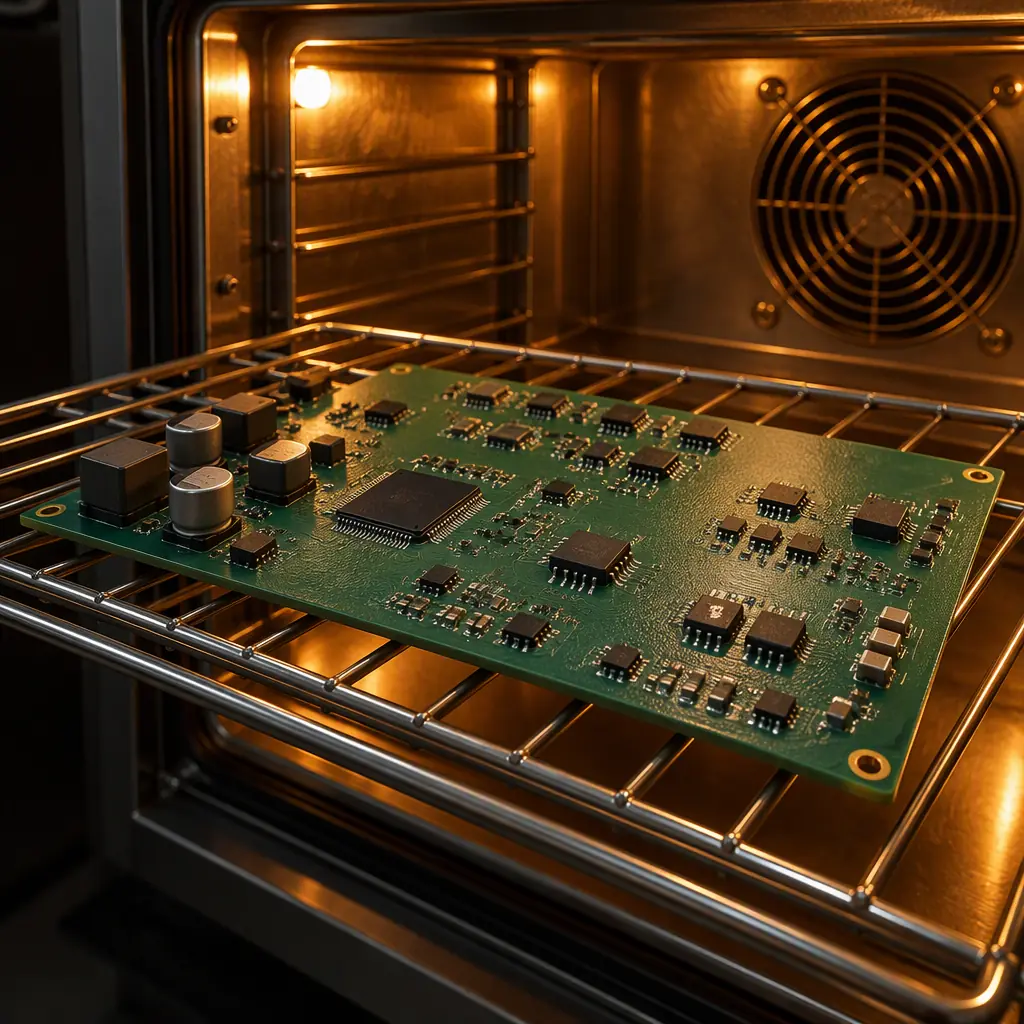
Bake-out before and after coating. Pre-bake removes absorbed moisture from the board and components, which would otherwise be trapped under the film and released slowly. Post-cure bake-out drives off residual solvent. Both steps are standard practice in high-vacuum assembly, and both are frequently compressed when schedules tighten — with the consequences appearing only in orbit.
Cleanliness before coating. Ionic and organic contamination under the film becomes a source of volatiles and a leakage path once the coating is fully cured over it. This is the same cleanliness discipline that governs ionic contamination testing, applied with extra seriousness for vacuum service.
Thickness and uniformity. Thicker is not safer for outgassing. A thicker film retains proportionally more solvent and takes longer to cure through, so coating beyond the specified thickness can push a marginal material over the CVCM limit. Coating to the specified thickness — the subject of coating thickness control — is a vacuum requirement, not merely a cost discipline.
What to Request From a Coater
For a vacuum program, the evidence request is more specific than for a terrestrial one. Five items cover it.
ASTM E595 test report for the exact coating chemistry and revision, with TML, CVCM and WVR stated numerically.
Confirmation the material is on the program’s approved list — many space primes and agencies maintain their own, and CC-830 qualification alone does not satisfy them.
Cure schedule records for the production batch, showing time and temperature against the material’s specified window.
Bake-out procedure, with pre-bake and post-cure steps and their parameters documented.
Cleanliness and thickness records, because both influence what the film ultimately outgasses.
Note what is not on the list: a compliance certificate alone. For vacuum work, a certificate without the underlying E595 numbers is a claim without an answer to the only question that matters.
Where This Sits With Other Requirements
Outgassing is one screen among several for space hardware. It sits alongside LEO satellite design considerations, thermal vacuum cycling, and radiation tolerance, each addressed by its own discipline. Coating selection frequently interacts with thermal design, because a coating that controls emissivity is also a coating that must not outgas — the two requirements have to be satisfied by the same film.
For programs that involve both vacuum and high voltage, the dielectric performance requirements add a further layer, which is why the IPC-CC-830 material qualification evidence and the E595 report are typically requested together rather than separately.
The Bottom Line
Outgassing is the quiet failure mode of coated assemblies in vacuum. It is invisible at build, diagnosable only in orbit, and it originates from material chemistry and process control in roughly equal measure. The screening standard is ASTM E595; the numbers are TML and CVCM; the limits are 1.0% and 0.10%; and CVCM is the one that usually decides acceptance.
The engineering conclusion is straightforward. Choose a chemistry with documented E595 results at the revision you will actually use, then control the cure and bake-out tightly enough that production pieces behave like the test coupon. For a buyer, the ask is equally straightforward: request the E595 report with numbers, and the cure records that prove the process matched it.
Our coating lines support vacuum-grade programs with parylene and low-outgassing silicone chemistries, documented cure schedules and retrievable E595 data. If you are specifying coating for a space or high-vacuum assembly, send us the requirement and we will tell you which chemistry clears it.