
The most expensive component fault is not the one that fails test. A part that fails test costs a rework cycle and a scrap component. The fault that costs a field action is the one that passes every electrical check because it is electrically sound, but is not the part the customer qualified: a different temperature grade, a different tolerance, a different dielectric, a different package with the same footprint, or a genuine part that has been re-marked from a slower speed grade.
None of those are visible on a board. All of them are visible on a reel, if anyone looks. Goods-in is the only place in the process where the physical part can be compared against the paper that describes it, before it disappears into a feeder and becomes indistinguishable from the correct part. That makes goods-in verification a distinct control from incoming quality inspection, which is usually about solderability and package condition, and it is the control that most quotations do not describe at all.
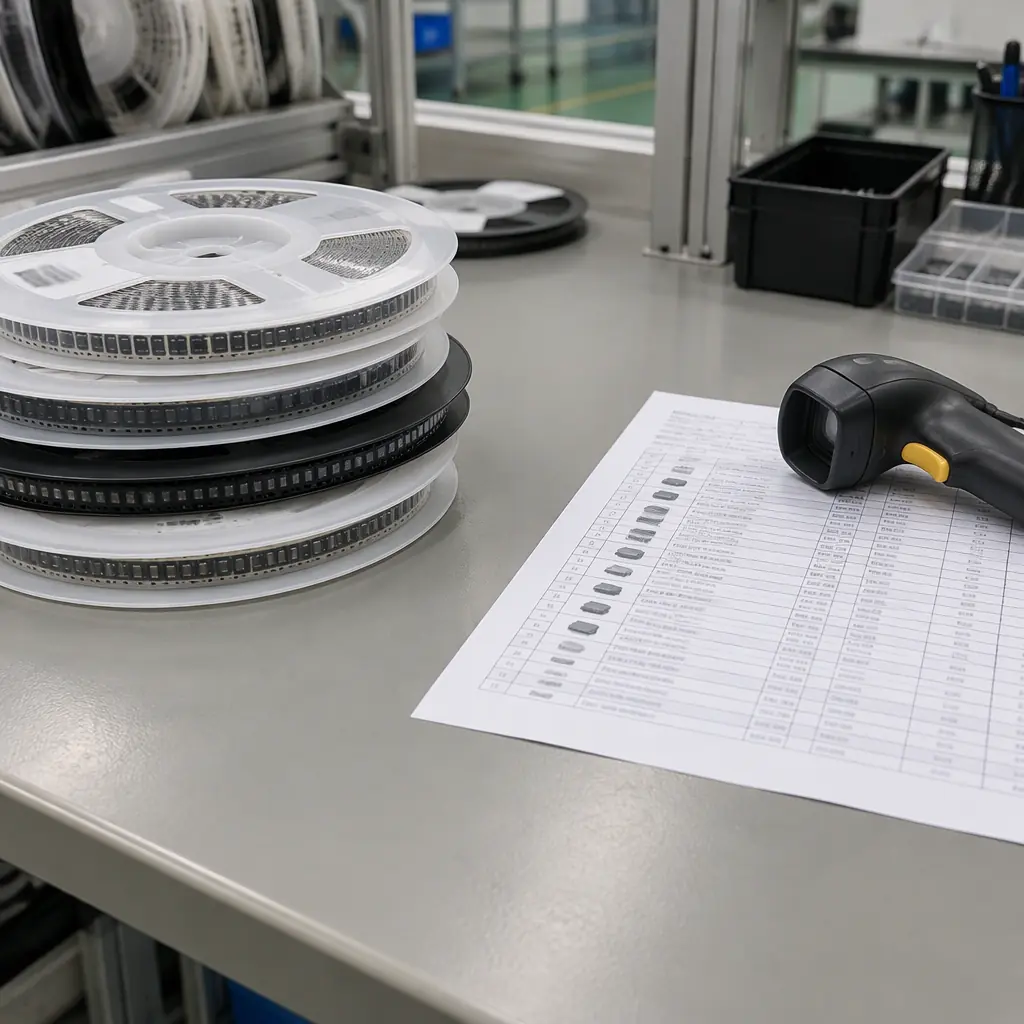
The Goods-In Sequence, Step by Step
A goods-in process that works is a sequence of gates, each one narrow enough to be executable in seconds and each one with a known blind spot. The sequence matters because the cheap gates come first: a paper check costs nothing, a label check costs seconds, and a laboratory check costs days. Running the expensive gates before the cheap ones is how a receiving department ends up flooded.
| Gate | What is checked | Catches | Blind spot | Time |
|---|---|---|---|---|
| 1. Package and paperwork | Part number, quantity, lot, date code on the label against the PO and packing list | Wrong part shipped, short shipment, expired stock | Correct label on the wrong reel | |
| 2. BOM reconciliation | MPN on the label against the BOM line, field by field | Approved alternate used without agreement, wrong suffix, wrong package | A BOM line that was itself ambiguous | |
| 3. Label versus part | Marking on the component body against the MPN marking code | Re-marked or mismarked parts, counterfeit copies | Marking that has been convincingly reproduced | |
| 4. Packaging integrity | Moisture barrier bag seal, desiccant, humidity indicator, reel condition | Moisture damage, MSL violations, physical damage | Bag that was resealed after opening | |
| 5. Sample verification | XRF, X-ray, solvent test, marking permanency on a sample | Counterfeit plating, wrong die, resurfaced parts | Anything that varies across the reel | |
| 6. Record and release | Serialised recording against lot, physical segregation until release | Unverified stock reaching the line | Records not linked to the actual reel issued |
The valuable question to ask a supplier is not whether they run all six gates, but which gates produce a record and what happens to a lot that fails one. A process where gate 2 fails and the part is used anyway with a verbal note is worse than no gate at all, because it creates the appearance of control. Physical segregation until release is the mechanism that makes the sequence real, and it is easy to verify on a factory visit: ask to see the hold area.
BOM Scrubbing: Where Most Errors Are Created, Not Caught
Goods-in can only compare a label against a BOM line. If the BOM line is ambiguous, the comparison is meaningless, and a surprising share of component problems are born at the BOM rather than in the warehouse. The scrub that prevents them is a specific exercise run before the first purchase order, not a spell-check.
- Package suffix. A base part number plus a package code is a different orderable part from the same base with a different code. An 0402 and an 0603 variant of the same MLCC have different base numbers in most families, but several logic and discrete families share a base number across SOT-23, SC-70 and SOT-323, where the suffix is the only difference and the footprints are not interchangeable.
- Tolerance and voltage code. A capacitor BOM line that specifies capacitance and package but leaves voltage and dielectric to the supplier will be filled with whatever is available, and a 25 V X7R substituted for a 50 V X5R changes both derating margin and capacitance stability. The buying decision is convenient and the design assumption is gone.
- Temperature grade and qualification. An AEC-Q200 part and its industrial-grade sibling frequently share a datasheet, a footprint and a marking prefix. The difference is the qualification record, which is worth money and is invisible on the reel.
- RoHS and finish suffix. Lead-free and tin-lead variants are usually distinguished by a suffix or a separate number, and a BOM carried over from an older programme may specify the leaded number while the documentation claims lead-free.
- End-of-life and last-time-buy status. A part that is NRND will be filled from the open market at some point, and the open market is where verification levels change.
A BOM scrub that resolves those five categories against the manufacturer's current datasheet, and records the resolved MPN back into the BOM with a revision, converts goods-in from guesswork into comparison. It also gives the buyer something more useful than a price: a list of lines where the design is one substitution away from a failure, which is a risk document rather than a purchasing one. Where lines are already obsolete, the decision tree is in our guide to component obsolescence management.
Approved Alternates Versus Silent Substitution
Substitution is not a defect. Every resilient supply chain has alternates, and a supplier who cannot substitute during a shortage is a supplier who will stop a line. The problem is unapproved substitution, where a part is used because it fits and because the approved part was not on the shelf, and nobody tells the buyer until a field failure makes it visible.
The distinction is worth making concrete, because "we only use approved alternates" is unverifiable as stated. Four fields decide whether an alternate is genuinely equivalent for a given design, and if any of them differ, the substitution is an engineering change and not a purchasing decision.
| Field | Equivalent | Requires engineering review |
|---|---|---|
| Electrical values and tolerance | Identical within the specified tolerance over temperature | Any difference in nominal value, tolerance band, or temperature coefficient |
| Voltage / power / current rating | Rating met or exceeded with the same derating assumption | Lower rating, or higher rating with different derating behaviour (for example a different dielectric) |
| Package and footprint | Same body size, same land pattern, same height within clearance | Same land pattern but different height or wettable flank |
| Qualification | Same grade table and same end-use qualification | Industrial part substituted for an automotive or medical-grade part |
The practical control is an approved vendor list with a defined alternate per BOM line, together with the rule that a substitution outside that list requires written approval before the part is issued to the line. The counterpart rule matters just as much: the buyer should state in writing which lines may be substituted freely, because a blanket "no substitution" clause is ignored in practice and a blanket permission is worse than nothing. The negotiation of that list is the substance of our guide to dual sourcing strategy.
One asymmetry is worth flagging. Substitution pressure is highest exactly when verification capability is lowest, because shortages push purchasing toward the open market, where traceability chains are shortest. A programme that runs strict goods-in verification in normal times and relaxes it during a shortage has the control inverted.
Three Verification Levels and What Each Costs
Verification is a ladder, and the right rung is a decision about what the part does and what a failure would cost. Applying the top rung to every line is unaffordable; applying the bottom rung to a safety function is indefensible. Naming the levels makes the conversation possible.
| Level | Method | What it establishes | Typical time | When to require it |
|---|---|---|---|---|
| L1 Paper | Label and MPN against BOM, traceability documents, authorised distributor invoice | The part came from the stated source and matches the stated number | Seconds per reel | Every line, every lot, without exception |
| L2 Label and package | L1 plus marking comparison, packaging condition, date code decode, MSL bag check | The reel is as marked and has been stored correctly | 1-2 minutes per reel | Every new lot; every lot from a new source |
| L3 Laboratory sample | XRF for plating and material, X-ray for die and bond, marking permanency, solvent test, electrical sample test | The physical part is what the marking claims | Hours to days per lot | Open-market purchases, new suppliers, safety and mission-critical lines, any lot with a broken traceability chain |
L3 is not a guarantee either. XRF reads surface plating, X-ray reads internal structure at low resolution, and a professionally re-marked part can pass both. The method that catches the most is the simplest: comparing the marking against the manufacturer's own marking specification for that exact part number, at magnification, including the date code format and the factory code. Counterfeit markings are usually correct in the large characters and wrong in the small ones.
Where L3 is applied, it should be applied to a sample from a sealed reel, not to a part the supplier chose, and the sample should be drawn after the reel has been logged rather than before. The difference between those two sequences is the difference between a verification programme and a demonstration. Independent laboratory testing for counterfeit avoidance follows the methods in our guide to counterfeit component verification, and the broader detection logic is in PCB counterfeit detection.
Date Code, Moisture and the Reel Label
Three items on a reel label carry reliability information that has nothing to do with the part number, and all three are routinely ignored because they look like logistics data.
Date code sets the clock on solderability and on moisture exposure. A plastic-bodied component older than the manufacturer's stated floor life, stored in a warehouse without humidity control, may have absorbed enough moisture to fail during reflow. The visible result is popcorn cracking inside the package, which appears as a subtle electrical failure rather than an obvious physical one. Decoding the date code format per manufacturer matters, because formats differ and a four-digit code is not always year-and-week.
Moisture barrier bag status determines whether the parts need baking before use. A sealed bag with an intact humidity indicator card inside its marked spot can go to the line directly; a bag that has been opened and resealed, or a card showing a colour change, requires a bake and a reseal with a new card. This is the single most commonly skipped step in goods-in, because a bag that looks sealed is assumed to be sealed. The full handling regime is in our guide to MSL and moisture sensitivity.
Reel label versus component marking is the gate that catches a mixed reel, which is what happens when a partial reel is topped up from another partial. Mixed reels are rarely counterfeit and are frequently the source of an unexplained assembly error, because the pick-and-place machine cannot see the difference and the operator is not looking. Any reel whose label quantity does not match its physical condition should be treated as suspect and inspected, not topped up.
The Cost of Catching It Late
The multiplier that justifies all of this is not subtle, and it is worth stating as a table because it is the argument that survives a cost-reduction review.
| Detection point | Cost per incident | What is included | What is not |
|---|---|---|---|
| Goods-in | 1x | Reel quarantine, paperwork, replacement lead time | Line delay if the part was already on the critical path |
| Before reflow | 2-5x | Reel removed, feeder reloaded, line stop | Any board contamination |
| At AOI or ICT | 10-30x | Rework labour, scrap components, test time, plus analysis to identify the cause | The boards already built with the part |
| At functional test | 30-100x | Full-unit debug, teardown, requalification of the reworked unit | Rework-induced damage |
| In the field | 1,000x and up | Field replacement, logistics, warranty administration, customer relationship | Recall cost, regulatory notification, brand damage |
Those multipliers are deliberately broad because they depend on the product, but the shape of the curve does not change: the cost of a fault rises by an order of magnitude at every stage it travels downstream. A verification step that costs seconds per reel is competing against a multiplier of a thousand, and the only reason it gets cut is that the seconds are visible and the multiplier is hypothetical until it is not.
The same logic applies to traceability. A lot record that links a shipped board to the reel it came from is what converts a field failure from an unsolvable mystery into a bounded investigation with a known population. That requirement is formalised in IPC-1782, and the practical implementation is set out in our guide to lot traceability under IPC-1782. Without it, the day a suspect lot is discovered, the honest answer to "which shipments contain it" is that nobody knows, and the conservative response is to recall everything.
What a Buyer Should Ask Before Releasing the Order
Five questions, answerable in one email, distinguish a supplier that runs a verification process from a supplier that has a receiving department.
- Which gates produce a record, and can I see a sample lot record? A record with a reel label photograph and a BOM line reference is worth more than a procedure document.
- What is your policy when gate 2 fails? The answer should involve quarantine and a buyer notification, not a note in the job file.
- Do you purchase from the open market, and under what conditions? A "no" is unusual and should be probed. A "yes, with L3 verification" is a better answer than a denial that turns out to be untrue.
- Who approves an alternate, and is the approval in writing per lot? The name and the mechanism matter more than the policy statement.
- How is a reel linked to a shipped assembly? The answer should be a system and a field, not a practice.
Where a programme has strict requirements, these answers belong in the quality agreement rather than in an email, and the goods-in sequence should appear as a control in the process flow. That placement is what makes it auditable at the next supplier audit, which is covered in our guide to PCB supplier audits. The same discipline protects the buyer against the other incoming risk, which is a component that is genuine and correct but has been damaged in storage, the subject of incoming quality inspection.
Frequently Asked Questions
Is goods-in verification the same as incoming quality inspection? No. Incoming quality inspection checks whether the part is physically sound: coplanarity, solderability, packaging damage. Goods-in verification checks whether the part is the part that was ordered. Both are needed, and they use different evidence.
Should every lot go through L3? No. L3 is expensive and slow, and applying it universally would either stop the line or be quietly abandoned. Use it where the traceability chain is broken, the source is not an authorised distributor, or the failure consequence is severe.
Can XRF prove a part is genuine? It can prove that the surface plating composition matches or does not match the expected specification. It cannot prove the die inside is the correct one and cannot detect a part that has been re-marked with the correct plating.
What if the BOM itself is wrong? Then goods-in will verify the wrong part correctly, and the failure arrives at test. This is why BOM scrubbing is the first gate and why it needs to be a documented exercise with a revision, not an implicit assumption that the BOM is right because it came from the customer.
Who pays for L3 testing? Usually the party that created the risk. New suppliers and open-market purchases can reasonably be conditioned on supplier-funded sample testing, while a buyer who specifies obsolete parts is buying that risk knowingly and should expect to fund the verification.