
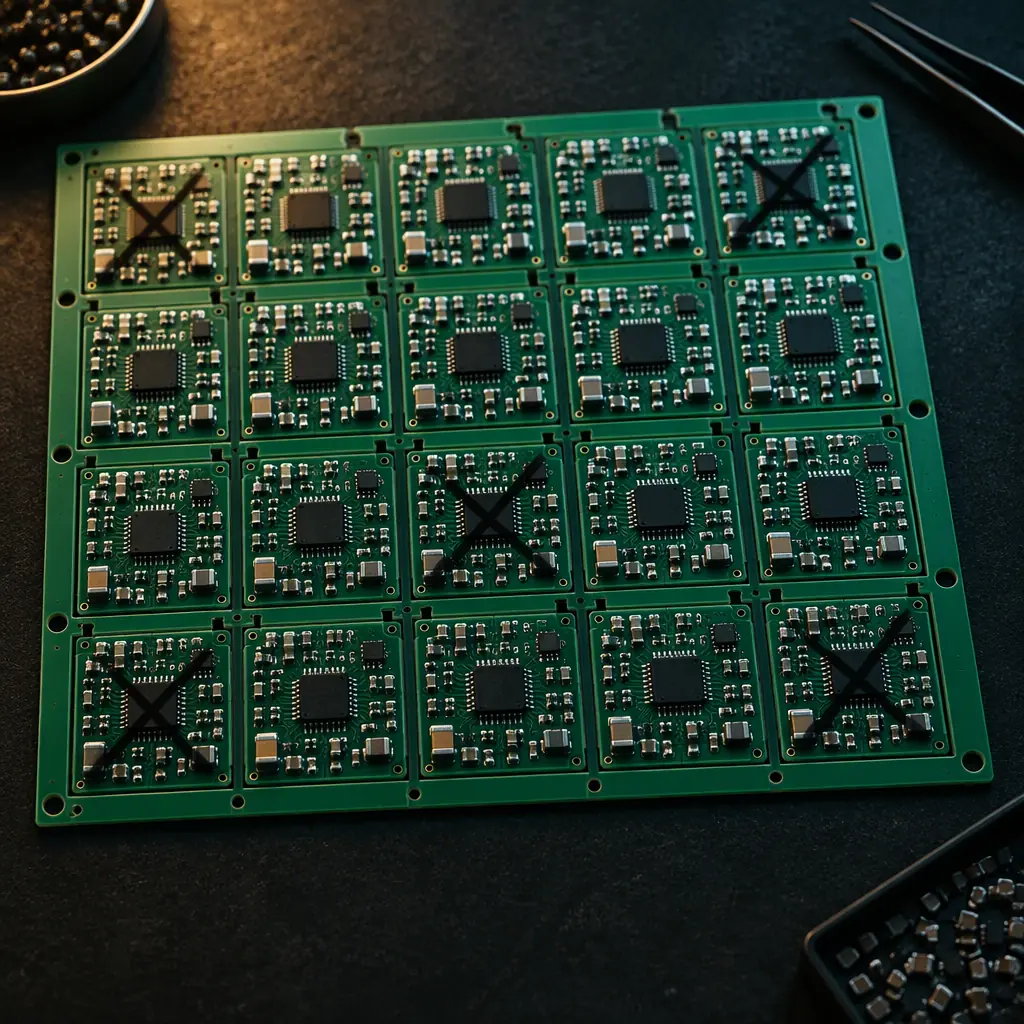
An x-out panel is a production panel on which one or more individual circuits — the units that will eventually be separated into finished boards — has failed a fabrication or assembly test, and has been permanently marked so it will never be populated. The remaining circuits on the panel, the good ones, are valid product and are perfectly usable. The x-out is simply the fabricator's way of acknowledging a defect at the panel level and recovering the good units instead of scrapping the entire panel. Whether that is acceptable to you as a buyer is a commercial and quality decision that should be made before the first panel is built, not negotiated after a shipment has arrived.
This guide explains what x-outs and known-good-units actually are, why panel-level defects happen in the first place, how the industry standards treat them, how to write a workable x-out rule into your purchase order, and what the true cost of rejecting x-outs looks like. At Huaxing PCBA we routinely handle x-out panels across 8 SMT lines under IATF 16949 and ISO 9001, and we set the x-out policy with the customer at the quotation stage.
What an X-Out Panel Actually Is
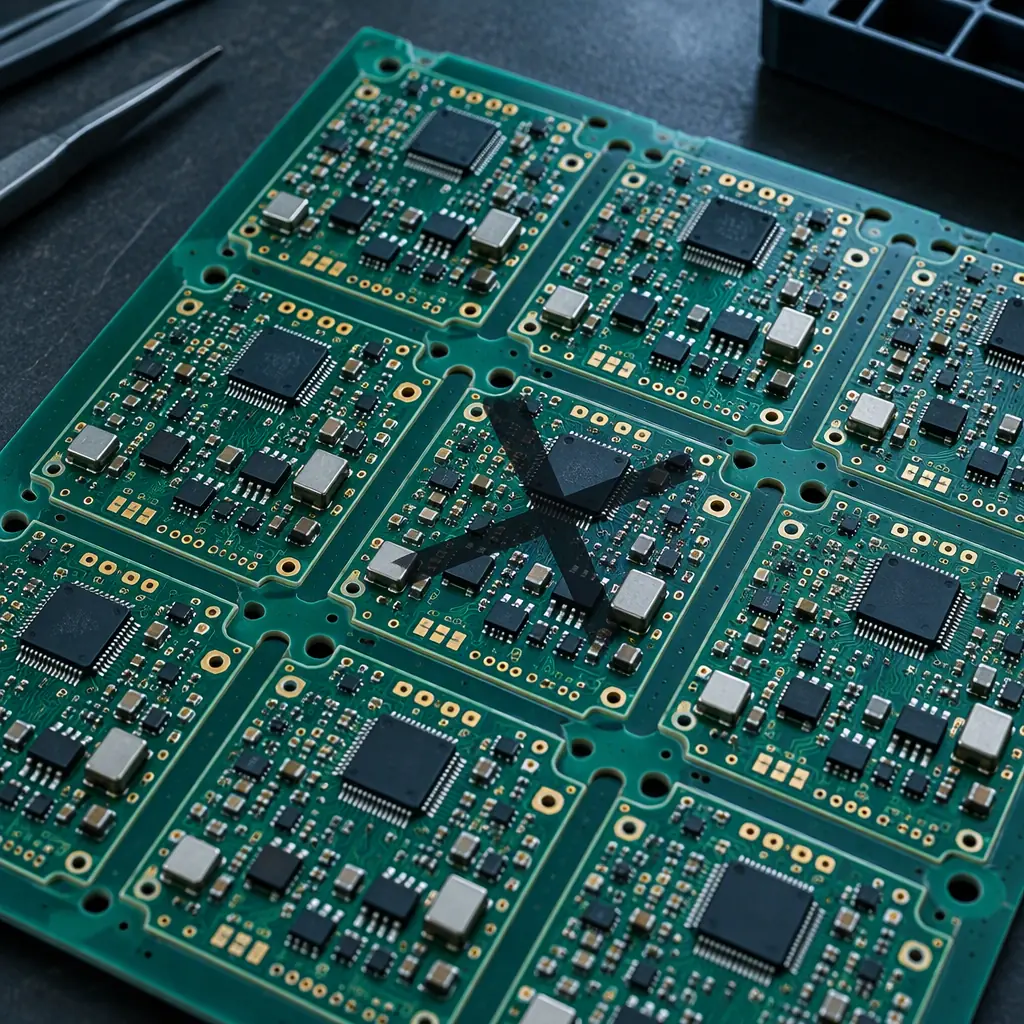
Almost every PCB is not manufactured as a single board but as one circuit among many on a larger production panel. The panel carries a grid of identical circuits, plus tooling that helps the machinery handle it: fiducials for optical alignment, edge rails or breakaway strips for conveyor handling, and a matrix of v-score or routing channels along which the panel will later be separated into individual boards. The panel is the unit of manufacture; the individual circuit is the unit of delivery.
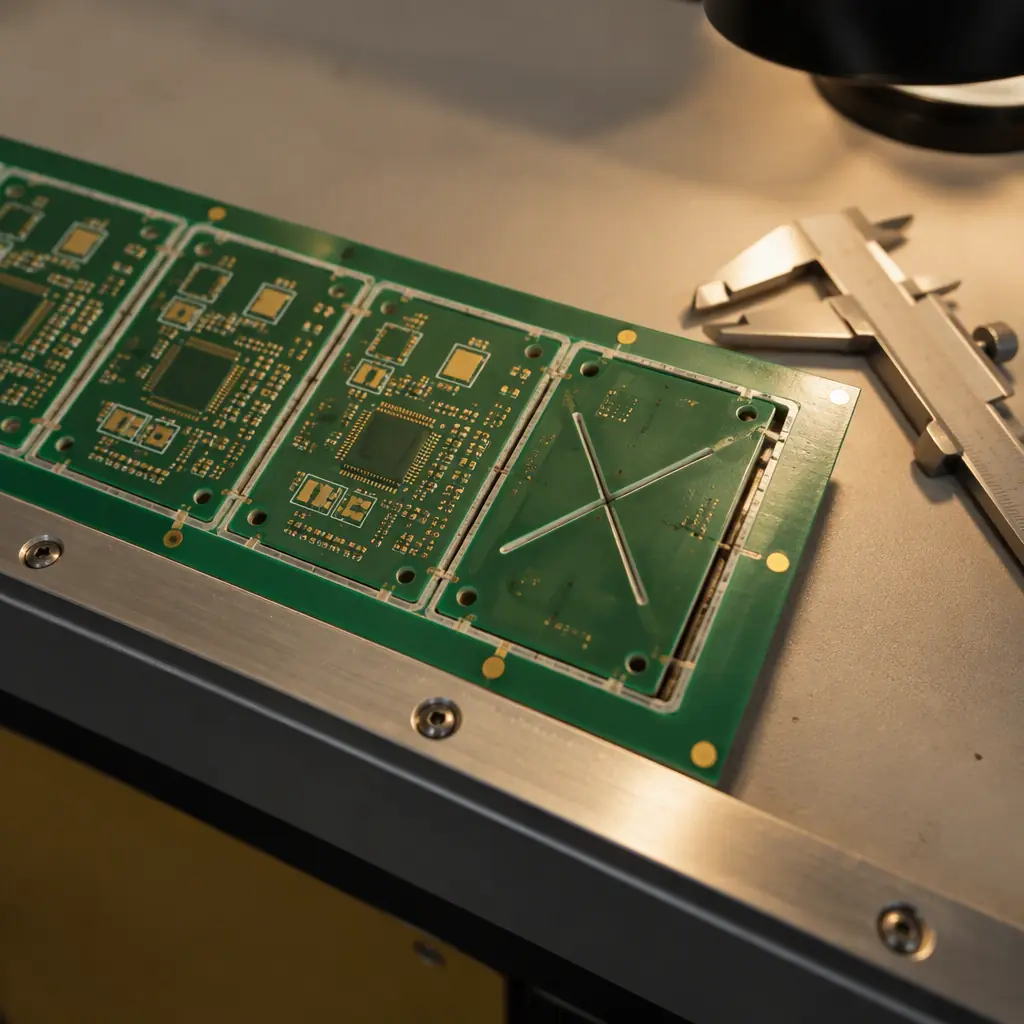
A defect that affects one circuit — a short, an open, a plating void on a single circuit's inner layer — does not necessarily ruin the rest of the panel. A fabricator who discards an entire twelve-circuit panel because of one bad circuit throws away eleven good units. To avoid that, the fabricator scores or drills the bad circuit with an X marking, or otherwise marks it indelibly so that it can never be confused for good product, and ships the panel with the good circuits intact. Each good circuit on an x-out panel is called a known-good-unit, or KGU.
This is a normal and accepted practice in the industry. It is not a sign of a sloppy fabricator; it is a sign of an efficiently managed one. The question is not whether x-outs exist, but what rules govern them on your order.
Key Takeaway: An x-out is a defect at the panel level, recovered at the unit level. The good circuits on an x-out panel are fully valid product — what matters is that your purchase order states how many x-outs per panel you will accept, and that a marking system exists to prevent a known-bad unit from ever reaching assembly.
Why Panel-Level Defects Happen
X-outs are not random. They cluster around the processes that are hardest to control perfectly across a large panel, and understanding them tells you where a fabricator's capability actually lies.
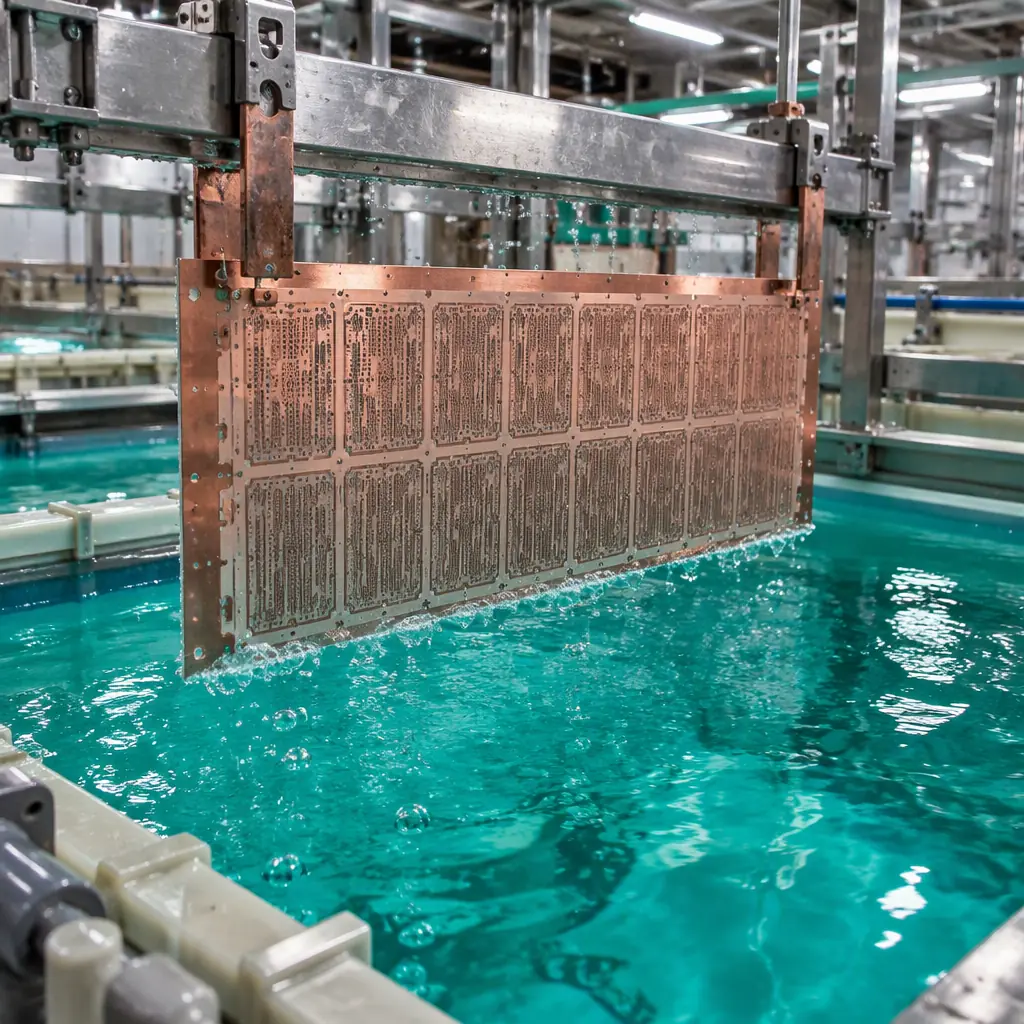
Plating and copper distribution. Electroplating current density varies across a panel, particularly near the panel edge and around sparse or dense copper areas. Circuits in a low-current zone can come out with thinner copper or marginal plating, and a single plated-through hole that fails an electrical test takes down that circuit. Panels are laid out with thieving bars and balanced copper to reduce this, but some edge circuits remain more exposed.
Imaging and etching. Fine-line traces are imaged and etched across the whole panel at once. A scratch on a film, a dust particle, or a slight etch non-uniformity can create a short or a near-open on whichever circuits happen to sit under it. With line widths below 100 µm, the tolerance window is narrow and a panel-level defect is not unusual.
Mechanical handling and processing. Drilling, lamination, and surface finishing all subject the panel to physical handling. A single nicked edge on a v-score channel, or a scratch that crosses one circuit, produces exactly one x-out. Because handling defects scale with panel area, larger panels tend to accumulate more x-outs than smaller ones over the same process tolerance.
Inner-layer registration. In multilayer boards each layer is registered to the others. Across a large panel, registration error tends to grow toward the panel corners, so the circuits at the extreme corners are statistically more likely to be the ones that fail an annular-ring check.
What the Standards and Contract Say
The PCB industry standards that govern fabrication acceptance — IPC-6011 for rigid boards, IPC-6012 for rigid boards in detail — do not decide for a buyer whether x-outs are acceptable. They define when a circuit must be rejected, and they leave the disposition of the panel and the acceptance of x-outs to the buyer-seller agreement. That is an important point of leverage: because the standard is silent on x-out acceptance, the rule that applies to your order is the one you write.
In practice, three conventions have emerged and are widely used in purchase orders:
| X-Out Rule | Meaning | Typical Use |
|---|---|---|
| No x-outs allowed | Every circuit on every panel must pass; any panel with a defect is scrapped or rebuilt | High-reliability, medical, aerospace, small panels |
| X-outs allowed up to a limit | e.g. "no more than 10% of circuits per panel may be x-outs" | Most commercial orders — the standard compromise |
| X-outs accepted freely | Buyer accepts any number of x-outs on a panel | Cost-sensitive, non-critical consumer product |
The middle option is what most commercial orders use, and it is expressed as a maximum x-out percentage or a maximum count per panel. The important companion clause is the marking requirement: every x-out must be permanently and unambiguously marked — almost always a drilled or scored X through the circuit, plus a dot of the solder mask or a paint mark — so that automated assembly equipment and operators can reject it before any components are placed. A panel shipped with an unmarked bad unit is a far worse outcome than a panel with more x-outs than your limit, because the bad unit can be populated and shipped.
How to Write an X-Out Rule Into Your Purchase Order
An x-out rule is only enforceable if it is specific. A clause that says "x-outs not preferred" will be interpreted differently by every fabricator. The following elements make a rule that both sides can hold to.
State the maximum, as a number and a percentage
Write "no more than one x-out per panel, and no more than 5% of total ordered units" rather than a vague preference. The absolute number catches small panels where one x-out is already a large percentage; the percentage catches large panels where a single x-out is trivial.
Require permanent, machine-readable marking
Specify that every x-out unit be marked with a drilled or routed X plus a black dot, and that the marking be present before assembly. Where your SMT line uses automated optical inspection, this marking is what allows the machine to skip the bad unit rather than populate it.
Decide who counts the units
Clarify whether your ordered quantity is the number of panels delivered or the number of known-good-units. Orders placed by panel count and orders placed by good-unit count differ in delivered value; the cleanest practice is to order good units and let the fabricator manage x-out recovery internally.
Set the remedy if the limit is exceeded
Say what happens when a panel carries more x-outs than allowed: is the panel rejected and replaced, is the shortfall credited, or is it accepted at a reduced price? A rule without a remedy is advice, not a contract term.
What Rejecting X-Outs Actually Costs
Understanding the cost is what turns an x-out policy from a preference into a decision. Every x-out you refuse to accept has to be recovered somewhere, and the fabricator recovers it by building more panels, which means more material, more processing, and more testing — all of which appear in your price.
The simplest way to see the trade is to compare the two extremes. On a twelve-circuit panel with a typical defect rate of one bad circuit per panel, allowing the x-out means eleven good units delivered per panel. Demanding zero x-outs means the fabricator must either screen and rebuild panels until every one is perfect, or operate a process controlled so tightly that single-circuit defects do not occur. The first approach adds inspection labour and scrap; the second adds process control cost that is applied to every panel, not just the defective ones.
For most commercial and industrial product, the sensible policy is to allow a limited number of x-outs and invest the savings where they matter — in the fabricator's process control and in your incoming inspection. For high-reliability product, the sensible policy is the opposite: pay for the tight process, because a single marginal via that escapes into a populated flight-control board is not a cost you want to discover in the field. The deciding question is not the price of the panel; it is the cost of a bad unit that reaches the customer.
The related trade in panel design — how many circuits you fit and how you lay them out — is covered in our guide to panel utilization and nesting, and the cost structure of panels is broken down in panelization cost optimization.
X-Outs and Automated Assembly
On a modern SMT line, x-out handling is largely automated, and this is the practical reason the marking requirement matters so much. A pick-and-place machine programmed with the panel layout can be told which circuits are x-outs and will skip them, placing no components and consuming no material on the bad units. The same information lets the reflow and inspection steps ignore those circuits. The result is that an x-out costs the assembler almost nothing as long as it is correctly marked — and costs a great deal if it is not.
For buyers running their own assembly, the specification to pass to the fabricator is simple: every x-out unit must be marked in a way that the line's optical system can detect, at the location the line expects. Many fabricators use a standard convention — a routed X plus a black dot at a fixed position on the unit — and your job is to confirm that convention matches what your equipment reads. Where the assembly is done by the same supplier, this is an internal control and the fabricator's standard applies. Where fabrication and assembly are split, it is a specification that must appear on both orders.
The Bottom Line on X-Outs
X-outs are a normal, efficient part of PCB manufacturing, and a panel carrying a marked x-out is not a defective panel — it is a panel where the fabricator chose to recover good material rather than scrap it. The buyer's decision is how many to accept and how they must be marked. Put a number, a marking rule, and a remedy in the purchase order, order in good units rather than panels, and the question resolves itself before production starts rather than after the shipment lands.
At Huaxing PCBA we work to the x-out policy agreed at quotation across 8 SMT lines under IATF 16949 and ISO 9001, and we will confirm panel layout, x-out marking convention, and acceptable x-out percentage before tooling. Send your Gerber files with your panel preference and we will return a quote with the x-out rule stated explicitly inside 24 hours, or talk to our engineering team about a panel design that minimises x-out risk in the first place.