Two structures dominate first orders with an overseas PCB supplier, and both are bad for one side. In the first, the buyer pays in full up front and carries the entire risk of non-delivery. In the second, the supplier builds first and invoices on shipment, carrying the entire risk of non-payment. Which is why suppliers who are asked for that either refuse, price the risk in, or quietly deprioritise the order behind work that is already paid for. Neither outcome is a good foundation for a production relationship.
Milestone-based payment exists to split the risk in proportion to who is exposed at each stage. The difficulty is that most milestone structures in circulation are keyed to dates, 30 % on order, 70 % in 30 days, rather than to manufacturing events. A date-based milestone does not tell you whether anything was actually built, and it gives the buyer no basis to withhold a release if the first article fails. An event-based structure ties each release to something you can verify, which turns the payment schedule into a second layer of project control. This article covers the stages of a PCB and PCBA build, which of them justify a payment trigger, how first orders differ from repeat orders, and how tooling ownership interacts with deposits. At Huaxing PCBA we structure first orders against first-article approval and pre-shipment verification, and we operate net terms on established accounts.
Why PCB Payments Are Staged at All
A purchase order for custom electronics is different from one for a catalogue part in two ways that both affect payment. It is largely non-cancellable once material is committed, because the boards are built to your drawing and cannot be sold to anyone else. And it requires the supplier to spend real money before there is anything to ship: laminate, components, stencils, fixtures, and engineering time that produces no deliverable the buyer can inspect.
| What the supplier has spent | Point in the build | If the order is cancelled here |
|---|---|---|
| Engineering and CAM review | Before material is ordered | Recoverable, work stops cheaply |
| Tooling, stencils and fixtures | Early, often before fabrication | Partly recoverable if tooling transfers to the buyer |
| Laminate, components and consumables | At material release | Largely irrecoverable: often custom or long-lead |
| WIP value through fabrication and assembly | Mid-build | Progressively less recoverable, labour is spent |
| Finished tested goods | Before shipment | Recoverable only by selling to someone else, which is rarely possible |
This progression is what a milestone schedule is supposed to track. Each stage increases the supplier's sunk cost and reduces the buyer's ability to walk away at no cost, so the payment releases should follow the same curve. A schedule that takes most of the money before tooling is cut protects the supplier and exposes the buyer; one that takes everything after shipment exposes the supplier to the full build cost. The point of a well-formed schedule is that at any moment, neither party is exposed for more than the work actually done.
The Milestones You Are Actually Paying For
What follows is the build progression in the order it happens, with the deliverable that makes each stage verifiable. The verification is the important column: a milestone that cannot be evidenced is only a date with extra words.
| Milestone | Typical trigger | Evidence the buyer should hold |
|---|---|---|
| Order release | PO issued, data accepted | Order acknowledgement with drawing revision confirmed |
| Tooling and NRE release | Stencils, fixtures, test programs generated | Tooling list with ownership terms stated |
| Material release | Components and laminate committed | Material availability confirmation, long-lead flags raised |
| Fabrication complete | Boards through electrical test | Fabrication test results, coupon measurement data |
| First-article approval | First assembled unit inspected and approved | First-article report with measured values against limits |
| Pre-shipment verification | Final inspection and test complete | Test data package, packing list, shipping notice |
| Balance / credit term | Delivery accepted | Invoice, and on repeat accounts the agreed term from invoice date |
The two milestones that carry the most commercial weight are first-article approval and pre-shipment verification, and they are the two most often omitted from a schedule. First-article approval is the buyer's last practical opportunity to stop a build that is systematically wrong before the whole quantity is assembled. Without a payment event tied to it, the schedule gives the supplier no reason to pause for approval, and quantities get built on an unapproved process. Pre-shipment verification does the same job for the finished goods, and it is the natural place for the final release to sit. If your supplier objects to holding payment against first-article approval, that is worth understanding before you release tooling money.
The evidence behind these milestones overlaps with the technical documentation set, and it is worth reading alongside our guide to the PCB test report and documentation package and the first article inspection guide, since the documents that make a milestone verifiable are the same documents you need for acceptance.
Structure rule: A milestone should be written as "X % against [deliverable], evidenced by [document]" rather than as a percentage against a date. This single change converts the payment schedule from a cash-flow arrangement into a delivery control, and it removes most of the ambiguity that leads to payment disputes later.
Common Milestone Structures
The right split depends on whether the buyer and supplier have history. First orders carry the highest information asymmetry, and the schedule should reflect that rather than pretending the relationship is established.
First order with a new supplier
The typical structure is a deposit on order covering tooling and material commitment, a second release on first-article approval, and the balance on pre-shipment verification or against a short term after delivery. The intent is that the deposit covers what the supplier has genuinely spent by that point and no more, so a failed first article does not leave the buyer having paid for a full build.
Repeat order on an established account
Once a supplier has a payment history with you, the deposits typically fall away and the structure shifts to net terms: often net 30 for established industrial buyers, with shorter terms on new accounts. The tooling is already owned or already paid for, so the risk that justified a deposit no longer exists.
Prototype and NPI builds
Prototype orders carry a higher deposit proportion, and it is worth understanding why rather than treating it as a red flag. The ratio of engineering and setup cost to material cost is far higher on a five-board build than on a five-thousand-board build, and the supplier's unrecoverable spend happens earlier. On an NPI programme, expect the deposit to cover engineering and tooling, with the balance released after functional approval.
Volume production with scheduled releases
On programmes with a forecast and planned releases, milestones usually move to a schedule basis aligned with shipping windows rather than per-order events. The controls here are forecast accuracy and a defined cancellation window that states how much of a scheduled release can be cancelled free of charge and how much notice is required.
Milestone Payments and Your Working Capital
The schedule you negotiate is a working capital decision as much as a risk decision, and the two pull in opposite directions. Deposits reduce your exposure to a supplier failing but tie up cash before you have goods. Credit terms do the reverse. Most buyers are trying to move the balance from the first to the second over time, which is exactly what a payment history buys.
What changes a supplier's willingness to extend terms is not the size of the order but the predictability of the account. A buyer who pays on time, issues clear purchase orders with stable specifications and rarely renegotiates after the fact is a low-risk debtor and will be offered terms comparatively quickly. A buyer whose orders arrive as partial information and whose payment timing varies will be kept on deposits regardless of volume, because the supplier's cost of managing the account is the real variable. If net terms are a priority for your programme, ask what the supplier needs to see before extending them, and expect the answer to be about payment history rather than order value.
Letters of credit and escrow are the standard instruments for high-value or high-risk transactions, and they are frequently proposed as a general solution. They are worth using when the transaction value justifies the fees and the documentary process, and they are usually not worth it on a routine PCB order. The instrument adds cost, adds a documentary compliance step that can itself cause delays, and does not improve the quality of the underlying supplier relationship. For most buyers the better risk mitigations are a modest first order, verification of the supplier's certifications and references, and a milestone schedule with real approval gates.
Tooling, Stencils and NRE: Ownership and Release
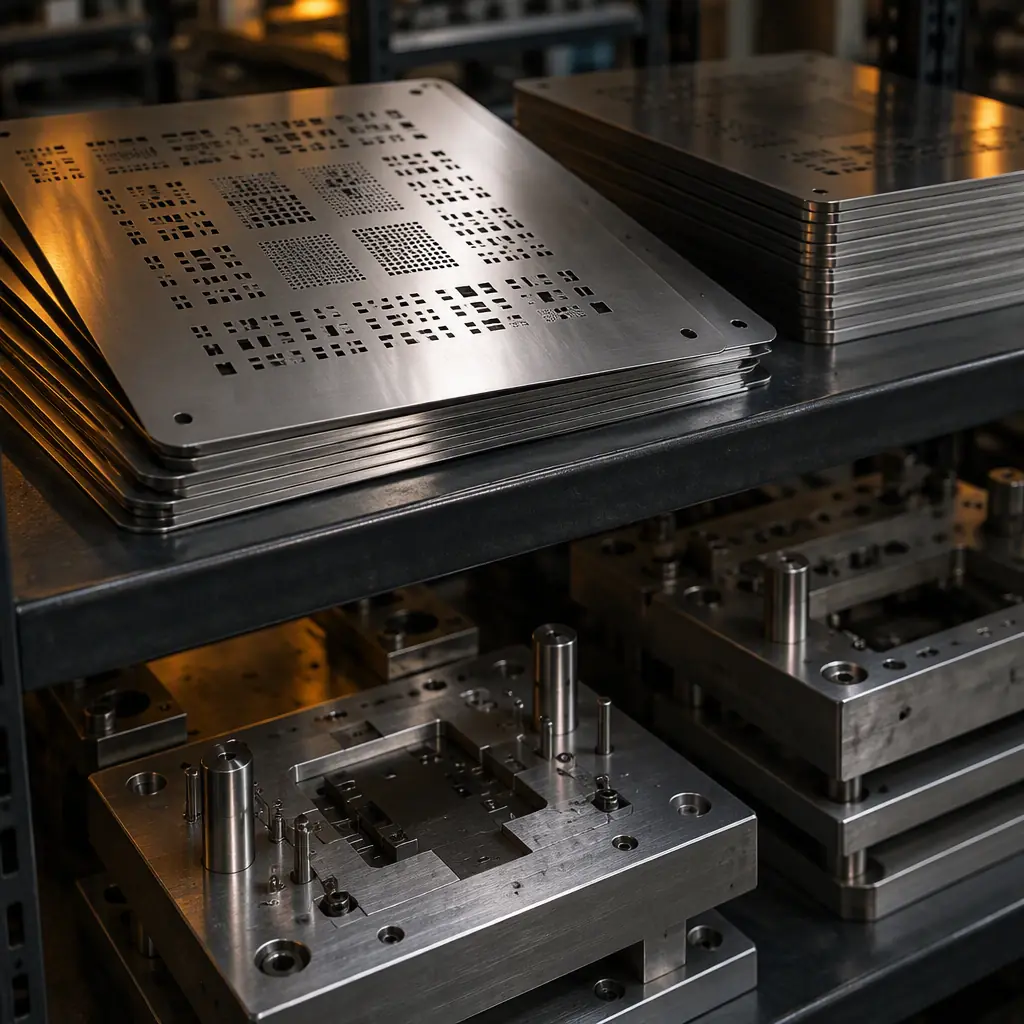
Tooling is the part of a PCB transaction with the weakest contractual clarity and the highest impact when something goes wrong, because the money is small relative to the build but the asset is essential to being able to leave the supplier at all. Laser-cut stencils, assembly fixtures, test fixtures and test programs are all built specifically for your product. Whoever holds them and whoever owns them are two different questions.
| Item | Typical ownership | What to agree in writing |
|---|---|---|
| SMT stencils | Customer, when separately charged | Whether they transfer, in what condition, and at what charge |
| Assembly / carrier fixtures | Usually customer if separately charged | Transfer terms and whether they are reusable at another supplier |
| Test fixtures and ICT programs | Frequently the supplier's | Whether programs are released as data, and at what cost |
| CAD / CAM data and panelisation | Customer | Confirmation that panelisation files are released to you, not held internally |
| Test programs and recipes | Supplier, unless agreed | Whether they are part of a transfer package and how they are priced |
The distinction that matters is between tooling that has been separately charged and tooling that has been absorbed into unit pricing. If you paid a separate NRE line for stencils and fixtures, the natural position is that you own them and can request transfer. If the tooling cost was built into the piece price, the supplier's position that they retain it is defensible. This should be settled before the first order rather than when you are trying to move a programme, and it should be stated on the quotation rather than left to the general terms. Our guide to PCB NRE and tooling costs covers how that line is normally built up and what a defensible charge looks like.
Conditional versus unconditional tooling release is the related question. An unconditional release means the tooling and related data are yours on payment, regardless of any ongoing commercial dispute. A conditional release ties it to a settled account. Suppliers understandably prefer the latter, and it is worth negotiating the former on tooling you have separately purchased, because the value of owning tooling is entirely in being able to leave with it. Where the answer is that the tooling cannot transfer because a fixture is bonded to a specific machine, that is a legitimate constraint. But it should be stated up front rather than discovered during a transfer.
Change Orders, Cancellations and Deposits
Engineering change orders and cancellations are where milestone schedules are most often tested, and where the absence of a defined cancellation window becomes expensive. The question to settle in advance is how much of the order remains recoverable at each stage, and the answer follows directly from the sunk-cost table earlier in this guide.
Before material release
A cancellation at this stage should cost little beyond the engineering time already spent and any tooling that has been cut. Tooling sunk cost is the main item, and whether it is recoverable depends on the ownership terms. This is the cheapest window to make a significant design change, and it is worth knowing how narrow it is.
After material release, before assembly
Custom laminate and long-lead components are usually non-returnable. The recoverable portion sits mainly in bare boards that can still be used on a revised build, which is why ECOs at this stage are sometimes handled by building out the current revision and cutting in the change on the next release rather than scrapping material.
During or after assembly
Once components are placed, the value is largely spent. A cancellation here generally means paying for the completed units, with any negotiation confined to the incomplete portion. This is the stage where a first-article approval gate earns its place, because it stops the whole quantity being assembled on a revision nobody has approved.
The practical discipline is to state the cancellation window and the recoverable proportion on the purchase order itself, not in the general terms and conditions that nobody reads until there is a dispute. Most suppliers will accept a defined window that matches their material commitment lead time, because it is the same constraint they are managing internally.
Deposits, Credit and Country Risk on a First Order
A first order with an overseas supplier combines two risks that are usually discussed separately: counterparty risk, which is about whether this supplier delivers, and jurisdiction risk, which is about what recourse you have if they do not. Both are managed by the same set of practical steps, and none of them involve paying a premium.
Start smaller than your eventual volume. A first order at pilot quantity costs less to get wrong and produces the evidence you need to judge the supplier. Not just whether they delivered, but whether the documentation, communication and change handling were as described. Verify certifications directly rather than accepting copies: an IATF 16949 or ISO 9001 certificate can be checked against the issuing body's register, and a supplier whose certificate has lapsed will usually be discovered this way rather than through conversation. Ask for two references with a similar product and volume profile, and ask those references specifically about how the supplier handled a problem rather than whether they were happy.
Where the transaction value is genuinely large, credit insurance or a sourcing intermediary can transfer some of the risk, at a cost that only makes sense above a certain order value. Below that threshold, the milestone structure does the same job more cheaply, which is the main argument for getting the schedule right on the first order rather than after the relationship has settled into a pattern.
Frequently Asked Questions
How should PCB payments be structured? Tie each release to a verifiable manufacturing event rather than a date: a deposit on order covering tooling and material commitment, a second release on first-article approval evidenced by a first-article report, and the balance on pre-shipment verification or against an agreed term after delivery. On established accounts the deposit stage usually falls away in favour of net 30 or similar terms.
What deposit is normal on a first PCB order? Practice varies with order composition rather than order value, because the deposit exists to cover what the supplier has irrecoverably spent. Orders with significant tooling or NRE content carry a higher proportion than orders that are mostly material, and prototype builds carry more than production builds. What matters more than the percentage is what the deposit is released against and whether the remainder is held to a verifiable approval point.
Who owns the stencils and fixtures made for my boards? Usually the buyer, when they have been charged as a separate NRE line. Tooling absorbed into unit pricing is more often retained by the supplier. The ownership and transfer terms should be stated on the quotation or purchase order before the first build, along with whether release is conditional on a settled account.
Make the Schedule Do Two Jobs
A payment schedule is usually treated as a cash-flow document and negotiated on percentages. Approached that way it protects one party and creates the conditions for a dispute. Built around verifiable events with named evidence, the same schedule also does the work of a project control: it forces a first-article approval gate, it defines when the supplier must present test data, and it makes a cancellation window concrete rather than contested. The percentages then follow from the underlying costs, which is the order the conversation should happen in.
At Huaxing PCBA we structure first orders against first-article approval and pre-shipment verification rather than calendar dates, with tooling and NRE stated separately on the quotation so ownership is unambiguous. We deliver to 150+ active customers in 30+ countries with 99.2 % on-time delivery, producing over 8 million components per day across 8 high-speed SMT lines and 4 DIP lines in a 15,000 m² facility, and we operate net terms on established accounts, with 24-hour prototyping and 5-day PCBA prototyping available for NPI programmes. Boards are built to 32 layers under ISO 9001, IATF 16949 and UL certification with IPC-A-610 Class 2 and 3 acceptance. Send your build package for a quote with the payment structure stated, or talk to us about terms for a production programme.