

Most low-volume guides stop at MOQ and panel sharing. Those are real levers, but they are the levers a buyer pulls. This article takes the other side of the table: the fixed changeover time that a running line has to absorb, how it is amortised across a quantity, and how to tell whether the amortisation in your quote is honest or padding.
Two buyers, two very different builds, one assembly house. This is the normal case in Shenzhen contract manufacturing, not the exception. A single line will run a 4-layer industrial control board on Tuesday, a 12-layer board with 300 BGA placements on Wednesday, and a 60-piece engineering build on Thursday, then go back to Tuesday's part on Friday.
When volume goes down, something else has to pay for the line. That "something" is setup time, and it is the single line item that decides whether your low-volume order is priced fairly or priced like a nuisance. A 2026 model we run against our own SMT schedule shows why: at 3,000 pieces a month, setup is about 1.6% of unit cost. At 100 pieces a month on the same board, it is 26%. Nothing about the board changed. Only the number of units absorbing the changeover did.
Why Low Volume Costs More: The Setup Amortisation Curve
Every SMT changeover has a fixed time cost. On our lines a full changeover from one product to another runs 45 to 90 minutes and contains these blocks:
| Changeover step | Typical time | Who it is charged to |
|---|---|---|
| Last-off and line clear, WIP reconciliation | 10-15 min | Shared across all buyers on the line |
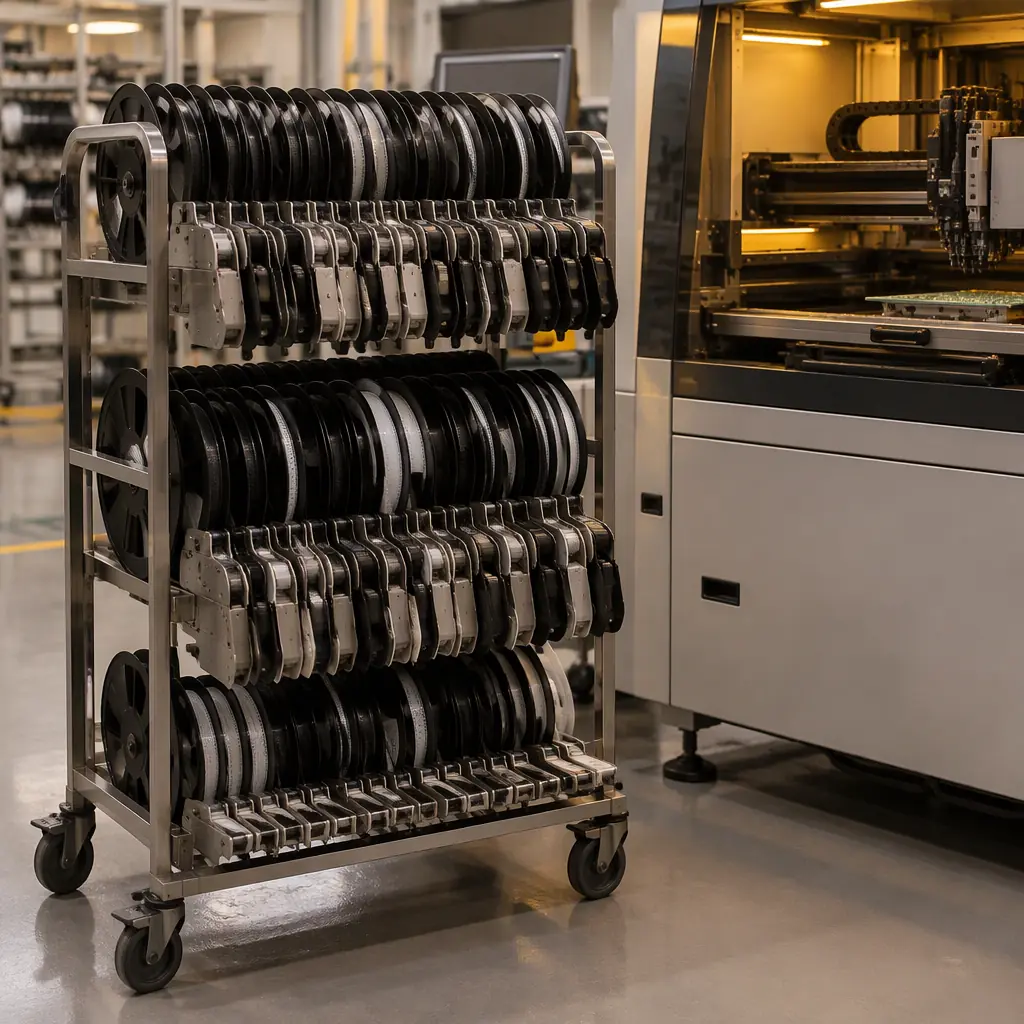
| Feeder and trolley swap, reel verification against BOM | 15-25 min | Your order |
| Stencil change, squeegee check, first print | 10-15 min | Your order |
| Program recall, fiducial teach, nozzle check | 10-20 min | Your order |
| First-article run and inspection sign-off | 15-30 min | Your order |
| Reflow profile verification (if alloy or mass changed) | 20-40 min | Your order, only when applicable |
The first row is the only one that gets shared. Everything else lands on the order that caused the switch. If the line is at a 20-minute internal changeover, that is a 20-minute bill. If it is at 70 minutes, that is a 70-minute bill. Multiply by the machine rate, which for a mid-range pick-and-place cell is commonly quoted in the USD 60 to 120 per hour band, and the arithmetic is easy to check against any quote.
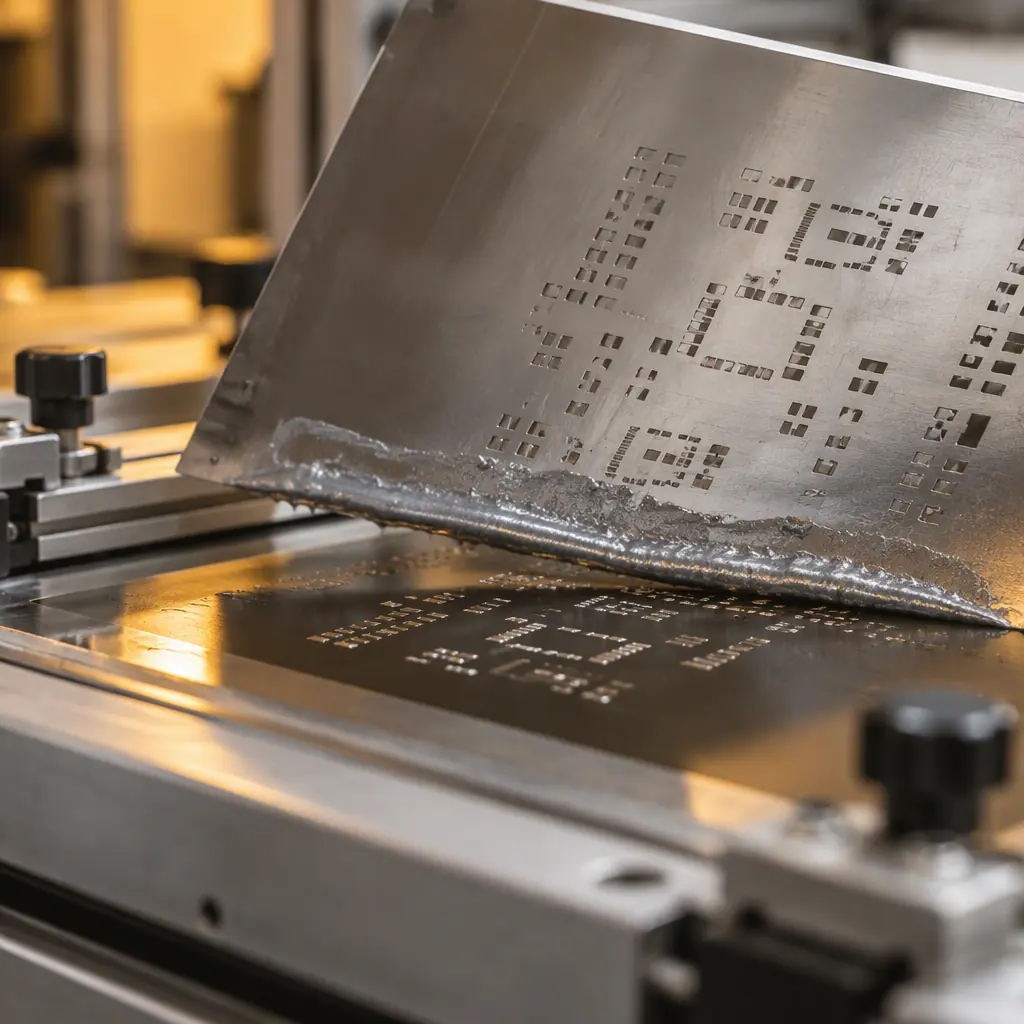
The practical consequence: two suppliers can quote the same board, and one is 25% cheaper, because one of them runs a 45-minute changeover and the other runs a 90-minute one. The buyer who asks only for the unit price is looking at the last line of the quote and ignoring the reason it is that number.
What a Fair Low-Volume Quote Actually Contains
Ask for three numbers separately, and the quote stops being a black box:
- Setup charge: a one-time, stated amount per order. On a 300-placement board it commonly lands between USD 150 and 450 depending on feeder count, stencil count and whether an alloy change is involved.
- Minimum order quantity or lot charge: the floor below which the supplier will not run, because the setup cannot be recovered. Many assembly houses set this at 50 to 100 pieces for a standard single-sided SMT build.
- Per-piece price at your actual quantity: not at a reference quantity. A quote that only holds at 1,000 pieces tells you nothing about a 150-piece release.
If setup is not stated, you cannot compare quotes and you cannot negotiate the right thing. Our own position is that an open setup line makes both sides better off, because the buyer can then choose to pay setup once and place a call-off order instead of paying it four times a year.
There is a fourth number worth requesting on anything above a prototype: the re-qualification threshold, meaning how many pieces can be added to a released build before the supplier insists on new first-article approval and a new setup charge. It is usually the point where the reel count or the revision changes, and knowing it prevents the surprise of a 200-piece top-up being priced as a fresh order.
Shared Line Time: How Your Order Shares a Week With Three Others
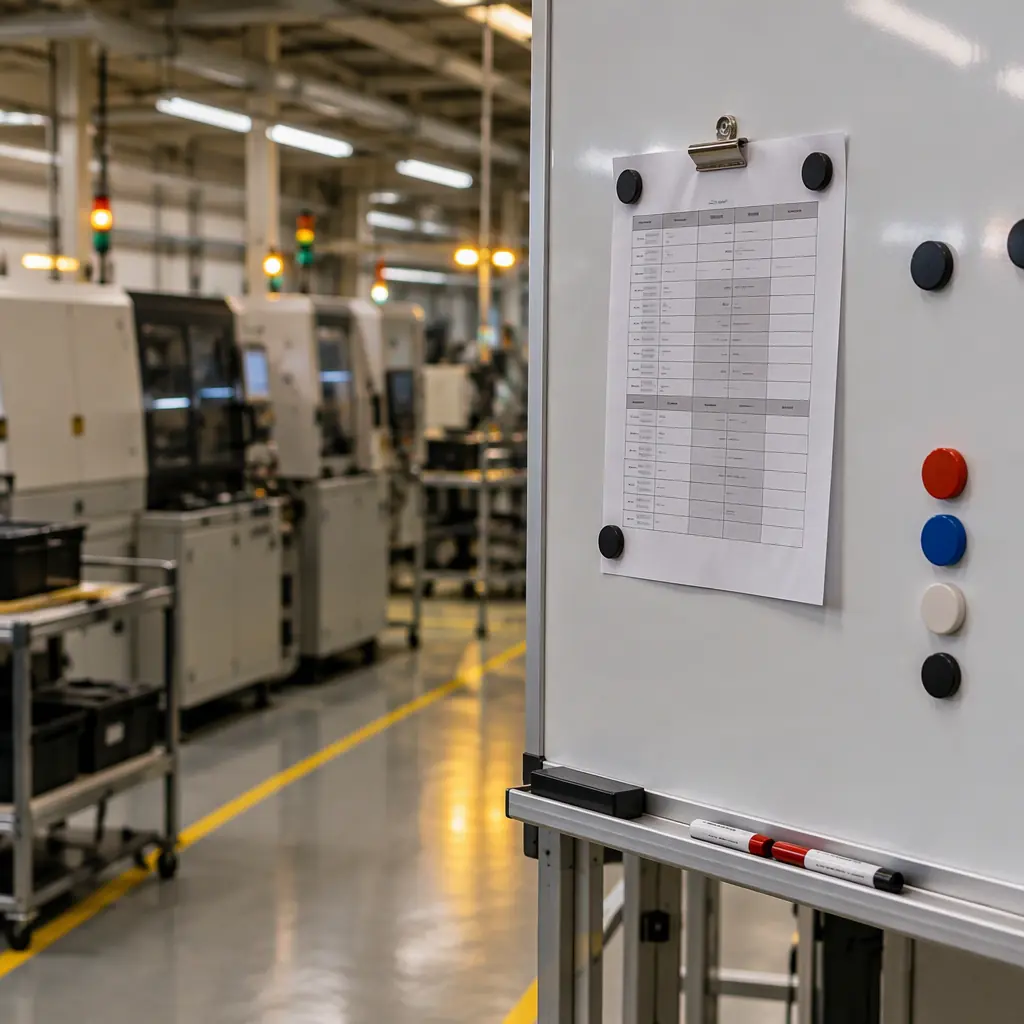
Nobody runs one board alone on one line all month, and that is not a problem as long as the sequencing is visible. Here is a real schedule shape from a mix-heavy week on a single SMT cell, with four products rotating through:
| Day | Product | Quantity | Changeovers | Effective utilisation |
|---|---|---|---|---|
| Mon | Industrial control, 4-layer, 180 placements | 1,200 | 1 in | High |
| Tue AM | Same product, continuation | 800 | 0 | High |
| Tue PM | Sensor node, 2,100 placements, 0201 mix | 300 | 1 | Medium |
| Wed | Power module, 12-layer, 340 placements, BGA-heavy | 150 | 1 | Low |
| Thu | Engineering build, 60 pieces, mixed technology | 60 | 2 (one in, one out) | Very low |
| Fri | Back to industrial control | 1,000 | 1 | High |
Thursday is where the money is. A 60-piece mixed-technology build consumes two changeovers plus a profile check to produce a run that takes under an hour of actual machine time. Every supplier handles this, but they handle it differently: the good ones group such builds onto a dedicated prototype cell or batch them with similar products so the changeover is shared, and the bad ones bill it straight and let the buyer discover it.
What you should ask for, once, is the supplier's rule for grouping. A concrete answer sounds like "engineering builds under 100 pieces go to the prototype line, and we will hold them for up to five working days to consolidate with another NPI run". A vague answer means the grouping is happening by luck.
Where Low Volume Genuinely Hurts Quality, and Where It Does Not
Low volume is often blamed for defects it does not cause. Separating the two is worth an hour of a buyer's time.
It does not hurt in-process control. SPI, AOI and X-ray settings live in the recipe, not in the quantity. A 150-piece build can be inspected at the same sampling rate as a 15,000-piece one, because the machine does not get tired.
It does hurt in places where learning requires repetition:
- Printer setup drift. A paste deposit responds to the room, the paste age and the squeegee. On a run of 150, there may be only 4 or 5 boards before the printer is pulled apart for the next product, so a marginal setup never gets corrected by feedback.
- Reflow profile pragmatism. Suppliers profile the worst-case assembly, which is correct, but on very low volume a product with unusual mass or a mixed alloy may run on a profile validated for a neighbour rather than one built for it. Ask which profile was used and when it was last validated.
- Operator familiarity. Rework on a board an operator has seen once is slower and less consistent than on a board they have built for three weeks.
The mitigation is dispatch documentation rather than volume: a frozen assembly drawing with polarity and pin-1 marked, a photo of a known-good board, and an agreed rework instruction. Those three items cost nothing and they carry the same weight at 60 pieces as at 60,000.
The Setup Reduction Playbook, and Why It Lands on the Buyer
The supplier side of this problem has a well-developed answer: reduce changeover time internally by externalising as much of it as possible. Done well, a 90-minute changeover becomes 30, and a third of that saving is genuinely available to the buyer. What matters for a procurement engineer is knowing which moves are available, because each one has a cost that eventually appears in a price.
| Technique | Typical time saved | Cost that shows up in the quote |
|---|---|---|
| Pre-kitted feeder trolleys, loaded offline against the BOM | 15-25 min per changeover | Trolley and feeder inventory, small per-order fee |
| Duplicate dedicated tooling per high-runner product | 20-40 min, and removes stencil change risk | Tooling charge on first order, then amortised |
| Quick-release stencil frames and magnetic pallets | 5-10 min | Capital, spread across all buyers |
| Program library pre-tuned per panel position | 10-15 min and fewer first-article surprises | Engineering time at NPI |
| Grouping similar products into a family run | 30-60 min across the family | Requires schedule flexibility from the buyer |
| Internal changeover discipline, measured and reviewed | 10-20 min, cumulative | Management attention, not a line item |
The last row is the one buyers can actually influence without paying for tooling. A supplier that measures changeover time as a tracked KPI will hold a tighter number for years. Asking whether the number is measured, and what it was last quarter, is a cheap way to estimate how much of the changeover you are being asked to fund twice. In our own case changeover time is tracked per line and reviewed weekly, which is why we can quote a figure rather than a range.
Five Procurement Questions That Separate Real Capacity From a Quote Template
Send these before the RFQ closes. The answers are not scored on eloquence, they are scored on whether they contain a number.
- What is your changeover time, measured, not theoretical? A supplier running internal SMED work will quote minutes from a recent measurement. One that says "it varies" has not measured it.
- How many products were on the line last week, and how many changeovers? This tells you whether your 150-piece order is normal traffic or a rare event that will be handled badly.
- Do you have a dedicated prototype or high-mix cell? If yes, ask for its feeder count and its typical stencil turnaround. If no, ask how NPI builds are sequenced against production.
- What is the re-qualification threshold on a released build? A stated numeric threshold (for example, "material change, revision change, or more than 30 days idle") is a controlled process. Silence is not.
- Will you hold setup as a separate line item and let us choose a call-off schedule? This is the single highest-leverage question for a buyer whose annual volume is real but whose monthly volume is small.
On the last point, the economics are straightforward. Four orders of 300 pieces with four setups is more expensive than one order of 1,200 pieces held in finished-goods stock, unless the carrying cost and the forecast risk exceed the setup cost. For most industrial and medical builds, the setup cost dominates and the call-off wins. For consumer products with a fast-changing BOM, it may not. The point is that the choice is only available to the buyer who asked for setup to be broken out.
How We Price Mixed-Volume Work
For context on what to expect from us specifically: a standard single-sided SMT build at 100 to 500 pieces is quoted with a stated setup charge and a per-piece price at the actual quantity, not a reference quantity. Mixed-technology builds with through-hole, selective solder or hand-solder content carry an additional assembly labour estimate per board, again stated separately. Engineering builds under 100 pieces can be consolidated with other NPI runs on request, which trims one changeover from the total.
Our SMT lines run high-mix schedules with 0201 and 0.4 mm pitch fine-pitch capability, and first-article inspection is a gated step on every new build regardless of quantity. If you want to see how that is documented, the related guides below cover the changeover, capacity and cost side of the same problem.