"We do functional test" is one of the least specific statements in a manufacturing quotation. It can mean a technician plugs the product into a bench supply and confirms that a light comes on. It can mean a purpose-built fixture exercising every I/O port, running a calibrated load test, and logging pass or fail against a serialised record. Both are functional test. One of them catches a missing 10 k pull-up and the other does not.
The difference is not effort for its own sake. It is the difference between a test programme defined by failure modes and one defined by a list of things that were easy to check. For a buyer moving from prototype to production, that distinction decides how many defective units reach the customer, and it has a computable cost attached to both sides.
The Four Test Stages at End of Line
Production test is not one station. It is a sequence of stages, each catching a different population of defects, and the sequence is designed so that the cheap test runs before the expensive one.
| Stage | What it does | Time per unit | Catches | Cannot catch |
|---|---|---|---|---|
| ICT / flying probe | Measures component presence, value and orientation on the bare assembly | 20-90 s | Wrong part, missing part, reversed polarity, open trace, short | Firmware faults, marginal timing, anything energised |
| FCT (functional) | Powers the unit and exercises its functions through a fixture | 20-180 s | Assembly faults that only appear under power, calibration errors, interface faults | Early-life failures that need time and temperature |
| Burn-in / aging | Runs the unit under load at elevated ambient for a defined period | 4-48 h | Infant mortality: latent component and joint defects | Design margin problems that need more stress than the profile |
| System test | Tests the finished product as the customer will use it, including enclosure and accessories | 60-300 s | Integration faults: harness, connectors, enclosure interference, firmware configuration | Anything the fixture cannot reach without disassembly |
The sequence matters economically. ICT is fast and cheap and removes assembly defects before they reach a powered station, where a shorted board can damage the fixture. Burn-in is expensive in capital and floor space and is placed after FCT so that it only sees units that already work. System test is last because it is the only stage that can confirm the product as shipped.
Coverage by Failure Mode, Not by Step Count
A 40-step test program sounds more thorough than a 12-step one, and often is not, because step count measures the test author's diligence rather than the test's reach. What matters is which failure modes the programme can actually detect. The table below is the version worth arguing about with a supplier.
| Failure mode | ICT | FCT | Burn-in | System test |
|---|---|---|---|---|
| Missing or wrong component | Yes | Often | No | Rarely |
| Reversed polarity | Yes | Usually | No | No |
| Open solder joint | Usually | Sometimes | Sometimes, if it opens under thermal load | Sometimes |
| Marginal solder joint (cracked, voided) | Rarely | Rarely | Yes, by temperature cycling under load | Rarely |
| Wrong firmware or configuration | No | Yes | No | Yes |
| Marginal timing or oscillator drift | No | Sometimes, if tested at limits | Sometimes | Sometimes |
| Connector and harness fault | No | Yes, if the fixture mates the connector | No | Yes |
| Enclosure interference or assembly error | No | No | No | Yes |
| Latent component defect | No | No | Yes | No |
| Calibration out of tolerance | No | Yes, if a reference is applied | No | Yes |
Read the marginal-joint row carefully. It is the row that justifies burn-in, and it is also the reason a programme with no burn-in and a strong FCT still ships a small number of field failures. The defect exists at the moment of test and does not manifest until the joint sees a temperature cycle under load.
Fixture Design: What Drives Cost
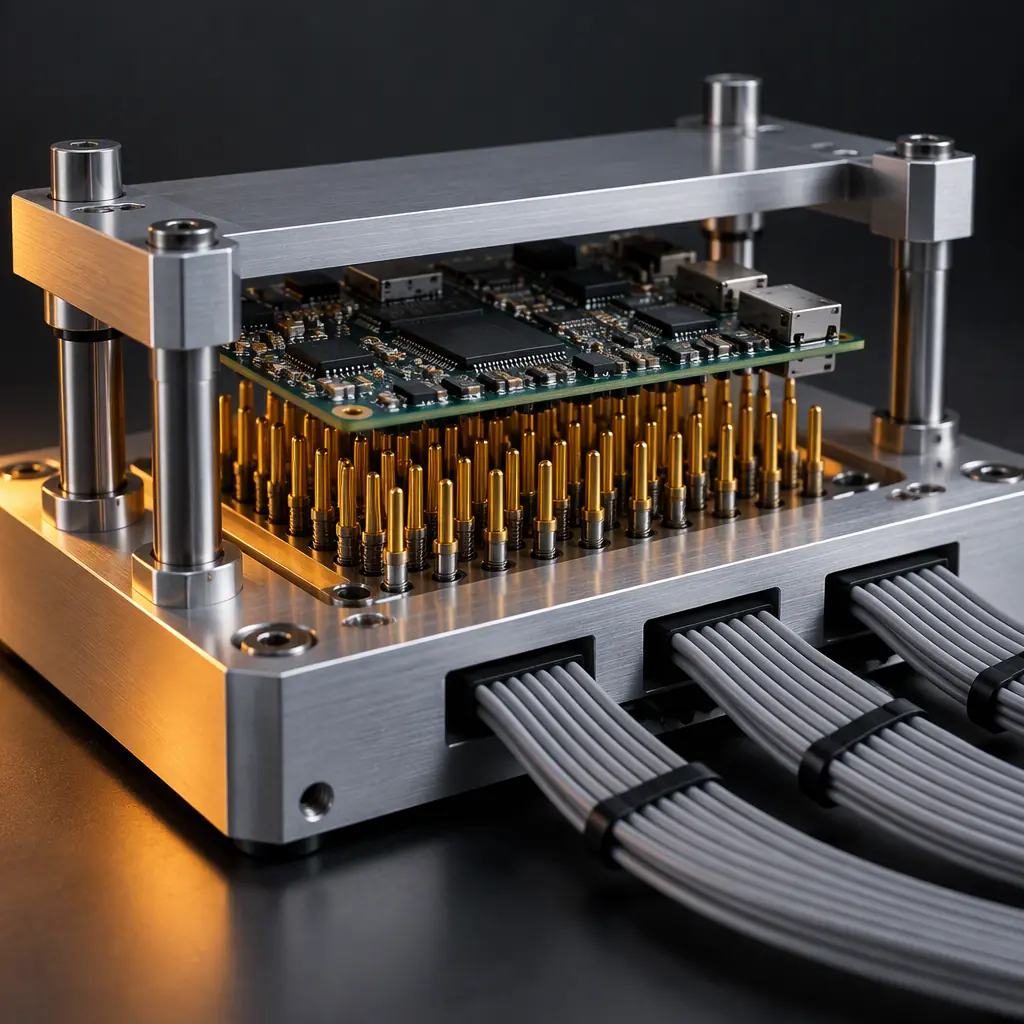
An FCT fixture is a mechanical and electrical interface between a generic test instrument and one specific product. Its cost is driven by how many contacts it needs, how small they are, and how much force it has to apply. Buyers routinely under-budget this by a factor of three because they price it as a jig.
| Parameter | Low end | High end | Effect on fixture cost |
|---|---|---|---|
| Contact count | 10-20 pogo pins | 200+ pins or a board-to-board connector interface | Scale factor 1x to 6x |
| Contact pitch | 2.54 mm | 0.5 mm fine pitch | +30 to 80% for probe and drilling precision |
| Current per contact | Under 1 A | 10 A+ power contacts | Separate power probes, +20 to 50% |
| RF path | None | Coaxial probes and shielded routing to 6 GHz | +50 to 150% |
| Clamping | Manual toggle clamp | Pneumatic or vacuum actuation | +40 to 120%, plus air supply |
| Mating connector | Test points on the board | Mates the product's own connector | +50 to 200%, and a wear item |
| Instrumentation | Bench supply and DMM | Programmable load, DMM, scope, programmable supply, switch matrix | Capital, separate from the fixture |
The connector-mating row deserves its own warning. A fixture that mates the product's own connector gives the best coverage, because it tests the interface the customer will use. It also wears that connector out, and the mating cycles are finite. A fixture that mates a connector 200 times a day needs a defined replacement interval, or the fixture becomes a source of intermittent failures that look like product defects.
Test Time Is Money
Test time is quoted in seconds and paid in station-hours. The arithmetic is simple and almost never in the quotation, which is why test-time decisions get made on the wrong grounds.
| Monthly volume | At 45 s per unit | At 180 s per unit | Extra station-hours per month |
|---|---|---|---|
| 500 | 6.3 h | 25 h | 18.8 h |
| 2,000 | 25 h | 100 h | 75 h |
| 5,000 | 62.5 h | 250 h | 187.5 h |
| 20,000 | 250 h | 1,000 h | 750 h |
At 5,000 units a month, the difference between a 45-second and a 180-second test is one full operator-month. That does not mean the faster test is better, because the 180-second test may be the one that catches the fault. It means the trade-off should be made deliberately: identify which of the additional 135 seconds buys coverage, and remove the rest. Test steps that exist because they were easy to add are the most expensive steps in the programme.
The 20,000-unit row also shows why parallel fixtures become necessary above a certain volume, and why a design that cannot be tested in under a minute constrains the whole line.
Burn-In: How Long, How Hot, and When It Is Waste
Burn-in exists to catch infant mortality: the defects that would have failed in the first weeks of service and instead fail on a rack in the factory. The bathtub curve predicts a falling failure rate in early life, and burn-in consumes that period deliberately.
Temperature accelerates most failure mechanisms roughly according to an Arrhenius relationship, so a few hours at 60 degrees Celsius can be equivalent to weeks at 25. Our own burn-in runs products continuously under load at 40 to 60 degrees Celsius for 4 to 48 hours, with temperature and current draw logged throughout for trend analysis. The duration is set by the failure population being screened for, not by a template.
Burn-in becomes waste in three situations. When the product has no wear-out mechanism in the screened window and the process is already mature, the rack is expensive insurance. When the stress profile is weaker than the service environment, it screens nothing. And when HASS or HALT could have found the margin problem at design stage for a fraction of the per-unit cost, running burn-in on every unit is paying repeatedly for a fault that should have been designed out once.
Fixture Ownership, ECOs and the Rev B Problem
The fixture question that costs the most money is not how much it costs to build; it is who owns it and who pays when the design changes. A fixture is product-specific tooling, and a BOM change that moves a test point or renames a connector makes the fixture wrong.
Three things should be in writing before the fixture is built. Who owns the drawings and the source code for the test program, and can the buyer take them to another supplier. What happens when a revision changes the test points: is the fixture modification quoted, included for one revision, or included for the life of the programme. And whether the fixture is dedicated to the product or shared, because a shared fixture is a changeover risk and a dedicated one is a capital cost.
The default in most contracts is that the supplier owns the fixture and the buyer owns nothing. That is fine while the relationship lasts and expensive when it ends, because moving a product to a second source without the fixture means paying for a second fixture and re-qualifying a test programme from scratch.
The EOL Test Spec a Supplier Can Actually Build
A test specification that can be quoted and built contains nine lines. Anything shorter is a conversation, not a specification.
- Unit under test — exact assembly level, with the configuration that is being tested.
- Test stages — which of ICT, FCT, burn-in and system test are required, in what order.
- Coverage requirement — the failure modes that must be detected, not the number of test steps.
- Pass and fail criteria — numeric limits for each measurement, with tolerance and the reference used.
- Logging — what is recorded per unit, and whether measured values are stored or only pass/fail.
- Fixture ownership — who owns it, who may modify it, and who pays for a revision change.
- Retest rule — how many retests are permitted before a unit is scrapped rather than reworked.
- Traceability key — the serial number or lot code that links a test record to a shipped unit.
- Documentation and escalation — what ships with the order, and who is notified when the first-pass yield falls below a threshold.
The retest rule is the one that gets skipped and matters most. A unit that is allowed to be retested indefinitely will eventually pass, and it will pass because the intermittent joint moved rather than because it was fixed. Limiting retests and requiring an investigation after a second failure converts a coin flip into a finding.
What to Ask Before You Place the Order
Ask which failure modes the proposed test programme detects, and ask them to point at the step that catches each one. Ask how many pogo pins the fixture has and what the connector mating-cycle limit is. Ask for the quote split between fixture, programming and per-unit test. Ask what happens to the fixture when you ship a rev change. And ask what first-pass yield they expect at ramp, and what the escalation threshold is.
A supplier that can answer those has built fixtures before. One that answers with a list of instruments it owns has described capital, not coverage.
The EOL station is the last place a defect can be caught, which puts it downstream of everything else in the programme. The upstream side is covered in our guide to defect escape rate and outgoing quality, which frames the same problem as a DPMO target rather than a test-coverage question. The fixture's electrical interface is the same engineering problem as probe card and ATE fixture design, and the relative cost of ICT versus FCT fixtures is broken down in our guide to ICT and FCT fixture cost.
Where the product includes a harness, the EOL station is often the first place a bad crimp is detected, because the fixture mates it. The acceptance criteria that should have caught it earlier are in our guide to IPC-A-620 harness inspection, and the sealing constraint on the same assembly is covered in the IP rating and enclosure sealing guide.
Define Your EOL Test Spec Before Ramp
Send the product assembly drawing, the interface list and the expected monthly volume. We will propose the test stages that match your failure modes, estimate fixture cost across the contact counts involved, and give you the station-hours for each test-time option so the trade-off is visible before ramp instead of at the first yield review.