In high-reliability electronics, a single oversized void beneath a BGA or a power device is one of the most common root causes of a board that passes burn-in and then fails a year into service. The acceptance guidance in IPC-7095 for BGA voiding, and the workmanship thresholds in IPC-A-610 and J-STD-001, exist precisely because voids are invisible to a visual inspection and destructive to reliability. Forced-air reflow the way most SMT lines run it can quietly push voiding past those targets on the exact boards that matter most.
So why would a design team choose vapor phase soldering (VPS)? Because its heating mechanism is fundamentally different: instead of blowing hot air across the board, VPS floods the chamber with a saturated, inert vapour that condenses on every surface at the same temperature. At Huaxing PCBA, we run both forced-air reflow across our 8 SMT lines and 4 DIP lines, and we bring VPS in when a program demands void reduction, tighter thermal spread, or a genuinely inert environment. This comparison is the decision framework we use inside the shop. And it is the one you need when a supplier claims they can do VPS for you.
What Vapor Phase Soldering Actually Is
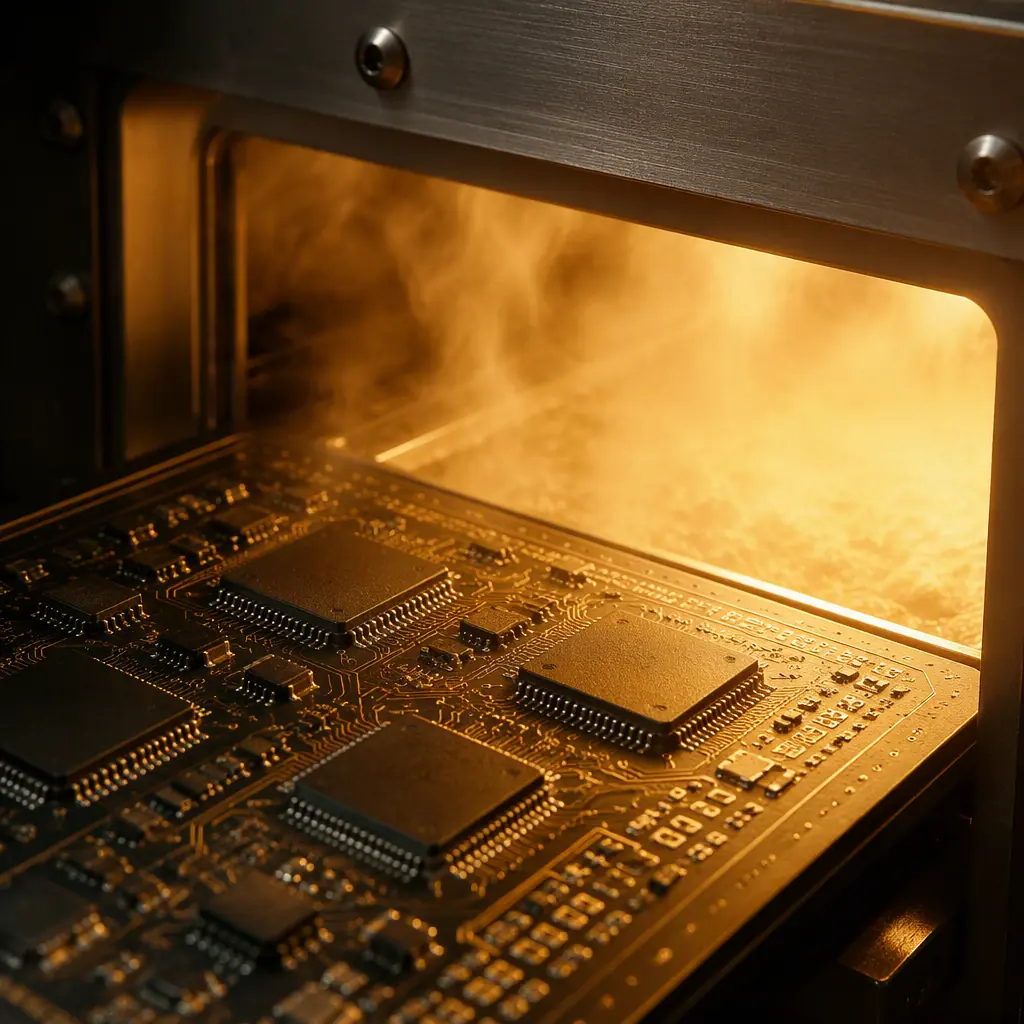
Vapor phase soldering is a reflow method that uses the latent heat of a boiling heat-transfer fluid: typically a perfluorinated liquid such as a Galden-type bath, to melt solder paste and form joints. The fluid is heated to its boiling point, and the vapour it produces condenses onto the relatively cooler board, releasing its latent heat of vaporisation and raising the assembly uniformly to just below that boiling temperature. Because the vapour is stable and motion-limited, the heating is dominated by condensation rather than convection.
The practical consequences are the reason buyers care. First, the board can never be heated above the fluid's boiling point, because any surface that reaches it stops condensing and stops gaining heat. That is a thermodynamic clamp no forced-air oven can offer. Second, because the vapour blankets the whole board at once rather than being blown across it, the thermal gradient across the assembly is very small. For a detailed look at how forced-air reflow tries to achieve the same uniformity with a dead-band of overshoot, see our reflow profile optimization guide.
How VPS Works, the Physics of Condensation Heating
Picture a sealed chamber with a pool of heat-transfer fluid at the bottom. When the fluid is brought to its boiling point, it generates a dense, saturated vapour that fills the chamber above the fluid. A printed circuit board introduced into that chamber is cooler than the vapour, so the vapour condenses on the board and on every component on it. The phase change from gas to liquid releases the fluid's latent heat, and that heat flows into the solder paste and the pads until the board surface reaches the vapour's saturation temperature.
Two properties follow from that mechanism. Temperature uniformity: condensation happens everywhere at once, so the whole assembly is brought toward the same temperature from every direction. Real VPS processes routinely hold the assembly within ±1 to ±2 °C across the board, which is far tighter than the larger gradients a forced-air oven produces on a board with mixed thermal mass. No over-temp zones: because the vapour's temperature is capped at the fluid's boiling point, a heavy copper plane, a large connector or a shielded module cannot run away and overheat the way it can when hot air slams into it. If you are managing a board with a wide mix of thermal mass, our discussion of solder paste selection shows how paste chemistry interacts with that heating curve.

VPS vs Forced-Air Reflow: The Comparison Table
| Factor | Vapor phase soldering (VPS) | Forced-air reflow |
|---|---|---|
| Heating mechanism | Latent heat of condensing vapour | Convective hot air |
| Board temperature uniformity | ±1 to ±2 °C | Typically ±5 °C or wider on mixed-mass boards |
| Max component temperature | Clamped at fluid boiling point, cannot overshoot | Depends on oven zones & recipe; overshoot possible |
| Atmosphere | Saturated inert vapour, effectively oxygen-free | Air or programmed N2 throughout |
| Solder voiding | Consistently lower, helps hit IPC-7095 <25 % area guidance | Higher; sensitive to moisture and outgassing |
| Throughput | Slower, batch-type processing | Fast conveyorized inline output |
| Operating cost | Heat-transfer fluid consumption is a constant line item | Energy for heaters & blowers; low consumables |
| Equipment footprint | Dedicated VPS chamber | Multi-zone reflow tunnel |
Where VPS Wins: Voids, Temperature Uniformity & Inert Atmosphere
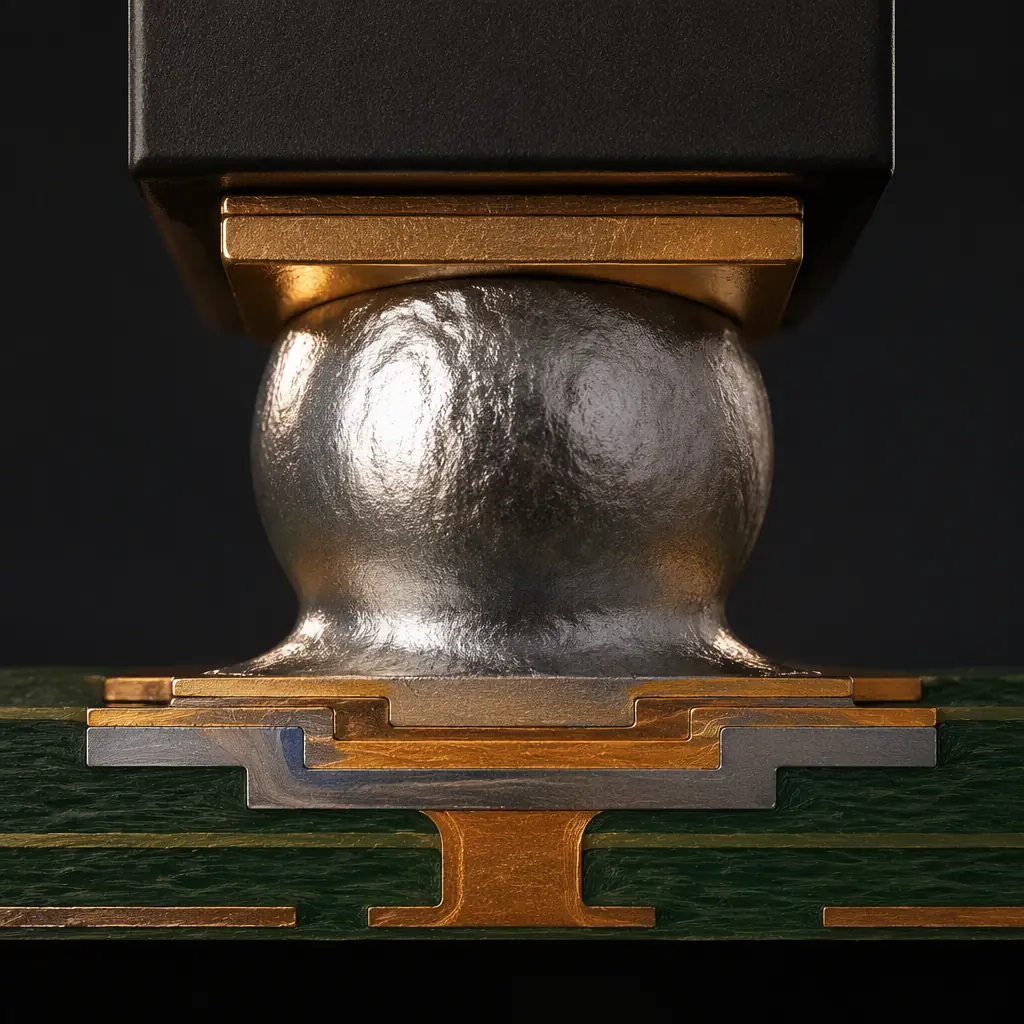
The strongest argument for vapor phase soldering is void reduction, and it flows from the two mechanisms above. Condensation heating is gentler and more even, so flux outgasses progressively instead of being violently driven out; the inert, essentially oxygen-free vapour also suppresses re-oxidation of solder and pads, which improves wetting and gives voids fewer chances to form and grow. The natural consequence is fewer and smaller voids at the exact interfaces, BGA balls, QFN pads and power-device die pads, where the IPC-7095 <25 % area voiding guideline and a customer's own internal limits bite hardest.
Inert atmosphere is its own reason to choose VPS. Because the board sees an oxygen-free vapour blanket rather than air, surface oxidation during the reflow window drops sharply. That matters for no-clean and low-residue processes, for fine-pitch components where pad contamination is already marginal, and for reliability-critical joints where a mediocre wetting profile is not acceptable. When integrated with the rest of the line, VPS is often the process of record on boards that combine SMT and through-hole work, which is where our how to choose the right through-hole process guide becomes relevant.
Heat-sensitive components & large thermal masses
Because the board cannot exceed the fluid's boiling point, a big power module, a shielded RF can or a heat-sink-attached device will not be driven past its rating. This is where forced-air reflow is most likely to cause a reject, but VPS clamps it.
Void-sensitive joints, BGA, QFN and power devices
Lower voiding toward the IPC-7095 <25 % area target and toward your own internal criteria. This is the single biggest reliability benefit in practice.
No-clean & low-residue assembly
An oxygen-free zone limits oxidation during the reflow window, so no-clean and low-gap assemblies wet out more reliably and leave less risk of void-driven field returns.
Key Takeaway: The reliability case for vapor phase soldering rests on three coupled benefits, a hard cap on component temperature, tight ±1 to ±2 °C board uniformity, and an inert, oxygen-free atmosphere that suppresses oxidation and voids. If your product fails IPC-7095-style void targets on a forced-air line, VPS is the process change to trial.

When You Still Want Reflow: Throughput, Cost & Trade-offs
Vapor phase soldering is not a blanket upgrade, it is a specialist method with real costs. The most obvious is throughput: a VPS chamber operates as a batch or semi-batch process, whereas a forced-air oven is a conveyorized inline machine that can cycle thousands of assemblies an hour. On a high-volume consumer line, switching to VPS would choke the output you are paying for. Our guide to double-sided SMT & mixed-technology assembly explores how much of that inline throughput you can actually retain when a design mixes technologies.
Then there is cost. The heat-transfer fluid, the Galden-type perfluorinated liquid, is expensive and is consumed, dragged out with the boards and lost to evaporation and carry-over. Fluid top-up becomes a standing operating line item, and used fluid needs proper handling. The equipment itself is a dedicated chamber rather than a multi-zone tunnel, so a shop may not want to reserve capacity for it unless there is a steady stream of high-reliability work to justify it. That is a big part of why most general-purpose contract manufacturers do not offer VPS at all.
Procurement Tip: Ask whether a supplier treats VPS as an everyday capability or as a specialty you must spin up. A dedicated VPS chamber is a real capital and consumables commitment; a factory that only has one line that can be run as VPS on request is a very different proposition from one that offers it as a standard process.
Who Should Specify VPS: Medical, Aerospace, Power & Defense
Because VPS buys reliability rather than speed, it lands where miniaturisation and environmental stress meet strict acceptance criteria. Medical implantables and single-use diagnostics need void-free, consistent joints on fine-pitch and shielded boards. Aerospace and defense flight and mission hardware is governed by IPC-A-610 and J-STD-001 acceptance and often by a customer's own voiding and workmanship limits that exceed the commercial norm. Power and automotive modules carry high current through big die pads where a single void becomes a hot spot and a fatigue initiation site. These are exactly the boards where solder paste choice matters too, see our comparison of lead-free vs leaded solder reliability.
Even with the best process, no SMT line produces a defect-fee first pass forever, which is why the reliability argument does not stop at reflow. For the service side of the story, what happens when a batch of void-heavy BGAs needs to be exercised back to a good state, our BGA reballing & rework guide and our breakdown of solder joint voids, bridging & cold joints cover the diagnosis and recovery half of the picture.
How to Ask Your Manufacturer for VPS
If you want VPS on your board, write it into the RFQ as a process requirement rather than a preference. Naming the target up front is what turns a vague request into a biddable one. It costs nothing and it stops a supplier from quietly substituting an inline oven.
Name the process, and the target
State "vapor phase reflow" and give a measurable voiding target, e.g. BGA/QFN voids below <25 % total void area per ball or pad, or the stricter limit your program defines. Ask the supplier to confirm their capability in writing.
Define the acceptance standard
Reference IPC-A-610 and J-STD-001 for workmanship and IPC-7095 for BGA voiding, and require inspection or X-ray evidence on representative samples, not just a first-article photo.
Confirm the thermal budget & materials
Share the temperature rating of your most sensitive component and confirm the fluid and the peak board temperature. Then lock the solder paste, since paste chemistry and void behaviour are coupled.
Key Takeaway: A VPS request that is verifiable has four parts: the process name, a numerical voiding target, a named acceptance standard, and documented evidence. If a supplier cannot quote a process and a target, they do not have a reproducible VPS capability to sell you.
Summary & Next Steps
Vapor phase soldering and forced-air reflow are not competing equals, they are different tools for different reliability budgets. Choose VPS when your boards are void-sensitive, heat-sensitive, or bound for medical, aerospace, defense or power applications where a single hidden void is a field failure. Choose forced-air reflow when throughput and cost per board dominate and your acceptance limits are more forgiving. Where a board sits between those poles, a hybrid judgement is often right. And that decision is best made with your contract manufacturer, early, using real data.
At Huaxing PCBA we run 8 SMT lines, 4 DIP lines and up to 32 layers inside a 15,000 m² facility with 500+ staff, processing over 8 million placements per day for customers in 30+ countries. We are ISO 9001, IATF 16949 and UL certified, and we document reflow process parameters just as carefully on our forced-air lines as on any VPS programme. Upload your files for a quote or talk to our engineering team about whether vapor phase soldering is the right reflow method for your high-reliability design.