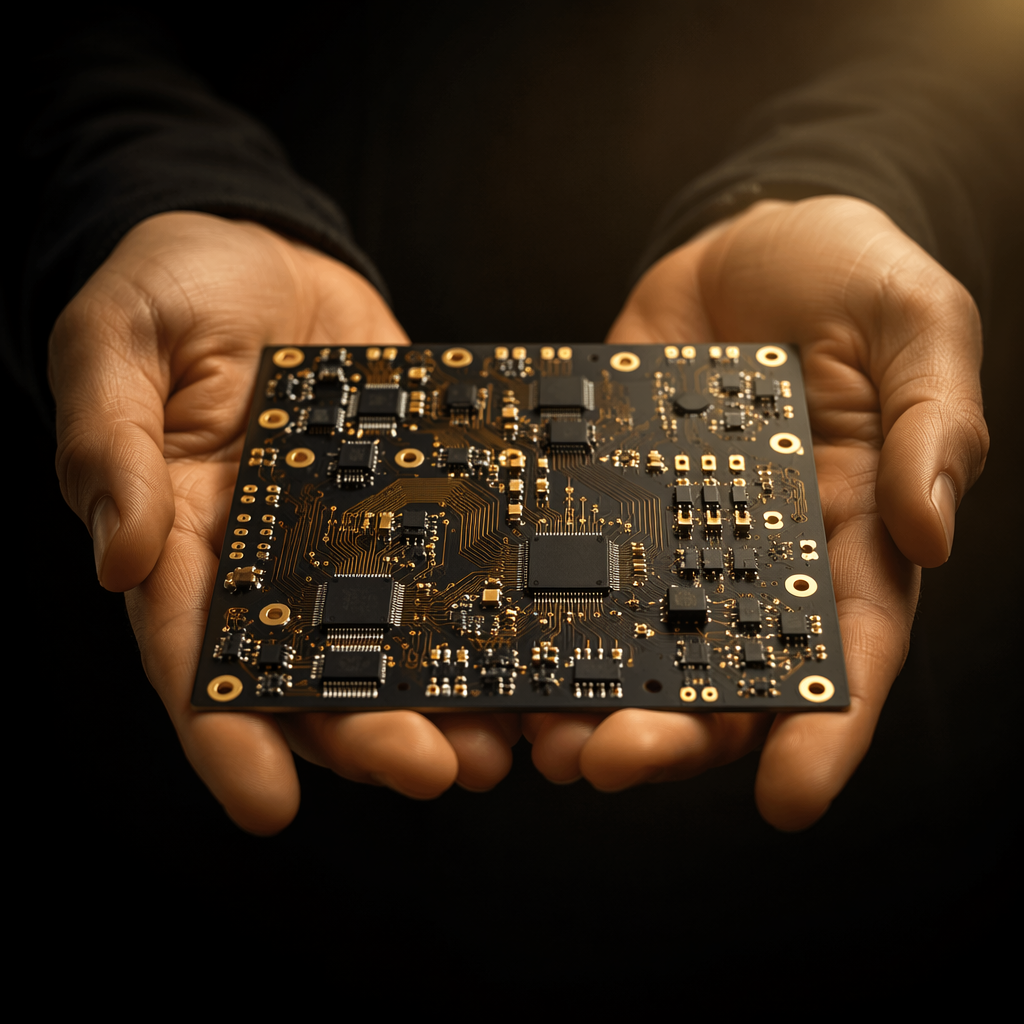

When you send a set of Gerber files, a stackup drawing and a BOM to a fabrication house, you have transferred the most complete description of your product that exists anywhere — more complete than a datasheet, more complete than a marketing photograph, more complete than a patent filing. A typical mutual NDA covers that transfer adequately in the sense that it creates a legal obligation. It rarely covers where the files are stored, who inside the supplier can open them, what happens to the tooling, or whether you may verify any of it.
For a hardware company whose competitive position rests on a board-level design, those gaps are the ones that matter. This guide sets out the six commercial terms that close them, in the order a buyer should negotiate them, plus the counterfeit and clone risks that sit adjacent to the NDA question. At Huaxing PCBA we execute NDAs with defined file-handling scope and tooling ownership as standard, because the alternative is a buyer carrying unmeasured risk on every order.

What a Standard PCB NDA Does and Does Not Cover
A conventional mutual NDA defines confidential information, sets a term, restricts use to the stated purpose, and creates an obligation to protect the information with reasonable care. Applied to a PCB order, it establishes that the supplier may use your design files to build your boards and for nothing else.
What it typically does not establish is any of the following: the retention period for the files after the order completes, whether the supplier may keep the design in a quoting library, whether the tooling is your property, who within the supplier is authorised to open the data, whether the file transfer channel is encrypted and logged, or whether you have the right to audit any of it. Each of these is a distinct term, and each is negotiable before the first order rather than after.
Key Takeaway: An NDA restricts use. It does not govern storage, retention, access control, tooling or verification. Those five items are separate clauses. Buyers who negotiate only the NDA signature have covered perhaps a third of the actual exposure.
Clause 1 — Define "Confidential Information" to Include Tooling and Process Data
The first drafting failure is scope. A clause covering "design files and technical documentation" leaves the derived artifacts out. Those artifacts include the fabrication tooling (drill programs, rout programs, test programs and, for assemblies, stencils and fixtures), the process recipe the supplier develops to build your board, the netlist behind the electrical test program, and the stackup plus impedance-calculation results.
Two of these deserve explicit mention. The electrical test program encodes your netlist — the complete connectivity of the design, which is often the hardest thing for a competitor to reconstruct from a photograph. The process recipe is your supplier's own work product and is legitimately theirs, but the parameters it contains describe your board. Specify that tooling and test programs created for your order are your property or, at minimum, are subject to the same confidentiality and retention terms as the design files themselves.
Clause 2 — Set a Retention and Destruction Period, With Evidence
Files that persist after the order creates a permanent exposure with no matching benefit. The clause to negotiate is a defined retention window — 12 months is a common commercial figure for an active programme — after which the supplier either returns or destroys the design data via a documented process, and can confirm it in writing on request.
There is a legitimate counter-argument to consider: if you intend to place repeat orders, the supplier needs the data to refabricate. The resolution is to make retention conditional rather than absolute. Specify that retention continues while an active supply relationship exists or a current quotation is open, and that data for dormant programmes is purged on an annual schedule with a confirmation report. This gives the supplier the operational continuity they need and gives you a defined endpoint instead of indefinite storage.
Clause 3 — Data Transfer and Access Control
Where the file goes and who can open it are ordinarily handled by email and an engineering shared drive. For a design worth protecting, four specific requirements move the practical risk materially.
Encrypted transfer, and a channel that can be revoked
Gerber and BOM files should move over an encrypted, access-controlled channel rather than as plain email attachments. An engineered file-transfer portal with per-order credentials is the practical standard: it supports revocation when a programme ends and creates a transfer log. Where a supplier insists on email, the minimum is an encrypted archive with the password sent over a separate channel.
Named-access list, not departmental access
The design should be readable by the engineers who must build it — CAM, process, test and quality — and not by the sales team, the quoting library, or anyone outside the order. Ask for a statement of which roles have read access to customer design data. Where a quoting team keeps a library of past customer designs to speed up future quotations, that library is a genuine exposure and should be excluded in writing.
Prohibition on external quoting, marketing and case-study use
Two specific uses need naming because they are otherwise permitted. Customer designs should not be used in marketing material, website galleries or trade-show presentations without written approval — photographs of a distinctive board are a design disclosure in their own right. And the design should not be used as a reference quote for other customers. If you want your supplier to feature your product publicly, grant that permission explicitly and separately.
Subcontractor and affiliate flow-down
Boards are frequently finished through subcontract operations — surface finish, laser drilling, assembly, conformal coating. Each subcontractor is another party holding at least a partial description of your design. The clause should require the supplier to flow equivalent confidentiality obligations to subcontractors and to disclose the category of operations that are subcontracted before production. Reporting what is subcontracted is standard practice and shouldn't be contentious; a refusal to state it is a signal worth noting.

Clause 4 — Tooling Ownership and Its Physical Fate
Tooling is the clause buyers most often assume rather than negotiate. It is also where practice varies most widely. Three separate questions need answers, and they should be written down rather than agreed verbally.
| Question | Why It Matters | Term to Negotiate |
|---|---|---|
| Who owns the tooling? | An amortised tooling charge paid by the buyer implies transfer of ownership; an unspecified charge leaves it with the supplier | State explicitly whether tooling is the buyer's property, the supplier's, or licensed to the buyer for the duration of the relationship |
| Where is it stored? | Physical archives hold foil, fixtures and drill plates; access controls on a physical store are weaker than on a file server | Require the tooling to be held in a controlled-access archive and released to the buyer on request |
| What happens at programme end? | Without a clause, tooling and files remain indefinitely | Define transfer, destruction or continued custody with a cost, triggered by a written request |
The ownership question has a direct commercial consequence beyond secrecy. Tooling held by a supplier is a switching cost if you try to move the programme, and it is the practical basis on which some suppliers expect repeat business. Buyers who care about dual-sourcing or about retaining the ability to transfer a programme should establish ownership at the start, when it costs nothing, rather than mid-programme when it is a negotiating position.
Clause 5 — Auditability, the Term That Makes the Others Real
Every clause above is a promise. An audit right is what converts a promise into something verifiable. Two levels are worth negotiating, and they serve different purposes.
The first is document-based: on request, the supplier provides evidence that file retention, access control and tooling custody follow the agreed terms. This might be a retention schedule extract, an access list, or a signed confidentiality acknowledgement from subcontractors. It is inexpensive to produce and it establishes that the obligations are tracked rather than aspirational.
The second is an on-site audit right, exercised either by you or by an independent auditor, covering the physical handling of design data and tooling. Where a programme is significant enough to justify a supplier audit for quality reasons, the IP dimension can be added to the same visit at almost no incremental cost. The structure of a quality-focused supplier audit, including the documentation to request in advance, is set out in our guide to PCB supplier audits.
Clause 6 — Programmes That Need More Than an NDA
For genuinely sensitive designs, contractual protection is the floor rather than the ceiling. Two situations warrant a different structure.
Chip-on-board and potted assemblies. When the board is coated, potted or over-moulded, the finished product does not disclose the design, but the files still do. This is where access control and retention matter most, because the physical product cannot be reverse engineered by a competitor as easily as a small dense PCB can be via depackaging and layer-by-layer imaging.
Programmes where the board is the product. Where your business advantage is the layout — RF matching networks, antenna geometry, thermal design, a proprietary power topology — consider a design-services arrangement in which you retain CAM and tooling control, or split the work so that no single supplier holds the complete picture. Partial-segmentation arrangements are common in high-value programmes and are commercially normal rather than an accusation of bad faith.
Adjacent Risks the NDA Does Not Touch
| Risk | Mechanism | Control |
|---|---|---|
| Counterfeit components entering through the supply chain | Brokered parts substituted for authorised distribution, often with re-marked packaging | Traceability requirements and incoming verification; see our guide to PCB counterfeit detection |
| Cloned assemblies sold onward by a third party | Finished product or design acquired outside the supplier relationship | Serialisation and lot traceability; see our article on IPC-1782 lot traceability |
| Design disclosure via marketing use | Suppliers publishing photos of distinctive boards as capability proof | Explicit written prohibition, granted only by exception |
| Obsolescence forcing a redesign that leaks the old design | Discontinued parts push redesign work into a wider supply chain | Obsolescence planning; see our article on component obsolescence management |
Procurement Tip: Ask two questions before releasing files. First, which roles inside the factory can open a customer design file, and is the quoting team among them? Second, do you hold tooling for customers who no longer place orders, and for how long? A supplier who can answer both with reference to a written procedure is operating a data governance process. One who answers from memory is operating an intention. The written procedure is what protects you in three years, after the sales engineer you negotiated with has moved on.
Summary
A signed NDA is a necessary, inexpensive first step and a poor final one. The exposure on a PCB order lives in the specifics: whether derived tooling and test programs are covered, how long files persist after the last shipment, who can open them, whether subcontractors carry the same obligation, who owns the tooling when the programme ends, and whether any of it can be verified.
Six clauses and two questions cover the practical ground. They cost a review cycle before the first order and nothing thereafter. The alternative — discovering the gaps when a competitor's product appears with your board inside it — is a much more expensive way to learn the same lesson.
At Huaxing PCBA we sign NDAs covering design data, derived tooling and test programs, transfer customer files over an access-controlled portal with per-order credentials, hold tooling in a controlled archive with ownership stated at order placement, and provide retention and access evidence on request. We work with IPAR and UL-traceable component sources to keep the counterfeit route closed. Review our supplier audit guide or contact our team to arrange an NDA and file-handling review before your next programme.