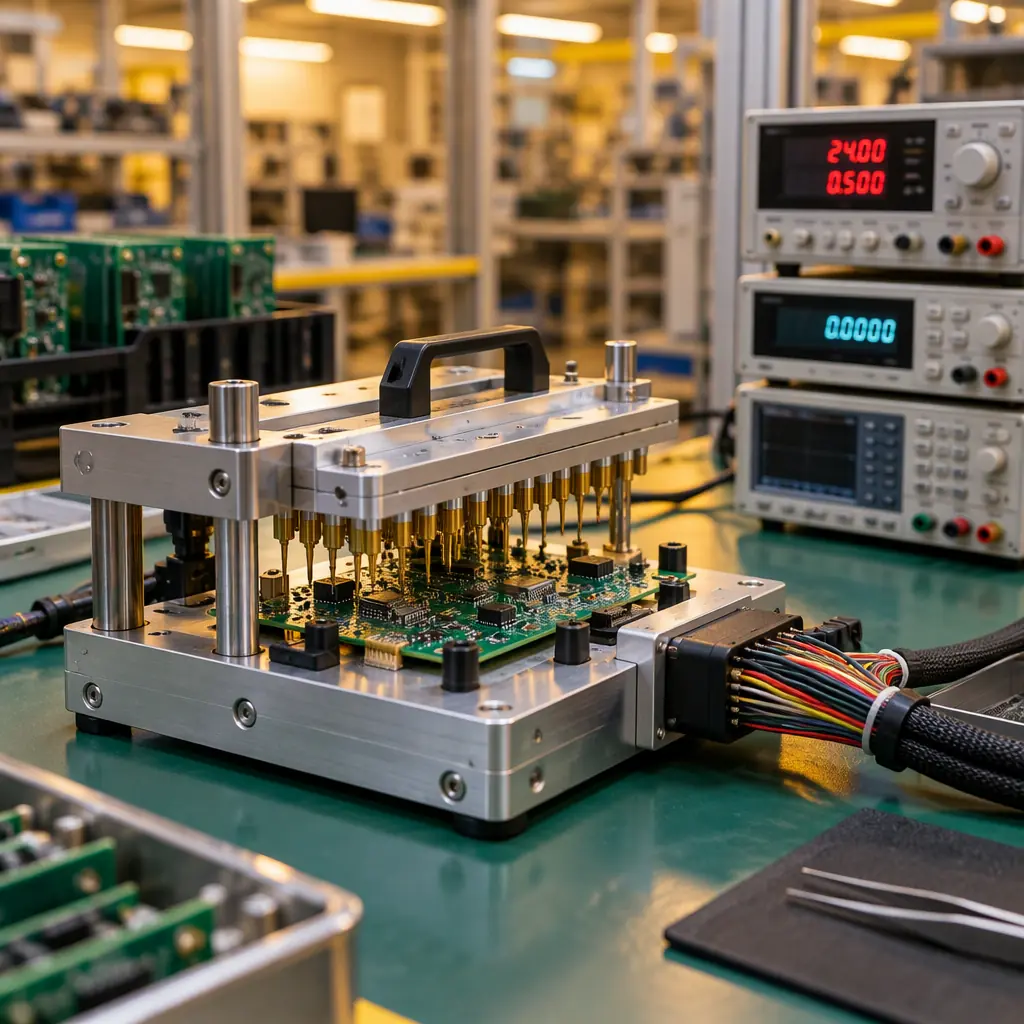
In-circuit test tells you the board was built correctly. Functional test tells you the board works. Those are not the same claim, and the gap between them is where most field returns are born: a correctly assembled board with a wrong component value, an unprogrammed microcontroller, a firmware revision from the wrong build, or a marginal regulator that passes at 25 °C and drops out at 70.
FCT is the only test on a normal PCBA line that exercises the product as a product. It is also the test most often quoted as a line item nobody can interpret, because the quote says "functional test" and the coverage behind that phrase ranges from applying power and watching an LED to running a full stimulus script with load simulation. This page sets out what FCT catches, what the fixture costs, and what belongs in writing before you accept a quote.
PCB Functional Test (FCT): Quick Answer
| Question | Short answer | Detail |
|---|---|---|
| What does FCT catch that ICT does not? | Anything that needs the product running | Firmware, communication interfaces, sensor behaviour, marginal analogue performance, current draw under load |
| When is FCT justified? | Any board with firmware or an interface | Below that, ICT or flying probe plus AOI is usually enough |
| What does the fixture cost? | Typically 1,200 to 4,000 USD | Driven by pogo count, load simulation and software, not by board area |
| How long does it take? | 30 to 90 s per board | Power-on tests sit near the low end, full interface scripts at the high end |
| What is the biggest hidden cost? | Test software maintenance | Every firmware or BOM revision can require a script change and a re-qualification |
What FCT Catches That ICT and AOI Cannot
ICT verifies that the right component is in the right place with the right orientation, and that the nets are connected. AOI verifies that the solder joints and placements look right. Neither can tell you whether the board boots. The defect classes below show where the line is.
| Defect class | AOI | ICT | FCT | Comment |
|---|---|---|---|---|
| Wrong value, wrong part fitted | Partly | Yes | Indirectly | ICT reads the value directly; FCT only sees the effect |
| Open or short joint | Partly | Yes | If it affects function | A shorted decoupling cap may never show at FCT |
| Unprogrammed or wrong firmware | No | No | Yes | Only FCT can read the build identifier back |
| Interface does not enumerate | No | No | Yes | USB, Ethernet, CAN and RS-485 need a live counterpart |
| Marginal analogue behaviour | No | Partly | Yes | Gain, offset and noise only show under stimulus |
| Current draw out of window | No | No | Yes | Catches a wrong-value resistor or a leaking cap that ICT passes |
| Thermal or timing margin | No | No | Only if tested hot | Requires an explicit hot-test step, rarely quoted by default |
The row that matters most in practice is firmware. A board with the wrong firmware build is electrically perfect and functionally wrong, and no amount of AOI or ICT will find it. The narrow case of end-of-line coverage is covered separately in the end-of-line functional test guide.
The Three FCT Flavours
"Functional test" in a quote can mean any of three things, and the price difference between them is large. Ask which one is being quoted.
Power-on only. Apply the specified supply, measure input current, check that a status LED or a rail comes up. Ten to twenty seconds, minimal fixture, no test software beyond a supply and a meter. Catches gross failures and nothing subtle.
Firmware-loaded. The fixture programs the board, reads back a build identifier, and runs a self-test routine that the firmware exposes. This is the most common production FCT and the one that catches wrong-build and configuration errors. Thirty to sixty seconds.
Full stimulus with load simulation. The fixture presents real or simulated loads and interfaces: an Ethernet link partner, a CAN node, a relay load bank, a simulated sensor. This is where marginal analogue and interface defects are found, and where fixture cost and software effort climb fastest. Sixty to ninety seconds, sometimes more.
Fixture Anatomy and Where the NRE Goes
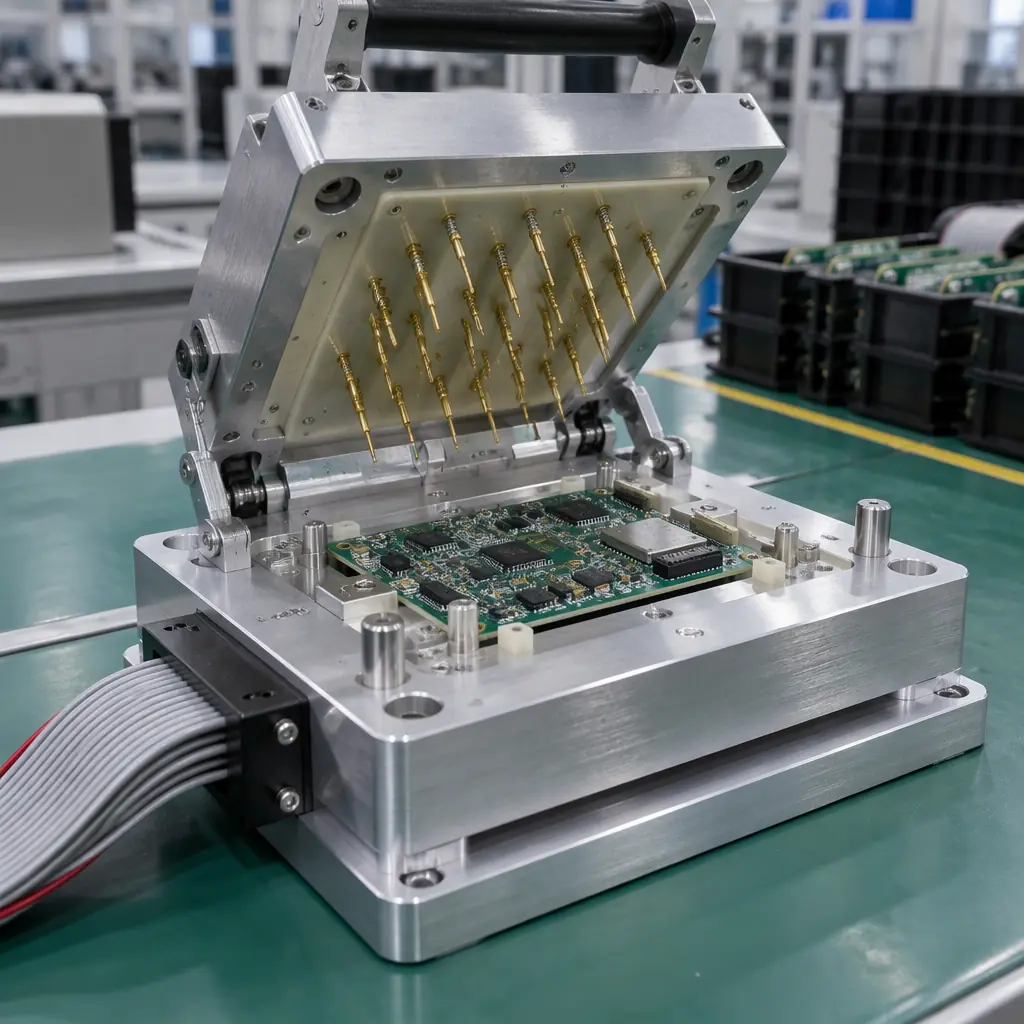
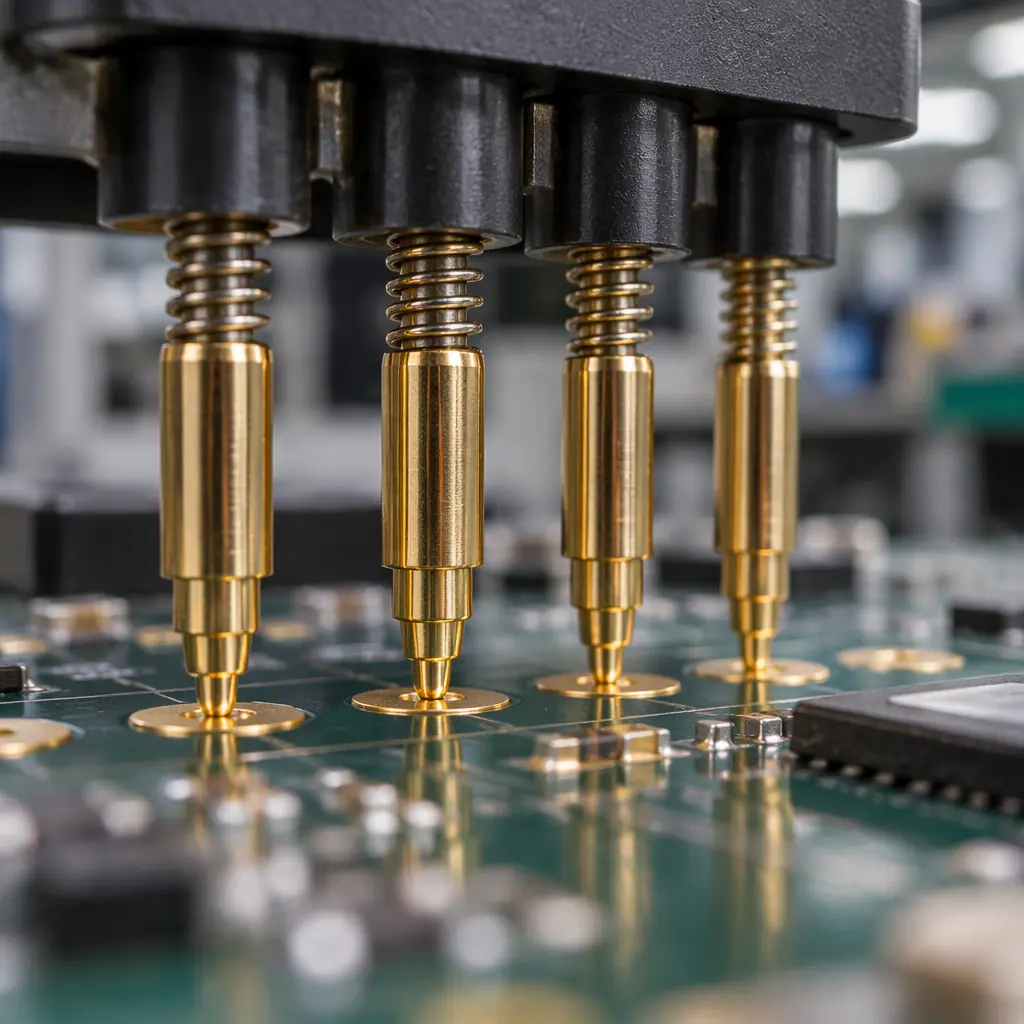
A functional test fixture is not a bed-of-nails ICT fixture with different software. It has more in common with a small test instrument. The cost breaks down into four parts, and the one people underestimate is the last:
| Cost element | What drives it | Typical share of NRE |
|---|---|---|
| Mechanical fixture and pogo field | Probe count, pitch, board support, clamping | 30 to 40 percent |
| Interface and load hardware | Connector mating, relays, load banks, instrument channels | 25 to 35 percent |
| Test software | Number of test steps, interface protocols, pass limits | 20 to 30 percent |
| First-article correlation and debug | Golden sample availability, limit setting, repeatability runs | 10 to 15 percent |
Two consequences follow. First, a fixture cost quoted without a test specification is a guess, because the software element depends entirely on how many steps you want. Second, the per-node arithmetic used for ICT does not transfer: the ICT per-node NRE and break-even method is the right model for continuity testing, not for functional test.
Cost per Board, Worked
Fixture NRE is only half the sum. The recurring cost is test seconds, operator time and fallout. The model below uses a 2,500 USD fixture, 45 s cycle, 25 USD per hour loaded operator rate, and a two percent first-pass failure rate with one retest allowed.
| Volume | Fixture NRE per board | Test time per board | Operator per board | Total per board |
|---|---|---|---|---|
| 500 boards | 5.00 | 0.31 | 0.31 | 5.62 |
| 2,000 boards | 1.25 | 0.31 | 0.31 | 1.87 |
| 10,000 boards | 0.25 | 0.31 | 0.31 | 0.87 |
Read the first row honestly: at 500 boards, FCT costs more than five dollars a board in NRE alone. That is not an argument against it, because the alternative is shipping boards whose firmware you never verified. It is an argument for pricing the commitment rather than the line item. The crossover where FCT becomes cheaper than the field failure it prevents is usually well below 1,000 boards for any product with a firmware image and an interface.
The same comparison made on a test-method basis, including flying probe and ICT, is in the flying probe versus ICT versus FCT comparison, and the full fixture cost picture including maintenance is in the PCBA test fixture cost guide.
Failure Disposition and the Retest Trap
The most common way a functional test programme becomes decorative is the retest policy. A board fails, the operator reseats it, it passes, and the failure disappears from the record. If that loop is invisible, your FCT statistics show a two percent failure rate when the real defect population is higher and the failures are being converted into intermittent field returns.
Four rules make the data trustworthy:
What to Write on the Purchase Order
Six items turn "functional test" from a phrase into a specification. Each one prevents a specific dispute.
1. Test specification revision. Which document defines what is tested. Without a revision reference, there is no way to prove the agreed coverage was performed.
2. Coverage statement against a stated denominator. "Full coverage" is meaningless without saying of what. Express it as the percentage of functional blocks exercised, or of firmware self-test routines invoked. The measurement problem is set out in the ICT coverage percentage audit, and the same denominator discipline applies here.
3. Pass and fail limits per measured parameter. Current draw, output voltage, timing, communication success criteria. A limit like "current approximately nominal" cannot be enforced by any operator.
4. Fixture ownership and transfer. Who owns the fixture at end of programme, and what happens if you move to a second source. A fixture you cannot take with you is a switching cost, not an asset. The escrow and transfer question is worked through in the fixture NRE and break-even analysis.
5. Data retention and format. Per-unit test records, retained for a stated period, in a format you can read. For regulated products this is required; for everything else it is how you investigate a field return two years later.
6. Re-qualification trigger. Which changes require the fixture and script to be re-validated before production continues: BOM change, firmware change, component substitute. Without this, a silent firmware update can pass a test that no longer checks anything.
Where FCT sits in a complete plan, with the ordering rules and the escape-cost arithmetic, is covered in the PCBA test strategy guide. The design-side constraint on all of it is physical: you cannot probe what the layout does not expose, which is the test point access constraint.
Frequently Asked Questions
Is functional test the same as in-circuit test? No. ICT checks component presence, value and connectivity using a bed-of-nails fixture. Functional test powers the assembled board and checks that it behaves as a product, including firmware and interfaces. Most production lines need both, plus AOI, for different defect classes.
What does an FCT fixture cost? Typically 1,200 to 4,000 USD depending on probe count, load simulation and test software complexity. A power-on-only fixture sits at the low end; a fixture that emulates interfaces and presents real loads sits at the top, and can exceed it when instrument channels are needed.
How many boards justify a functional test fixture? For any product with firmware, the answer is almost always yes from the first production batch, because there is no other way to verify the build. The per-board cost falls below one dollar by roughly 10,000 boards, but the decision is driven by escape cost rather than by the crossover point.
Can FCT replace ICT? For most boards, no. FCT sees the effect of a defect rather than the defect itself, so it misses failures that do not affect the tested function, such as a shorted decoupling capacitor. The two tests cover different populations, and the method comparison sets out the overlap.
Put a Test Specification Behind the Quote
Huaxing PCBA builds the fixture and writes the test script in the same programme, so the coverage you specify is the coverage that runs. Send the schematic, the firmware interface and the product's failure modes. We return a test plan naming which defect classes are covered by AOI, which by ICT or flying probe, and which by FCT, with the fixture NRE and the per-board recurring cost separated on the quote.