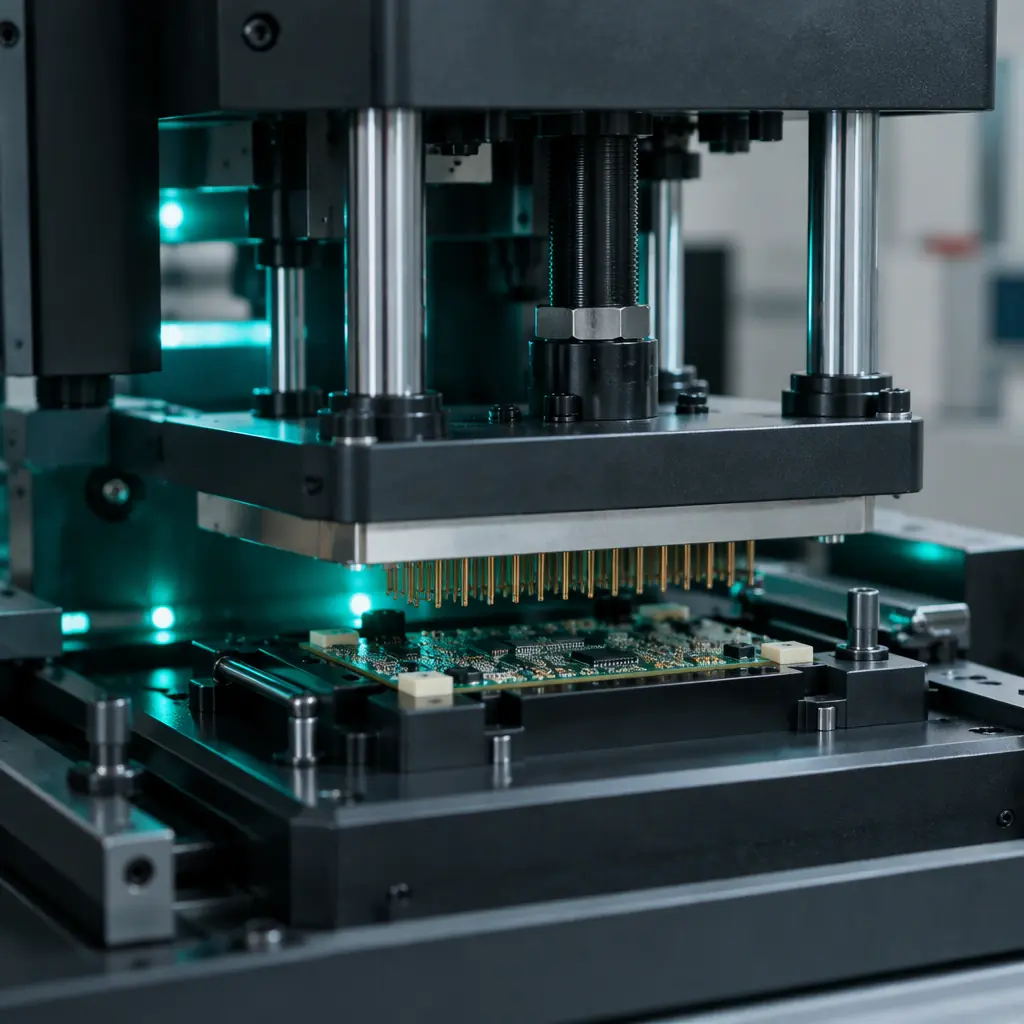
An in-circuit test fixture is quoted as a single line item: "ICT fixture and program, USD 4,800." That number is the wrong thing to negotiate on, because the fixture is not a cost, it is a commitment. It locks a specific board revision to a specific set of probe positions on a specific machine, and every one of those three things can change after you have paid for it.
The right way to read an ICT quotation is to break the fixture into its cost drivers, understand which of them the design controls rather than the supplier, and calculate the volume at which it beats the alternative. Do that before the design freezes and you get a genuine per-board saving. Skip it and you get a fixture that pays back never, or one that strands you with a single supplier because nobody asked who owns the hardware.
What an ICT Fixture Actually Costs Per Node
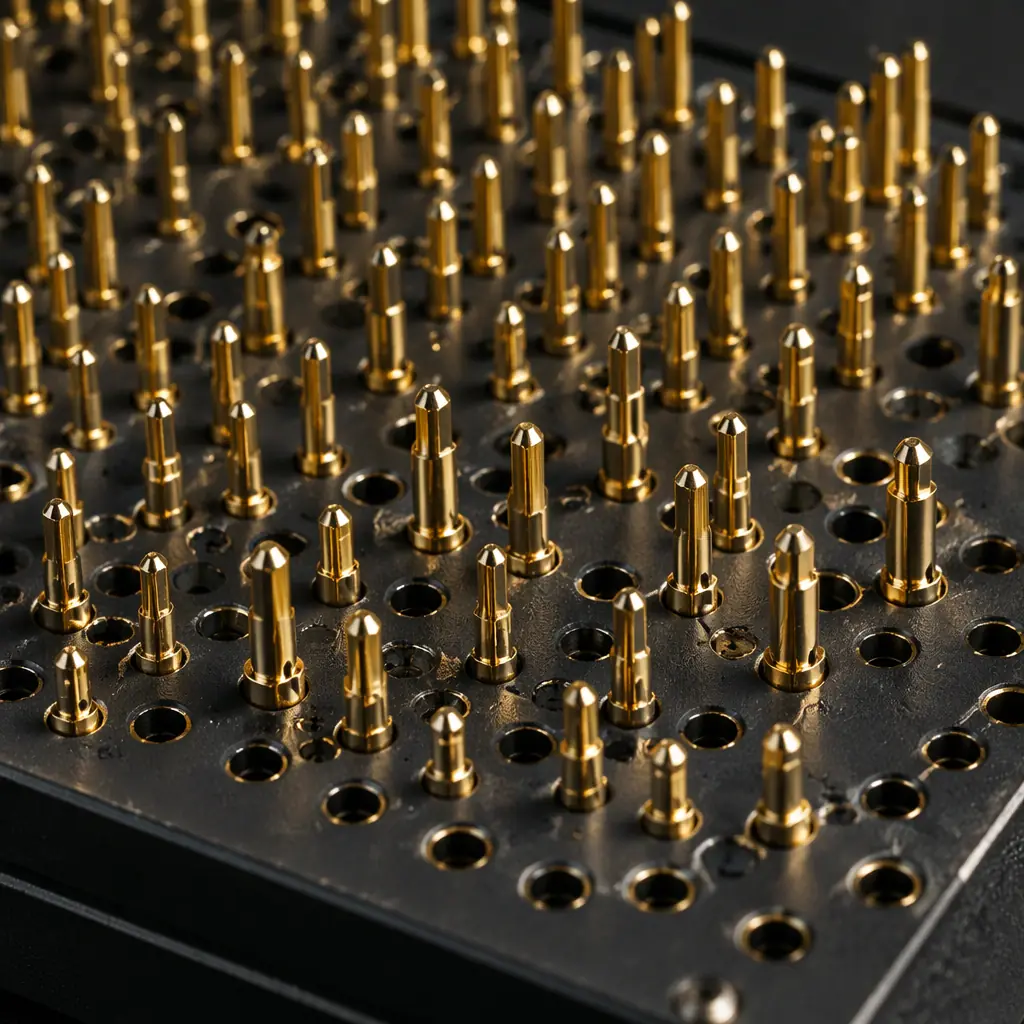
Fixture cost scales with node count, but not linearly and not at a single rate. Five components make up the total, and they respond differently to the same design change.
| Cost Component | What Drives It | Typical Unit Cost | Who Controls It |
|---|---|---|---|
| Probes and receptacles | Node count, probe type, pitch | USD 1.50-6.00 per node | Design: node count and clearance |
| Wiring and connectors | Node count, harness complexity, wire gauge | USD 0.40-1.20 per node | Design: node count |
| Fixture base and drilling | Board size, layer count of fixture, density | USD 600-2,500 flat | Board area, not your choice |
| Vacuum or mechanical actuation | Board size, force requirement | USD 400-1,800 flat | Board size and support plan |
| Program development and debug | Node count, netlist quality, ambiguity groups | USD 1,200-4,000 flat | Netlist and Design for Test |
A typical 800-node fixture on a 250 × 180 mm board lands around USD 4,500-6,500 including program. A 1,600-node fixture on a 350 × 250 mm board lands around USD 9,000-13,000. The per-node rate falls as node count rises because the flat components amortise, which is why dense boards look expensive per unit area but reasonable per node.
The component that surprises buyers most is program development. Two boards with identical node counts can differ by USD 2,500 in programming cost purely on netlist quality and on how many nets have no accessible test point. A net with no probe becomes an ambiguity group, and every ambiguity group has to be resolved by a written justification that someone has to produce and someone else has to approve. Our design for testability guide covers the access rules that prevent this, and the test fixture cost overview covers the fixture families themselves.
ICT Fixture NRE: The Cost Components and Typical Range
Short answer, for the search snippet: ICT fixture NRE typically runs USD 4,500-6,500 for an 800-node board and USD 9,000-13,000 for a 1,600-node board, made up of probes and receptacles at USD 1.50-6.00 per node, wiring at USD 0.40-1.20 per node, a fixture base of USD 600-2,500, actuation of USD 400-1,800, and program development of USD 1,200-4,000. Node count, board size and netlist quality determine the total; none of them are set by the test supplier.
The NRE is one-time, which means its contribution to unit cost depends entirely on volume. That is the whole reason break-even matters and the reason a fixture quoted for a 500-unit prototype build is almost always the wrong purchase. The next section does the arithmetic.
Break-Even Volume: Fixture Versus Flying Probe, Worked
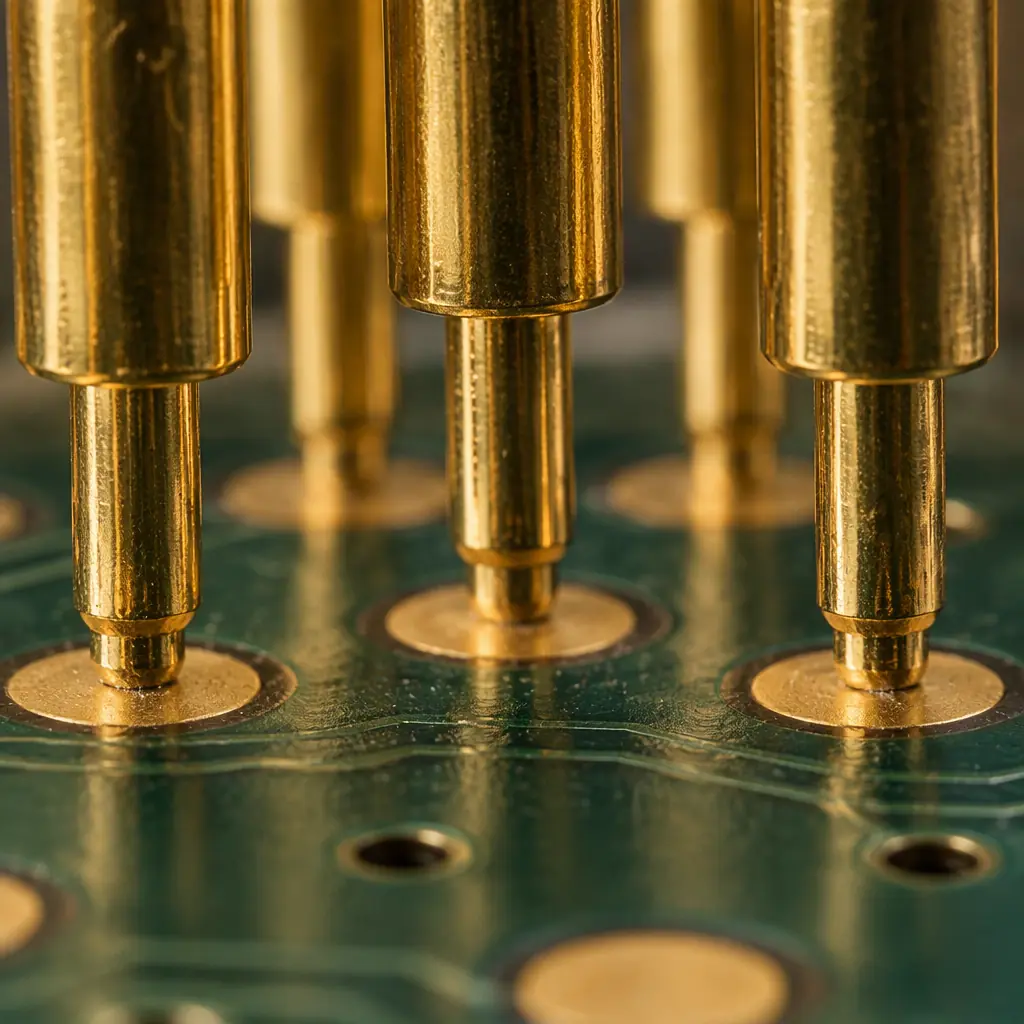
The comparison is between two cost structures, not two technologies. A fixture front-loads cost into NRE and then tests fast and cheaply. Flying probe has near-zero NRE and a high per-board test time, which converts directly into a high per-board price. The crossover is a volume number, and it moves sharply with node count because both fixture NRE and flying probe test time scale with nodes.
| Volume | Fixture NRE Amortised | Fixture Test Cost/Board | Flying Probe Cost/Board | Total per Board, Fixture | Total per Board, Flying Probe |
|---|---|---|---|---|---|
| 2,000 boards | USD 2.75 | USD 0.55 | USD 3.90 | USD 3.30 | USD 3.90 |
| 10,000 boards | USD 0.55 | USD 0.55 | USD 3.90 | USD 1.10 | USD 3.90 |
| 50,000 boards | USD 0.11 | USD 0.55 | USD 3.90 | USD 0.66 | USD 3.90 |
Worked on a 800-node board with a USD 5,500 fixture NRE, a fixture test cycle of 22 seconds at a loaded rate of USD 90/hour (USD 0.55 per board), and a flying probe cycle of 156 seconds at the same rate (USD 3.90 per board). The crossover sits at about 1,640 boards: 5,500 ÷ (3.90 − 0.55). Below that, flying probe wins outright; above it, the fixture saves USD 3.35 per board for the life of the design.
Three things break that tidy result, and all three are common.
The Design Changes and the Fixture Does Not
An ECO that moves one component or adds one net can invalidate a fixture if the new feature lands on an existing probe position. Re-drilling and re-wiring a fixture costs 40-60% of the original NRE, and the program has to be re-debugged. A design that will still be under ECO for its first two quarters is a poor candidate for a fixture, regardless of volume. Our ECO cost by process gate guide covers where in the lifecycle a change is cheapest to absorb.
Test Coverage Is Not Equal
A fixture tests only what it has probes for. Flying probe can reach nodes that a fixture cannot, and can test a dense fine-pitch area that has no room for a probe. On boards with high component density or a lot of shielding, the fixture may deliver lower coverage than flying probe despite costing more. Coverage, not cost, should decide which one you specify. Our ICT versus FCT coverage comparison covers what each stage catches.
The Volume Is Real, Not Forecast
Break-even on a forecast is not break-even. A fixture justified on a 20,000-unit lifetime forecast that delivers 3,000 units has cost the buyer USD 1.83 per board of amortised NRE against a flying probe saving that never materialised. Weight the volume by the probability the programme survives, not by the marketing plan.
Node Budget and Test-Point Access: What DFM Decides Before Quotation
By the time a fixture is quoted, most of its cost is already fixed. The design has determined node count, pad sizes, clearances and which nets have accessible test points, and the fixture supplier can only price what the layout offers. Two decisions dominate.
Test-point sizing and spacing. A probe needs a flat, solder-mask-free pad and enough clearance from its neighbours that the receptacle body does not collide with an adjacent component. A 1.0 mm pad on 2.54 mm centres is comfortable; 0.8 mm on 1.27 mm centres is possible but drives probe cost up and reliability down. Below about 0.6 mm, probe selection becomes restrictive and the fixture price per node roughly doubles.
Access under components. A test point placed under a tall component cannot be probed. This sounds obvious, but it is the most common source of late-stage fixture rework, because designers add test points after placement is finalised and do not check the keep-out. The result is either a redesign or an ambiguity group plus a written justification.
Our DFM review runs a test-point audit before quotation: node count against netlist, pad size and spacing against the probe library, component clearance above each proposed probe position, and the resulting ambiguity group count. Boards that pass that audit get a fixture quote that holds. Boards that skip it get a quote that revises.
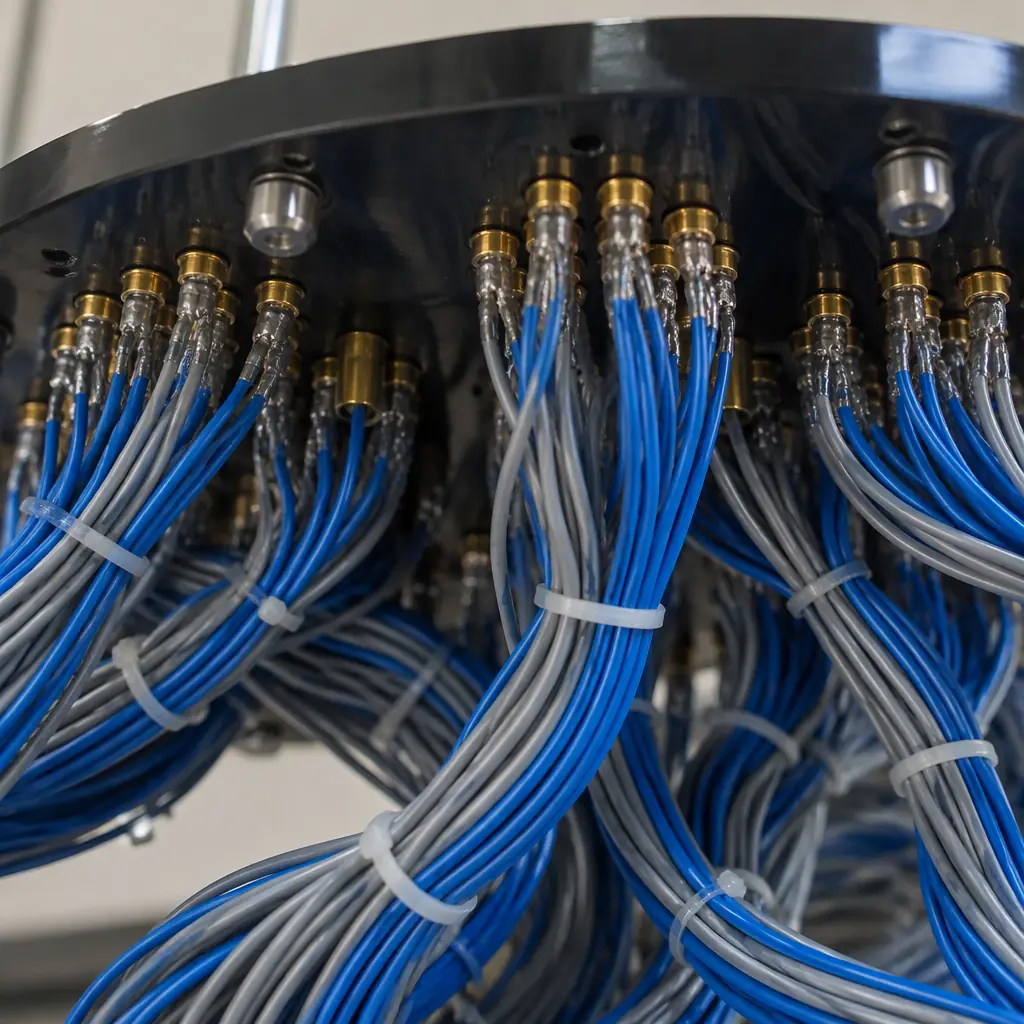
Who Owns the Fixture? Escrow, Transfer, and the Single-Supplier Trap
This is the question almost nobody asks at quotation and everybody wishes they had asked at the second sourcing round. A fixture built by a contract manufacturer for your board is, by default, the contract manufacturer's property. It sits on their floor, is maintained by their technicians, and runs their program. When you want to move the product, the fixture does not travel with it.
The commercial consequences are straightforward. Your negotiating position on the next round of pricing is weaker because qualifying a new supplier means paying fixture NRE again. Your lead time on a transfer is measured in weeks of fixture rebuild, not days of line setup. And in a dispute, you may find that the fixture you paid for is not something you can take possession of, because the cost was invoiced as a test service rather than as equipment.
Four clauses prevent this. They are short, and a supplier who operates a legitimate operation will accept all four without argument.
Ownership on the Invoice
The fixture shall be invoiced as a separately identified asset owned by the buyer, with the NRE line itemised apart from test service charges. This is a documentation change, not a cost change, and it is the foundation for everything else.
Data and Program Deliverables
The buyer receives the fixture program source, the netlist used, the probe map and the fixture mechanical drawings, on request and without additional charge. Without these, a fixture transferred to another supplier is a box of probes with no test logic.
Transfer and Escrow Terms
The supplier ships the fixture, or releases it to a nominated party, on request within a defined period. Where the fixture is held on the supplier's premises, an escrow arrangement covering the program and documentation should exist so that a supplier failure does not strand the test capability. Our tooling and design-file ownership guide covers the escrow structure.
Maintenance and Calibration Responsibility
The clause should say who replaces worn probes, at what interval, at whose cost, and what happens to probe substitution records when the fixture transfers. Worn probes are a coverage risk long before they stop working.

When Not to Build a Fixture
There are four situations where the arithmetic or the risk says no, regardless of volume.
- Design not yet stable. If ECO activity is still high or the schematic has a scheduled revision pending, wait. Every ECO after a fixture is built is a partial rebuild.
- Below roughly 1,500 units lifetime. Flying probe wins on total cost, and it carries no lock-in. Our flying probe versus ICT comparison covers the coverage trade-off in that decision.
- Boards with inaccessible critical nets. If the high-risk nets have no probe access, the fixture is testing the easy part and skipping the part that matters. Fix the layout first.
- High-mix, low-volume portfolios. Ten products at 800 units each do not justify ten fixtures, and one fixture shared across variants usually fits none of them.
Two board families that consistently justify fixtures: automotive and medical assemblies where class 3 inspection and 100% test coverage are contractual, and high-volume consumer boards where a 22-second test versus a 156-second test pays back the NRE within the first production batch. Our test strategy and coverage planning guide covers how to build the overall plan around whichever route you pick.
Summary: Price the Commitment, Not the Line Item
ICT fixture cost is a function of node count, board size, netlist quality and program complexity, and only two of those have anything to do with the test supplier. The commercial decision is not whether the fixture is affordable; it is whether the volume and design stability justify front-loading NRE against a per-board saving of roughly USD 3.35. Get that arithmetic right and the fixture is the cheapest test you will ever run. Get the ownership clauses wrong and it is the most expensive thing on the floor.
At Huaxing PCBA we run ICT, FCT and flying probe in-house with fixtures built and programmed against a DFM-audited test-point set, on boards up to 32 layers, under IATF 16949 and ISO 9001. Fixtures are invoiced as buyer-owned assets with program source and probe map delivered on request. Read our NRE and tooling cost guide for how fixture NRE sits alongside stencil and programming charges, or send your Gerbers and BOM for a test-plan quotation.