
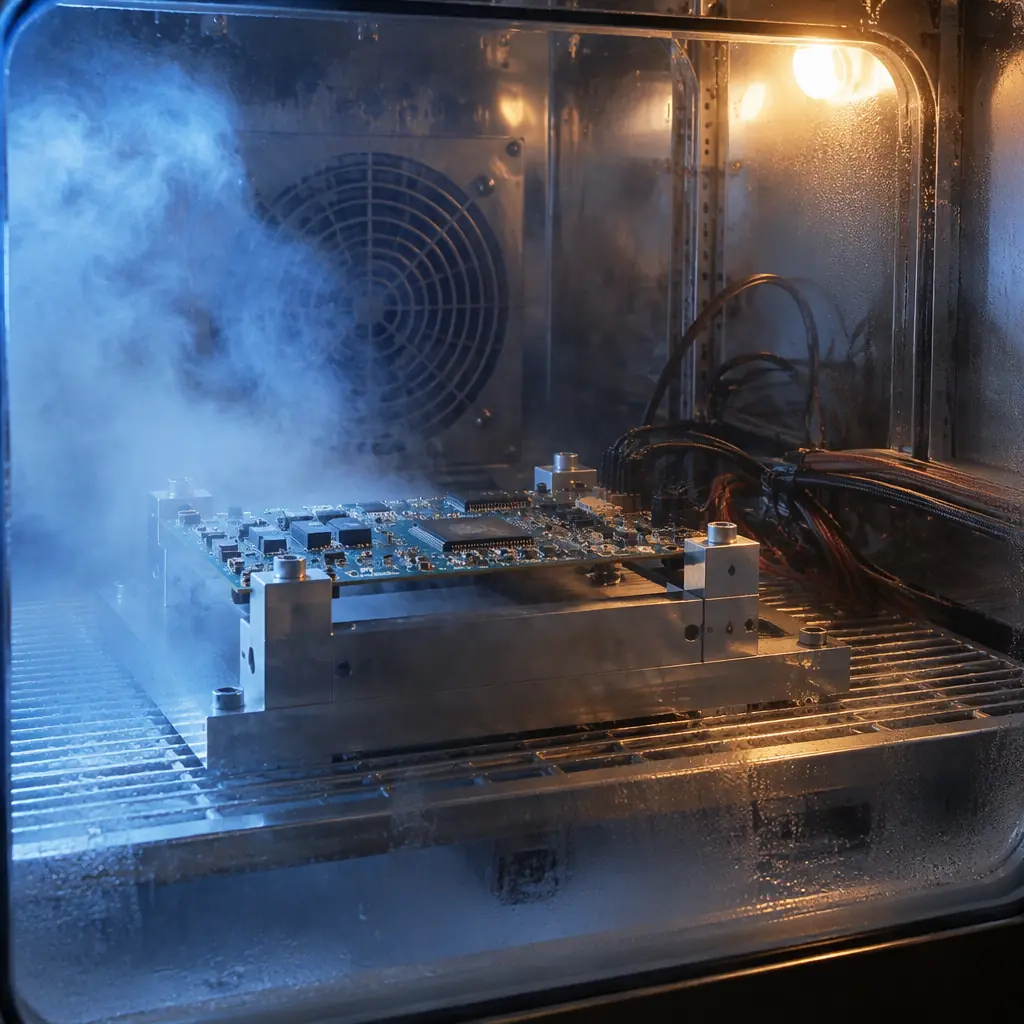
Most programs that buy a reliability test buy the wrong one first. HALT is commissioned, a chamber is booked, the assembly is driven to destruction, a report arrives with four margin figures, and then nothing happens — because no one decided in advance what margin would be enough, or what production would screen against once the number was known. HALT without a screen limit is an expensive report. HASS without a HALT-derived limit is an equally expensive way to damage good product.
The two tests answer different questions. HALT asks how much margin does this design have, using a handful of units and no pass/fail criterion — the test runs until something breaks. HASS asks is this unit built correctly, using every unit or a sample from every lot, with limits that must be derived from the HALT result. Getting the second from the first is arithmetic, not judgement, and it is where most programs break down.
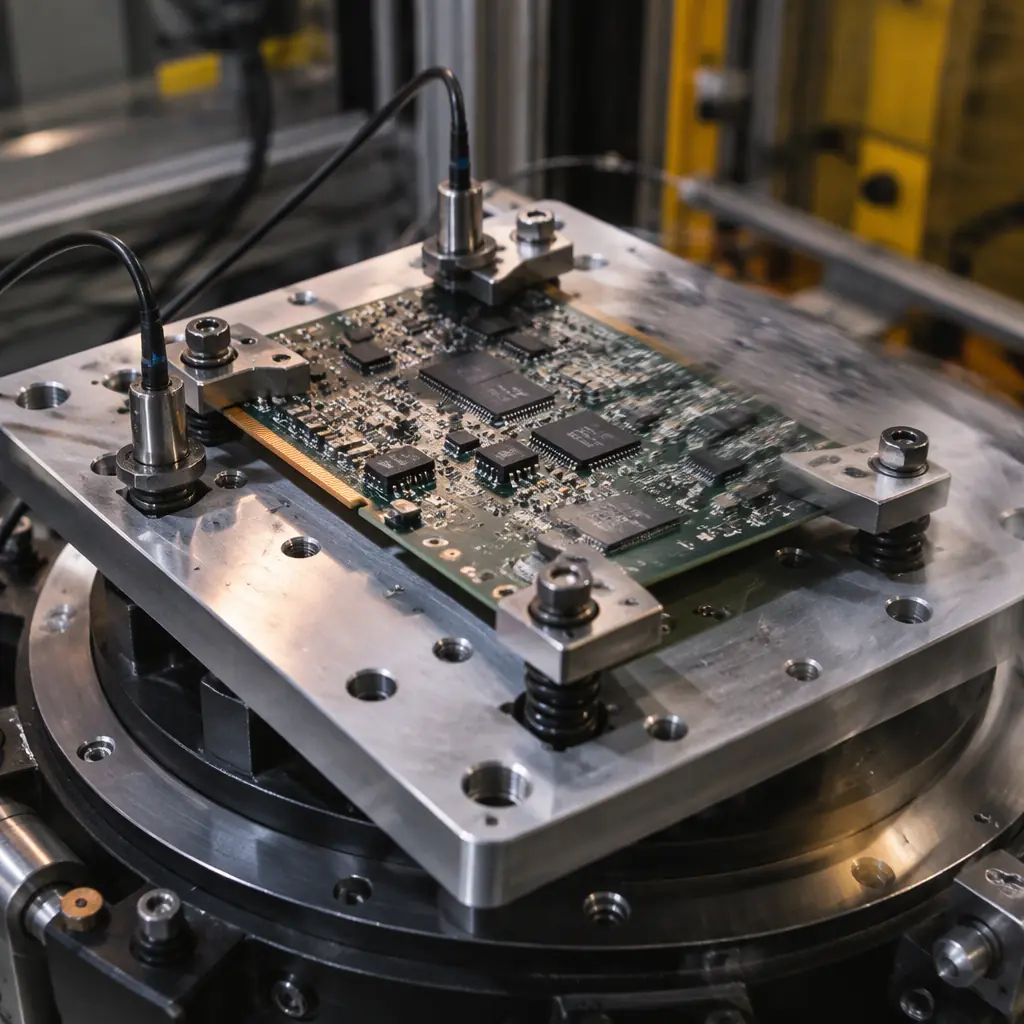
HALT and HASS in Brief
HALT (Highly Accelerated Life Test) is a development-stage test. A small number of units are subjected to progressively harsher thermal and vibration stress until a failure occurs, then the failing item is analysed and the test continues to find the next limiting mode. The output is a set of operating and destruct limits. HASS (Highly Accelerated Stress Screen) is a production-stage screen. Every unit, or a sample per lot, is exposed to stress levels comfortably inside the HALT limits — high enough to precipitate latent defects, low enough that a good unit is not consumed.
The one-sentence distinction: HALT finds the wall; HASS runs production against a line drawn short of it. If the line was never calculated from the wall, you are guessing in both directions.
What HALT Produces: Four Margins
A HALT campaign reports limits per stress axis, not a single reliability number. The four axes below are the standard set, and each yields an operating limit (no failure) and a destruct limit (permanent failure or the chamber's own ceiling).
| Stress axis | Typical starting range | What usually fails first | Design lever |
|---|---|---|---|
| Cold step | +20 °C down to −60 °C or lower | Electrolytic capacitor ESR, crystal start-up | Component temperature rating, heater placement |
| Hot step | +20 °C up to +150 °C or higher | Solder joint fatigue, plastic creep, connector retention | Thermal path, derating, alloy and finish choice |
| Rapid thermal transition | 40–70 °C/min between extremes | CTE mismatch at large SMT parts, BGA corner joints | Underfill, compliant terminations, laminate choice |
| Vibration (6-axis, stepped) | From 5 Grms upward in steps | Large components, connector bodies, board resonance | Mounting, stiffening, mass reduction, staking |
Treat those figures as starting points, not targets. The number the test produces is specific to the design, the mounting and the chamber, and a report that reproduces generic values has probably not tested anything.
The Margin Rule: When to Stop
The reason programs stall after HALT is that nobody defined "enough margin" before the test started. Two stop criteria work in practice.
The specification-plus-margin rule
Stop when the operating limit is at least a fixed margin beyond the product's own specification, on every axis. A commonly used working margin is 10 °C of thermal headroom below the cold spec and above the hot spec, and roughly 5 Grms additional random vibration beyond the specified profile. Where the specification is wide, the margin test is usually satisfied easily; where it is tight, it exposes a design that has almost no headroom.
The fundamental-limit rule
Stop when the failure mode is no longer fixable within the design — the laminate is charred, the semiconductor junction is destroyed, or the chamber has reached its ceiling. The last failure before an unfixable one is the design's real limit, and that limit defines the HASS window. For a broader treatment of how thermal cycling conditions are chosen, see our guide to thermal cycling testing.
Record both. A program that reports only "the design has 20 °C of margin" has thrown away the information needed to build the screen.
HASS: Deriving Screen Limits from HALT
The screen limit is not a percentage of the destruct limit picked at random. The standard construction is to take the operating limit and subtract a guard band, so that the screen stresses a good unit far below the point where the design itself begins to degrade, while still exceeding anything the field will produce.
Worked example on a thermal axis. The product specification is −20 to +70 °C. HALT finds the lower operating limit at −45 °C and the upper at +120 °C. A guard band of 20 °C from each operating limit gives screen limits of −25 °C and +100 °C. Check both conditions: the screen must be beyond the specification (−25 °C is 5 °C beyond −20 °C; +100 °C is 30 °C beyond +70 °C — both satisfied), and it must sit well inside the operating limit (20 °C of headroom on each side). That screen precipitates weak units without reaching the design's own limit.
| Parameter | Value in worked example | Rule |
|---|---|---|
| Specification range | −20 to +70 °C | From the product datasheet |
| HALT operating limits | −45 °C / +120 °C | Measured, not assumed |
| Guard band | 20 °C each side | Typical 15–25 °C; larger for critical programs |
| HASS screen limits | −25 °C / +100 °C | Operating limit minus guard band |
| Verification | Beyond spec, inside operating limit | Both conditions must hold |
The same arithmetic applies to vibration with a guard band expressed in Grms. What it does not survive is a screen limit inherited from a previous program's report — the HALT limits belong to the specific design, mounting and build, and a limit copied across is a limit that has never been validated.
A screen that is too aggressive shows up as a rising fall-out that does not decline, plus damage isolated to the screen itself: cracked joints on parts that passed functional test, intermittent connectors, or moisture-driven failures from condensation on each thermal transition. Where the failures look like the ones in our HTOL thermal ageing write-up — a slow drift rather than an abrupt break — the screen is likely precipitating genuine defects rather than causing them.

Sample Size and Cost per Regime
The choice between the two is usually decided by volume and by what the program is trying to prove — not by which test is "better".
| Regime | Units | Duration | What it proves | Where it fits |
|---|---|---|---|---|
| HALT | 3–6 per axis, can be reused until destructive | 1–2 weeks including setup and analysis | Design margin and failure modes | Design stage, before tooling release |
| HASS, 100% screen | Every unit | Minutes to hours per unit | Each unit has no latent manufacturing defect | High-value, low-volume builds |
| HASS, lot sample | Sample per lot | Minutes per unit, amortised over lot | Process control across the lot | Mid-volume production |
| Burn-in / ESS | 100% or sample | Hours at elevated temperature | Early-life failure removal | Where HASS equipment is not economic |
| ORT (ongoing reliability) | Sample per interval | Days to weeks | Design still meets spec after process drift | All volumes, requires no HALT |
Cost per unit falls as volume rises, but the fixed cost of HASS — chamber time, fixtures, a validated limit set, and a disposition rule for failures — does not. On a program of a few hundred units a year, the ongoing reliability test is often the more defensible spend, and it requires no HALT-derived limits at all. Both the burn-in and ESS route and the ORT route are covered in burn-in and ESS testing.
When HASS Is the Wrong Answer
Three situations make HASS a net negative, and all three are common in custom PCBA work.
Low volume, high mix
If each build is a different design, the HALT-derived limits change every time and the fixed cost never amortises. A screen validated for one build is not valid for the next, and running it anyway applies unvalidated stress to product that has never been characterised.
Single-lot or prototype programs
HASS is a process control tool. A one-lot program has no process to control — the useful spend is a first-article inspection and a functional test at temperature, not a screen against limits derived from a HALT that was never run. Our qualification report review guide covers what to accept in place of a full reliability package.
Where the failure mode is wear-out, not latent defect
HASS precipitates defects that exist in the unit now. It cannot find a wear-out mechanism that needs 10,000 hours at temperature to develop — that is the domain of HTOL and of accelerated life testing. Applying HASS to a wear-out problem produces passes and a false sense of coverage; see our failure analysis guide for how to determine which mechanism you are actually chasing.
Procurement note: when a supplier offers "HALT/HASS testing" as a line item, ask which one, on how many units, and whether the HASS limits were derived from that design's HALT operating limits with a stated guard band. An answer of "we run both" without a limit derivation is a service description, not evidence.
Summary
HALT is a development tool that produces four margins and a failure-mode list; HASS is a production screen whose limits must be calculated from those margins minus a guard band. The arithmetic is simple — operating limit minus 15–25 °C, verified to sit beyond the specification and well inside the design limit — and it is the step most programs skip. Where volume is low and the mix is high, the defensible alternative is ongoing reliability testing rather than an unvalidated screen.
At Huaxing PCBA, reliability programmes are built around the evidence the product actually needs: thermal cycling and HTOL for wear-out mechanisms, functional test at temperature for first articles, and cross-section and failure analysis when a qualified lot drifts. If you are writing a test plan or reviewing a supplier's reliability package, send the specification and the target volume and our engineering team will come back with the regime and sampling that fits — within 24 hours.