
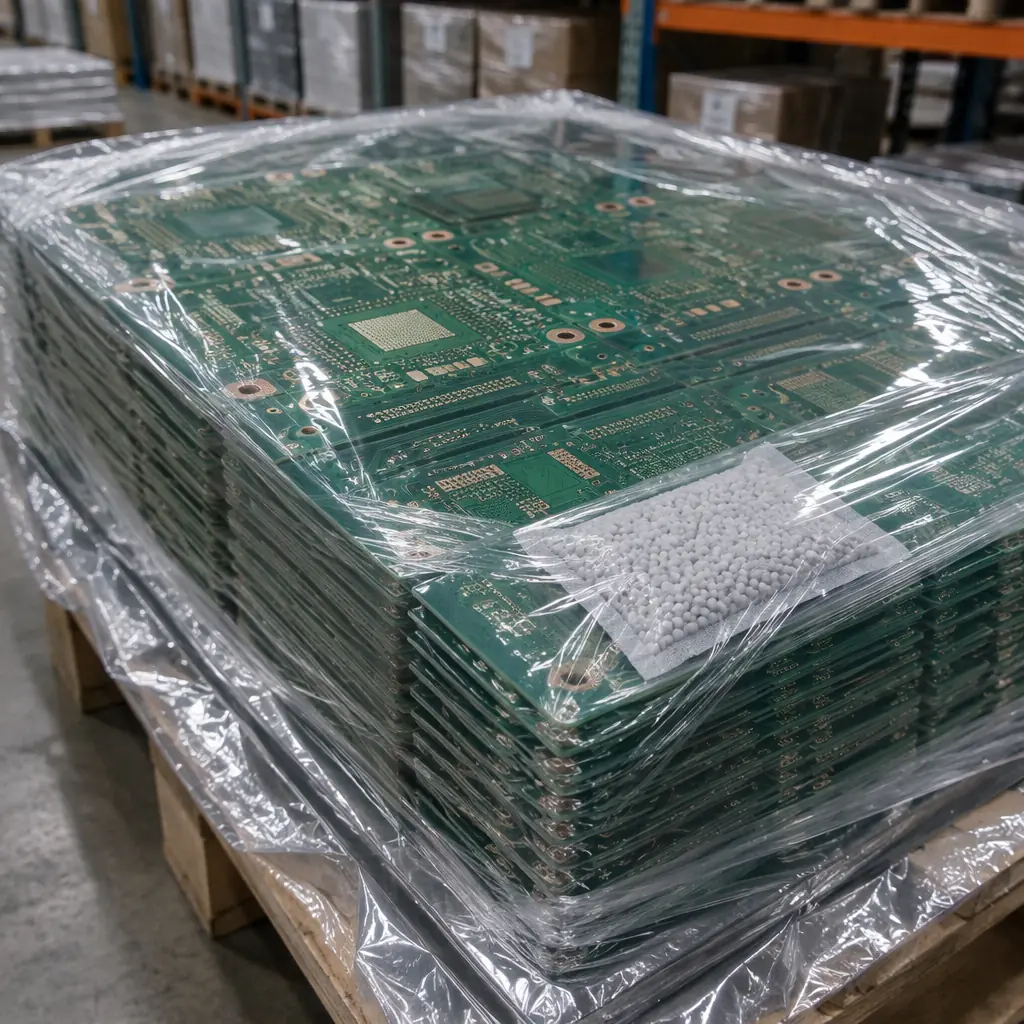
A bare board is not finished when it passes final inspection. Between the fabricator's outgoing check and the first board entering an SMT line, a PCB passes through vacuum packing, a freight forwarder, a customs bond, a receiving dock, an incoming inspection bench, a warehouse shelf, a kitting cart and a loader. Any one of those steps can turn a board that met specification into one that will not wet, will not sit flat, or will not clamp in a fixture. The scrap that results is real, it is common, and the argument about who pays for it usually starts with no data on either side.
The reason the argument is hard is that handling damage does not look like damage. Nobody drops a pallet of boards and hands over a shattered box. What happens is a stack that sat open in a humid warehouse for three weeks, a magazine that was pushed rather than lifted, a bag that was opened and resealed without desiccant, and a board with a slightly whitened edge that delaminates in reflow. Each of those leaves a board inside dimensional tolerance and outside process reality, and each leaves the receiving party holding a defect that the fabricator's final inspection record correctly says did not exist when the boards shipped.
This page covers what actually degrades a bare board after fabrication, how each damage mode presents on the line, how responsibility is normally apportioned under standard terms, and what a purchase order and a goods-in routine need to contain so that the answer is decided before the boards arrive. The fabrication side of the tolerance question is covered in PCB manufacturing tolerances, and the packaging specification in PCB packaging and transit protection.
What Actually Damages a Bare Board After Fabrication
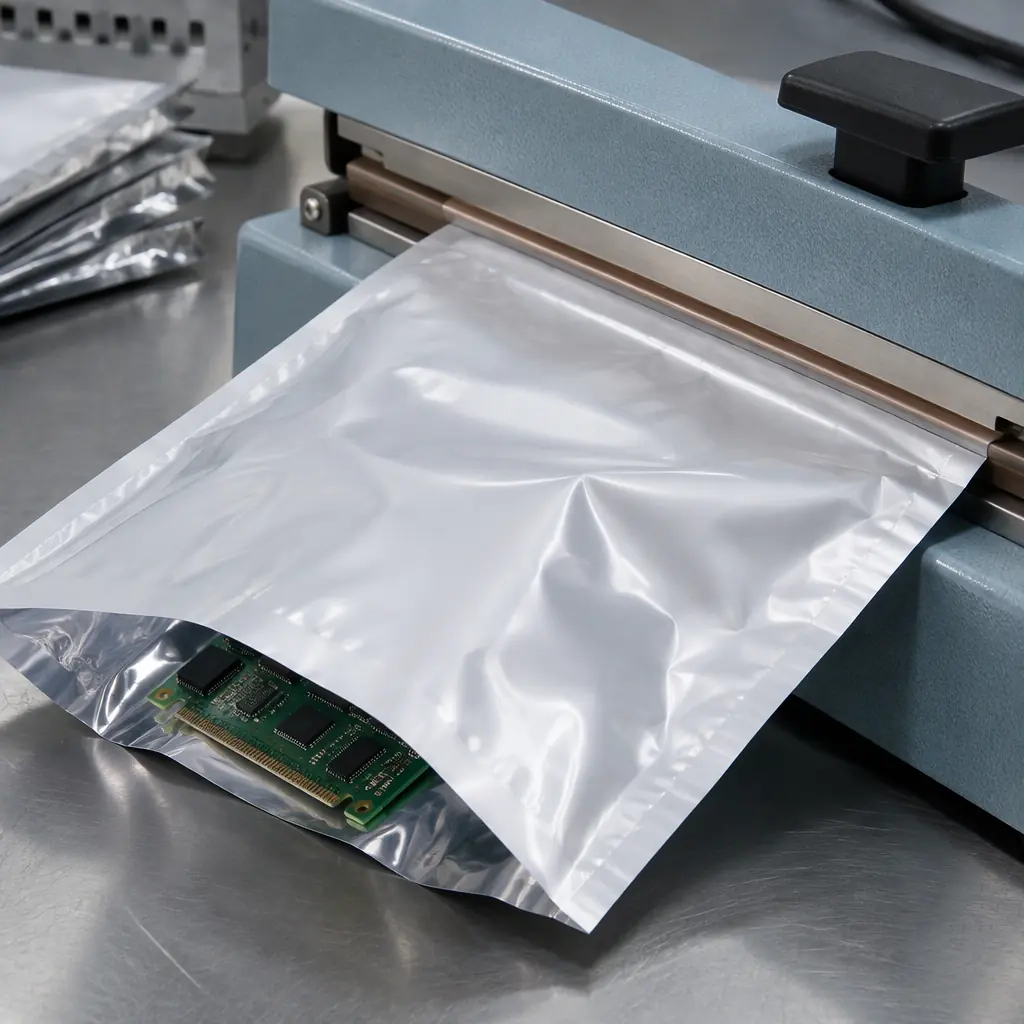
The seal is the product. A bag reopened to check a count and resealed without a fresh desiccant pack is no longer a moisture barrier.
Five mechanisms account for most post-fabrication damage, and they are worth separating because each has a different responsible party and a different fix.
Surface oxidation is the most common and the least visible. Copper, and to a lesser degree the finish over it, oxidises in air. OSP finishes are designed to be consumed in the first reflow and have a limited shelf life measured in months; ENIG and immersion tin are more stable but not inert; bare copper becomes very difficult to solder within days of exposure. Oxidation accelerates sharply with humidity and temperature, so a pallet that crosses the equator in an unpressurised container, or a carton that sits on a dock in a monsoon season, ages months in weeks. The visible signature on the board is a dulled or discoloured finish, but the functional signature appears only at soldering: poor wetting, non-wetting on some pads and not others, and a joint yield that falls across the lot rather than at random. The mechanism at the joint is discussed in flux activator depletion.
Moisture absorption by the laminate is the second and the most expensive. FR-4 absorbs water, and absorbed moisture flashes to steam at reflow temperature. On a thin board or a large panel the result is measurably more warpage through the oven; on a board with a large area of copper or a thick stackup it can produce blistering or delamination between layers. The standard control is baking before assembly, which works but costs an oven cycle and a handling step, and which is impossible to schedule if nobody knows the boards were exposed. Moisture sensitivity and baking schedules for boards are covered alongside component moisture control in the MSL moisture sensitivity guide, and the storage specification in PCB storage and moisture control.
Edge and corner damage is the third. De-panelised boards have routed or V-scored edges, and those edges are the most fragile part of the board. Fibreglass fibres at a routed edge are exposed and will absorb moisture and can wick flux; a chipped edge on a thin board can propagate a crack into the laminate; a corner that has been knocked exposes copper at the edge plating. The damage is caused by magazines that are overloaded, by boards slid rather than lifted from a stack, by cartons packed without interleaving, and by depaneling that was done by hand with a tool rather than in a fixture. What makes edge damage commercially awkward is that it is usually visible and usually arguable: the fabricator can show a routed edge within tolerance at shipment, and the assembler can show a chipped one at receipt, and neither can prove when it happened.
Physical contamination is the fourth: fingerprints, solder resist flakes from a poorly cured board, dust from a warehouse, and adhesive residue from labels applied and removed. Fingerprints are the most underrated of these because the salts and oils in skin are mildly corrosive on copper and can cause localised non-wetting that looks like an oxide problem in a specific area of the board. A board handled without gloves in receiving and then baked is a board that has baked its fingerprints on.
Electrostatic damage is the fifth and it is the one that produces defects nobody attributes to handling. A bare board with no components is far less sensitive than a populated one, but boards carrying fine traces, thin dielectric layers and, in some cases, embedded components or resistive films are not immune. Damage from a discharge during handling is often latent: the board passes all electrical tests and fails in the field. ESD control practice for board handling is set out in PCB ESD control programs and the packaging side in ESD packaging standards, and the point to note for this article is that ESD damage is nearly impossible to attribute retroactively.
Key takeaway: Almost every post-fabrication damage mode is invisible at the moment it happens and only surfaces as a process failure weeks later. That is why the controls are packaging, records and receiving discipline rather than inspection alone.
How Each Damage Mode Presents on the Line
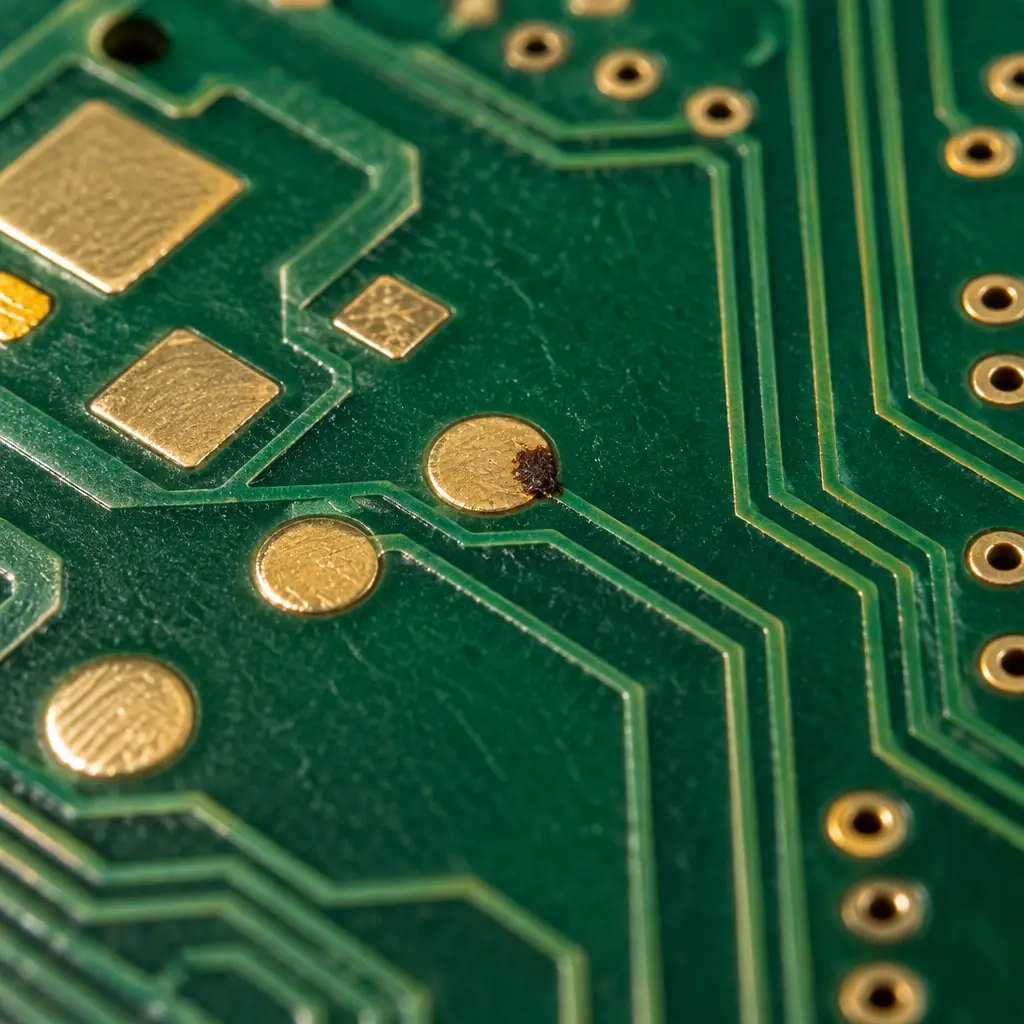
Localised corrosion on a pad is the fingerprint of contamination, not of general ageing. General ageing dulls the whole lot evenly.
The reason a receiving inspection rarely catches handling damage is that the functional consequences appear at soldering, not at inspection. A useful discipline is to know what each mode looks like on the line, so that a defect trend can be traced back to the handling step rather than to the process.
| Damage mode | What the line sees | Where it concentrates | First thing to check |
|---|---|---|---|
| Surface oxidation | Poor wetting, dull joints, higher paste activity needed | Uniform across the lot, worse on older stock | Bag seal integrity and lot date vs open date |
| Absorbed moisture | Warpage, blistering, delamination after reflow | Large panels, thick boards, first boards after a weekend | Storage humidity log and whether baking was done |
| Edge and corner chips | Edge plating damage, laminate cracks propagating inward, cosmetic rejects | Corner boards in the magazine, boards from the bottom of the stack | Magazine condition and how boards are removed |
| Contamination | Localised non-wetting or solder balling in a pattern that matches handling | Areas near board edges or where fingers go | Glove discipline and label residue |
| ESD damage | Latent electrical failures, no visible sign | Random, often field returns | Packaging type and receiving bench grounding |
Reading that table against a live defect trend usually identifies the mechanism within a shift. A wetting problem that gets worse as the lot is used is oxidation. A warpage problem that appears on Monday mornings after the plant has been closed for two days is moisture. A chip problem that concentrates on boards from the bottom of a stack is packing and handling. A non-wetting problem in a stripe across one side of a board is a fingerprint, because that is where a hand held it.
For panel-level handling specifically, the way boards are separated and the fixtures used to hold them also determine how much handling damage a build accepts. Depanelisation method, support and edge clearance are covered in the PCB depaneling guide, and the process carriers in solder pallets and process carriers.
Apportioning Responsibility Without a Fight
Under most standard conditions of sale, risk passes to the buyer at the point of shipment, and the fabricator's obligation is to deliver boards that conform at that point. That is a defensible commercial position and it produces the outcome where almost every post-shipment failure belongs to the buyer unless the buyer can prove the cause predated shipment. That proof is difficult for oxidation and nearly impossible for edge chips, which is why handling damage so often becomes a cost the buyer absorbs quietly.
There is a second layer to the problem on custom fabrication. A bare board is a bespoke product, frequently with a tooling investment and a minimum order quantity attached, and a scrapped lot cannot usually be replaced quickly from stock. A board lot that oxidises in storage is not just a loss of material, it is a schedule problem and a possible expedite premium, and both belong in the analysis. The economics of custom tooling and minimum quantities are covered in the MOQ and cost guide, and the general mechanics of scrapping in engineering change scrap cost.
The practical answer is not to argue about cause after the fact but to move the boundary forward. Three measures do most of the work. First, define the receiving standard and inspect against it at goods-in, with photographs, so that a defect is documented at the moment of receipt rather than discovered at the SMT line. Second, specify packaging and shipping conditions in the purchase order, including moisture barrier packaging with desiccant and humidity indicator, so that a badly packed shipment is a nonconformance at receipt regardless of what happens later. Third, require that the board carry a date code and that a baking decision be driven by documented exposure rather than by guesswork. Boards-inspection practice, including what to sample and what to retain, is covered in incoming quality inspection.
What the Purchase Order Should Say
The clauses below are written to be inserted into a purchase order for bare boards or as a schedule to a supply agreement. They do not transfer risk unfairly; they define what each party is responsible for documenting, which is what makes the risk allocation enforceable.
The supplier shall pack every shipment of bare boards in sealed moisture barrier packaging with a desiccant quantity appropriate to the package volume and a humidity indicator card visible without opening the package. The supplier shall mark each board or inner package with a date code and shall state on the certificate of conformance the date code, the surface finish, and the recommended storage and reflow window. The supplier shall not open, reseal or repack finished boards after final inspection without recording the exposure. The buyer shall inspect each lot at receipt against the specified dimensional, visual and packaging criteria, and shall record the inspection before the boards enter assembly stock. Boards that fail the receiving inspection shall be reported to the supplier within ten working days of receipt, with photographs and the package state as found.
The buyer shall store bare boards in the original sealed packaging in an environment of not more than 60 percent relative humidity, and shall record the date each package is opened and, where the package is not consumed in a single shift, the time it spends open. Where a package has been open beyond the period stated on the certificate, the boards shall be baked in accordance with a documented schedule before use, and the bake shall be recorded against the lot. Boards subject to handling damage in the buyer's processes shall be dispositioned under the buyer's nonconforming product procedure.
The two sentences that change outcomes are the packing requirement and the inspection deadline. The packing requirement gives the buyer a defined standard to reject against at the dock, which is the only point where the evidence is still intact. The ten working day reporting window is what makes a later claim credible, because a claim raised three months after receipt is a claim with no package to inspect and no humidity indicator to read. The disposition framework for boards that are rejected or granted use-as-is is set out in PCB waiver and deviation control, and the way a gap between specification and capability is handled before it reaches a build is in engineering change scrap cost.
Handling at the Assembler's End
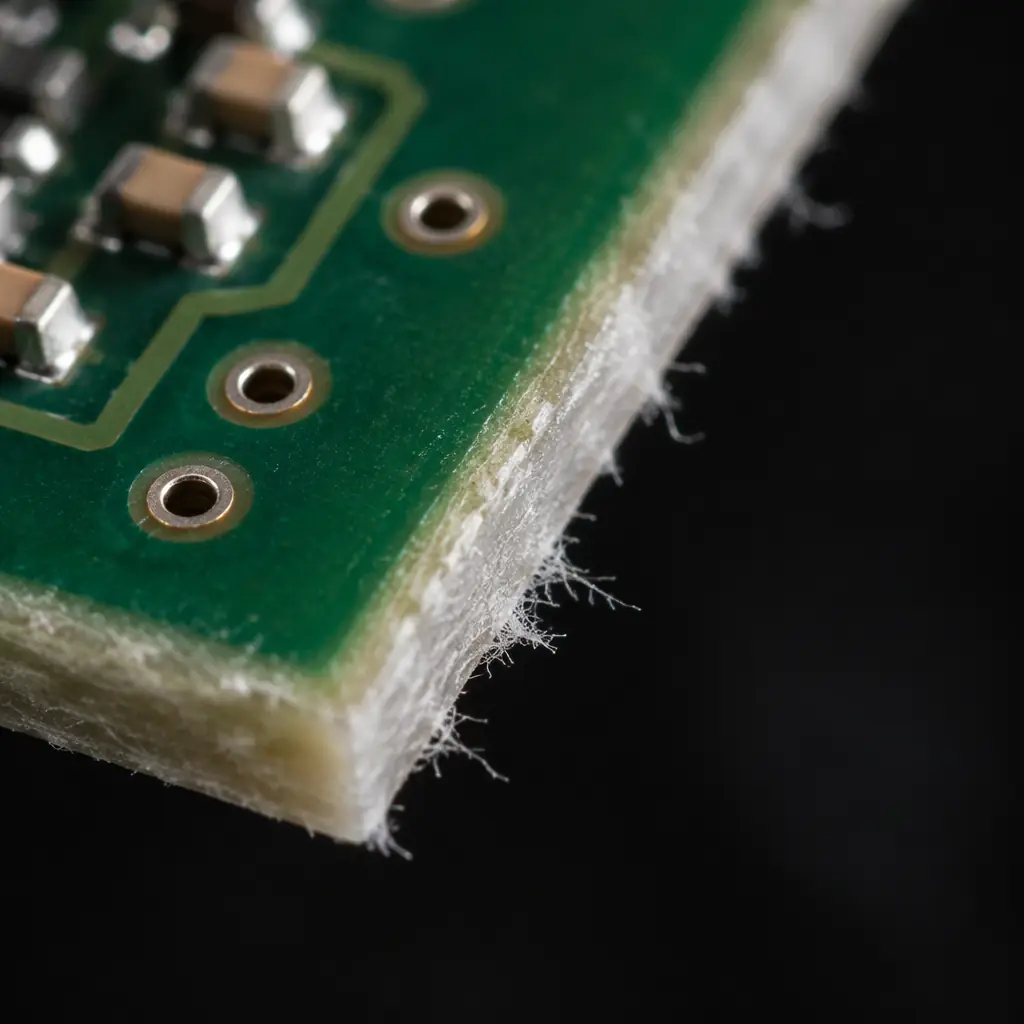
Exposed edge fibres from routing and hand depaneling wick moisture and flux. A clean edge is a handling and tooling result, not a finishing result.
A large part of bare board damage happens inside the assembly plant, and it is generally cheaper to fix there than to argue about it with a fabricator. Three regimes cover most of it.
The first is receiving and storage. Boards should be logged at receipt with date code and package condition, stored on racking rather than on the floor, kept in a stable humidity environment and opened only when they are about to be used. The single most common control failure is a package opened for a sample count and resealed by folding the film over rather than by heat sealing, which silently converts a moisture barrier package into a cardboard box.
The second is handling discipline. Boards being moved from a magazine to a line should be lifted at the board body with gloved hands rather than slid, magazines should be loaded within their rated capacity, and boards should never be stacked directly on each other without interleaving. Where boards are handled in a cleanroom or a controlled area, the glove and ESD requirements of that area should apply to bare boards as well, which is not always the case in practice.
The third is the bake decision. Baking is effective and it is easy to over-apply: repeated bakes oxidise an OSP finish and can degrade some surface finishes, so a bake that is used as a blanket response to any doubt ends up creating the oxidation problem it was intended to prevent. The right practice is a documented exposure record that drives a bake only when the threshold is met, which is the same discipline the purchase order clause asks the buyer to keep. Where boards are baked, the bake should be recorded against the lot so that a later wetting problem can be traced to a bake or the absence of one rather than guessed at.
A Realistic Scrap Budget
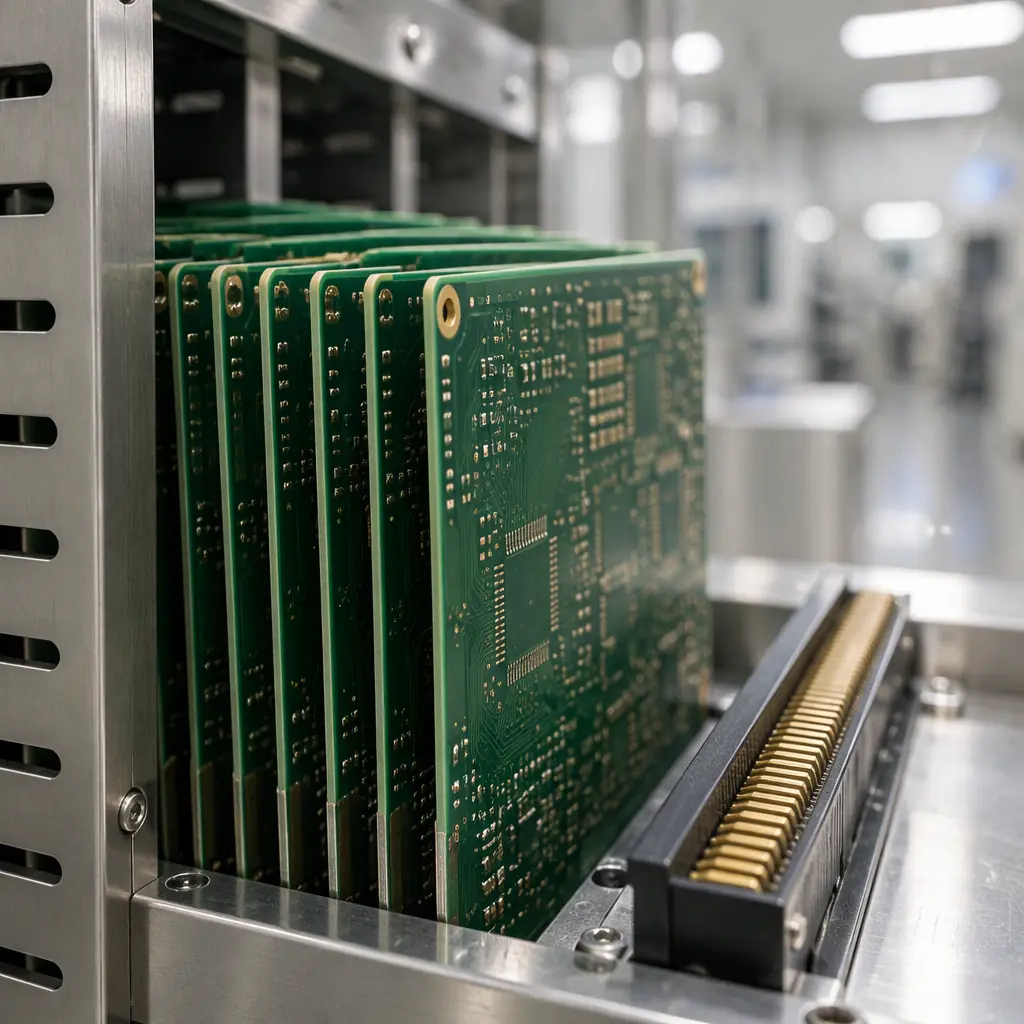
Magazines are where handling damage concentrates: at the slots, at the corners and wherever a board is levered out rather than lifted.
Buyers tend to budget bare board scrap as a small percentage and then discover it is not small when a lot goes bad. The useful way to think about it is by mechanism rather than by average.
Oxidation scrap is usually a whole-lot event rather than a board-by-board one, because oxidation is a whole-package phenomenon. A lot that has aged out is not 3 percent defective, it is unusable, and the cost is the lot value plus the schedule impact. Moisture scrap is typically concentrated at the start of a run, on the first panels through the oven after the boards have been opened, which makes it visible and manageable if the bake routine is followed. Edge and corner damage is genuinely marginal, with a small percentage of the lot affected and the affected boards concentrated at the extremes of the stack. Contamination is a low-rate, high-visibility problem that is easy to trace because it is patterned. ESD damage is the outlier: invisible, rarely attributed, and potentially a field failure rather than a line failure.
The budgeting consequence is that the average scrap rate is the least useful number. What matters is which mechanisms exist in a given supply chain and how much of the lot each one can take out at once. A build with a sealed package, a receiving inspection and a bake threshold has a scrap exposure in the low single digits and mostly at the margin. A build with a folded-over bag, a dock-side store and no opening log has a whole-lot exposure it has not priced. Control of the laminate and finish quality on the fabrication side, which is the supplier's half of the same problem, is covered in the PCB materials guide and the surface finish selection guide.
Where the Scrap Boundary Should Sit
A bare board leaves the fabricator in specification and can still be unusable at the SMT line, and the gap is almost always created by packaging, storage and handling rather than by fabrication. Oxidation, absorbed moisture, edge damage, contamination and ESD each leave a distinct signature on the line, and each points back to a specific handling step once the signature is recognised.
The commercial fix is to move the boundary forward: define the packing standard in the purchase order, inspect and photograph at receipt, keep an opening and exposure log, and bake on a documented threshold rather than on doubt. A buyer with those records can apportion a scrap event in an afternoon. A buyer without them absorbs it.
At Huaxing PCBA bare boards are shipped in sealed moisture barrier packaging with desiccant and a humidity indicator, date-coded on the inner package, and stored in a humidity-controlled area with an opening log before they reach an SMT line. For a build where board storage across a long programme is the concern, the storage control scope covers the environment and the bake thresholds, and packaging and transit protection covers the shipment side. To price a programme that includes both fabrication and assembly with a single handling chain, send the Gerber and BOM through the quote form and the quote will state the packaging, storage and bake regime the boards run under.