
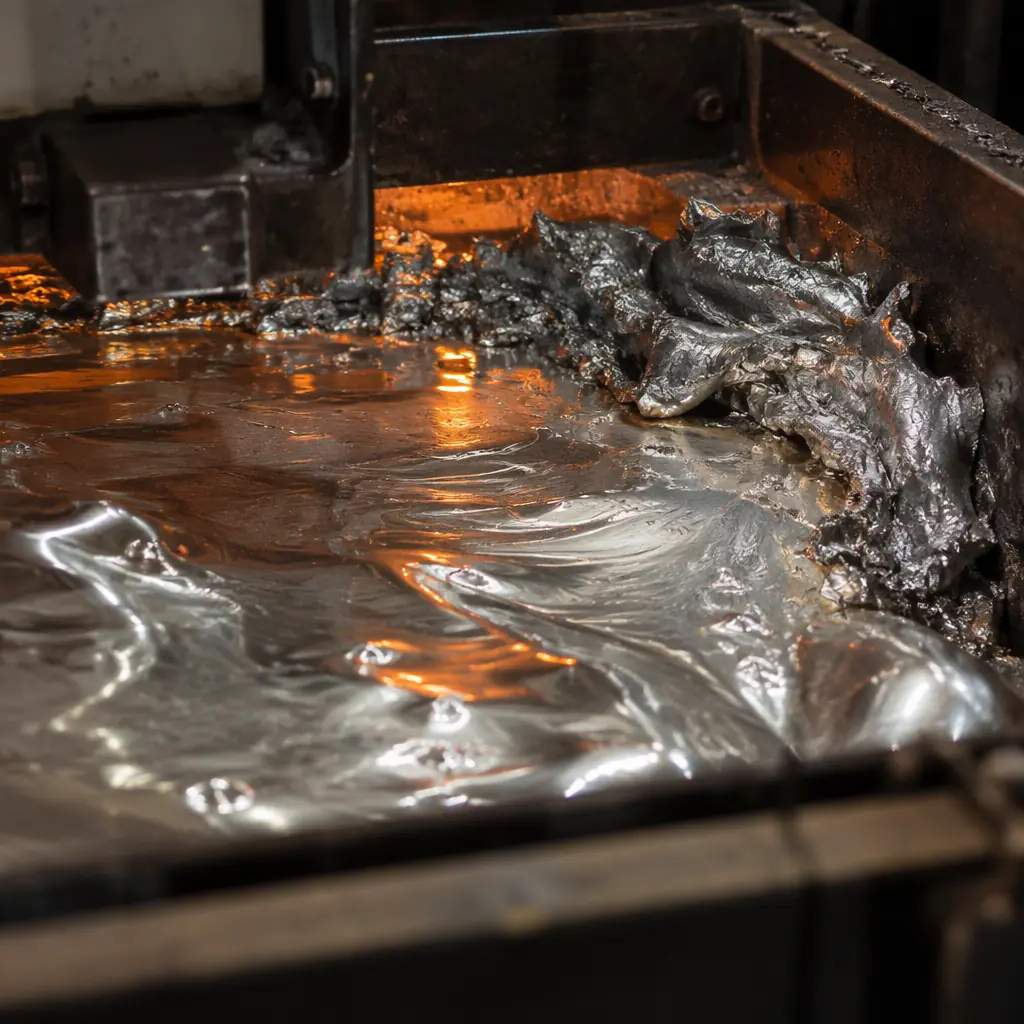
A contract assembler quotes a wave solder build by the joint, the panel or the hour, and somewhere in that number is a metal loss the buyer never sees itemised. It is the solder that oxidised on the surface of the pot and was skimmed into a bucket. On a pot running SAC305 at 260 degrees with no atmosphere control, that loss commonly lands between 15 and 30 percent of the alloy consumed, and on a small pot with a wide open surface and infrequent skimming it can run higher. None of it goes into a joint.
Dross is usually presented as an act of nature, a raw material surcharge that every supplier pays and every buyer absorbs. It is not a fixed quantity. It responds to alloy choice, pot surface area, bath depth, wave height, skimming routine, flux chemistry, the ratio of running hours to idle hours, and whether the pot sits under a nitrogen blanket. A buyer who knows which of those levers the supplier controls can ask a question that gets a number instead of a shrug, and can put that number in a purchase order.
This page covers what dross physically is, why the practical rate matters more than the quoted one, how each process variable moves it, what a metal audit looks like on a real build, and how a purchase order should codify the whole thing. The mechanics of the wave process itself, including flux application, preheat and contact time windows, are set out in wave solder process control, and the choice between wave, selective and hand soldering is covered in wave vs selective soldering.
What Dross Physically Is, and Why the Alloy Matters to the Rate
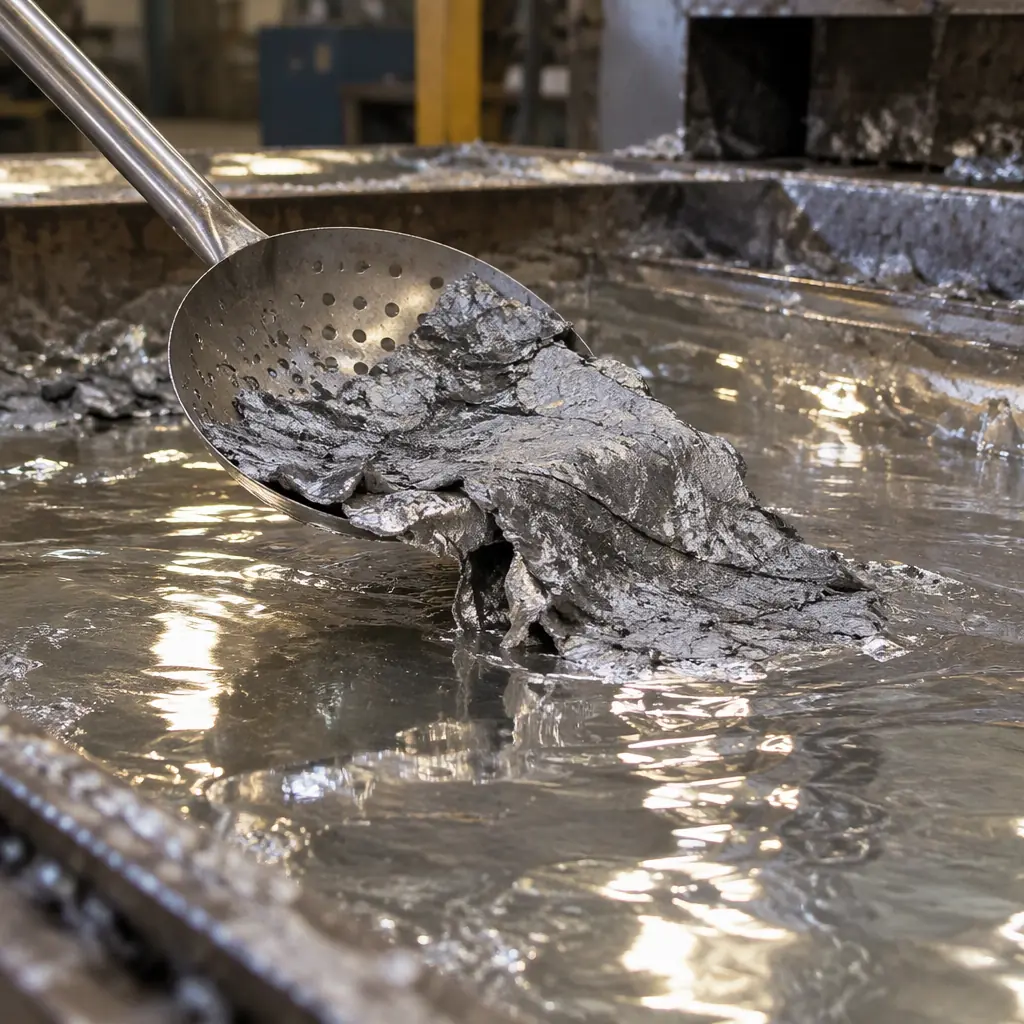
Skimmed dross is a metal-oxide and metal-entrapment mixture, not pure oxide. Roughly half the weight lifted off the pot is still usable alloy.
Molten solder in contact with air oxidises. The oxide forms a skin on the surface, the wave pumps fresh metal into that skin continuously, and the skin thickens until it is heavy enough to be removed or until it drags onto boards as solder balls and icicles. What comes off the pot on a skimmer is not the oxide alone: the oxide network traps a substantial fraction of liquid alloy inside its structure. Analysis of skimmed wave solder dross typically returns somewhere between 40 and 65 percent metal by weight, with the balance oxide and flux residues. That trapped metal is the reason dross has resale or recovery value, and it is also the reason dross weight is a poor proxy for true metal loss unless the metal content has been measured.
Alloy chemistry changes the rate in two ways. Tin is the most readily oxidised constituent, so high-tin alloys oxidise at a lower temperature than the leaded alloys they replaced: SAC305 at 217 to 220 degrees liquidus, against 183 degrees for Sn63Pb37, means the pot sits roughly 35 degrees hotter for the same superheat at the wave, and oxidation rate is exponentially sensitive to temperature. The second effect is copper. Dissolved copper in a SAC305 pot rises over time as boards are processed, because the copper pads and plated holes dissolve into the bath. Above roughly 1.0 percent copper the alloy's liquidus climbs and its fluidity drops, technicians respond by raising pot temperature, and the oxidation rate climbs with it. A pot whose copper is trending upwards has a dross rate that trends upwards a few weeks later, which is one of the reasons solder alloy verification and pot analysis are not housekeeping chores.
Lead-free conversion raised the baseline rate in most plants, and the industry response was twofold: better pot geometry and nitrogen. Neither is universal, and the buyer has no way of knowing which is in play without asking.
The Four Process Variables That Move the Rate
Given a fixed alloy, the dross rate is set mostly by four things, and all four are visible to a supplier's process engineer and invisible to a buyer receiving certificates. Asking about them is how a conversation about surcharges becomes a conversation about metal consumption.
Exposed Surface Area of the Pot
Oxidation happens at the surface, so the rate scales with the area of molten metal open to air, not with the volume of the bath. A 400 mm wide pot holding 300 kg of solder exposes roughly the same surface as a 400 mm wide pot holding 150 kg, and both oxidise at a similar rate per hour while the smaller one turns its inventory over twice as fast. This is why large pots are marginally more efficient per kilogram of throughput and why small pots in low-volume plants are dross factories. Pot size relative to the build is a legitimate question in a supplier audit.
Running Hours Versus Idle Hours at Temperature
Idle time is not free. A wave soldering machine left at set temperature overnight with the pump off still oxidises its surface, and a plant that runs two shifts of wave work and leaves the pot hot for the third shift pays for dross it never uses. Where the pot is idled, a lowered setpoint or a night-time idle program cuts the rate materially. A conservative supplier budgets metal consumption against total pot hours, not machine hours, which is a distinction the quotation rarely makes explicit.
Skimming Frequency and Technique
Two failure modes bracket this variable. Skim too rarely and thick oxide plates drag under the wave and land on boards as solder balls, bridges and icicles, converting a metal cost into a rework cost. Skim too aggressively and every pass lifts good alloy with the oxide, because the skimmer takes a layer of liquid metal along with the crust. The practical rule in a controlled line is skim when the oxide skin reaches a defined thickness, typically at the start of each shift and after any period of heavy board loading, using a skimmer that drains rather than a flat scraper that scoops, and never return skimmings to the pot. Dross rate per shift is a reportable number and a supplier with a written routine can produce it.
Nitrogen Blanket or Air
A nitrogen tunnel around the wave reduces oxygen at the surface and cuts dross generation substantially, with published and supplier-reported reductions in the range of 50 to 80 percent depending on enclosure quality and oxygen concentration achieved. It also improves hole fill on thick boards and reduces bridging, which is why most high-reliability wave lines run it. The cost is the nitrogen itself and the enclosure maintenance, and the trade points in different directions on different builds: on a high-volume through-hole heavy board the metal saving alone justifies it, on a low-volume mixed build with short runs the gas bill may not. Whether a supplier's pot is nitrogen-capable is a fair question and a clean one to ask.
Two secondary variables are worth knowing because they are often blamed for metal loss that they did not cause. Flux chemistry affects the surface film and can slow or accelerate oxidation at the pot edge, and a heavily activated water-soluble flux leaves more residue that reports into the dross weight. Solder bar quality matters too: bars with heavy surface oxide or voids add their own contamination, and a supplier buying on price alone may be feeding the pot poorer metal than the certificate suggests. Neither of these moves the rate as much as the four above, and both are easier to check after a metal audit than to argue about in advance.
Key takeaway: Dross rate is a process output, not a fact of physics. Pot surface area, idle hours, skimming routine and atmosphere together account for most of the variation between two suppliers running the same alloy on the same board, and all four are things a supplier can describe in writing.
Reading the Rate: Percent of Consumption, Not Percent of Weight
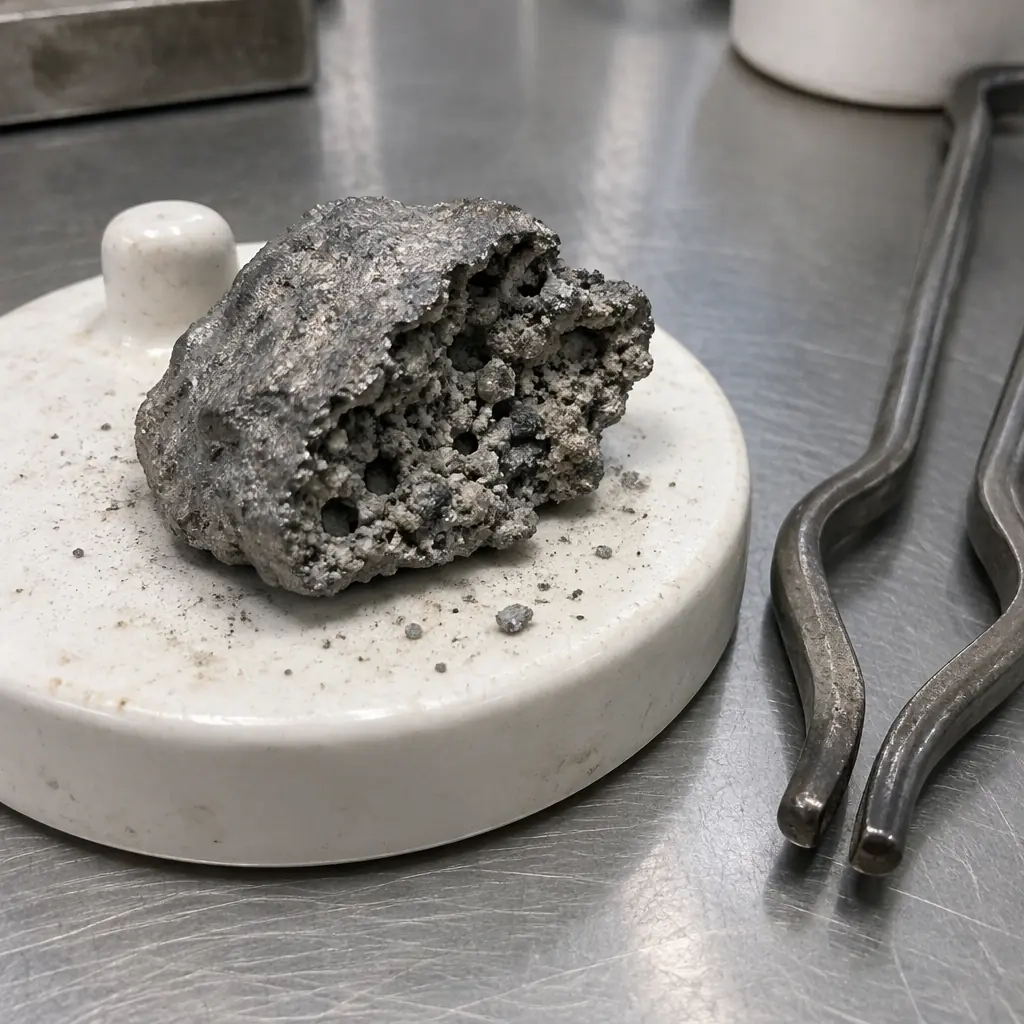
A broken dross lump shows the granular oxide interior. Weight alone overstates metal loss because the structure holds liquid alloy.
Dross is usually reported as a weight, which is the least useful form of the number. The meaningful metric is dross mass generated per unit of solder consumed over a defined period, because that ratio is what converts into cost per board. A workable formula for a monthly metal audit:
| Line item | How it is measured | What a healthy figure looks like | What a bad figure tells you |
|---|---|---|---|
| Solder bar consumed (kg) | Issue slips from the store, reconciled against the pot level at period start and end | Matches the BOM metal content within a few percent | Bars issued without slips, or pots topped up informally |
| Dross collected (kg) | Sealed dross drums weighed at collection | Consistent month to month on the same build | Wild swings between months with unchanged throughput |
| Dross as % of consumption | Dross collected ÷ solder consumed | Under 20 percent on an air pot, under 10 percent with nitrogen | Above 30 percent: check skim routine, idle program, pot temperature |
| Metal content of dross (%) | Assay from the dross recycler, or a lab sample | 40 to 65 percent metal by weight | Very low metal content means the skimmer is scooping clean alloy |
| Net metal loss (kg) | Dross weight × metal content | Half or less of the gross dross figure | Using gross dross as the loss figure overstates the cost and hides the real one |
| Copper trend in the bath | Spectrographic bath sample, weekly or per alloy top-up cycle | Below roughly 0.9 percent for SAC305 in normal service | Rising copper raises temperature, temperature raises dross: the two problems compound |
The final row explains a pattern that surprises buyers. A pot that has been running for months without a bath analysis accumulates copper, the technician raises the setpoint to keep the wave flowing, and the dross rate climbs. Nothing about the boards changed. Bath chemistry control, including how often the pot is analysed and when it is dumped and recharged, is therefore a dross control measure as much as a joint quality measure, and the failure analysis path when joints go bad is covered in PCB failure analysis.
For a buyer, the practical version of this table is three questions. What is your dross rate as a percentage of alloy consumed on work comparable to mine, what is the metal content of what you collect, and when was your pot last analysed for copper. A supplier with a controlled process answers all three from records. A supplier without one answers with an opinion, and the opinion is worth less than the number.
Where Dross Turns Into a Defect Rather Than a Cost
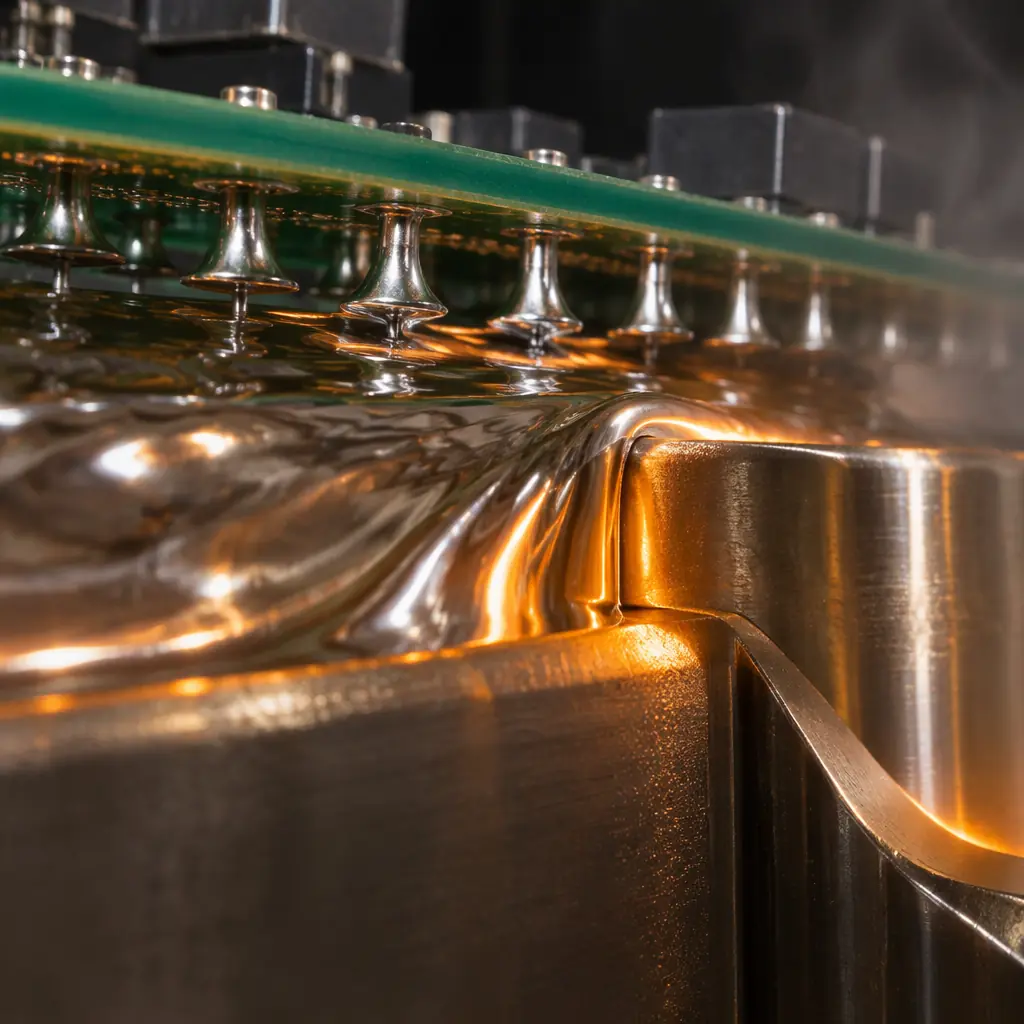
A clean wave transfer shows bright concave fillets. Oxide carried under the wave shows up as dull joints, solder balls and bridging.
Metal loss is the easy cost to see. The harder one is oxide that never reaches the skimmer because it went onto a board. The defect signatures are recognisable and they cluster together on the same production run, which is the clue that the pot rather than the board is at fault.
Solder balls and beading around through-hole joints are the classic signature of oxide carried under the wave. The oxide film enters the solder joint area, breaks up during cooling and leaves isolated spheres sitting on solder mask or wedged between leads. Bridging follows the same mechanism: oxide reduces the surface tension driven separation that normally pulls adjacent joints apart on leaving the wave, so a heavy oxide load produces a bridge rate that jumps without any change in pad geometry. Dull, grainy fillets with irregular wetting angles point to the same cause when the profile and flux are unchanged. Icicles and excess solder on the exit side appear when the wave height has been raised to compensate for poor wetting that was itself caused by oxide.
The costs are asymmetric. A dross rate that rises from 18 to 25 percent on a build consumes a few hundred dollars of extra alloy a month on a mid-volume line. The same rise, unmanaged, can produce a bridge rate that pushes a board from a 97 percent first-pass yield to 93 percent, and the rework, touch-up and retest of those four points costs more than the metal. For a buyer, the consequence is that dross management is a yield control measure, and the way first-pass yield behaves under a specific process is discussed in SMT first pass yield diagnosis. Acceptance criteria for the resulting joints sit in the IPC-A-610 classes applied to the build, and a general treatment is in IPC-A-610 acceptance criteria.
Nitrogen: The Lever Worth Asking About
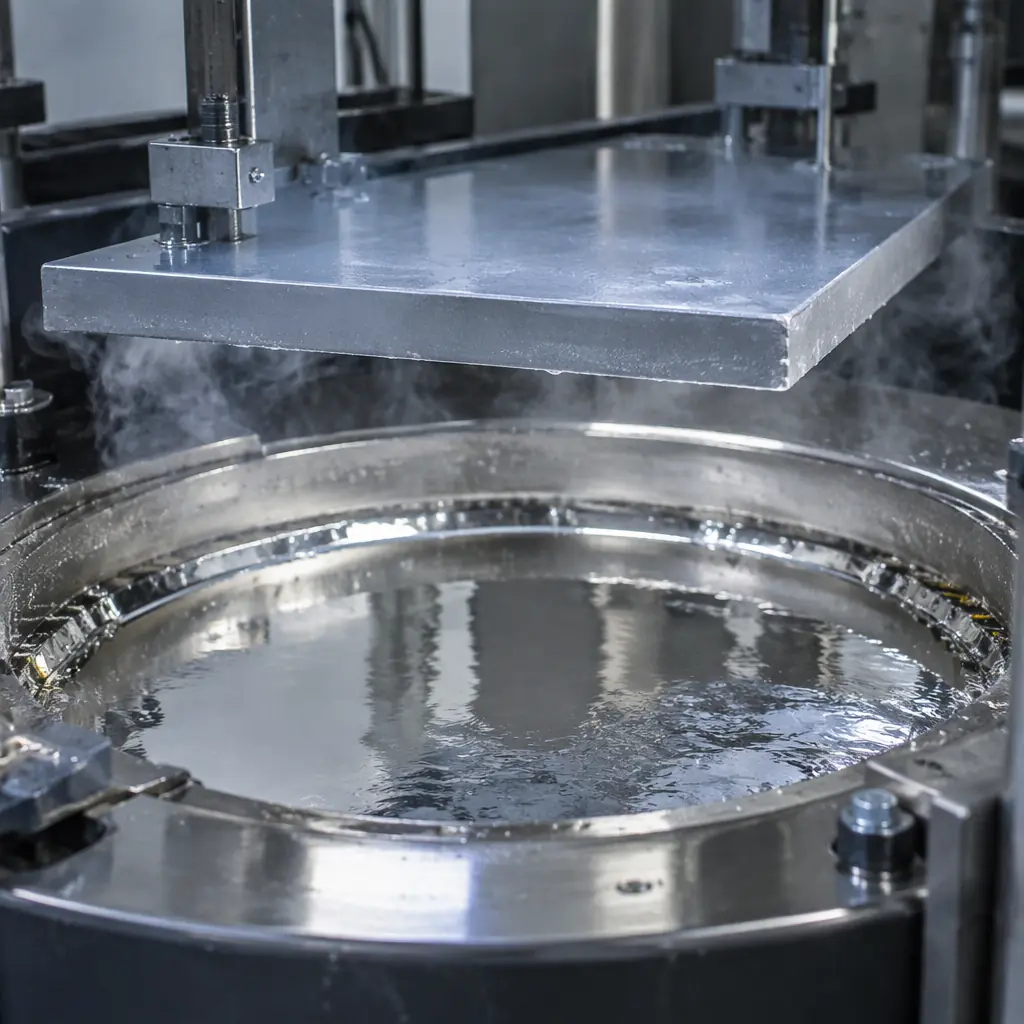
A nitrogen blanket works by keeping oxygen off the surface, not by adding anything to the alloy. Enclosure quality decides how much of the saving you actually get.
Nitrogen on a wave pot is the single largest available reduction in dross generation, and it is also the variable with the widest spread between the brochure claim and the measured result. The mechanism is straightforward: if oxygen concentration at the metal surface is held low enough, oxide does not form at a meaningful rate and the surface stays bright. The practical results depend almost entirely on how well the tunnel or hood seals, what residual oxygen is actually reached, and whether the machine's board entry and exit openings draw air back in.
What a buyer should take from this is not a number to demand but a set of questions that reveal whether nitrogen is being used as process control or as a marketing line. Does the line run nitrogen on wave work, and at what residual oxygen level is it verified. Is the oxygen measured and logged, and at what interval. Does the pot have a covered idle mode, and is it used. Each question has a factual answer in a controlled plant and a vague one elsewhere, and the vague ones tell you how the build is genuinely run.
The economics from a supplier's side are a trade between gas, enclosure maintenance and metal. On a high-volume build with heavy through-hole content the metal saving and the yield improvement together usually pay for the nitrogen. On a low-volume mixed build with short runs the gas and the set-up time may not, and the supplier may reasonably choose air with disciplined skimming instead. Both positions are defensible. What is not defensible is a surcharge presented as though the rate were a constant of nature.
What Metal Consumption Should Look Like in a Quotation
Most contract assembly quotations fold metal into a per-joint or per-panel price and never show the assumption behind it. That is not dishonest, but it makes the metal loss invisible and it makes comparison between quotes impossible, because two suppliers quoting similar prices may be assuming very different dross rates. A buyer who wants the number can ask for it in a form that is quick to produce.
The request is a metal consumption statement for the previous quarter on comparable work: kilograms of alloy issued, kilograms of dross collected, the metal content of that dross as assayed by the recycler or a laboratory, and the number of panels or joints produced. From those four numbers the effective metal cost per board falls out directly, and it can be compared with the BOM's theoretical metal content to see how much of the gap is accounted for by dross. A supplier who cannot produce the four numbers does not have the records, which is itself the answer.
The comparison is worth doing because the gap between a well-run pot and a poorly-run one is not marginal. On the same alloy and comparable board mix, a plant running a covered pot with nitrogen, a written skimming routine and a bath analysis schedule can sit in the low single digits as a percentage of consumption. A plant running an open pot left hot around the clock, skimmed when somebody notices, can sit several times higher, and the difference appears in the per-board price as surely as the labour rate does. Enquiries that arrive with the metal statement already supplied are the ones that get quoted with a tighter margin, which is a practical reason to make the request part of the sourcing routine rather than a challenge raised at contract review.
Writing the Clause
The reason to put dross management in a purchase order is not to police the supplier's process. It is to fix the boundary between a metal cost the buyer pays and a metal cost the supplier carries, and to make the record exist before a yield dispute. The clause below is written to be inserted into a supplier quality agreement or a purchase order schedule.
The supplier shall operate wave soldering with a written pot management procedure covering the setpoint temperature, the skimming interval and method, the idle mode and the bath analysis schedule, and shall make the procedure available to the buyer on request. The supplier shall analyse the solder bath for alloy composition and copper content at intervals not exceeding one month or one alloy top-up cycle, whichever is shorter, and shall retain the results. The supplier shall record monthly the quantity of solder alloy consumed and the quantity of dross collected, and shall provide these figures with the metal content of the collected dross as assayed by its recycler, on request and in any case quarterly. Dross shall be removed from the production area in sealed containers and shall never be returned to the pot. Where nitrogen atmosphere is used, the residual oxygen level shall be verified and logged at an interval defined in the process control plan. Metal consumption in excess of the agreed rate shall be investigated by the supplier as a process nonconformity under the corrective action procedure, and the buyer shall not be charged a metal surcharge attributable to the supplier's loss rate without supporting consumption data. The supplier shall notify the buyer before any change of solder alloy brand, pot, wave machine or flux chemistry on an approved build.
The load-bearing sentence is the one that ties the surcharge to data. A metal surcharge on an order where the supplier has not provided consumption figures is a price increase, not a cost recovery, and the distinction is worth making explicit in the agreement before the first invoice. The second load-bearing sentence is the prohibition on returning dross, which is the practice most likely to convert a small metal cost into a bridge-rate complaint. Related supplier-side controls on the same process, including flux application and preheat verification, are described in wave solder process control.
What to Ask For on the Next Order
Dross is metal that was paid for and did not become a joint, and its rate is set by the pot and the routine around it rather than by physics alone. Exposed surface area, idle hours at temperature, skimming practice and atmosphere account for most of the spread between suppliers running the same alloy, and each has a factual answer a supplier can give. The number worth asking for is dross as a percentage of alloy consumed with the metal content of what is collected, because gross dross weight overstates the loss and, used as a cost figure, distorts every comparison it appears in.
The commercial consequence is simple: a metal surcharge presented without consumption data is not a cost, it is a price, and a buyer who asks the four questions can tell the difference. Once the numbers exist, the clause writing is straightforward, and the residue is a build whose metal loss is small enough to be a rounding item rather than a negotiating position.
At Huaxing PCBA the wave lines run with a written pot management routine, a bath analysis schedule and a recorded dross figure per build, and the metal consumption statement goes out with the quarterly quality pack rather than on request. For builds with heavy through-hole content, the process control scope sets out what the line verifies per shift, and alloy verification covers the bath chemistry side. To price a wave assembly that includes through-hole reflow or selective work as well, send the Gerber and BOM through the quote form and the reply will state the metal assumption behind the price.