
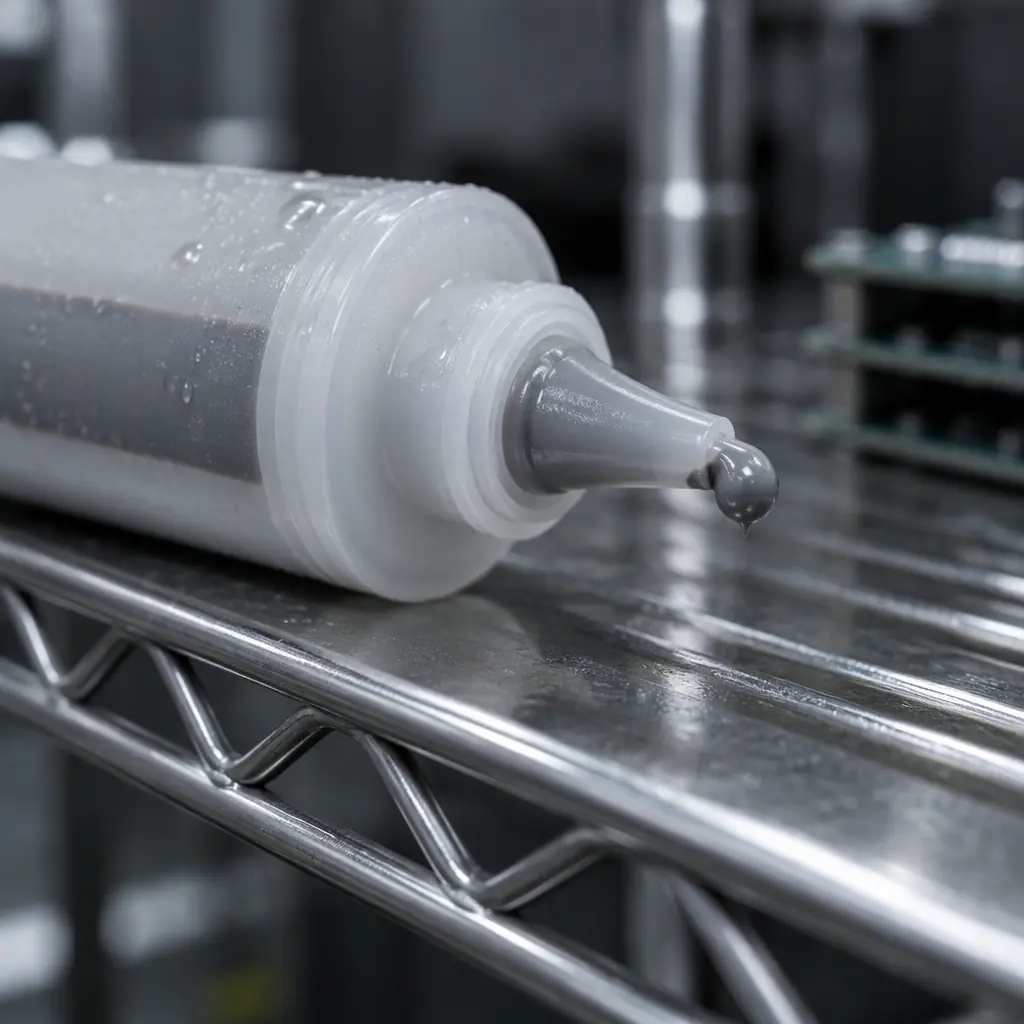
Soldering paste arrived at the plant on a pallet, sits in a refrigerator for six months, and is still inside its label date. That sequence is common and it is not a sign that anything is wrong, but it also does not prove the paste will print. Paste shelf life is the sum of three separate expirations, and the printed date covers only the first of them. A lot can be inside its label date and already unusable because it was left on a bench for eleven hours in August, and a lot can be weeks past its label date and still run a 0.4 mm aperture test window without a single defect. The difference matters commercially, because the first case is a scrap argument and the second is a test result.
This page sets out what physically changes in a solder paste as it ages, which of those changes are recoverable and which are not, how the standards frame shelf life and floor life, the sequence a paste should pass through before an expired lot is written off, and the clause that puts the disposition decision in writing before the first order ships. It is written for buyers and quality engineers who are being handed a certificate of conformance and asked to accept it. The way paste chemistry affects defect formation during printing is covered separately in the solder paste selection guide, and the defects that expired paste produces are set out in solder paste printing defects.
One more distinction belongs up front, because it drives everything below. A solder paste is a suspension of solder powder in a flux vehicle, and the powder does not age in the way the flux does. Metal, whether SAC305 or a low-temperature bismuth alloy, stays metal. What changes is the chemistry around it and the physical distribution of the particle bed: the flux vehicle loses solvent, its activators react and are consumed, the rheology thickens or skins, and the powder slowly oxidises at the surface where it meets flux. A lot whose label has expired has a chemistry problem, not a metal problem, and that is why a test can sometimes rescue it and sometimes cannot.
The Three Clocks on a Jar of Paste

A refrigerated store room holds the shelf-life clock. It does not hold the floor-time clock, which is the one that produces most wetting failures.
Every paste lot is running three timers at once, and a quality system that tracks one of them is tracking a third of the problem.
The first is the labelled shelf life, counted from the date of manufacture. For most SAC305 pastes in a sealed jar this is six months at refrigerated temperature or twelve months when stored cold and unopened. For water-soluble and highly activated chemistries it is often shorter, because the activators are more aggressive and consume themselves faster. This is the date that appears on the label and on the certificate of conformance, and it is the only one most buyers ever see.
The second is the cold-chain exposure, which is not printed anywhere. A paste that spent three weeks on a dock in a container at 38 degrees has been aged far beyond its nominal position in the shelf life, and the label date says nothing about it. The relevant question at goods-in is the temperature record over transit, and for most shipments from Asia to Europe or North America that record does not exist unless it was specified.
The third is floor time, the accumulated hours the paste spends above the storage temperature once it is out of the refrigerator. Floor time is not reset by returning the jar to the refrigerator. A jar that is warmed to 25 degrees for four hours, printed from, then cooled overnight, has spent four hours of its floor life; the next morning it starts again from four, not zero. A jar used across four shifts can reach its floor-life limit while carrying a label date that is still two months away.
The practical consequence is that the disposition of a paste lot depends on which clock ran out, and the buyer who wants to argue about it needs data on all three rather than a date on a label.
What Actually Degrades, and What Does Not
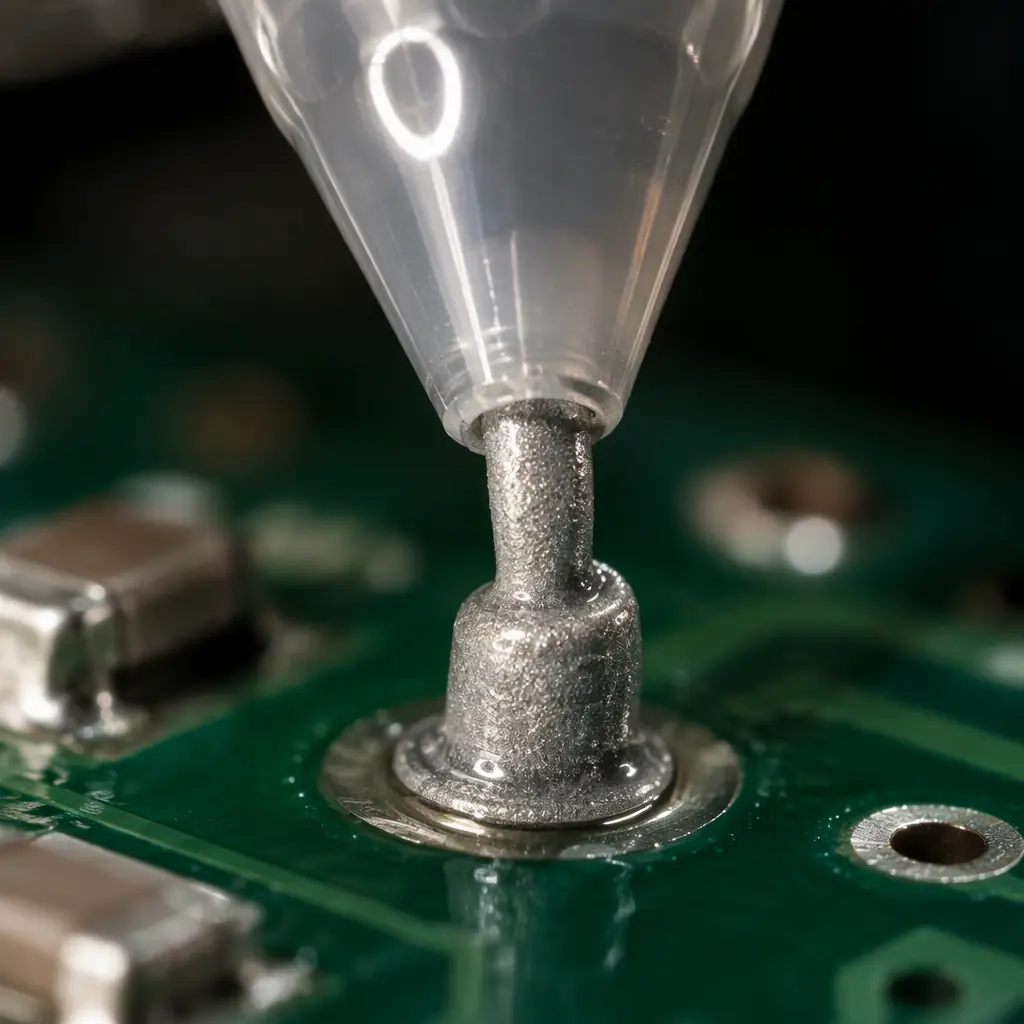
Viscosity rises as the flux vehicle loses solvent. A paste that has thickened prints short deposits and slumps at fine apertures before it fails outright.
The degradation story is mechanical and chemical rather than alloy related, and it is worth understanding each mechanism because each has a different recovery path.
Solvent loss is the dominant change in an opened jar. The flux vehicle carries a solvent package that controls viscosity and tack, and every hour the jar sits open that package partly evaporates from the surface. The result is a paste that thickens, prints with slumping edges and skips at fine apertures, and leaves a dry crust at the top of the jar. This is recoverable in a limited sense: most paste suppliers allow a controlled amount of fresh paste to be folded in to restore rheology, but folding paste in is a process step that must be written into procedure and it cannot fix activator chemistry.
Activator depletion is the change that decides most dispositions. Solder powder carries an oxide layer, thin on fresh powder and thicker on powder that has been exposed to moisture and air. The flux activators exist to remove that oxide during reflow so the alloy can wet the pad and the component termination. Activators are consumed doing that work, and paste stored for a long time, or paste warmed and cooled repeatedly, loses activity without any visible change. The defect signature is distinctive: wetting on the pad is partial, the fillet is concave or irregular rather than smooth, and there is a higher rate of non-wetting on pads with heavier oxidation such as a stored HASL surface. This is the failure mode that no amount of folding fresh paste into an old jar will fix, because the fresh paste brings fresh activator only in proportion to the amount added.
Powder oxidation is a slower mechanism and it also raises the melting behaviour of the surface layer. On SAC305 powder the tin oxide skin is thin and the alloy melts at its nominal 217 to 220 degrees, but an oxidised powder needs more thermal energy and more flux activity to coalesce, which is why old paste is more sensitive to a marginal reflow profile. On bismuth-based low-temperature alloys the issue is different and more acute, because those alloys melt at 138 to 170 degrees and their flux systems are designed to activate in that narrower window; an aged low-temperature paste can fail to coalesce fully while the profile still looks correct.
What does not degrade in a sealed jar is the powder particle size distribution. A jar of Type 4 powder still contains Type 4 powder a year later. What changes is the effective behaviour of that powder in a thickened vehicle, which is why an expired lot can print acceptably at a 0.5 mm pitch and fail at a 0.3 mm aperture on the same board.
Refrigerated, Room Temperature and the Cost of Getting It Wrong
The storage decision on a paste is a trade between capital, process control and usable life, and each option has a real cost that buyers should see before they choose.
Refrigerated storage at 2 to 10 degrees is the default for SAC305 in high-mix production. It buys the full labelled shelf life and it preserves activator chemistry, and its cost is the cold chain itself: a dedicated refrigerator with a temperature logger, a warming procedure of at least two hours in the sealed jar before use, a record of every jar's in and out times, and a discipline problem because a jar taken out and left on the bench is the single most common cause of premature floor-time expiry.
Room-temperature storage at 20 to 25 degrees is viable for some no-clean chemistries and is common in low-volume and prototype environments. It removes the warming step and the cold-chain risk, and it shortens usable life, often to three months from manufacture rather than six. For a prototype line running one or two batches a week this is the honest choice: the paste is consumed faster than it ages, and the refrigerator adds a procedure nobody follows. For a production line running daily, room-temperature storage of a slow-moving paste is how a jar reaches its floor-life limit in the third week.
There is a third option that is not really storage at all: buying paste in the quantity the build consumes. A 500 gram jar of paste for a 40-board run is the wrong unit, because the jar will be opened, partly used, and aged before the next run. Paste is available in 100 gram and smaller cartridges, and the cost per gram is higher while the cost per usable gram is often lower once scrap is counted. The arithmetic is covered in solder paste consumption cost model.
| Route | Typical labelled life | What it costs to run | Where it fails |
|---|---|---|---|
| Refrigerated 2 to 10°C, sealed | 6 months SAC305, 12 months some chemistries | Fridge, logger, 2 h warming step, in/out records | Jar left on bench; floor time accumulates unlogged |
| Room temperature 20 to 25°C | 3 months typical, chemistry dependent | Nothing beyond stock rotation | Slow-moving paste ages out mid-project |
| Refrigerated, decanted into small cartridges | Full labelled life per cartridge | Higher price per gram, more SKU lines | Cartridge waste at the end of a small run |
| No storage control | Indeterminate | Nothing | Every clock runs simultaneously, no defence in a dispute |
Testing an Expired Lot Instead of Guessing

Activator chemistry is what aging consumes. A flux that has lost activity looks identical and wets measurably slower on oxidised copper.
An expired lot is not automatically scrap, and scrapping it without a test is as poor a decision as using it without one. Two tests separate the recoverable from the dead, and both are cheap relative to a rework campaign.
Viscosity and slump are the first test, and they catch the solvent-loss cases. A spiral viscometer reading against the supplier's specification range tells you whether the vehicle is still in the printable band, and a simple print-and-hold test on a glass slide or a scrap board, held at ambient for the interval between print and reflow, shows whether the deposit slumps or bridges. A paste that passes both has not lost its rheology and the aging is in the chemistry, which the second test addresses.
Wetting balance or a print-and-reflow coupon is the second test, and it is the one that catches activator depletion. A wetting balance test on oxidised copper measures the time to reach a defined wetting force, and an aged paste shows a measurably longer wetting time than a fresh control. A cheaper substitute is a small coupon build: print the aged paste and a fresh control of the same alloy on identical coupons, reflow both through the production profile, and compare wetting angle and fillet shape under a microscope. The test method and its acceptance numbers are set out in solder float test vs wetting balance.
The sequence that works in practice is this. Check the label date and the floor-time record first, and if the lot is inside both, print it. If either is exceeded, run the viscosity and print-hold check. If those pass, run the coupon comparison against a fresh control. If the coupon wetting is within the supplier's accepted band, the lot can be released with a documented deviation that names the test, the control, and the acceptance result. If wetting is degraded, the lot is scrap for any board with fine-pitch or high-reliability requirements, and may still be usable on coarse-pitch non-critical product, which is a decision the buyer should make rather than the supplier.
What makes this testable rather than theoretical is a documented baseline. A fresh-control coupon kept from the same alloy and the same supplier, profiled through the same oven, gives a wetting reference that a year-old lot can be compared against. Without that control the test result is an opinion with a number attached.
What the Standards Say, and What They Leave to You
J-STD-005 covers the requirements for solder paste, including alloy composition, powder size classification and the test methods for viscosity, slump, and solder balling. It does not set a shelf life; it defines the tests a paste must pass. J-STD-004 separately classifies flux activity, with the L0 and L1 designations for low-activity rosin and resin systems and the OR designations for organic systems, and the activity classification is the relevant one when judging whether an aged paste still has the chemistry to wet a given surface finish.
The practical reading is that the industry standards tell you how to test a paste and at what activity level a flux sits, and they leave the shelf life, storage route and disposition of an aged lot to the supplier's data sheet and the buyer's specification. That is why two suppliers can both be compliant and one will accept a seven-month-old lot while the other will not, and why the buyer's purchase order has to state the position rather than relying on a certificate.
The buyer-relevant consequence is that a certificate of conformance stating the lot is within shelf life proves one thing: the printed date has not passed. It says nothing about floor time, transit temperature, or activator activity. Those are the three variables that produce the defects, and they are only visible in records the buyer asks for.
Floor Time: The Clock Nobody Logs
Of the three clocks, floor time is the one that produces most real failures and the one almost never recorded. The mechanism is simple: paste is warmed, used, partly returned to the refrigerator, and warmed again, and nobody adds up the hours.
A workable control is a jar label with three fields: lot number, date opened, and cumulative hours at ambient. Operators mark the jar out and in at each session and add the elapsed hours. A jar that reaches the supplier's stated floor life, typically 24 to 48 hours at 25 degrees for SAC305 and shorter for water-soluble chemistries, is disposed of regardless of its printed date. The label costs nothing and it converts an unmeasurable variable into a number that can be audited.
The other half of the control is the warming routine. A sealed jar needs time to reach ambient before opening, and opening a cold jar is what produces condensation inside the lid and on the paste surface, which adds water to a vehicle that was formulated without it. Two hours in the sealed jar is the usual specification, and the common failure is a rush job that opens a cold jar after twenty minutes.
Eight Lines for the Purchase Order
The clause below is written to be inserted into a purchase order or a supplier quality agreement. It states the shelf life requirement at delivery rather than at manufacture, defines what the supplier must document, and sets out how the parties handle an aged or expired lot.
The supplier shall deliver solder paste with a remaining shelf life of not less than 75 percent of the labelled shelf life at the date of shipment, and shall state the lot number and manufacture date on the certificate of conformance. The supplier shall store paste under the conditions stated on its data sheet and shall maintain a temperature record for the storage period, available to the buyer on request. The supplier shall record floor time for each jar or cartridge from first opening, including cumulative ambient exposure, and shall retire any paste that reaches its stated floor life regardless of label date. Where an aged or expired lot is proposed for use, the supplier shall submit the lot for viscosity and wetting verification against a fresh control of the same alloy, and shall not use the lot on product with a pitch below 0.5 mm or a Class 3 requirement without the buyer's written approval. Paste that fails the verification shall be disposed of at the supplier's cost and shall not be returned to stock. The supplier shall notify the buyer before changing paste supplier, alloy, powder size classification or flux activity type on an approved build.
Two lines in that clause carry most of the commercial weight. The remaining-life requirement at delivery is what stops a supplier shipping the end of a pallet, which is a routine practice when the buyer's order does not say otherwise. The floor-time record is what makes the disposition test meaningful, because without it an expired lot cannot be distinguished from a lot that was mishandled three weeks ago.
What This Costs on a Real Order
Paste is a small line in a bill of materials and a large line in a defect investigation, which is the reason it gets specified badly. A 500 gram jar of SAC305 paste runs in the low tens of dollars and covers a modest run; the rework of a single board with a wetting failure costs more in labour and test time than the jar did. The economics of shelf-life control are therefore not the price of the paste, they are the cost of the rework it prevents and the confidence it gives when a wetting complaint arrives and the question is whether the paste or the profile caused it.
A buyer who has a floor-time record, a cold-chain requirement at delivery and a documented disposition test can answer that question. A buyer who has a certificate of conformance and a label date cannot, and in a dispute over a wetting defect that is the difference between a supplier funded rework and an argument. The incoming inspection process is where the records should be checked at goods-in rather than discovered at the reflow oven, and the way an aged paste signature is separated from a profile problem is covered in solder paste defect attribution. The reflow side of the same question, including how a profile is verified against a process window, sits in reflow oven profiling.
None of this is exotic. It is a label, a log, and eight lines in a purchase order, and it converts the most common cause of wetting defects in a contract assembly build from an argument into a record.