Every PCB procurement manager faces the same tension: carry enough inventory to prevent production line stoppages, but don't tie up so much working capital that the CFO starts asking questions. The traditional answer, place larger purchase orders to get volume discounts, then warehouse the excess, works until it doesn't. When demand shifts, those carefully-stocked boards become obsolete. When demand spikes, even the largest safety stock runs dry in weeks. Vendor-managed inventory (VMI) and consignment stock programs break this tradeoff, and for companies spending $500K+ annually on PCBs, the working capital savings alone often justify the implementation effort within the first year.
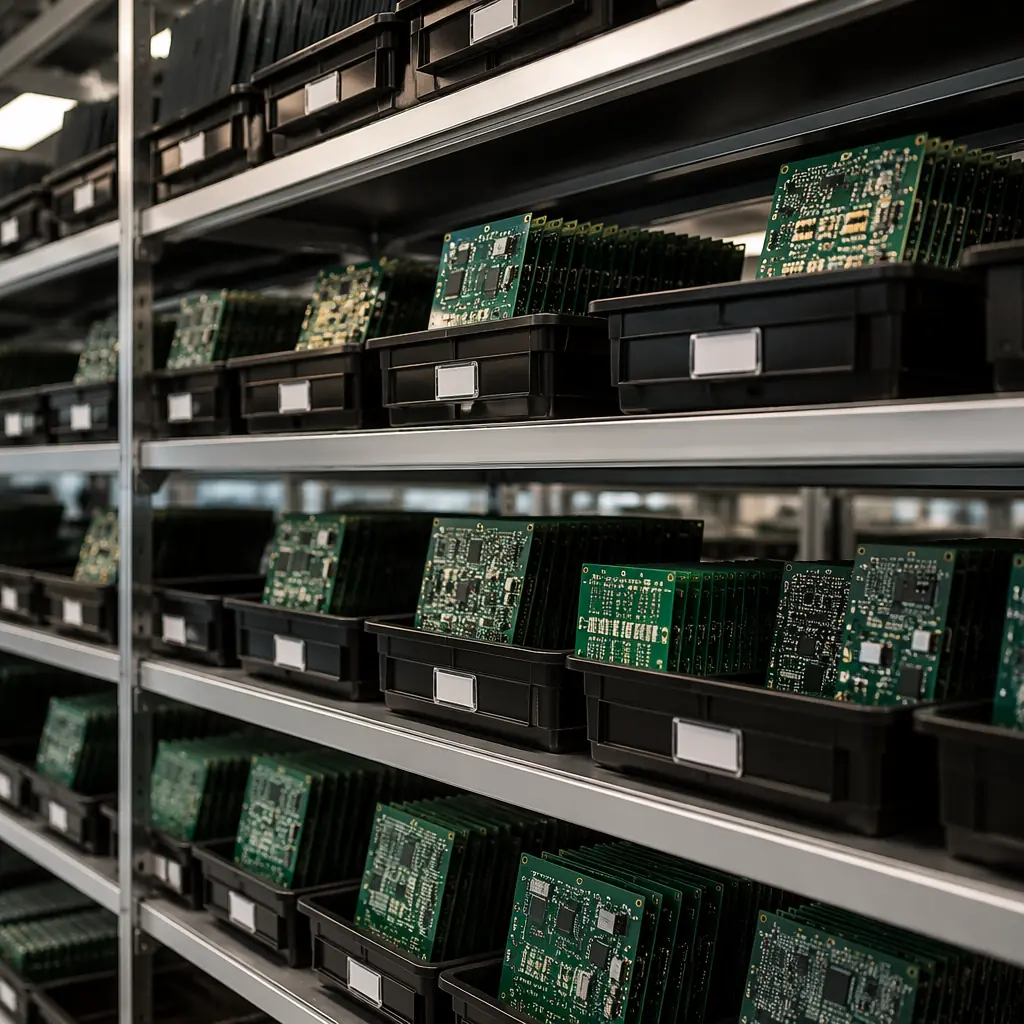
Huaxing PCBA operates VMI programs for multiple international clients, maintaining buffer stock at our 15,000 sqm Shenzhen facility and shipping against pull signals within 48 hours. With 8 SMT lines, 99.2% on-time delivery, and capacity for 80,000 sqm of PCB production monthly, our infrastructure is designed for the demand variability that VMI programs are built to handle.
VMI vs Consignment Stock vs Blanket Orders: Which Model Fits Your PCB Program?
Procurement professionals often use these terms interchangeably, but the legal, financial, and operational differences matter. Especially when your supplier is on the other side of the Pacific:
| Model | Who Owns the Inventory? | When Does Title Transfer? | Best For |
|---|---|---|---|
| VMI (Vendor-Managed Inventory) | Supplier until pulled | At shipment or receipt, negotiated in contract | Stable designs with predictable consumption; 3-12 month contracts; ≥$50K annual spend per SKU |
| Consignment Stock | Supplier; stored at buyer's facility or 3PL | When pulled from consignment location into production | Just-in-time manufacturing; buyer controls physical access; high mix of SKUs with variable demand |
| Blanket Order + Scheduled Releases | Buyer takes ownership at each release | Per release: each call-off is a separate transaction | Known annual volume but uneven monthly demand; simpler to administer than VMI |
| Kanban / Two-Bin System | Supplier maintains minimum/maximum levels | At each replenishment trigger | High-volume, low-complexity PCBs; lean manufacturing environments |
For most PCB buyers importing from China, VMI is the practical sweet spot. It keeps the inventory at the supplier's facility under their quality-controlled storage conditions, eliminates international shipping delays from the critical path (since buffer stock is already manufactured), and defers title transfer until the goods are actually needed. Our Blanket Orders vs Spot Buys comparison covers the financial tradeoffs of alternative procurement models.
Financial Reality Check: A company consuming $25K/month of PCBs with 8-week traditional lead time carries roughly $50K in pipeline inventory (goods ordered but not yet received) plus $25K-$50K in safety stock, $75K-$100K of working capital tied up in boards. A VMI program with the same supplier typically reduces this to $30K-$40K (the consignment buffer) because you're no longer funding the pipeline. The $40K-$60K of freed working capital, at a 10% cost of capital, saves $4K-$6K per year, and that's before accounting for reduced stockout risk.
5 Steps to Implement a PCB VMI Program
VMI isn't a service you buy, it's a partnership you build. These five steps move from initial qualification to operational steady-state:
Supplier Qualification, Can Your PCB Partner Actually Do VMI?
Not every PCB manufacturer can run VMI. Minimum requirements: financial stability to carry 2-3 months of your buffer stock on their balance sheet (ask for audited financials or trade references); dedicated floor space for segregated customer inventory with lot-level traceability; an ERP or WMS system that can generate min/max alerts and consumption reports; and demonstrated on-time delivery above 95% on standard orders (VMI amplifies existing delivery problems, it doesn't fix them). Our PCB Supplier Audit Checklist provides the full qualification framework, and the Supplier Quality Scorecard helps you track ongoing performance.
Demand Profiling, What Belongs in VMI and What Doesn't
Putting the wrong SKUs into VMI is the fastest way to destroy the business case. VMI works for: PCBs with stable, predictable consumption (coefficient of variation under 0.3), boards that have been in production for ≥6 months (design stable), and SKUs where stockout cost is high (line-down scenario). VMI does NOT work for: prototype or NPI boards with unpredictable demand, designs still in revision (each rev change invalidates buffer stock), and ultra-low-volume SKUs where buffer stock cost exceeds stockout risk. Our PCB Cost Drivers guide helps you model the total cost of ownership for each SKU, a critical input to VMI sizing decisions.
Buffer Stock Sizing, The Math That Makes or Breaks VMI
The VMI agreement must specify min/max inventory levels per SKU. The standard formula: Max = (avg weekly demand × replenishment lead time in weeks) + (Z-score × σ of weekly demand × √replenishment LT). For PCBs manufactured in China with 7-day manufacturing lead time and 3-day express shipping = 10 calendar days effective replenishment. If your weekly demand averages 500 boards with σ = 150 and you target 98% service level (Z = 2.05): Max ≈ (500 × 1.43) + (2.05 × 150 × 1.20) = 715 + 369 = 1,084 boards. Your supplier should carry roughly 1,100 boards for this SKU. Min level (reorder point) is usually set at safety stock only: 369 boards in this example. Aggressively tight sizing saves working capital; loose sizing prevents stockouts. Finding the balance requires shared demand data.
Contract Structure, Ownership, Obsolescence, and Exit Terms
The VMI contract must address three uncomfortable questions before they become disputes: (1) Obsolescence liability . Who eats the cost when you issue an ECO that makes buffer stock obsolete? Standard compromise: buyer commits to consume all WIP and finished goods within 90 days of ECO notification; supplier shares obsolescence cost 50/50 on remaining stock. (2) Minimum purchase commitment . What happens if your actual demand falls 40% below forecast? Typical structure: rolling 12-month forecast with first 3 months firm, months 4-6 at ±20% flexibility, months 7-12 advisory only. (3) Exit provisions . If you terminate VMI, how long does the supplier have to liquidate buffer stock, and who owns what's left? Standard: 90-day notice, supplier can recover raw material costs on remaining buffer, buyer takes finished PCBs at cost. Our supply chain risk management guide covers the broader contracting framework.
Operational Cadence, Reports, Reviews, and Replenishment Triggers
A VMI program runs on information flow, not purchase orders. The standard operational rhythm: daily . Supplier sends inventory position report (current stock, in-transit, consumed yesterday, projected days-of-supply); weekly . Buyer sends updated demand forecast (rolling 12 weeks); monthly . Joint review of service level (fill rate %), inventory turns, obsolescence exposure, and forecast accuracy (MAPE). Replenishment trigger: when inventory hits the agreed min level, the supplier manufactures the replenishment quantity without waiting for a purchase order. This is what cuts lead time from "submit PO → wait 4 weeks → receive" to "trigger hits min → supplier already manufacturing → ship in 48 hours." For insight into optimizing the underlying manufacturing timelines, see our PCB Lead Time Reduction guide.
When VMI Goes Wrong, and How to Prevent It
VMI failures follow predictable patterns. Here are the three most common and how to avoid them:
Failure Mode 1: The Forecast Fantasy
The buyer provides a wildly optimistic forecast to secure supplier commitment, then actual demand comes in 60% below forecast. The supplier now carries 2.5× the agreed buffer stock, tying up their working capital and eroding trust. Prevention: start VMI with 3-5 SKUs that have a 12-month demand history with CV under 0.25, prove the model on predictable SKUs before expanding to variable-demand boards. Our demand forecasting approach starts conservatively and scales with proven accuracy.
Failure Mode 2: The One-Sided Partnership
The buyer treats VMI as "free warehousing", pushing all inventory risk onto the supplier without committing to minimum volumes or sharing cost when designs change. The supplier eventually deprioritizes the account, lead times silently creep back up, and the VMI program dies without anyone formally ending it. Prevention: structure the agreement so both parties benefit, the supplier gets volume commitment and stable production scheduling; the buyer gets reduced lead time and working capital. No party should feel like they're absorbing all the risk.
Failure Mode 3: The Quality Decay
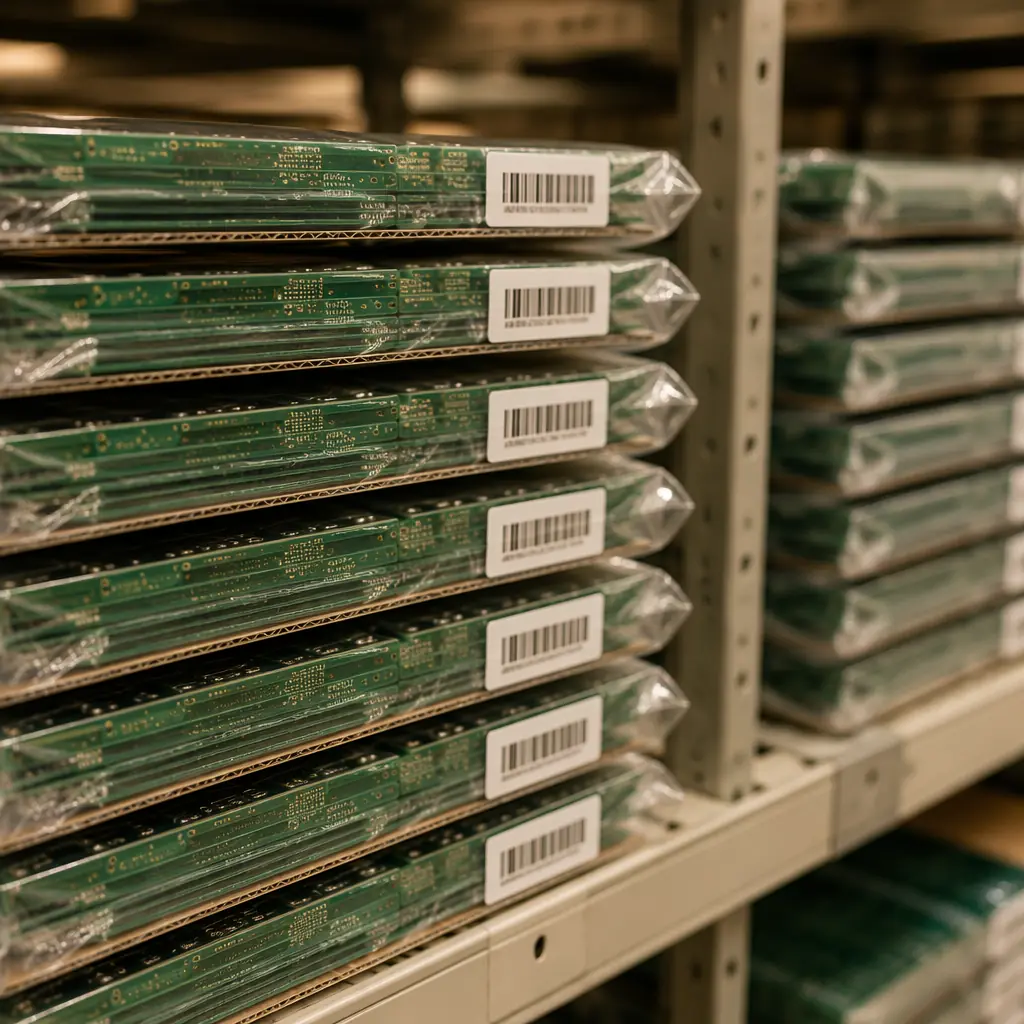
Buffer stock sits in storage for 4-6 months. Solderability degrades (especially on OSP surface finish boards), moisture absorption increases (even in sealed packaging), and MSL-sensitive components on assembled PCBA can develop popcorn defects during subsequent reflow. Prevention: specify ENIG rather than OSP for VMI-stored PCBs (ENIG has 12-month solderability shelf life vs 6 months for OSP); require vacuum-sealed packaging with humidity indicator cards; rotate buffer stock on FIFO basis with visible date-of-manufacture labeling. Our MSL Moisture Sensitivity Guide covers proper storage and handling protocols.
Getting Started: A 90-Day VMI Pilot
Don't try to move your entire PCB spend to VMI at once. Run a 90-day pilot with one supplier on 3-5 SKUs that meet all criteria: stable design (no pending ECOs), predictable demand (CV < 0.25), high stockout cost (line-down scenario), and annual spend >$10K per SKU. Measure three metrics: fill rate (target >98%), forecast accuracy (MAPE target <20%), and working capital reduction vs pre-VMI baseline. If the pilot succeeds across all three metrics, expand to additional SKUs in 90-day waves. If it fails on any metric, diagnose the root cause before expanding.
At Huaxing PCBA, we structure VMI programs around a simple principle: we succeed when your production line never stops for lack of boards. With 150+ active international clients, 99.2% on-time delivery, and full lot-level traceability integrated into our ERP system, we have the operational infrastructure to make VMI work, not just promise it. Read our supplier transition guide if you're considering moving existing PCB programs to a VMI-capable partner.