If you're sourcing PCBs for the European market, you've probably seen "halogen-free" appear on RFQs with increasing frequency. The EU's RoHS Directive hasn't yet added halogenated flame retardants to its restricted substances list, but the writing is on the wall. The European Commission's ongoing evaluation of RoHS exemptions, combined with major OEM mandates (Apple, Dell, Siemens, Bosch now require halogen-free PCBs in new designs), means that specifying halogen-free today is an investment in supply chain continuity, not a cost. At Huaxing PCBA, we've manufactured over 50,000 m² of halogen-free PCBs for automotive, medical, and consumer electronics customers across 9 countries. Here's what you need to know to specify, verify, and procure halogen-free PCBs with confidence.
The halogen-free story starts with a fire safety paradox: brominated flame retardants (BFRs) like TBBPA make FR-4 laminates resistant to ignition, but when those same PCBs reach end-of-life incineration, the bromine forms dioxins and furans, some of the most toxic persistent organic pollutants known. The IEC responded with IEC 61249-2-21, which defines "halogen-free" not as zero halogens (impossible in nature), but as below specific thresholds. This standard is now referenced by IPC-4101 for base materials, making it the de facto global specification for halogen-free PCB laminates.
What "Halogen-Free" Actually Means: The IEC 61249-2-21 Thresholds
IEC 61249-2-21 defines halogen-free for PCB base materials with three numeric limits. If your PCB laminate meets all three, it qualifies as halogen-free, regardless of what the marketing copy on the laminate datasheet says.
| Element | Maximum Concentration | Test Method | Why This Limit |
|---|---|---|---|
| Chlorine (Cl) | 900 ppm (0.09%) | IEC 61189-2, EN 14582 | Below the threshold where HCl gas forms during combustion |
| Bromine (Br) | 900 ppm (0.09%) | IEC 61189-2, EN 14582 | Same rationale, HBr gas is the bromine equivalent of HCl |
| Total Cl + Br | 1,500 ppm (0.15%) | Sum of individual measurements | Cumulative effect of both halogens during incineration |
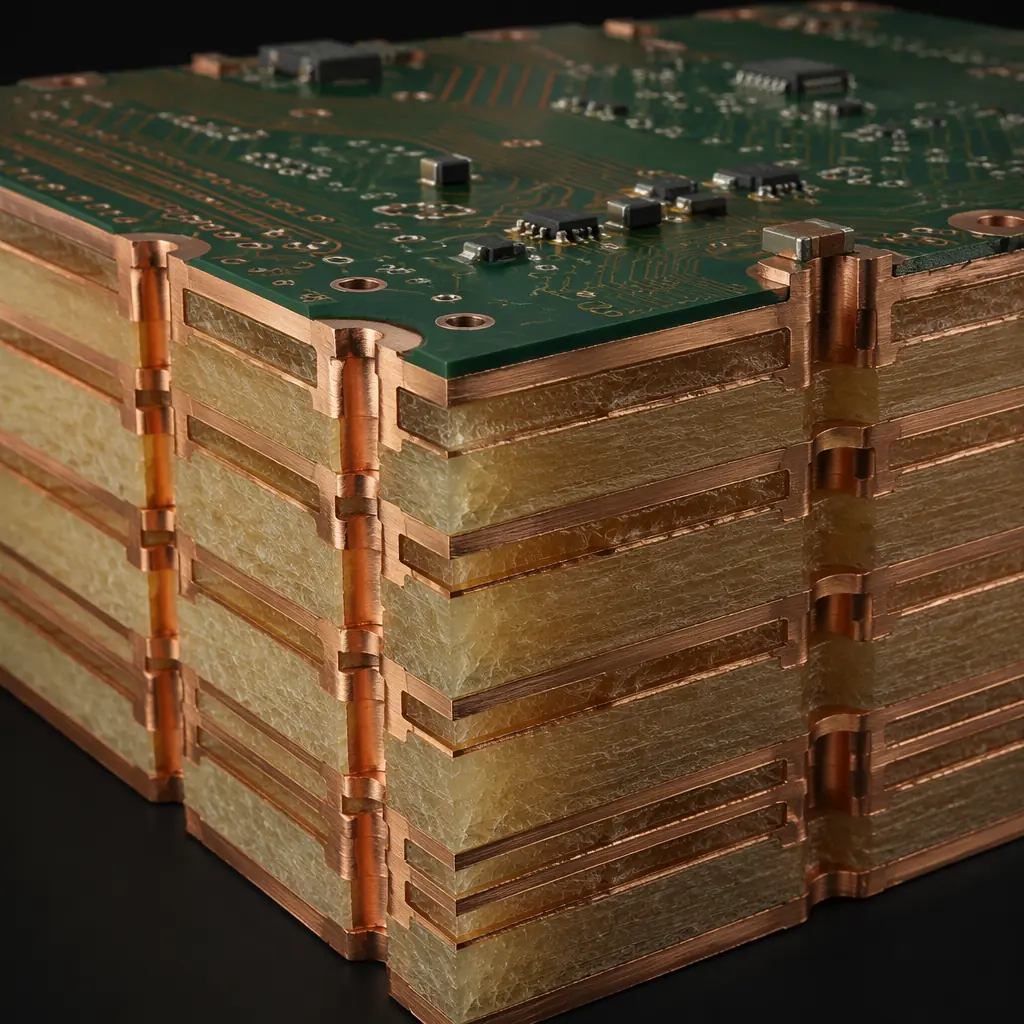
Critical distinction: IEC 61249-2-21 applies to the base laminate material only . Not the finished PCB with solder mask, silkscreen, and surface finish. A PCB can use a halogen-free laminate but still contain halogens in the solder mask (many green solder masks use brominated pigments for UV curing stability). If you need the entire finished PCB to be halogen-free, you must specify this separately for each material layer, laminate, prepreg, solder mask, and legend ink. See our PCB materials guide for the full laminate selection matrix.
Why Halogen-Free Matters Now: Regulatory and Market Drivers
Three forces are pushing halogen-free from "nice to have" to "must have" for PCB procurement in 2026. None of them are new regulations, they're market access requirements enforced through supply chain contracts.
EU RoHS Directive, The Pending Expansion
The European Commission's Pack 15 evaluation (ongoing since 2021) is specifically examining whether to restrict TBBPA (tetrabromobisphenol A), the brominated flame retardant used in >90% of standard FR-4 laminates. If TBBPA is added to Annex II of RoHS, every PCB containing a standard FR-4 laminate would become non-compliant overnight for the EU market. The final decision is expected in 2026-2027. Forward-looking OEMs are already transitioning their approved vendor lists (AVLs) to include halogen-free laminate alternatives. Our RoHS compliance guide covers the full restricted substances landscape.
Major OEM Green Procurement Standards
Apple's Regulated Substances Specification (069-0135) has required halogen-free PCBs since 2012. Dell's Specification 1A has required BFR/CFR-free printed circuit boards since 2009. Siemens (SN 36350) and Bosch (N33H) have similar requirements for all new designs. If your PCB goes into a product that will be sold to one of these companies, or competes with products that do, halogen-free is no longer optional. Additionally, Japan's JPCA-ES-01 standard (the Japanese equivalent of IEC 61249-2-21) is a procurement requirement for the entire Japanese consumer electronics supply chain, including Sony, Panasonic, and Toyota.
EPEAT and Eco-Label Certification Requirements
The EPEAT (Electronic Product Environmental Assessment Tool) registry, used by US federal procurement and 60+ institutional purchasers globally, awards points for halogen-free PCBs under criterion 4.1.2.2. Products with halogen-free PCBs can achieve EPEAT Gold status, which is increasingly a bid requirement for government, education, and healthcare IT contracts. Similarly, TCO Certified (Sweden) and Blue Angel (Germany) eco-labels include halogen-free PCB requirements in their latest revisions.
Halogen-Free Laminate Alternatives: Performance Trade-Offs
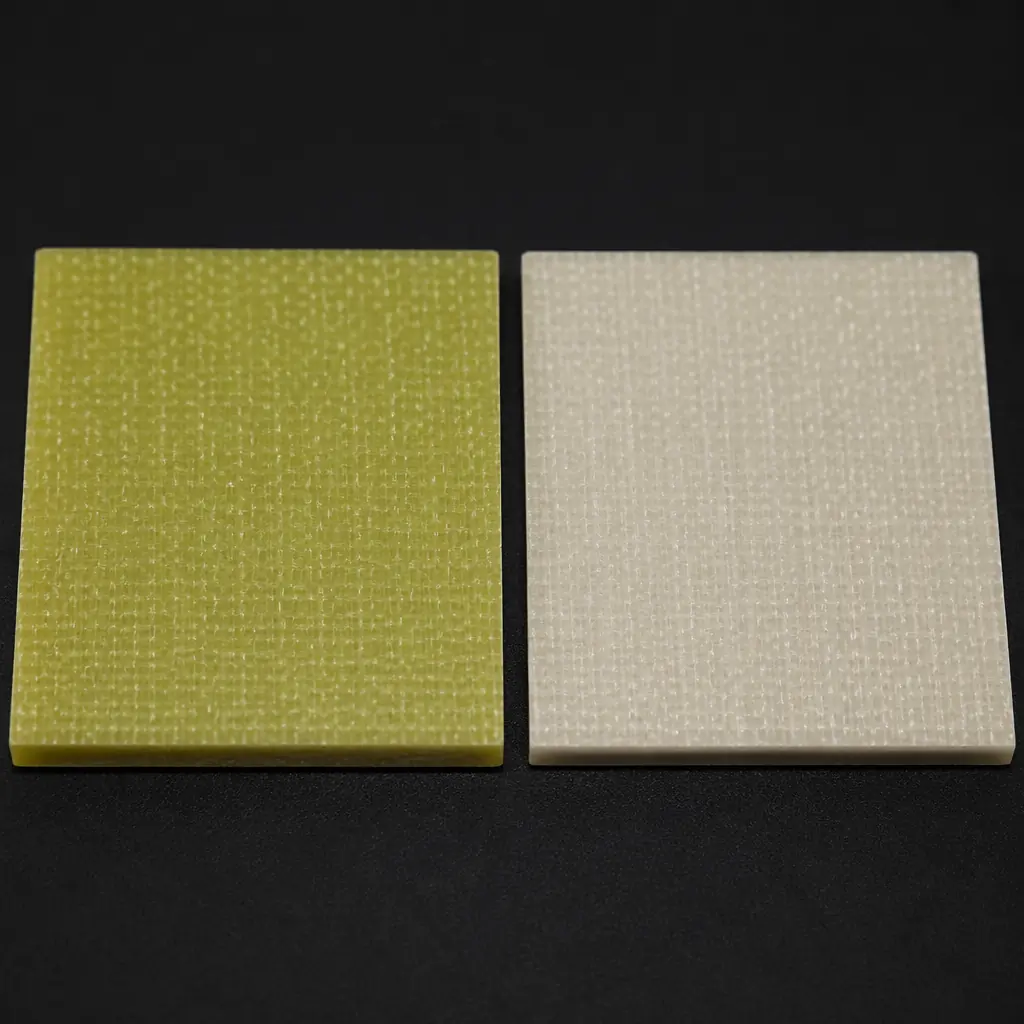
Standard FR-4 achieves its flame retardancy (UL 94 V-0 rating) through TBBPA, roughly 15-20% by weight of the epoxy resin. Halogen-free laminates replace TBBPA with phosphorus-based or nitrogen-based flame retardants, which form a char layer during combustion instead of releasing halogen gases. But these alternative chemistries change the laminate's electrical, thermal, and mechanical properties, sometimes for the better, sometimes not.
| Property | Standard FR-4 (TBBPA) | Halogen-Free FR-4 (Phosphorus) | Mid-Tg Halogen-Free | High-Tg Halogen-Free |
|---|---|---|---|---|
| Tg (Glass Transition) | 130-140°C | 140-150°C | 150°C | 170-180°C |
| Td (Decomposition) | 310°C | 340-350°C | 350°C | 360°C |
| Dk @ 1 GHz | 4.3-4.6 | 4.2-4.5 | 4.1-4.3 | 3.9-4.1 |
| Df @ 1 GHz | 0.018-0.022 | 0.013-0.017 | 0.012-0.015 | 0.009-0.012 |
| Z-axis CTE | 50-70 ppm/°C | 45-55 ppm/°C | 40-50 ppm/°C | 35-45 ppm/°C |
| Relative Cost | 1.0x (baseline) | 1.15-1.25x | 1.3-1.4x | 1.5-1.8x |
The good news: halogen-free laminates typically have better electrical performance than standard FR-4. The phosphorus-based flame retardant system produces a lower dielectric constant (Dk) and dissipation factor (Df), which improves signal integrity, an unexpected benefit for high-speed digital designs. The bad news: they cost 15-80% more depending on the Tg grade, and the phosphorus chemistry makes the laminate slightly more hygroscopic (moisture-absorbing), which means moisture sensitivity handling during assembly becomes more critical. For designs requiring premium electrical performance anyway, IoT, 5G, automotive radar, the electrical advantage can partially offset the material cost premium.
Practical advice: For a standard 4-layer PCB (100 × 100 mm, 2,000 pieces), switching from standard FR-4 to halogen-free mid-Tg adds approximately $0.30-0.50 per board in material cost, about 8-12% of the total PCB unit cost. For comparison, the same PCB with ENIG surface finish instead of HASL adds about $0.50-1.50 per board. Halogen-free is often the smaller cost increment. See our PCB cost factors guide for a complete cost breakdown model.
How to Verify: Testing Methods and Documentation
You can't visually distinguish a halogen-free PCB from a standard one. The green solder mask looks identical, the laminate color is the same, and there's no marking on the board itself. Verification requires either analytical chemistry or a supplier you trust with a documented quality system. Here's the verification ladder, from most to least rigorous.
Ion Chromatography (IC), The Gold Standard
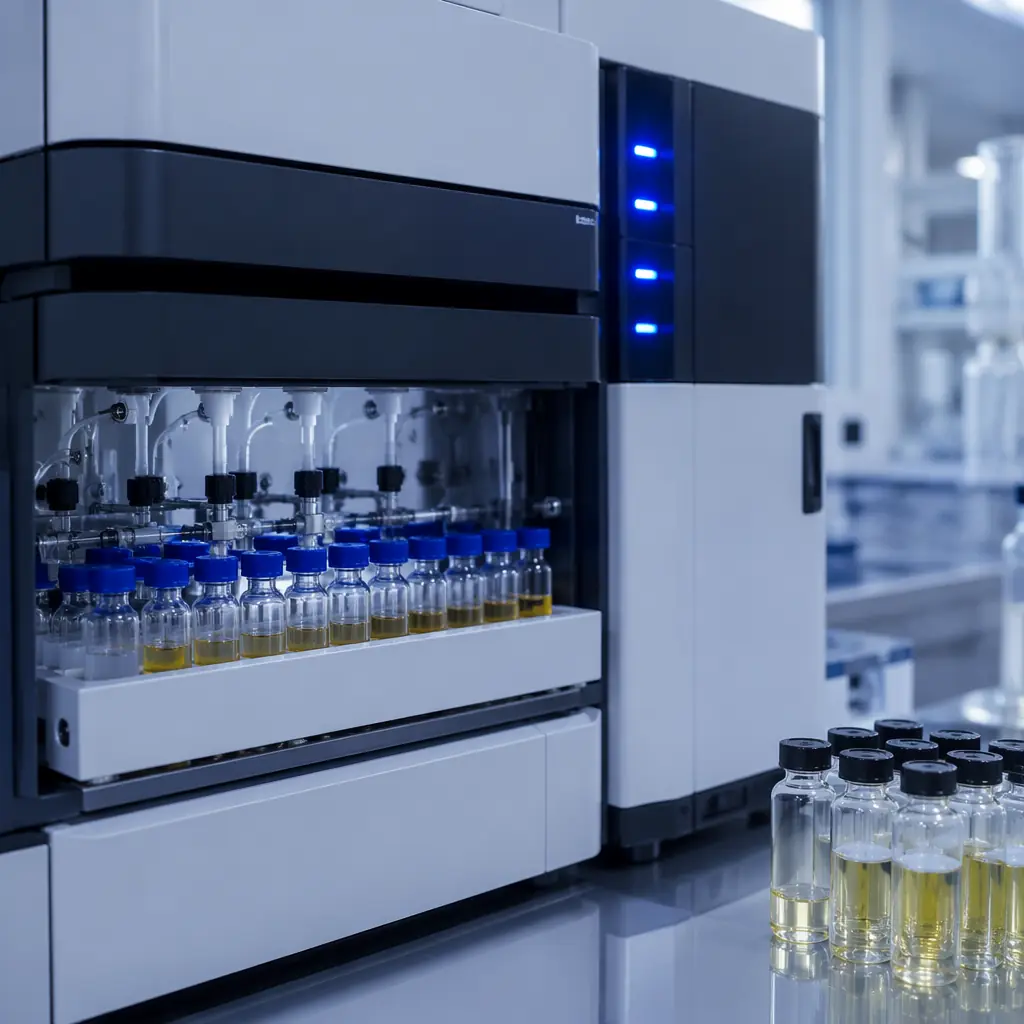
The PCB laminate sample is combusted in an oxygen bomb calorimeter, the combustion gases are absorbed in a solution, and the chloride and bromide ion concentrations are measured by ion chromatography. This method (per EN 14582) gives quantitative Cl and Br values in ppm with a detection limit of ~50 ppm. A passing result: Cl < 900 ppm, Br < 900 ppm, Cl+Br < 1,500 ppm. Ask your supplier for ion chromatography test reports from an ISO 17025-accredited lab, not an in-house certificate of compliance that merely states "halogen-free."
X-Ray Fluorescence (XRF), Screening Only
XRF can detect total bromine and chlorine in the PCB with a detection limit of ~100-200 ppm, but it cannot distinguish between halogenated flame retardants and other halogen sources (e.g., chloride ions from PCB fabrication chemicals, or bromine from the solder mask). XRF is useful as a quick incoming inspection screen, if XRF shows Br + Cl > 1,000 ppm on the bare laminate, it's likely not halogen-free. But a "pass" on XRF does not guarantee IEC 61249-2-21 compliance. For high-reliability applications, combine XRF screening with periodic IC verification. See our supplier quality scorecard guide for building verification into your supplier audit checklist.
Laminate Supplier Documentation, The Traceability Chain
The most practical verification path for volume production: require your PCB manufacturer to provide the original laminate manufacturer's certificate of analysis (CoA) for each batch. Major halogen-free laminate brands, Isola (DE156, DE104), Shengyi (S1150G, S1165), ITEQ (IT-180G2), EMC (EM-370), all provide batch-level ion chromatography data. The CoA must show the lot number, the Cl and Br ppm values, and the laminate standard (IEC 61249-2-21 or IPC-4101/126). At Huaxing, we maintain full material traceability from laminate lot number to finished PCB serial number for every halogen-free order.
How to Specify Halogen-Free in Your PCB RFQ
The most common mistake buyers make: writing "halogen-free" in the RFQ notes and assuming the supplier knows what that means. A responsible supplier will ask which standard you're referencing, IEC 61249-2-21, JPCA-ES-01, or an OEM-specific specification. A less rigorous supplier will ship standard FR-4 and call it halogen-free because the solder mask doesn't contain halogens. Here's the specification language that eliminates ambiguity.
Recommended RFQ specification text:
"All PCB laminate and prepreg materials shall comply with IEC 61249-2-21 halogen-free requirements: maximum chlorine (Cl) 900 ppm, maximum bromine (Br) 900 ppm, maximum total Cl+Br 1,500 ppm, measured by EN 14582 ion chromatography. Solder mask and legend ink shall also be halogen-free per IPC-SM-840 Class H. Supplier to provide laminate manufacturer's certificate of analysis (CoA) with lot-level ion chromatography data for each production batch. Third-party verification by ISO 17025-accredited laboratory required for first article inspection."
Also specify the laminate brand and type if your design requires specific electrical performance. For example: "Halogen-free laminate: Shengyi S1165 (Tg 170°C, Dk 3.95, Df 0.010 at 1 GHz) or equivalent, per IEC 61249-2-21." This ensures the supplier doesn't substitute a lower-Tg halogen-free laminate that meets the halogen limit but fails your thermal requirements. For designs with tight impedance control, reference our impedance control guide . The different Dk of halogen-free laminates means the impedance calculation must use the correct dielectric constant.
The Bottom Line: When to Pay for Halogen-Free
Halogen-free compliance is not a universal requirement, yet. For PCBs going into industrial equipment sold in markets without eco-label requirements and to customers without green procurement policies, standard FR-4 remains fully compliant with current regulations (RoHS, REACH). But if any of these apply to your product, halogen-free should be in your specification today: (1) you sell into the EU and your product life cycle extends beyond 2027, (2) your customer is a Fortune 500 OEM with published restricted substances specifications, (3) your product carries an eco-label (EPEAT, TCO, Blue Angel), or (4) your competitive positioning includes environmental sustainability as a differentiator. For a $0.30-0.50 per board cost increment on a typical 4-layer design, halogen-free is the cheapest supply chain insurance you can buy.
Ready to transition your PCB supply chain to halogen-free? Contact our engineering team with your current laminate specification, we'll recommend the halogen-free equivalent, provide a cost delta analysis, and ship first articles with full ion chromatography documentation. Also review our REACH, WEEE & TSCA compliance guide for the complete regulatory landscape affecting PCB materials, and our PCB certifications overview for the full audit and documentation framework.