In-circuit test and functional test are usually presented as a sequence: test the board electrically, then test the product behaviour. That sequence is not wrong, but it hides the decision that actually costs money, which is how much of each to buy and what a fixture is worth at your volume. Buyers who treat the choice as a preference between two technologies tend either to over-test small builds until the fixture dominates the unit cost, or to under-test large builds until field returns exceed the savings.
The choice is arithmetic, not philosophy. Each test method has a coverage profile, a fixed cost, a per-board cost and a failure mode of its own. This page sets out the coverage each method actually provides, itemises the cost structure that quotes rarely show, gives break-even volumes for four common combinations, and then reduces the decision to a rule that can be applied in a meeting without a spreadsheet. The individual test methods themselves, including flying probe and boundary scan, are described in flying probe versus ICT versus functional test, which this page assumes you have read.
The Question Buyers Actually Ask
The framing that produces a useful answer is not "which test is better" but "which defects do I expect, which of them can each method see, and what does each escape cost me". A board with 1,200 joints and a mix of analogue and digital content has a different expected defect population from a board with 200 joints and a single microcontroller. A board where a wrong-value resistor is a functional failure needs different coverage from a board where a wrong-value resistor changes a timing margin by 3 percent and passes everything.
Two numbers set the answer. The first is the cost of the fixture and the test programme, which is fixed and must be amortised across the volume of that specific design. The second is the field cost of one escaped defect, which is a property of your product, your customer and your warranty terms, and which you know better than any supplier does. Everything else is coverage, and coverage is where the methods differ most.
There is a third consideration that is rarely discussed in the same breath: what happens when the design changes. A fixture is built to a specific assembly, and every engineering change that affects a test point, a component position or a connector pinout may require a fixture change. On a product with an active change history, the fixture cost is not a one-off, it is a recurring charge, and that changes the break-even.
What Each Method Can And Cannot See
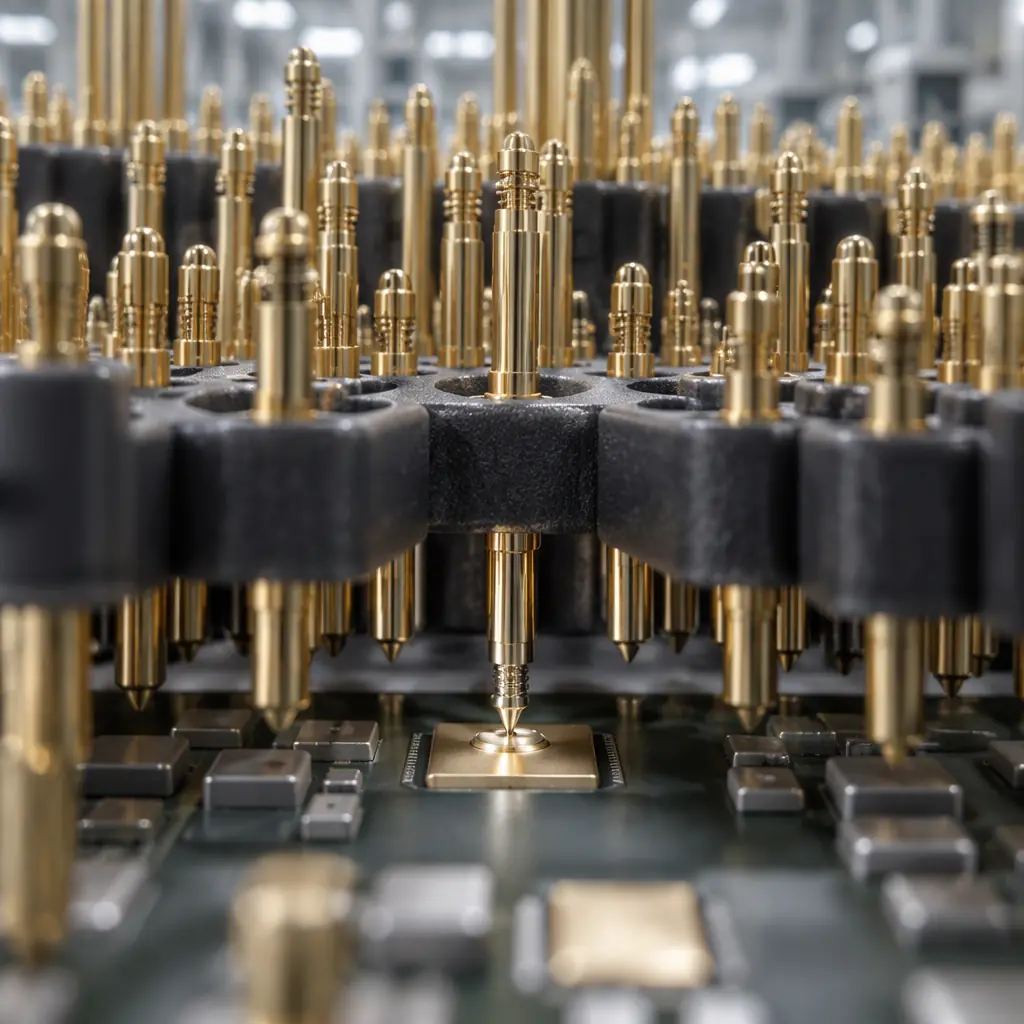
Every probe in a bed-of-nails fixture is a test point someone had to design in. Coverage is decided at layout, not at the fixture shop.
The coverage table below is the core of the decision. Read it as what each method can prove, not as what it is capable of in a demonstration. A method that can only access 60 percent of the nodes on a dense board provides 60 percent coverage in practice, whatever its technical ceiling.
| Defect | ICT / bed-of-nails | Flying probe | Boundary scan | Functional test |
|---|---|---|---|---|
| Open joint | Yes, per net | Yes, per net | Only on scan-chain nets | Only if functionally observable |
| Short between nets | Yes, per net pair | Yes, per net pair | Yes on scan nets | Sometimes, often as a symptom |
| Wrong component value | Yes with analogue measurement | Yes, slower | No | Only if value affects behaviour |
| Wrong component fitted | Detects electrically if value differs | Same as ICT | No | Only if functionally relevant |
| Missing component | Yes | Yes | No | Sometimes |
| Reversed polarity | Only in-circuit, powered | Same | No | Often the first thing it finds |
| Marginal analogue behaviour | Limited | Limited | No | Yes, within the test programme |
| Firmware or configuration | No | No | Indirectly, via JTAG | Yes |
| Assembly-level functional faults | No | No | No | Yes, within the test coverage |
Two conclusions follow immediately. ICT and flying probe are complementary to functional test rather than alternatives to it, because they prove the board is built correctly and functional test proves the product works. And the coverage of ICT is a function of test-point availability, which is decided at layout, so a design without test points cannot be tested even if the budget exists. That is the argument for design for testability discipline early rather than late, and the rules are in PCB design for testability.
Boundary scan deserves a separate note because it changes the economics on dense digital boards. Where the devices on a board support IEEE 1149.1, a scan chain can test interconnects between devices without any physical test access, which removes the probe density problem that makes bed-of-nails fixtures expensive on fine-pitch assemblies. It cannot test analogue sections or passive values, so it complements rather than replaces ICT, but on a board with several large digital devices it can cut the node count a fixture needs to reach and therefore cut the fixture cost substantially.
The Cost Structure Nobody Itemises
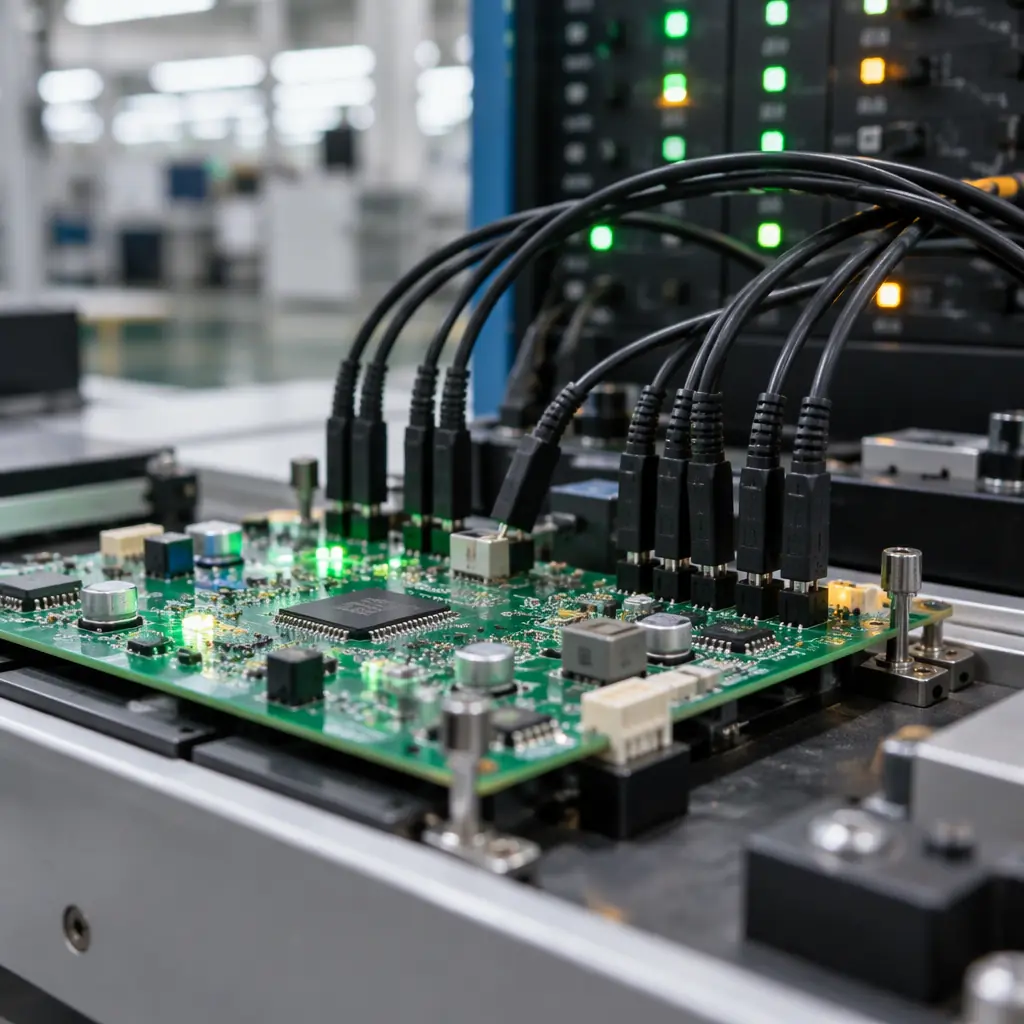
A functional test station is mostly engineering time. The instrument is the cheap part.
Quotes usually present test as a per-board charge. That charge hides five cost elements that behave very differently with volume, and until they are separated the decision cannot be made properly.
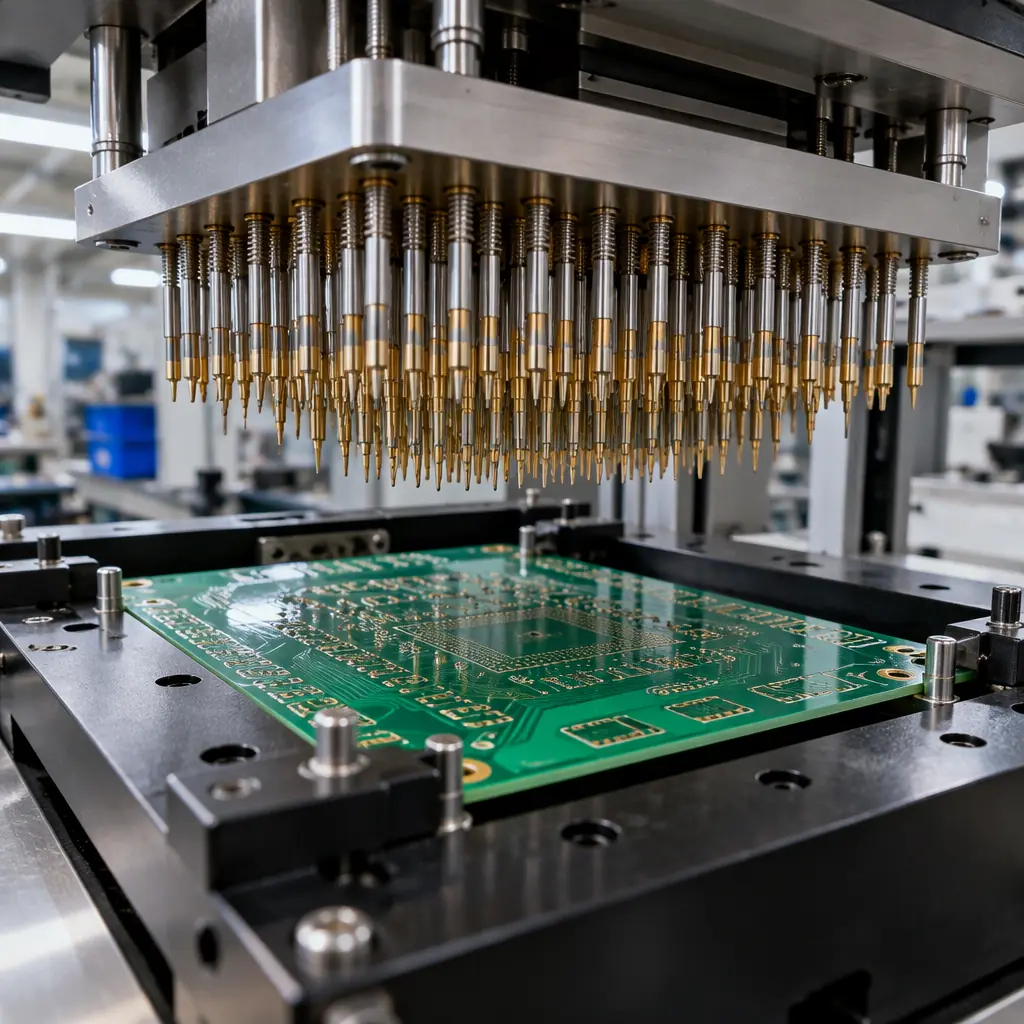
Fixture NRE is the first: the design and build of the bed-of-nails fixture, the probe selection, the drilling and the mechanical frame. On a mid-complexity board with 600 to 900 accessible nodes, that is a four to six week exercise and a substantial fixed cost, and it is specific to the assembly. Any change to the board that moves a test point invalidates part of it.
Test programme development is the second: writing the tests, setting limits, establishing the golden unit, correlating measurements and validating that the programme passes good boards and fails known-bad ones. On analogue content this is where most of the engineering hours go, because limits have to be set from measurement distributions rather than from component tolerances.
Test time per board is the third, and it is the element that makes high-volume decisions different from low-volume ones. ICT is fast per board because the fixture contacts all nodes at once; functional test is slow because it sequences behaviour. A functional test that takes 90 seconds on a 30-second takt time requires two stations, which doubles the equipment and the floor space.
Maintenance and calibration is the fourth. Probes wear, fixtures go out of alignment, test programmes drift as components change supplier. Fixture maintenance is a recurring cost that grows with the number of part numbers in production, not with volume, so it hurts high-mix operations disproportionately.
The fifth is the cost of the fixture arriving late. If a first article is due and the fixture is not ready, the alternatives are to ship untested, to test manually at high cost, or to hold the build. All three are expensive and none of them appear in the per-board quote. Where a fixture is built, the cost of the test cell it occupies is a separate line again: fixtures are the subject of PCBA test fixtures and their cost, and the end-of-line station that usually sits beside them is covered in end-of-line functional test.
Break-Even By Volume
The table below uses representative figures for a 900-joint mixed-technology industrial board: an ICT fixture at USD 9,000 fixed with a per-board test cost of USD 0.55, a functional test station at USD 4,000 for the harness and programme with a per-board cost of USD 2.20 driven by 90 seconds of station time, and a flying probe alternative with no fixture but USD 3.50 per board and a much lower throughput ceiling. Treat the absolute numbers as a shape, not a quote.
| Annual volume | ICT only | FCT only | ICT + FCT | Flying probe + FCT |
|---|---|---|---|---|
| 100 boards | USD 9,055 | USD 4,220 | USD 13,275 | USD 4,350 |
| 1,000 boards | USD 9,550 | USD 6,200 | USD 15,750 | USD 5,700 |
| 10,000 boards | USD 14,500 | USD 26,000 | USD 31,500 | USD 39,000 |
| 100,000 boards | USD 64,000 | USD 224,000 | USD 279,000 | USD 354,000 |
| Unit cost at 1,000 | USD 9.55 | USD 6.20 | USD 15.75 | USD 5.70 |
| Unit cost at 100,000 | USD 0.64 | USD 2.24 | USD 2.79 | USD 3.54 |
The shape of that table is the whole argument. At 1,000 boards a year the fixture is a tax on the program and flying probe plus functional test is the cheapest route, which is why low-volume high-mix work is dominated by probe and functional test. At 100,000 boards the fixture has been amortised to almost nothing and ICT becomes the cheapest per-board option, while functional test becomes the dominant cost because it is the slowest step. The crossover for this particular board sits somewhere between 3,000 and 6,000 boards a year, and it moves with fixture complexity: a 2,000 node fixture pushes it much higher, a 300 node fixture pushes it much lower.
There is a second break-even that matters more than the fixture: the volume at which adding a test stage pays for itself by reducing escapes. If the fixture plus programme costs USD 13,000 and reduces the escape rate from 3 percent of boards to 0.2 percent, the annual saving is the difference multiplied by the field cost per escape. At 10,000 boards and a field cost of USD 400, that is 280 escapes avoided, or USD 112,000, against a cost of USD 31,500. At 1,000 boards the same calculation gives USD 11,200 of avoided field cost against USD 15,750 of test cost, which is a loss, and the case for testing at that volume has to be made on customer requirement or on safety rather than on arithmetic.
Key takeaway: Fixture economics favour volume, functional test economics favour coverage and speed of setup, and flying probe economics favour variety. The expensive mistake is applying a high-volume strategy to a low-volume program because the test name sounds more thorough.
The Cost of An Escape You Did Not Test For
The field cost per escape is the number that justifies or destroys every test decision, and it is almost always larger than buyers estimate. It has five components, and on industrial and medical products the last two dominate.
The direct components are return freight, diagnosis labour, replacement hardware and the labour to fit it. On a product installed at a customer site rather than shipped to a distributor, add travel and downtime. These are visible and usually counted.
The less visible components are the administrative cost of the complaint, the engineering time spent on root cause when the failure rate is low enough to be treated as a one-off, and the effect on the next award. On a build where a customer runs a supplier scorecard, an escape is measured in defect escape rate and affects the position on the approved list, which is a cost that does not appear in any warranty report.
The most expensive escape is the one that is intermittent. A marginal joint that passes ICT because it is continuous at room temperature and fails at 70 degrees in the field cannot be found by any amount of re-testing at the factory, and it cannot be reproduced reliably in failure analysis. On these defects, coverage of the right kind at the factory is not a cost optimisation, it is the only defence, because the field cannot diagnose them and the customer cannot be convinced the boards were ever good.
A Decision Rule You Can Apply In Ten Minutes
The following rule reproduces the outcome of the tables above without arithmetic. It assumes the board is already designed with reasonable test access; if it is not, fix that first, because every option gets worse without it.
If annual volume is under 1,000 and the design has fine-pitch parts without full test access, use flying probe plus functional test. The fixture cannot be justified and the design probably will not support it anyway.
If annual volume is between 1,000 and 5,000, use functional test as the primary gate and add ICT only if the expected defect population includes wrong-value or missing passive components that functional test cannot observe. On this band the fixture is justified by coverage rather than by cost, and the buyer should say so explicitly rather than pretend it is a saving.
If annual volume is above 5,000 on a stable design with limited change history, use ICT plus functional test. At this volume the fixture is amortised within the first year, ICT carries the structural coverage and functional test carries the behavioural coverage, and the combination is cheaper than the field returns it prevents.
If the design is dense digital with several devices supporting IEEE 1149.1, add boundary scan at any volume. It reduces the node count a fixture must reach, which reduces fixture cost, and it catches interconnect faults that would otherwise need probe access the board does not have.
In every case, run one calculation before the award: the annual cost of escapes at your current or expected escape rate, against the annual cost of the test stage under discussion. If the test stage costs more than the escapes it prevents, buy it anyway if the customer requires it, and say so. A quality decision presented honestly is defensible; a cost saving that does not exist is not.
Test Strategy As A Purchasing Decision
ICT and functional test are not rivals. ICT and flying probe prove the board is physically and electrically built the way the design says; functional test proves the product behaves the way the specification says. The decision that carries the money is where the crossover sits for your volume and your design's change history, and that crossover is arithmetic once the fixture cost, the test time and the field cost per escape are written down.
At Huaxing PCBA test strategy is set at NPI with the customer rather than quoted as a line item: bed-of-nails fixtures are built in-house to the assembly, functional test harnesses and programmes are developed with a golden unit and validated against known-bad boards, and flying probe is used where volume or design access does not support a fixture. First article packages under first article inspection include the test programme validation, so coverage is demonstrated rather than asserted. If you have a build where the test line is dominating the cost or where field returns suggest coverage is thinner than assumed, send the BOM, the board and your current test flow through the quote form and we will price the four combinations against your actual volume.