Scrap the intuition that an AQL number tells you how many bad boards you are agreeing to accept. It does not. AQL 1.0 does not mean one percent of the lot may be defective; it means a specific sampling plan will accept, with a stated probability, a lot whose true defect rate sits at or just below that level, and will reject most lots above it. The plan is a pair of numbers, accept and reject, derived from lot size and inspection level. Get the lot definition wrong and every downstream number is wrong with it.
That is where most PCB and PCBA purchase orders fall apart. A clause of "AQL 1.0" copied from a fastener supplier's quality agreement is not enforceable against a supplier who ships 40 panels of a four-up design in one carton, and then 600 assembled boards built from those panels three weeks later. Those are two different lots, two different defect populations and, if you are honest about it, two different sampling plans. Huaxing PCBA works to documented AQL plans inside our control plans and applies IPC-6012 acceptance to bare board and IPC-A-610 Class 2 or 3 to assembly, and the gap between a buyer's clause and what the factory measures is one of the recurring causes of quality disputes we see on inherited programmes.
What an AQL Clause Actually Promises
Three numbers define the plan: the lot, the inspection level, and the AQL value per defect class. Nothing else moves the sample size. The tables in ISO 2859-1 convert those three inputs into a code letter, a sample size, and an accept/reject pair. If any one of the three is missing from the purchase order, the clause is not a plan; it is a phrase that lets both sides interpret the result however suits them after a rejection.
The confidence claim is worth stating plainly because it is routinely overstated. At inspection level II with AQL 1.0 on a 3,200-unit lot, the plan samples 125 units and accepts at three defects. That plan has roughly a 95 percent chance of accepting a lot whose true defect rate is 1.0 percent, and a 10 percent chance of rejecting the same lot on sampling noise alone. It has a much lower chance of accepting a lot running at 5 percent, but it is not zero. Sampling is a filter with known holes, not a guarantee. Any supplier who presents an AQL certificate as proof that zero bad units shipped is describing a plan they do not have.
| Element | What it fixes | Consequence when left out of the PO |
|---|---|---|
| Lot definition | Which units count as one inspection batch | Buyer counts the order, factory counts the build day, sample sizes differ by 3x |
| Inspection level | Sample size for a given lot size | Supplier defaults to Level I, buyer assumed Level II, protection halves |
| AQL per class | Accept/reject boundary for critical, major, minor | All defects pooled into one class, majors pass on the minor allowance |
| Acceptance standard | What counts as a defect at all | Cosmetic disagreements become commercial disputes |
The fourth row is the one buyers forget. A defect count means nothing without an acceptance standard defining the defect. IPC-A-610 Class 2 and Class 3 give different verdicts on the same fillet, so the class must be named in the same sentence as the AQL. Our IPC Class 2 vs Class 3 comparison covers where those verdicts diverge in practice.
Lot Size for Panels, Kits and Daily Builds
Bare board and assembly rarely share a lot structure, and treating them as one order is the most common source of nonsense numbers in a quality agreement.
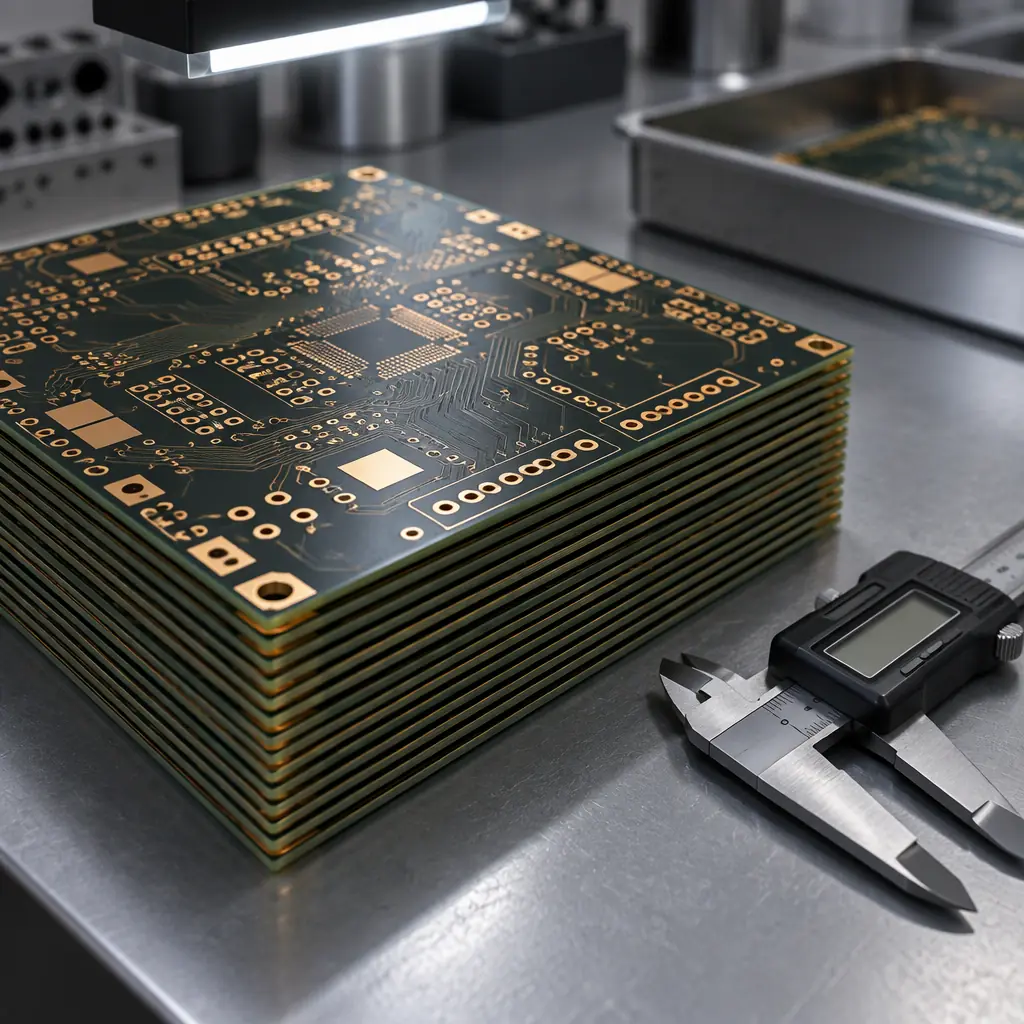
A bare-board lot is a fabrication lot: one panel design, one laminate batch, one plating run. If you order 500 boards from a four-up panel, the deliverable is 125 panels plus 25 spares, and the inspection population the factory can actually sample is the 150 panels, not the 500 finished pieces. Some of those panels will be routed apart later; at incoming inspection they are still panels. Sampling 500 pieces from a stack of 150 is not a sampling plan, it is arithmetic error.
An assembly lot is a build lot: one part number, one BOM revision, one production day. A buyer who releases 6,000 boards over three weekly builds has three lots, and a supplier who pools them into one inspection has quietly tripled the lot size and, with it, the sample. Pooling is not generous; it dilutes a bad week across two good ones.
High-mix programmes break the model differently. A lot of 12 boards of one part number and 8 of another is not a lot of 20; it is two lots at code letter A with a sample size of 2, and a sample of 2 proves almost nothing. For high-mix, low-volume work the useful control is not AQL at all but first-article inspection plus a documented process check, which is why FAI on the first panel of every build carries far more weight than a nominal sample on a 12-piece lot.
| Lot size (units) | Code letter, Level II | Sample size | AQL 0.65 Ac/Re | AQL 1.5 Ac/Re |
|---|---|---|---|---|
| 9-15 | A | 2 | 0 / 1 | 0 / 1 |
| 26-50 | C | 5 | 0 / 1 | 0 / 1 |
| 91-150 | F | 20 | 0 / 1 | 1 / 2 |
| 281-500 | H | 50 | 1 / 2 | 2 / 3 |
| 1,201-3,200 | K | 125 | 2 / 3 | 5 / 6 |
Read the first two rows honestly. A 40-panel order at Level II samples five panels. Five panels of a four-up design covers 20 board positions out of 160, and every defect class except the most egregious will pass. This is not a supplier failing you; it is the table telling you that sampling cannot police a small lot. Small lots need different tools: 100 percent electrical test, a documented AOI recipe with escape rate history, and a first-article record you can audit. See the general AQL guide for the full table set and the worked three-parameter example.
Two Defect Tables, Not One
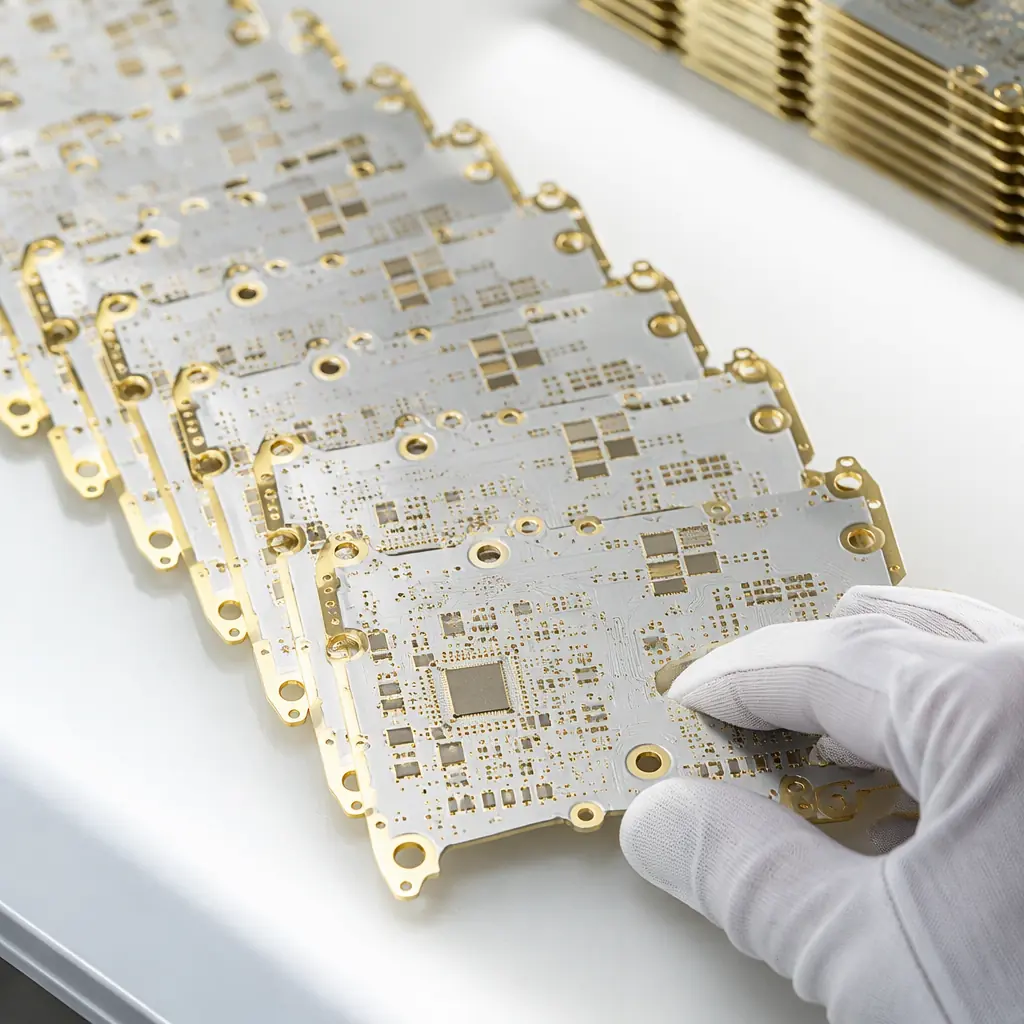
Bare board and assembly fail in different ways, so the same defect class carries different weight on each. A minor solder mask scratch on a bare board may be invisible after assembly; the same scratch over a gold finger is a scrapped panel. Collapsing both into one table is why buyers end up arguing about cosmetic defects while a functional one passes.
| Class | Bare board (IPC-6012) | Assembly (IPC-A-610 Class 2/3) | Typical AQL |
|---|---|---|---|
| Critical | Wrong laminate or Tg, missing copper on a power layer, delamination through a via | Reversed polarity, wrong component, counterfeit part, bridge on mains voltage | 0, accept on zero |
| Major | Annular ring below minimum, plating void exceeding 25 percent of wall, bow beyond the specified limit | Insufficient wetting, tombstone, missing component, voiding above the class limit | 0.65 - 1.0 |
| Minor | Silkscreen offset, solder mask scuff outside a land, legend smear | Component offset within tolerance, minor flux residue, cosmetic mark | 1.5 - 2.5 |
Two practical consequences follow. First, write the class reference into the clause, not just the AQL, because the AQL presupposes a definition of defect that only the standard supplies. Second, do not let a cosmetic class absorb functional failures. A solder joint that passes visual but fails functionally is a major defect regardless of how it looked, which is exactly the gap a joint defect taxonomy is meant to close.
Zero Acceptance Plans: the Numbers Behind C=0
Every few years a buyer discovers the C=0 plans and proposes replacing AQL with them, on the reasoning that accepting any defect is unacceptable. The plans are legitimate and they do what they claim, but the sample sizes are the part that gets left out of the proposal.
A conventional AQL 1.0 plan on a 3,200-unit lot samples 125 boards and accepts at three defects. The C=0 equivalent holding roughly the same consumer risk, at a lot tolerance percent defective of 1.0 percent, needs a sample near 230 boards with an accept number of zero. On a 3,200-board order that is 230 full inspections instead of 125, and the lot is rejected on the first defect found rather than the fourth. That is a real tightening of the plan, and it costs real inspection hours, which in a high-mix shop is often the tightest resource on the line.
The correct use is selective. Apply C=0 to the defect class that actually hurts: critical and major on safety-relevant assemblies, connector or press-fit populations where one bad unit takes down a system, and any part number with a recent escape history. Leave the cosmetic class on a conventional AQL, because rejecting a 3,200-unit lot for a silkscreen smear is not quality discipline, it is a supply interruption. Our OQC process guide shows how that split is documented at the shipping gate.
Switching Rules and What Happens After a Reject
Most quality agreements stop at the accept/reject numbers and never say what changes after a rejection, which leaves the supplier free to inspect the next lot exactly as before and the buyer with no mechanism to tighten. ISO 2859-1 supplies the mechanism: normal, tightened and reduced inspection, with defined triggers.
After two lots out of five are rejected on original inspection, the plan moves to tightened inspection, which for the same lot size roughly doubles the sample and reduces the accept number. The supplier stays on tightened until five consecutive lots are accepted, then returns to normal. Reduced inspection is the other direction: ten consecutive accepted lots can qualify a supplier for a smaller sample, which is where a well-run programme recovers its inspection hours.
Write the trigger into the agreement in one sentence, with the counting rule stated. Two rejections in five consecutive lots of the same part number is standard, but the phrase "consecutive" and whether a skip-lot counts as accepted are both open to interpretation, and both get argued about after the fact. If your factory runs a control plan with SPC charts on the critical characteristics, reduced inspection should be tied to those charts staying in control, not to a run of lucky lots.
The Clause to Put in the Purchase Order
The enforceable version of an AQL term is short and specific. It names the lot, the level, the standard, the class and the switching trigger, in that order, and it sits next to the acceptance criteria rather than buried in a general terms annex.
A working form: sampling per ISO 2859-1, general inspection level II, lot defined as one part number from one production day not exceeding 5,000 units. Critical defects AQL 0 with accept on zero; major defects AQL 0.65; minor defects AQL 1.5. Acceptance criteria per IPC-6012 Class 2 for bare board and IPC-A-610 Class 2 for assembly, with the class named for each. Tightened inspection applies after two rejections in five consecutive lots. Records of sample size, defects found, and the accept/reject decision are supplied with each shipment.
The last sentence is the one that gets results. A plan without records cannot be audited, and an unauditable plan reverts to whatever the supplier says it did. Ask for the sample size and defect count on the shipping documents, and reconcile them against the table for the lot size you were actually shipped. That single reconciliation catches more quality-term failures than any additional paragraph of contract language, and it pairs naturally with the documentation expectations in a pre-shipment inspection routine.
Summary
An AQL is a plan, not a promise. It needs a lot definition that matches how the factory builds, an inspection level, a defect class table per product stage, the acceptance standard named beside it, and a switching rule that tightens the plan after a rejection. On small panel lots the table itself will tell you sampling cannot police the order, which is the signal to lean on first-article inspection and electrical test instead of a nominal sample size. On large assembly lots the plan works, but only if the major class cannot hide inside the minor allowance.