
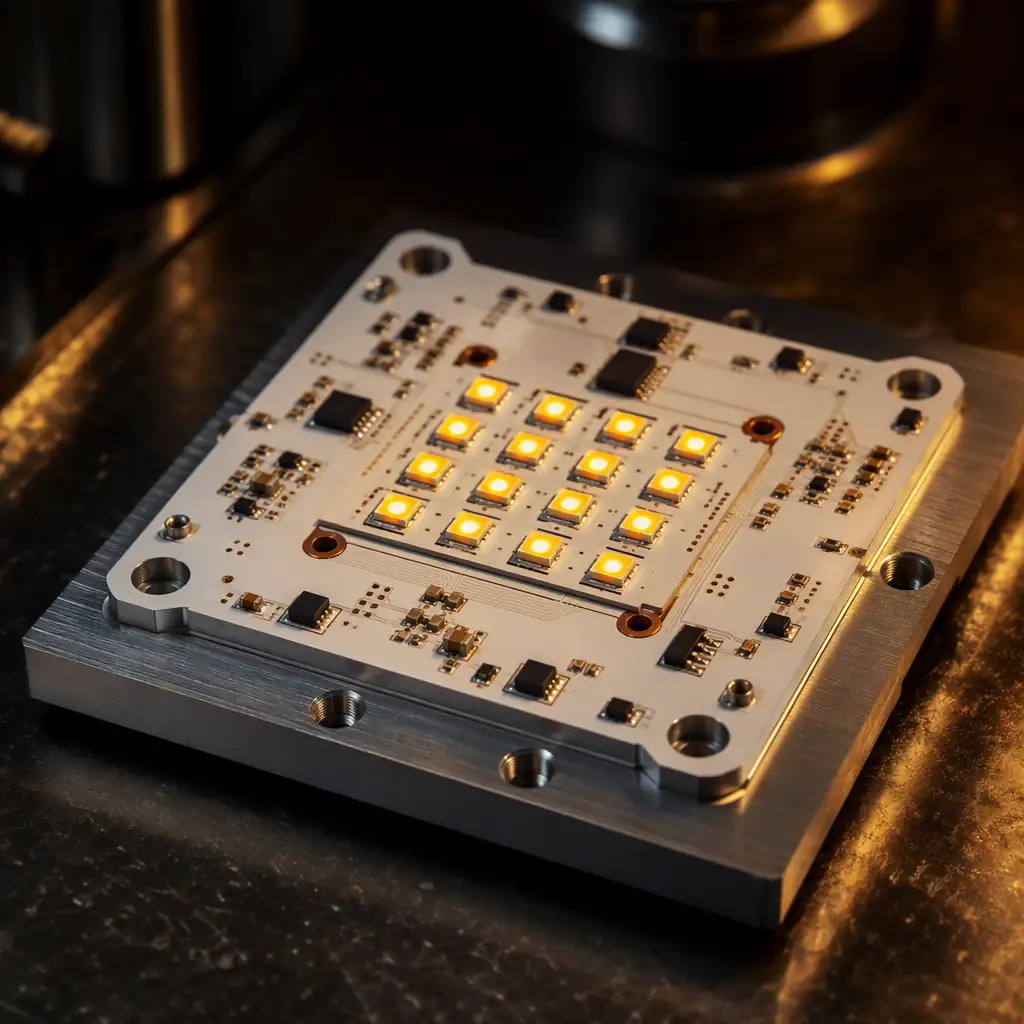
PCB Types / Aluminum MCPCB
Aluminum metal-core PCBs (MCPCBs) solve the fundamental challenge of high-power electronics: getting heat out. With an aluminum base plate bonded to the circuit layer through a thermally conductive dielectric, MCPCBs eliminate the need for separate heatsinks in LED lighting, power supplies, and automotive electronics.
Technology Overview
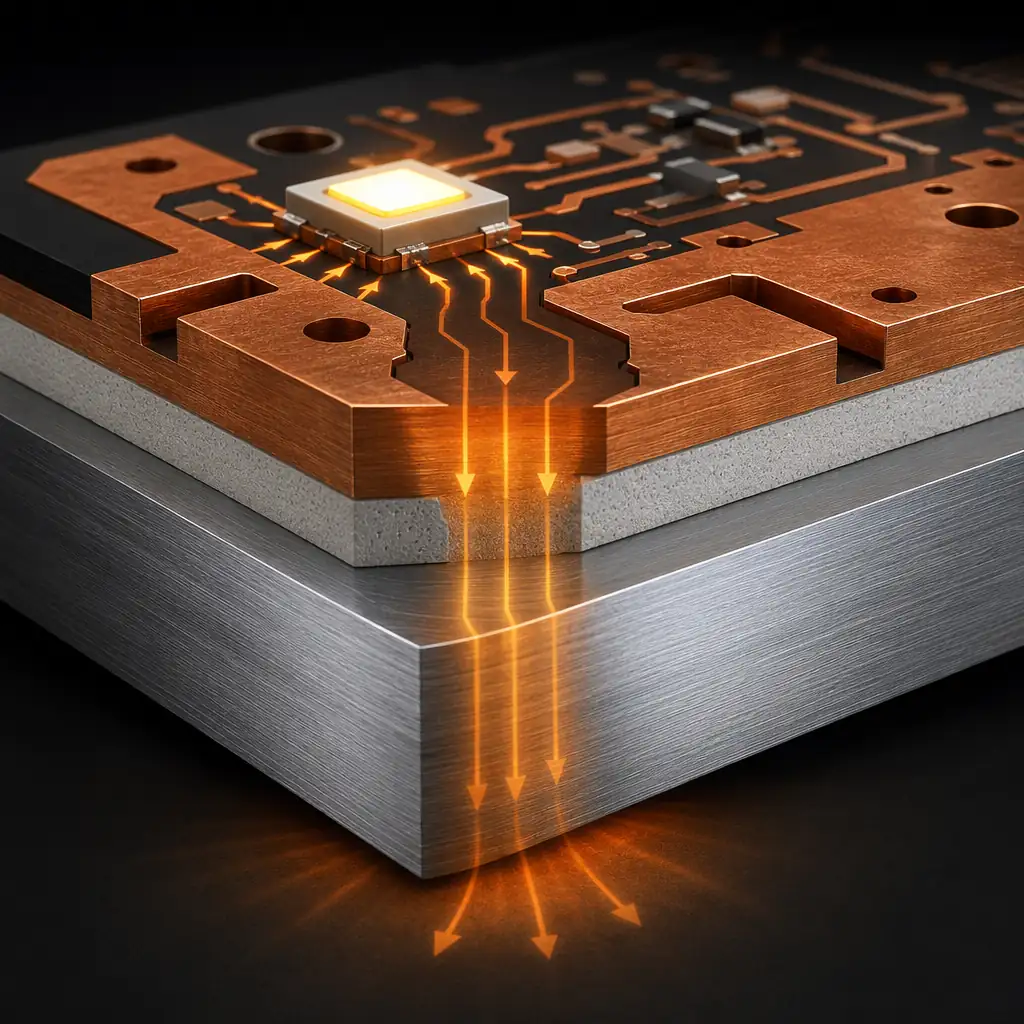
A metal-core PCB replaces the traditional FR-4 base with an aluminum (or copper) plate. The circuit layer is separated from the metal base by a thin dielectric layer that is electrically insulating but thermally conductive. Heat generated by components conducts through the dielectric into the aluminum base, which acts as a built-in heat spreader.
Our standard MCPCB uses a 0.8-3.0mm aluminum base with a 75-150µm thermally conductive dielectric (1-3 W/m·K). For extreme thermal applications, copper-core (380 W/m·K) and ceramic substrates are available as alternatives.
Technical Specifications
| Number of Layers | 1 – 4 circuit layers (single-sided most common; 2-4L with thermal vias) |
| Aluminum Base Thickness | 0.8 – 3.0 mm; 1.0 / 1.5 / 2.0 mm standard stock |
| Aluminum Alloy | 5052 (standard) · 6061 (higher strength); Cu base option for >3 W/m·K |
| Dielectric Thickness | 75 – 150 µm; 100µm most common |
| Thermal Conductivity | 1.0 / 1.5 / 2.0 / 3.0 W/m·K (dielectric-dependent) |
| Breakdown Voltage | >3 kV AC (100µm dielectric); >5 kV for 150µm |
| Copper Weight (Circuit) | 1 – 4 OZ (35 – 140µm); 3-4oz common for high-current LED |
| Min. Trace / Space | 6 / 6 mil (1oz); 8/8 mil (2oz); 10/10 mil (3oz+); laser-cut for fine features |
| Solder Mask | White (standard for LED reflectivity) · Black · Green |
| Surface Finish | ENIG · OSP · HASL (Pb-free) · Immersion Ag |
| Via Types | Through-hole only (no blind/buried in MCPCB); PTH isolated from Al base |
| Quality Standard | IPC-6012 Class 2 · IPC-6018 · IATF 16949 · UL |
The most common MCPCB type, LEDs or power components on the circuit side, aluminum base on the bottom. Used in LED downlight, street light, floodlight, and automotive headlamp modules.
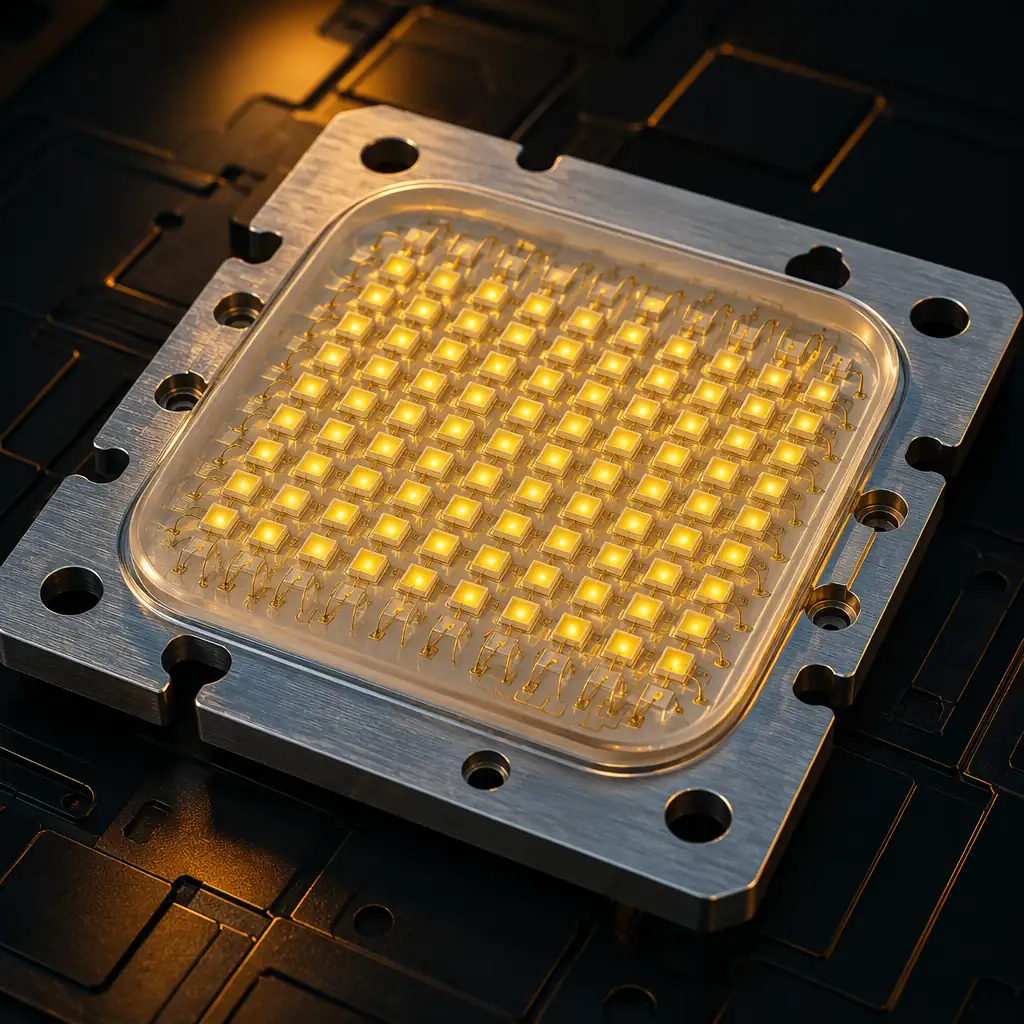
LED dies are directly bonded to the aluminum base through a cavity in the dielectric, achieving the lowest thermal resistance path. Used in high-power COB LED arrays where junction temperature is critical.
Two circuit layers separated by an insulating layer, with aluminum base bonded to one side. Allows routing on both sides. PTH connects layers but must be isolated from the Al base.
For extreme thermal applications: copper base replaces aluminum for 100× better thermal conductivity. Used in laser diode, IGBT module, and high-power RF amplifier applications where aluminum is insufficient.
Manufacturing Process
The critical step in MCPCB manufacturing is bonding the copper circuit layer to the aluminum base through the thermally conductive dielectric. We use a vacuum lamination press to ensure void-free bonding. Any air bubbles in the dielectric create hot spots that can cause thermal runaway and component failure.
Downlight, floodlight, street light, grow light, UV-C LED
Headlamp LED, DRL, fog lamp, interior ambient
AC-DC adapter, LED driver, PoE injector, SMPS
5G AAU PA carrier, RF power amplifier, antenna module
Motor drive, IGBT module, solid-state relay
Surgical light, dental curing, phototherapy device
Tell us your thermal requirements, LED configuration, and aluminum base thickness. We'll review your design for MCPCB manufacturability within 24 hours.
Tell us layers, thermal conductivity needed, Al base thickness, quantity. Free DFM within 24h.