
Every contract manufacturer knows what a changeover costs. Almost none of them show it to the customer, which is why the same board can come back at two different prices depending on order size and be defended as "panelisation" or "material pricing". The real driver is setup, and setup is measurable to within a few minutes if the line is instrumented.
Changeover matters to buyers for a specific reason: it is the mechanism by which small orders become expensive. A 50-board order and a 5,000-board order of the same product carry the same setup, but only one of them has enough units to absorb it. Understanding where that crossover sits lets a buyer consolidate orders deliberately instead of discovering the penalty at quotation.

The Activities Inside a Changeover
A changeover is not one action. It is a sequence of eight to twelve activities, some of which scale with the number of unique part numbers and some of which do not. Splitting them is the only way to quote setup credibly.
Line stop and board clearance
Finishing the boards already on the line, clearing the reflow oven and cooling it if a profile change is required. This is a fixed 20 to 40 minutes and is unaffected by how complex the next product is. Ovens with a profile library avoid the full cooling cycle and save roughly 15 minutes.
Feeder removal and replenishment
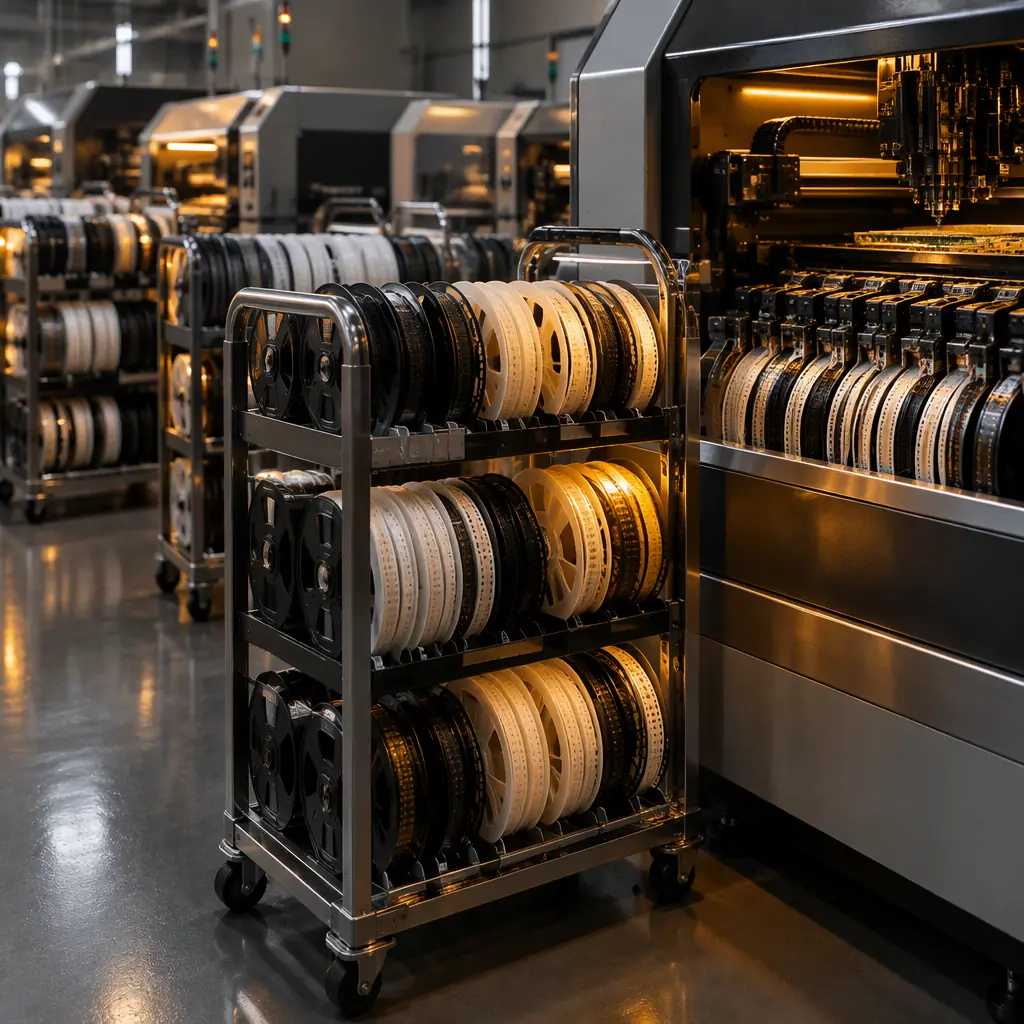
Removing the previous product's feeders and loading the new set. The variable that matters is the number of new part numbers, not the total BOM line count. Reels that are common between products stay on the cart. In a high-mix environment where consecutive products share 60 percent of their parts, this activity runs 25 to 45 minutes; where they share nothing, it runs 60 to 90 minutes.
Stencil change and printer setup
Unclamping, cleaning, loading and aligning the stencil, then verifying paste deposit by SPI. Typically 15 to 25 minutes per side on a double-sided build. This is the activity where a second printer earns its capital cost in a high-mix plant.
Program load and first-article build
Loading the placement program, running the first panel, and inspecting it against the golden sample. The first-article step is not optional and it is not fast: 20 to 40 minutes including the inspection. Every rejected first article adds a stencil clean and a re-run.
AOI program change and verification
Loading the inspection program and verifying it does not false-call on the new product. Call it 10 to 20 minutes, and note that a new AOI program with untuned thresholds can hold up the line for far longer than the changeover itself.
Adding the non-variable activities gives a floor of roughly 60 to 90 minutes that no amount of skill removes. The variable activities add 30 to 120 minutes depending on part-number overlap and product complexity. A realistic mid-complexity changeover therefore lands between two and four hours of line time.
Converting Line Hours into Money
Line time has a cost whether or not it is producing. For a mid-range SMT line the internal burden rate sits around USD 120 to 220 per hour once equipment depreciation, floor space, utilities and operator labour are counted. Setup labour is not additive because the operators are already paid for the shift, which is exactly why setup cost is invisible on a quotation: it is absorbed into overhead and reappears as a margin decision.
Take a three-hour changeover on a line burdened at USD 160 per hour. The direct cost is USD 480. If the line could otherwise run at 400 boards per hour with a contribution margin of USD 2.00 per board, the opportunity cost of the changeover is another USD 2,400. That second number is the one that explains small-order pricing, and it is the one buyers never see.
The Batch Size Where Changeover Stops Dominating
The useful calculation is setup cost per board as a percentage of unit price, or equivalently the share of line time spent on setup. A common planning target in high-mix plants is to hold changeover below 10 percent of available line time per product run.
| Batch size (boards) | Line time at 400/hr | Setup as share of run time | Setup cost per board |
|---|---|---|---|
| 50 | 0.13 hr | 2,400 percent | USD 9.60 |
| 250 | 0.63 hr | 480 percent | USD 1.92 |
| 1,000 | 2.5 hr | 120 percent | USD 0.48 |
| 3,000 | 7.5 hr | 40 percent | USD 0.16 |
| 12,000 | 30 hr | 10 percent | USD 0.04 |
The 10 percent target is crossed at roughly 12,000 boards for a three-hour changeover and 400 boards per hour, which is a bigger number than most buyers expect. That does not mean small orders are uneconomic, only that they carry a visible per-board penalty and should be planned around. The same arithmetic at a one-hour changeover crosses 10 percent at about 4,000 boards, which is why reducing setup time is the single highest-leverage improvement available to a high-mix plant.
Four Changes That Cut Setup Without Buying Equipment
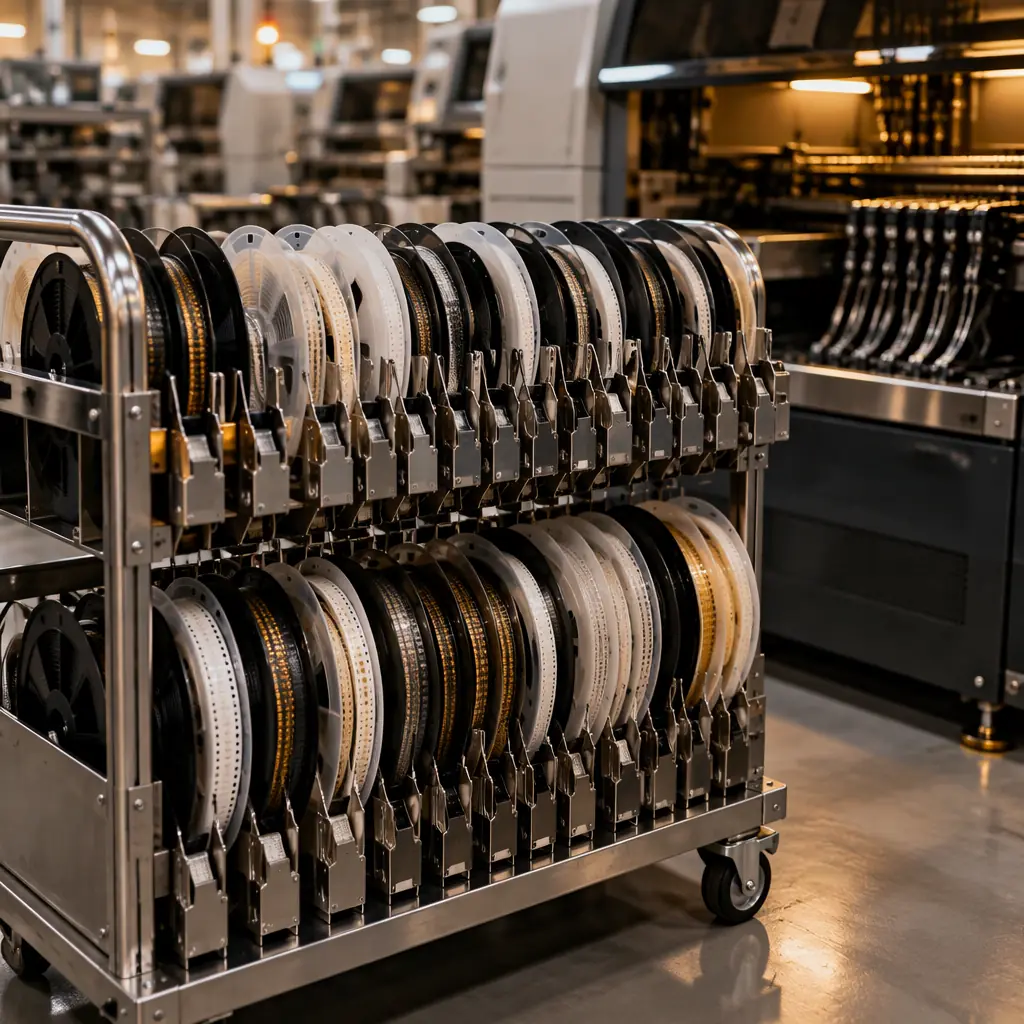
Offline kitting is the first and largest. Loading feeders onto a cart away from the line while the previous product is still running converts a line-side activity into a background one. Plants that do this properly cut feeder change time by 40 to 60 percent, and the only capital involved is a second set of feeder carts.
Product families designed for common feeders is the second, and it is a design decision rather than a manufacturing one. Standardising on a small set of decoupling capacitor values, a single connector family and consistent package choices means consecutive products share most reels. A structured SMED review of changeover almost always finds 30 percent of the variable time disappearing once the BOMs are harmonised.
Stencil and program libraries are the third. Pre-loaded printer programs and pre-verified AOI programs with a golden sample photograph on file remove most of the first-article iteration. The capacity planning guide covers how to reserve the resulting time in the plan rather than letting it be consumed by the next order.
The fourth is panel design. A panel that runs two products simultaneously, or a panelised family that shares stencil apertures, allows a single setup to serve two orders. This is where panelisation and setup cost meet, and the MOQ and panelisation guide works through the economics. The low-volume setup amortisation page covers the same mechanics from the buyer's side, including how to time orders so that consecutive builds share a setup.
How Buyers Should Use This
Ask for the changeover time as a number, in hours, for a specific product. A manufacturer that cannot answer has not measured it, and the setup charge in the quotation is then a guess that may or may not reflect reality. A manufacturer that answers with a number is telling you it tracks line time, which is a reasonable proxy for whether it tracks anything else.
Then model your own order pattern. Four orders of 1,000 boards cost considerably more in total setup than one order of 4,000, and the difference is visible before you request a quotation rather than after. Where a quarterly order can be turned into a six-month blanket release with scheduled calls off, the setup saving often funds the inventory carrying cost outright. That trade is set out in the blanket order versus spot buy comparison.
The last point is revision discipline. Every engineering change after first article re-triggers a partial changeover, which is why the ECO cost-by-gate analysis matters alongside this one. A change approved after setup has been amortised is a change paid for twice.