Every PCB shipment crossing a border is exposed to three separate decisions made by a customs officer who will never see your product. What is this classified as. Where was it made. What is it worth. Get any one of them wrong and the outcome ranges from a 4.5% duty you did not budget for to a penalty assessment on every entry filed in the past twelve months, plus the interest. Get all three right and there is often money coming back: duty recovery programs return the vast majority of duties paid on goods that were later exported, and most PCB importers never claim it.
The trap is that an EMS purchase does not look like a commodity purchase. You buy a part number, not a tariff line. The bill of materials, the fabrication site, the assembly site, the test data and the tooling you paid for all feed into a single entry filed by a broker who was given a commercial invoice with three lines of text on it. This article covers what the buyer can control from their side of the relationship, and what to ask the supplier for before the first shipment leaves.
The Three Questions Customs Actually Answers
Classification, origin and valuation are legally independent. A correct tariff code on a shipment of unverified origin is still a wrong entry. That is why brokers ask buyers to sign off on origin separately from classification even though both appear on the same form: the liability sits with the importer of record, not the broker, and not the factory.
What Is It, the Classification Question
Customs assigns a tariff subheading based on the article's objective characteristics at the time of entry. A bare, unpopulated board is a different article from the same board after components are mounted, and both are different again from a populated panel that will be depanelized downstream. If your supplier invoices a populated assembly under the tariff line that applies to bare laminates, the entry is wrong regardless of how small the components are.
Where Is It Made, the Origin Question
Origin is not the shipping address, not the location of the factory that issued the invoice, and not where the order was received. It is determined by where the article underwent its last substantial transformation, as defined by the importing country's rules. In a multi-country flow, fabrication in one place and assembly in another means the origin determination has to be made on the assembly step rather than on the bare board.
What Is It Worth, the Valuation Question
Duty is assessed on value, and value is not automatically the invoice line. Payments made outside the invoice, the value of tooling or test fixtures provided free of charge to the manufacturer, and the relationship between buyer and seller all enter the calculation. See our PCB NRE and tooling cost guide for how tooling is normally billed, since that is the most common place the customs value diverges from the commercial value.
Key Takeaway: The importer of record carries the liability, but almost all of the evidence needed to defend an entry sits with the supplier. A factory that cannot produce an origin statement, a per-lot Bill of Materials with manufacturer part numbers, and a fabrication location record is a factory that leaves you exposed regardless of the price it quoted.
Tariff Classification: Bare Boards, Assemblies and Panels
Printed circuit boards occupy a small number of headings in Chapter 85, and the choice between them is driven by what the board is at the moment of import. The practical split buyers need to understand is between a board as a passive interconnect article, a board as the substrate of an electronic assembly, and a board that is a component of a larger machine.
| Article at time of entry | Characteristics that matter | Practical classification driver |
|---|---|---|
| Bare rigid board, no components | Copper circuits on laminate, no active parts, no connectorized function | Classified as a bare printed circuit board, duty rate typically low single digits |
| Populated assembly, single function | Components mounted, performs one discrete electrical function | Usually classified as a part of the equipment it serves, not as a circuit board |
| Populated assembly with a controller function | Processing, memory, I/O, programmable logic | Frequently lands under the automatic data processing or control-panel family, materially higher rate |
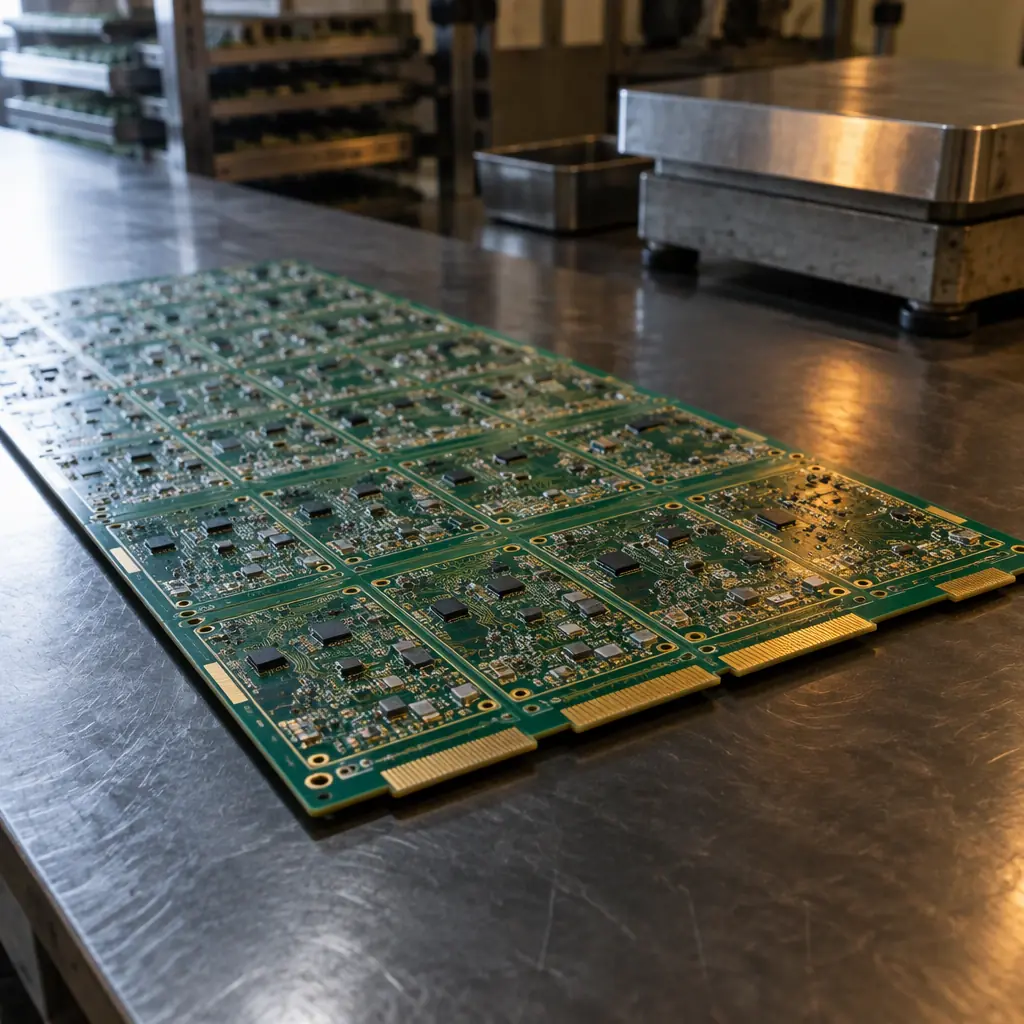
| Populated panel, multiple units | Designed to be depanelized after import | Classified on the characteristics of the individual assembly, not the panel |
The last row is the one that catches buyers. A panel is not a product. Customs looks through the panel to the unit that will go into the finished device, so an entry that describes the shipment as panels can attract a classification that does not match, in either direction. The classification decision should be made against the assembly drawing and the functional description, and both should be in the supplier's document set.
Rate levels are a separate question, and they change. The structural tariffs applied to electronics from China, and the semiconductor-specific measures applied to integrated circuits, have been revised repeatedly and are layered on top of the base rate. Do not build a landed-cost model on a rate you read in an article. Get the rate from your broker for the specific subheading and the specific origin, in writing, for the entry date you plan to use.
Origin After Multi-Country Assembly
Consider a realistic flow. Bare boards fabricated in Shenzhen. Components procured through a distributor network with mixed country of manufacture. Assembly performed either in Shenzhen or at a contract site in Southeast Asia that the buyer nominated for tariff reasons. The finished assembly ships to the end customer. Where is it made?
Under the substantial transformation test used by most major markets, the answer turns on whether the assembly operation produced a new article with a different name, character or use than its inputs. Mounting components onto a bare board normally does change the character of the article: a laminate with copper traces becomes a functioning electronic assembly. That is why origin is usually conferred at the assembly site. It is not automatically so, however. A simple population of a board with connectors, or a test-and-label operation, may not meet the threshold, and a ruling from the importing authority is the only definitive answer for a contested case.
Do Not Assume the Invoice Country Is the Origin
An assembly site that receives finished boards and mounts three connectors may issue an invoice from its own country, and buyers routinely read that as the country of origin. If the operation does not cross the transformation threshold, the origin remains where the board was fabricated. This is the single most common origin dispute on EMS shipments, and it is discovered during a verification audit years after entry.
Trade-Agreement Claims Require More Than Geography
Qualifying for preferential treatment under a free trade agreement requires meeting the agreement's specific rule of origin for the tariff line, plus documentary proof on the agreement's own certificate format. Assembling in a partner country is necessary but not sufficient: the rule of origin may require a regional value content threshold or a tariff shift that the bill of materials does not achieve. Our PCB BOM preparation guide covers the MPN-level BOM data that any origin calculator actually needs.
Origin Is Determined Per Part Number, Not Per Supplier
A supplier with two assembly sites will produce two different origins from the same tooling and the same bare-board source. Commercial invoices that list the supplier's headquarters address, or that describe origin only at the supplier level, cannot support a per-entry origin claim. The origin statement has to name the part number and the production site.
Valuation: Where the Invoice and the Customs Value Diverge
Transaction value is the default basis, but it is not simply the price on the invoice. Four adjustments do most of the damage in PCB supply chains.
Assists. Anything you supply free of charge or at reduced cost for use in producing the imported goods has to be added to the value. That includes tooling, stencils, test fixtures, test programs, and engineering samples you sent to the factory. In PCB assembly, customer-supplied tooling is routine, and buyers commonly assume that because they paid for it separately it does not belong in the customs value. It does.
Free-issued components. If you consign components to the assembler, the value of those components is part of the imported article's value even though it never appears on the assembler's invoice. Our consignment vs turnkey assembly comparison explains where consigned material enters the commercial flow, and the same material enters the customs valuation. A turnkey purchase is simpler to value because one invoice covers the whole article.
Related-party pricing. If buyer and seller are related, transaction value is acceptable only if the relationship did not influence the price. Supporting that usually means showing that the price is comparable to transactions with unrelated buyers, or to the deductive or computed value of similar goods. This matters for companies that source through their own offshore procurement entity.
First sale. Where goods are bought and sold through an intermediary before import, some jurisdictions permit valuation on the earlier sale, provided the goods were clearly destined for export at that point and the transaction is at arm's length. It is a legitimate and sizeable reduction on multi-tier supply chains, and it requires documentation the intermediary rarely keeps by default. Ask for it before the arrangement is set up, not after.
Key Takeaway: The number on the commercial invoice is a starting point, not a customs value. Assists, free-issued material and related-party adjustments are additions the importer must make and the supplier's documentation must be able to support. Build the landed-cost model from the adjusted value, then check it against what the invoice actually says.
Recovering Duty You Have Already Paid
Duty that was paid on imported goods which are later exported, or which are destroyed under customs supervision, is frequently recoverable. The mechanism in the United States is drawback, which returns the large majority of the duty paid, subject to filing windows and documentation requirements that are unforgiving. Comparable regimes exist in the EU and other major markets under different names.
The catch, and it is the reason most PCB importers never claim, is that drawback is documentation-driven at the level of the imported lot. To claim, you need to trace an exported article back to the specific import entry on which duty was paid. That demands per-lot traceability, and it demands that the supplier's marking and lot records survive all the way to your export shipment. Our IPC-1782 lot traceability guide covers what per-lot identification actually requires on a PCB assembly, and PCB labeling and marking practice covers how that identification is physically carried on the part.
Kitting Versus Assembly Changes the Recovery Math
Duty paid on imported components that are later exported inside an assembly is recoverable only if the components were identified to the entry. A turnkey assembly that arrives as one article has one duty basis and one recovery path. A consigned component flow creates many small entries that each need their own trail. Neither is impossible, but the record-keeping burden is materially different and should influence how you structure the purchase, not just how you file the claim.
Duty-Paid Inventory in a Free Trade Zone
Admission of goods into a free trade zone or bonded warehouse defers duty until the goods leave for domestic consumption. Goods that are re-exported from the zone never attract duty at all. For distributors holding PCB inventory for regional customers, deferral is usually worth more than drawback, because it removes the cash outlay rather than refunding it later. Both options require the supplier to ship with documentation matching the zone entry format, which is a line item to agree before the first PO.
Filing Windows Do Not Move
Recovery claims are time-barred from the date of import, not from the date you discovered the opportunity. An internal review that finds three years of unclaimed duty on PCB imports will usually find that the earliest entries are already out of window. Build the traceability and the claim process before the export program scales, or the recoverable portion shrinks every quarter.
What to Demand in the Supplier's Export Document Package
A supplier that ships internationally as a normal course of business should be able to produce a fixed document package per shipment without being asked twice. If any of the following is missing or inconsistent, the entry is being filed on assumptions.
| Document | What it must contain | Common failure |
|---|---|---|
| Commercial invoice | Part number, description matching the drawing, quantity, unit value, terms, origin per line | Origin stated only at supplier level; description written for the buyer rather than customs |
| Packing list | Carton count, gross and net weight, dimensions, per-carton contents | Weights copied from a previous shipment; carton count not matching the invoice |
| Origin statement | Per part number, naming the production site, with the basis for the claim | Boilerplate certificate with no part number and no production site |
| Bill of materials | MPN level, manufacturer, quantity per assembly | Generic descriptions such as "capacitor, 100nF" without manufacturer part numbers |
| Test and inspection records | Lot identification matching the marking on the goods | Records keyed to a work order that cannot be linked to the shipped lot |
The origin statement is the document that most often fails in practice, because it is the one that requires the factory to make a legal assertion rather than report a measurement. A usable statement names the part number, the fabrication location, the assembly location, and the basis on which origin was determined. Anything less leaves the importer of record holding a claim they cannot defend.
Summary: Build the File Before You Build the Volume
Trade compliance on PCB purchases is not a broker problem solved after the shipment lands. It is a purchasing decision made when the specification and the purchase order are written. Three questions determine the entry, and all three are answered by documents the factory either already keeps or does not: the classification follows the functional description on the drawing, the origin follows the production site and the transformation test, and the value follows the assists and the material flow rather than the invoice total.
At Huaxing PCBA, our 45,000 sq m Shenzhen facility fabricates up to 58 layers and assembles on 9 SMT lines, IATF 16949 and ISO 9001 certified, with AIS-format per-lot traceability and material certificates retained against each work order. Export documentation is issued per shipment with part number, production site and origin basis, and our engineering team will confirm the fabrication and assembly locations for your part numbers before you file. Read the import duty and tariff rate guide for the rate side of the calculation, or contact our team with the part numbers you need documented.