
When you receive 10,000 PCBs from a Chinese manufacturer and find 50 defects, is that a good result or a supplier failure? The answer depends entirely on what metrics you negotiated and which benchmarks you're measuring against. Most procurement managers evaluate PCB suppliers on price, lead time, and certifications. But the KPIs that actually predict long-term manufacturing performance are DPPM (defective parts per million), first-pass yield, process capability (CpK), and on-time delivery rate. Without specifying target thresholds for these metrics in your supplier agreement, you're essentially buying blind.
At Huaxing PCBA, our 8 SMT lines process over 800 million solder joints per day, and our quality system tracks every defect at the individual board level. Based on real production data from high-volume PCB fabrication and assembly runs across automotive, medical, and industrial customers, here's what procurement managers should know about quality metrics, and what numbers constitute a genuinely excellent supplier.

DPPM: The Universal Quality Metric, and What It Actually Measures
DPPM (defective parts per million) is the semiconductor industry's legacy metric that has become the standard yardstick for PCB and PCBA quality. One DPPM = one defective board per million boards shipped. A supplier claiming "99.9% quality" sounds impressive but actually means 1,000 DPPM, which is catastrophic for automotive or medical applications. The math matters.
Bare PCB Fabrication: Target <500 DPPM, Excellent <100 DPPM
For bare PCB fabrication, defects are typically visual or dimensional: shorts, opens, plating voids, solder mask misregistration, or out-of-spec hole sizes. A supplier running <500 DPPM is competent. A supplier consistently below 100 DPPM is world-class and likely has automated optical inspection (AOI) at multiple process stages, not just final inspection. Our IPC-A-600 Class 3 production line maintains <50 DPPM on high-layer-count boards through inline AOI after etching, after solder mask, and at final electrical test. See our AOI vs X-Ray vs SPI inspection guide for how automated inspection drives these numbers.
PCBA (Assembly): Target <1,000 DPPM, Excellent <200 DPPM
PCB assembly introduces additional defect categories: tombstoning, bridging, insufficient solder, component shift, and wrong-polarity placement. The IPC-A-610 Class 2 acceptable defect rate is loosely defined, but in practice, a supplier delivering <1,000 DPPM on mixed-technology boards (SMT + through-hole) is performing well. For high-reliability sectors, expect <200 DPPM with full X-ray inspection on BGAs and QFNs. IPC Class 2 vs Class 3 standards have dramatically different acceptance criteria. A Class 3 supplier's DPPM should be an order of magnitude lower.
Distinguish Defect Detection vs Escaped Defects
A supplier reporting 50 DPPM may actually have a 2% internal defect rate, they're just catching everything before it ships. The metric you genuinely care about is escaped DPPM: defects you find at incoming inspection, not defects the supplier found and reworked internally. Always ask suppliers to report both their internal defect rate and their escaped DPPM. A supplier who can't or won't separate these numbers may be hiding a quality problem behind their rework station. This distinction is why incoming quality inspection remains essential even with certified suppliers.
DPPM Targets by Industry Vertical
Consumer electronics typically accepts 1,000-3,000 DPPM at final inspection. Industrial controls demand <500 DPPM. Automotive (IATF 16949) requires <50 DPPM on safety-critical circuits and <200 DPPM on non-safety electronics. Medical implantables and aerospace flight controls demand essentially zero: often specified as <10 DPPM with 100% inspection. If your supplier quotes the same DPPM guarantee regardless of your industry, they're not tailoring their process to your reliability requirements. Read our automotive PCB requirements guide for IATF 16949-specific quality systems.
Key Procurement Insight: Never accept a DPPM commitment without defining the defect classification system. A supplier counting only "functional failures" as defects while excluding cosmetic issues can report 50 DPPM while shipping boards with visible solder mask scratches. Always reference IPC-A-600 (bare boards) or IPC-A-610 (assemblies) as the governing standard in your purchase order.
First-Pass Yield (FPY): The Metric That Reveals Process Maturity
DPPM tells you what escaped. First-pass yield tells you how efficiently the supplier builds your boards. FPY = number of boards that pass all tests on the first attempt, without any rework, divided by total boards started. A low FPY means high rework rates, which adds cost, compromises long-term reliability, and indicates underlying process problems that DPPM alone would hide.
Bare PCB Fabrication FPY: Target >95%, Excellent >98%
For a standard 4-8 layer FR-4 PCB, a well-controlled fabrication line should achieve >95% first-pass yield at electrical test. For HDI boards with microvias, expect 90-93% due to the inherent complexity. If a supplier's FPY is below 90% on standard multilayer boards, their process control, particularly around drilling registration and plating uniformity, has systematic issues. PCB cross-section analysis can reveal whether low FPY stems from plating thickness variation or drill wander.
PCBA First-Pass Yield: Target >92%, Excellent >97%
SMT assembly FPY benchmarks: a line running 0201 passives and 0.4mm-pitch BGAs should deliver >92% FPY before rework. If the supplier achieves >97%, their stencil design, solder paste printing, and reflow profiling are tightly controlled. Ask for FPY broken down by process step, a supplier with 98% overall FPY but 85% FPY at BGA placement may be hand-touching every complex component. SMT stencil design is often the single biggest lever for improving placement FPY.
Process Capability (CpK): The Statistical Foundation of Quality
CpK measures how consistently a manufacturing process stays within specification limits. Unlike DPPM, which only counts the finished boards that fail, CpK predicts whether the process is capable of meeting specs before boards are built. A CpK of 1.0 means the process just barely fits within the spec window. A CpK of 1.33 is the accepted minimum for stable production. A CpK of 1.67 or higher indicates a genuinely robust process that can absorb normal variation without producing defects.
Critical PCB Parameters Requiring CpK Monitoring
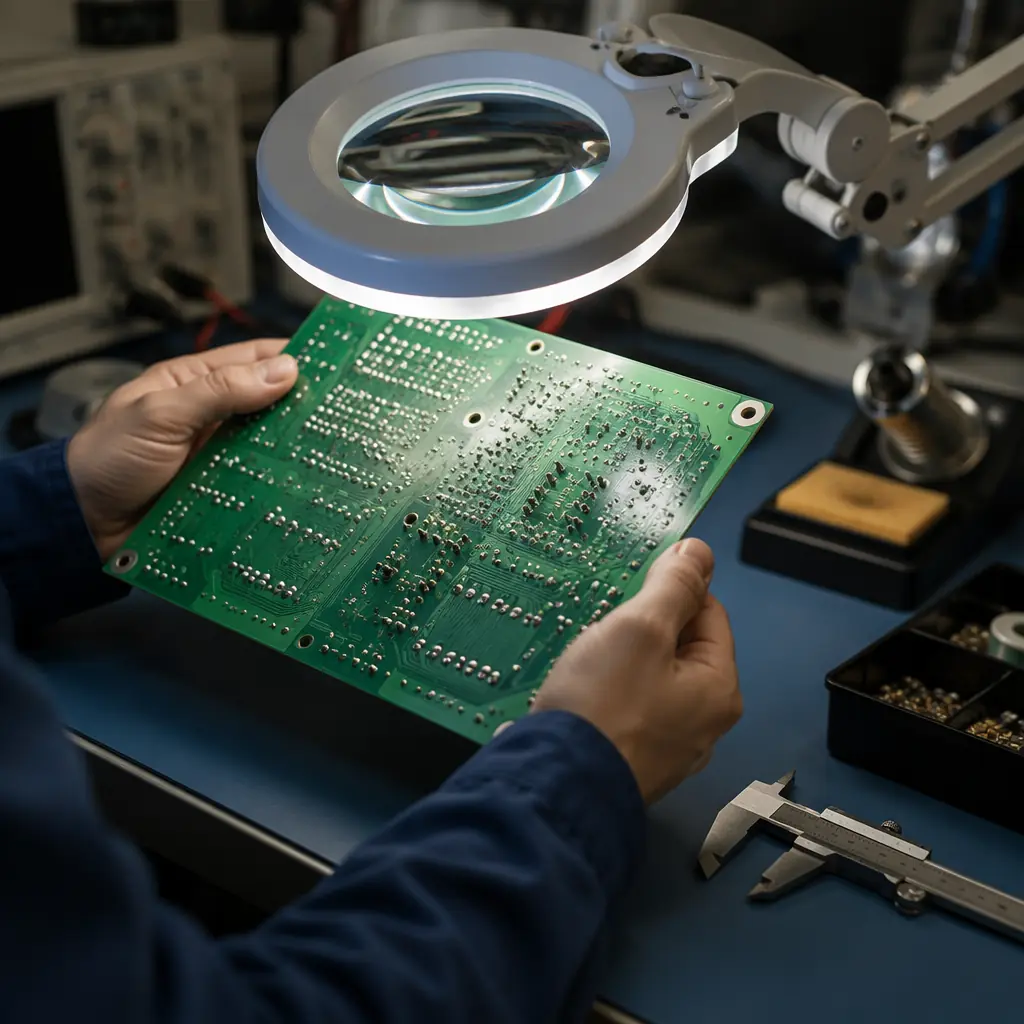
For bare PCB fabrication, the parameters that most impact reliability, and therefore deserve CpK ≥1.33, are: plated through-hole copper thickness (target 25μm minimum, CpK ensures no thin spots), impedance control (±10% is easy, ±5% requires CpK ≥1.67), solder mask registration (±50μm tolerance), and drill-to-copper clearance on inner layers. A supplier who can't produce CpK data for these four parameters on their production line is operating on inspection-based quality control, not process-based. This is the difference between first article inspection finding an issue before production vs catching it after.
PCBA CpK: Focus on Solder Paste Printing
In SMT assembly, roughly 60-70% of all defects originate at the solder paste printing stage. A supplier monitoring solder paste volume CpK after printing (using SPI. Solder paste inspection) with a target of ≥1.33 is proactively preventing defects. If their SPI CpK drops below 1.0, they're essentially gambling that reflow will fix printing inconsistencies, which it won't for fine-pitch components. Demand SPI CpK data in quarterly business reviews. For BGA-specific quality metrics, see our BGA assembly guide.
Red Flag: A supplier who says "we inspect 100% so we don't need CpK monitoring" fundamentally misunderstands quality engineering. 100% inspection catches defective units; CpK prevents them from being produced in the first place. The cost difference between prevention and detection is typically 10:1.
On-Time Delivery (OTD) and the Quality-Delivery Tradeoff
OTD seems like a logistics metric, but it's deeply connected to quality. A supplier with poor first-pass yield will inevitably miss delivery dates. Because every board that fails and needs rework adds unplanned cycle time. OTD below 90% in a supplier with "99% quality" claims is a contradiction that usually means their DPPM numbers are calculated with creative accounting.
| Quality Tier | Bare PCB DPPM | PCBA DPPM | First-Pass Yield | OTD Rate | Typical Industry |
|---|---|---|---|---|---|
| Excellent | <100 | <200 | >97% | >98% | Medical implant, aerospace |
| Good | 100-500 | 200-1,000 | 92-97% | 95-98% | Automotive, industrial |
| Acceptable | 500-1,500 | 1,000-3,000 | 88-92% | 90-95% | Consumer electronics, IoT |
| Red Flag | >1,500 | >3,000 | <88% | <90% | Requires supplier improvement plan |
Building Quality Metrics Into Your Supplier Agreement
The most common mistake procurement managers make is treating quality metrics as a post-award monitoring exercise rather than a pre-award negotiation point. If DPPM targets, FPY thresholds, and CpK requirements aren't in the contract, they aren't enforceable. Here's what to include:
Specify Both DPPM Target and Maximum Threshold
Set a target DPPM (what you expect in normal production) and a maximum DPPM (above which corrective action is contractually required). For example: "Target <200 DPPM on PCBA, maximum 500 DPPM. Any rolling 3-month average exceeding 500 DPPM triggers a mandatory root cause analysis and corrective action plan within 15 business days." Without the "rolling 3-month" qualifier, a single bad batch can't trigger penalties, but without the maximum threshold, there's no contractual obligation to improve. Our supplier quality scorecard guide provides a complete framework for weighting these metrics.
Define Defect Classification Up Front
Use IPC-A-610 Class 2 or 3 as your acceptance standard, and specify which defect categories count toward DPPM. Cosmetic issues (minor solder mask scratches away from conductors) should be tracked separately from functional defects. A supplier agreement that says "<200 DPPM" without specifying the standard is unenforceable, the supplier can define "defect" however they want. This is particularly critical for quality dispute resolution . Having the standard in writing avoids "we consider this acceptable" arguments.
Require Monthly Quality Data, Not Just Quarterly Summaries
Monthly reporting of DPPM, FPY, CpK on critical parameters, and OTD broken down by your specific part numbers, not aggregated across all customers. A supplier's overall DPPM of 150 could mask 2000 DPPM on your most complex HDI board if 90% of their volume is simple 2-layer consumer boards. Demand part-number-level data. See our supplier audit checklist for verification techniques during on-site visits.
What This Means for Your Next PCB Order
Quality metrics are procurement leverage, not just engineering concerns. A supplier who can consistently deliver <100 DPPM on bare PCBs with CpK >1.67 on impedance control and 98% FPY on assembly is not just making good boards. They're running a process that makes defects statistically unlikely. At Huaxing PCBA, our quality system operates at these thresholds as standard: inline AOI at three process stages, SPI with closed-loop feedback to the printer, X-ray on every BGA, and monthly CpK reporting on all critical parameters. Every purchase order ships with a certificate of conformance referencing the specific IPC class and acceptance criteria. For procurement managers who want to move from price-based supplier selection to performance-based partnership, defining these metrics is the first step. Our PCB supplier RFP framework includes a quality metrics template you can use in your next sourcing event.