
Capabilities / PCBA Assembly / Conformal Coating
Moisture, dust, chemicals, salt spray, temperature extremes, unprotected PCBs fail fast in the field. Our conformal coating and potting services seal your electronics against environmental attack with IPC-CC-830 certified processes. Four coating chemistries, three application methods, one result: reliability.
Coating Chemistries
Solvent-based acrylic is the most widely used conformal coating. Good moisture and fungus resistance. Easy to apply and easy to rework, soldering iron burns through it for component replacement. Operating range -65C to +125C. Ideal for consumer electronics, IoT devices, and general industrial controls where moderate protection is sufficient and reworkability matters.
Silicone coatings operate from -65C to +200C, making them the only choice for under-hood automotive electronics, downhole drilling equipment, and aerospace engine controls. Excellent flexibility absorbs thermal expansion mismatch. Higher moisture permeability than acrylic but far superior in thermal cycling endurance. Available in UV-cure formulations for fast processing.
Polyurethane provides the best chemical and abrasion resistance of the liquid coatings. Resists fuels, solvents, hydraulic fluids, and cleaning agents. Common in fuel system electronics, industrial process controls, and marine equipment. Single-component moisture-cure formulations eliminate mixing errors. Harder to rework than acrylic, plan for no post-coat servicing.
Parylene is applied by vapor deposition in a vacuum chamber, not as a liquid. It forms a truly conformal, pinhole-free film as thin as 0.1 microns. Penetrates under components and into crevices impossible to reach with spray. The gold standard for medical implants, military avionics, and MEMS devices. Highest unit cost but unmatched protection-per-micron.
Application Methods
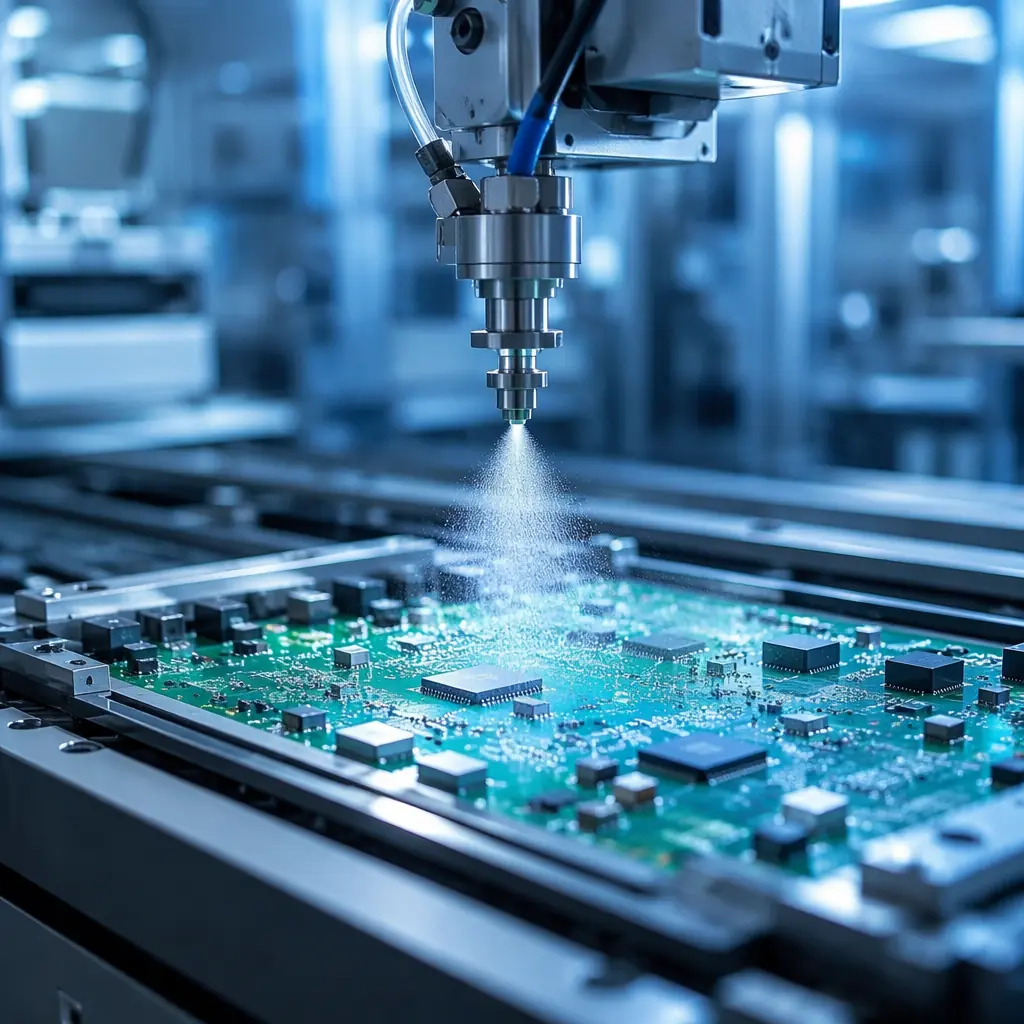
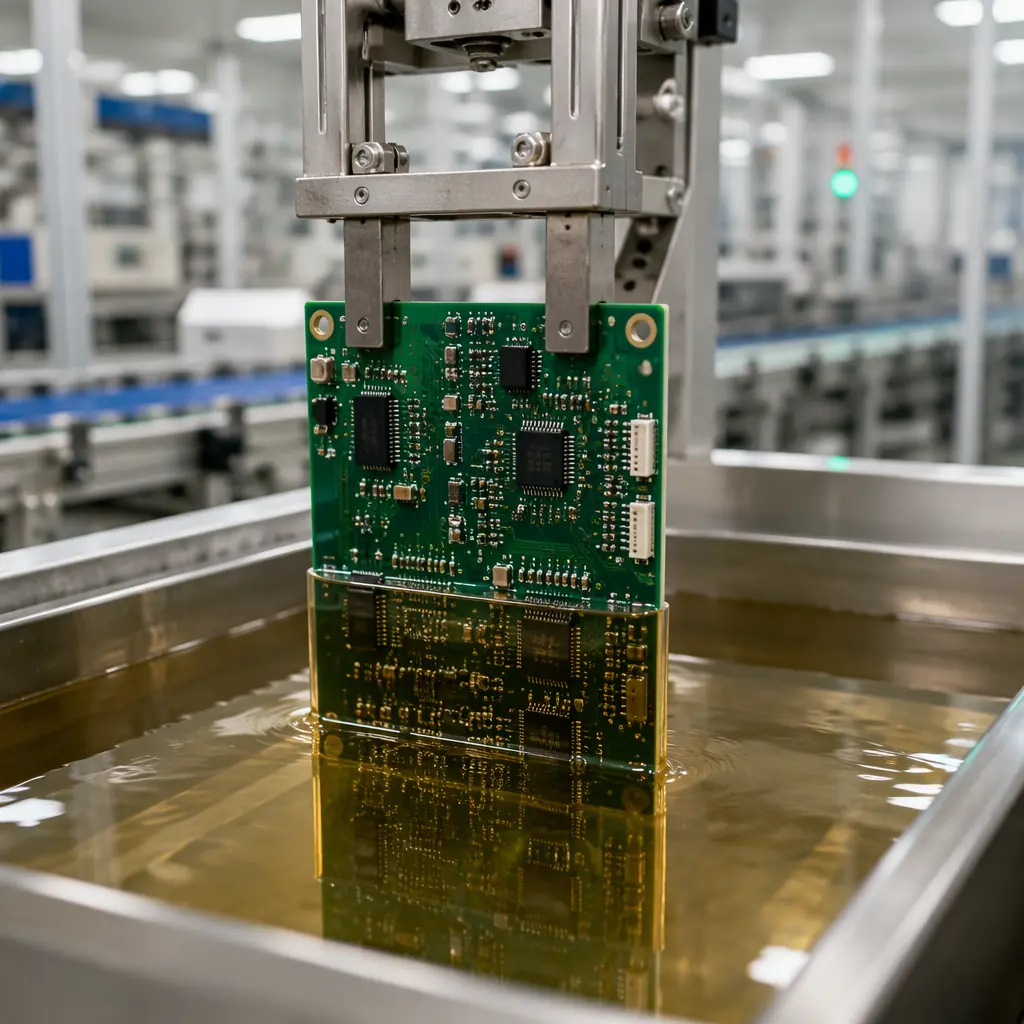
Coating application method is as critical as coating chemistry. We select the method based on board geometry, keep-out zones, production volume, and coating thickness requirements. Most production boards use our Nordson Asymtek Select Coat SC-350 for automated selective application, programmable per-board, precise to 0.5mm keep-out accuracy.
Quality Assurance
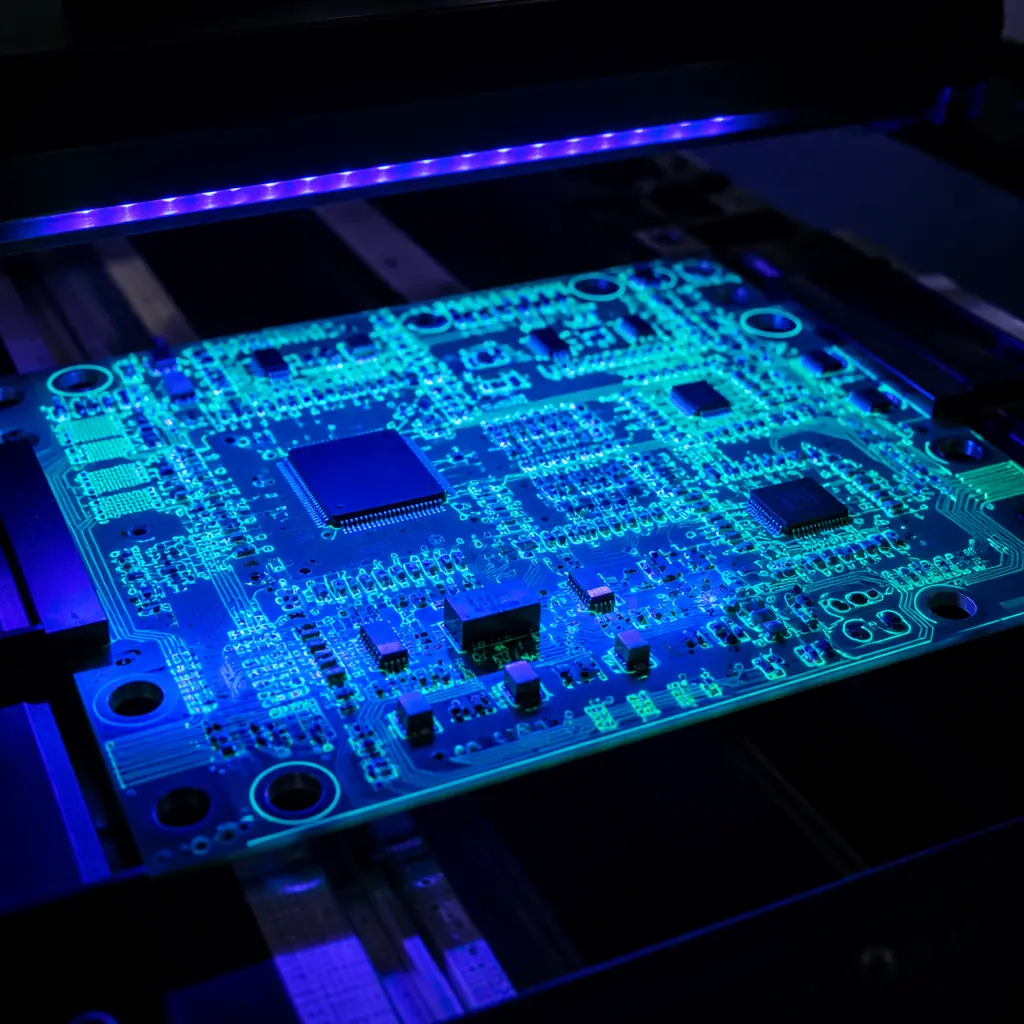
Every coated board passes through UV light inspection. All coating materials contain a UV tracer dye that fluoresces under 365nm UV light, making coverage gaps, thin spots, and overspray immediately visible. We verify coating thickness with an eddy-current probe on test coupons processed alongside every batch.
Silicone coating, selective spray. Withstands -40C to +150C cycling, transmission fluid exposure, and vibration. Typical thickness: 50-100 microns. Connectors and OBD port masked during coating. Common for ECU, TCU, ABS controllers, and battery management systems.
Polyurethane coating, full dip or spray. Salt spray resistance per ASTM B117. UV-stable formulations prevent coating degradation in sunlight. Typical thickness: 75-130 microns. Used on navigation, communication, and deck equipment where salt water exposure is continuous.
Parylene Type C, vapor deposited. Biocompatible per ISO 10993. Ultrathin (5-25 microns), pinhole-free, conforms to sub-micron topography. Applied in cleanroom conditions. Used for neural stimulators, cochlear implants, and cardiac rhythm management devices.
Acrylic coating, selective spray or brush. Basic moisture and dust protection at the lowest cost. Easy rework for prototype and development boards. Typical thickness: 30-50 microns. Provides the minimum environmental barrier needed for indoor consumer products.
When a thin coating is not enough, full encapsulation embeds the entire PCB assembly in a solid block of protective material. Complete waterproofing, shock resistance, and tamper-proofing for the most demanding environments.
Two-part epoxy provides the highest mechanical strength and chemical resistance. Hard, rigid, non-reworkable. Excellent thermal conductivity for heat-dissipating applications (LED drivers, power supplies). Operating range -55C to +150C. Vacuum degassing removes air bubbles before cure.
Soft, flexible silicone gel for shock absorption and vibration damping. Transparent formulations allow visual inspection of components. Repairable, gel can be cut away for rework. Operating range -65C to +200C. Common in high-voltage power supplies and automotive sensors.
| Parameter | Acrylic (AR) | Silicone (SR) | Polyurethane (UR) | Parylene (XY) |
|---|---|---|---|---|
| Application | Spray, dip, brush | Spray, dip, brush | Spray, dip, brush | Vapor deposition |
| Thickness | 30-130 microns | 50-210 microns | 30-130 microns | 0.1-25 microns |
| Temp. Range | -65 to +125C | -65 to +200C | -65 to +125C | -200 to +150C |
| Dielectric Strength | 1,200-1,500 V/mil | 400-600 V/mil | 1,000-1,400 V/mil | 5,000-7,000 V/mil |
| Moisture Resistance | Good | Moderate | Excellent | Excellent |
| Chemical Resistance | Moderate | Moderate | Excellent | Excellent |
| Reworkable | Yes, thermal | Yes, mechanical | Difficult | Abrasion only |
| Cure Method | Solvent evaporative | Moisture or UV | Moisture cure | N/A (deposited) |
| Standard | IPC-CC-830, IPC-A-610 Class 2/3 | |||
Tell us about your operating environment, temperature range, moisture exposure, chemical contact, vibration, and we'll recommend the optimal coating chemistry and application method with a complete quote within 24 hours.
Upload Gerber + BOM, 24h quote with free DFM review.